From Programme Plus, a piece by Tony Millard, covering the recent move of Gordon Smith from Rangers to Brighton, and the state of the game north of the border:
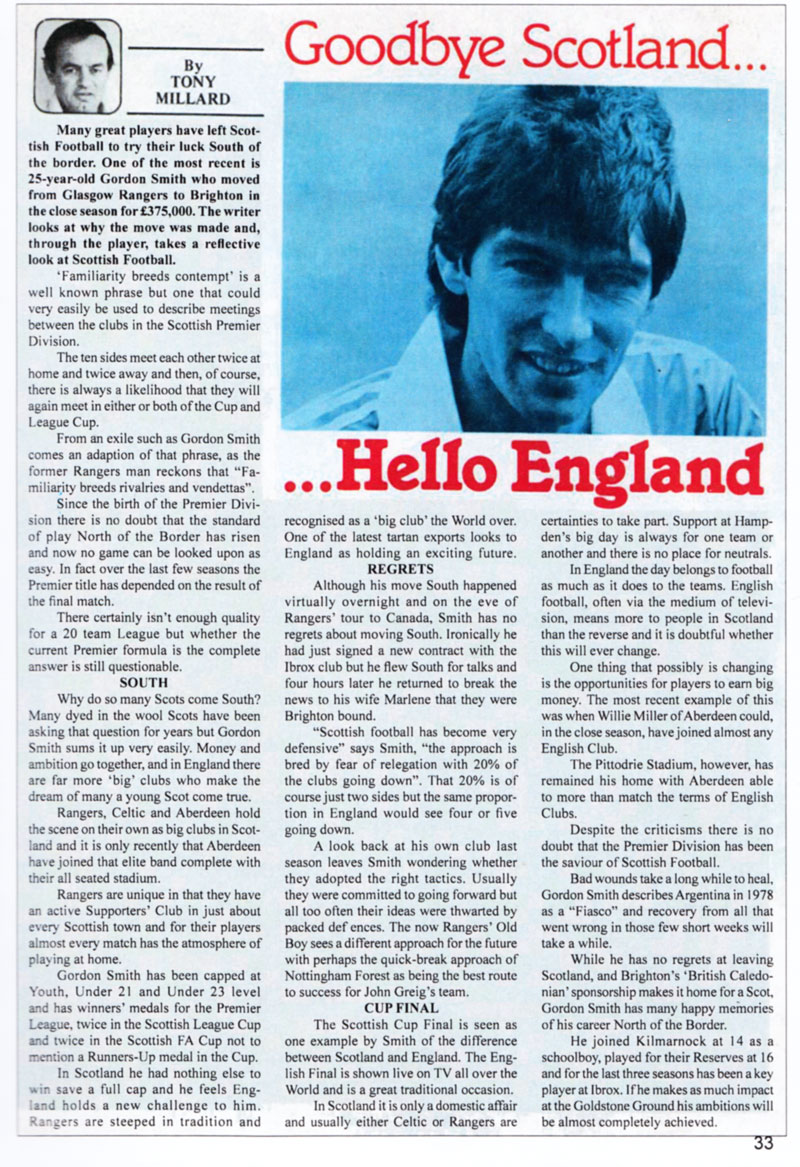
While he has no regrets at leaving Scotland, and Brighton’s ‘British Caledonian’ sponsorship makes it home for a Scot, Gordon Smith has many happy memories of his career North of the Border. He joined Kilmarnock at 14 as a schoolboy, played for their Reserves at 16 and for the last three seasons has been a key player at Ibrox. If he makes as much impact at the Goldstone Ground his ambitions will be almost completely achieved.
Years later, in his autobiography ‘And Smith Did Score’ (page 118), Smith expresses more about the changes he experienced:
“When I first went to Brighton, I was stunned by the difference and how well the players were treated compared to up in Scotland. When the Brighton players were travelling to away games on the coach, we had stewards serving us food like on an aeroplane. At Rangers, if the bus stopped on the way back from somewhere like Aberdeen, the players would have to buy their own fish suppers. And, if Willie Waddell decided that the bus wasn’t stopping, then we wouldn’t even get a fish supper!”
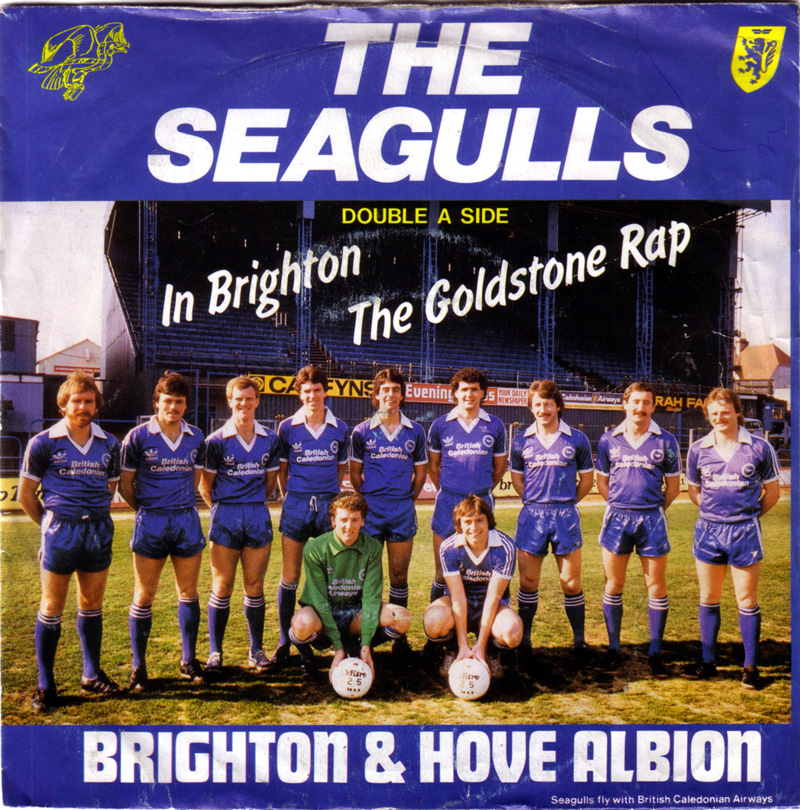
First Division footballers they may have been, but Brighton’s team of ’82 also made an audacious bid for pop fame and hip-hop credibility.
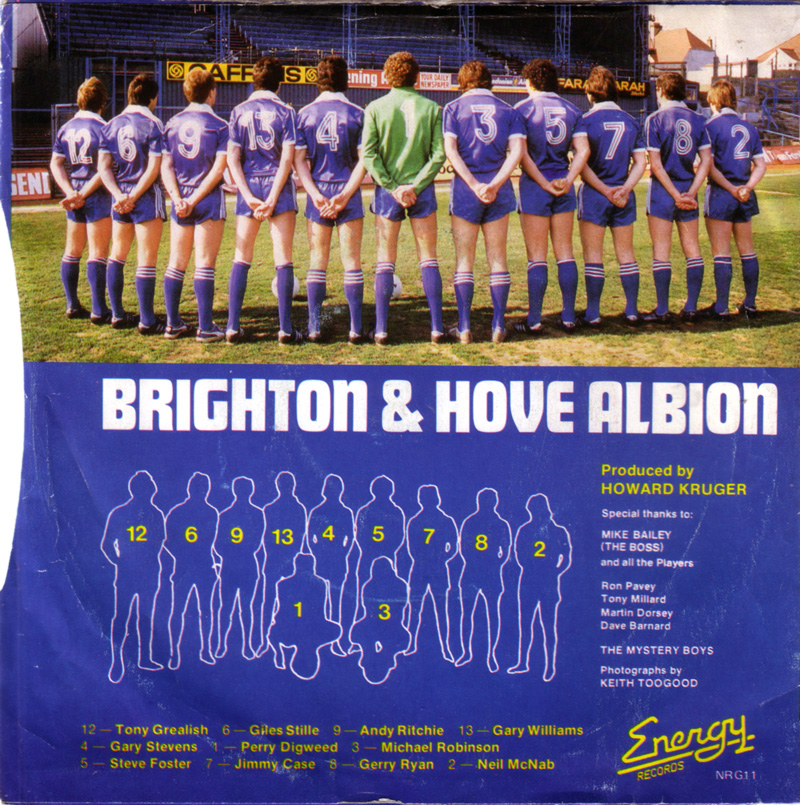
From left to right, here are the rather earnest-looking Gordon Smith, Steve Gatting, Perry Digweed, Andy Ritchie, Jimmy Case, Gary Williams, Gary Stevens, Gerry Ryan, Michael Robinson and Steve Foster seeking to set the world alight with their dulcet tones and Farah slacks, not to mention their previously unrevealed rapping skills:
In the Brighton v Tottenham match programme from March 1982, it was announced:
Last Wednesday our first team squad had a unique day out when they travelled to recording studios in South London to cut their first record. The record is entitled ‘In Brighton’ and should be available on general sale in early April.
Howard Krugar, who lives in Hove and specialises in organising concerts for some of the world’s biggest stars, is the man behind the idea and he is hopeful of the disc making the charts. In fact it is highly likely that the Albion squad will appear on ‘Top of the Pops’.
Also involved in the record is BBC football commentator Peter Brackley who livens things up with commentary on a memorable Albion goal… which one? Well, for that you’ll have to buy the record.
Thanks to the lads at We Are Brighton, you can hear ‘In Brighton’ here:
Based on the Drifters’ song ‘On Broadway,’ the song received a positive response from John Henty who gave it a spin at Radio Brighton on Sunday 4th April. With dubious lyrics such as ‘Big Fozzie keeps it tight for Brighton’ and the boast of ‘Playin’ at the Goldstone Ground, where good football’s always found’ (sadly, no football of any kind down there now), not to mention even dodgier singing, the song probably did not have much of a fanbase outside of Brighton supporters.
Nevertheless, it was also played by Peter Powell on Radio One. However, as notes that month in the Brighton v Manchester United programme lamented:
Last week Peter Powell played the disc on his Radio One show but allowed his own support of Wolves to colour his comments on the merits of the recording.
The song was also erroneously aired on BBC’s ‘Match of the 80s’ series in the 1990s in its coverage of Brighton’s FA Cup run of 1983, with Danny Baker hesitating about even calling it a ‘song’! And, just in case you are wondering, the Andy Ritchie goal that Brackley acts out a commentary on is almost certainly this swerving free-kick belter from the Brighton v West Bromwich Albion game in February 1982:
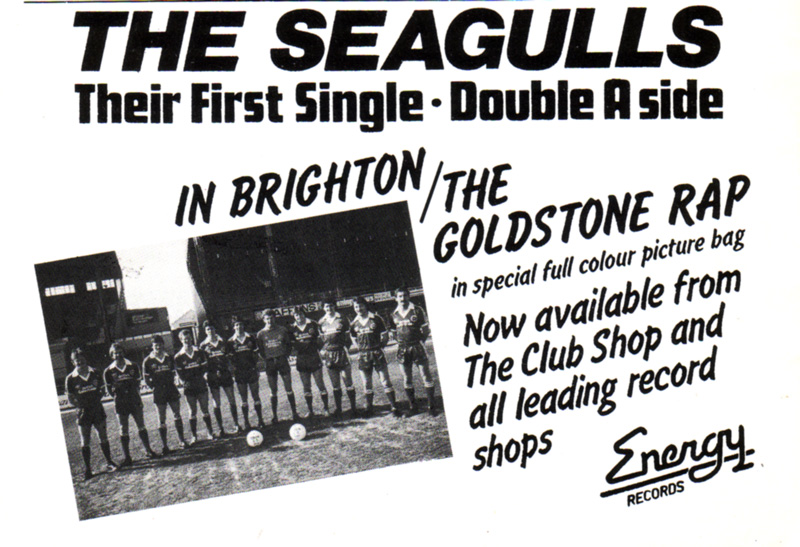
The other track on this Double A-side was ‘The Goldstone Rap’, which this very blog you are reading takes its name from. Looking at it now, it’s amazing to think that Brighton & Hove Albion were at the forefront of the UK hip-hop scene in 1982, especially as this was almost certainly the first ever football song to feature rapping.
Unlikely to win any prizes at the MOBO awards, the rap memorably includes such lyrical gems as: ‘When you make that cross you’re gonna cross it fine / Give the ball to the player on the dead ball line.’
Never mind the MOBOs, though. Were you at Busby’s Night Club on Kingswest, Kings Road, in Brighton on the evening of Tuesday 6th April 1982? If you were, you would have been present to the grand launch of the single, as Brighton & Hove Albion’s first team squad belted out their musical masterpieces on stage! Sadly, I have no video footage of this priceless moment.
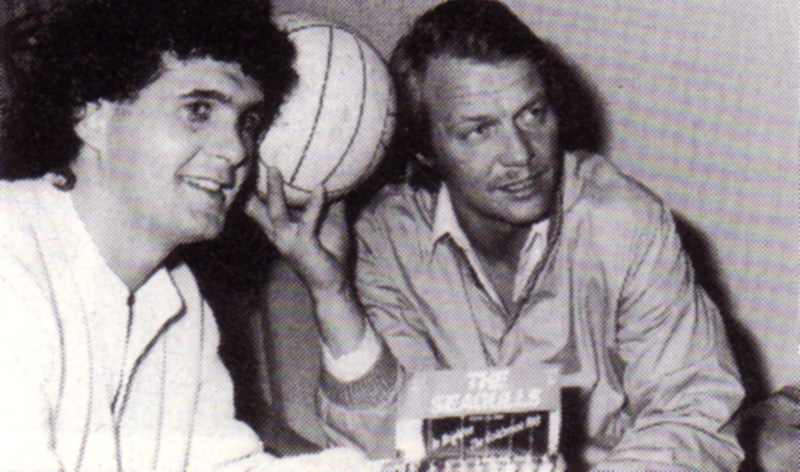
When released to the general public, the colour sleeve of the 7″ looked splendid, with the players proudly posing in front of the temporary Lego Stand in all its glory:
The price was a bargain £1.20. Buyers of the single from the club shop were also given a chance to enter a great competition to win two tickets to Dallas, Texas, with British Caledonian Airways.
So, was the Brighton release a launchpad to instant chart fame and fortune? Unfortunately, the single sank without trace but it gave Steve Foster (whose vocals also featured on the England 1982 World Cup song ‘This Time’), an opportunity to meet up with proper singer David Soul and wing a copy to the ‘Starsky and Hutch’ star:
Years later, I was wondering about ‘The Goldstone Rap’ and imagining what it would have sounded like if it adopted the electro sound of 1982’s other great hip-hop release, ‘The Message’ by Grandmaster Flash & The Furious Five. Thanks to the power of the internet, and due to a discussion on North Stand Chat, I got to find out.
Major props to Ian, the DJ who created this ‘Goldstone Message’:
A much enhanced version, I hope you’ll agree. In terms of pushing at the limits of what was possible for music and Brighton & Hove Albion footballers, it was certainly close to the edge.
Brilliant anecdote from Gordon Smith’s ‘And Smith Did Score’ autobiography, page 123:
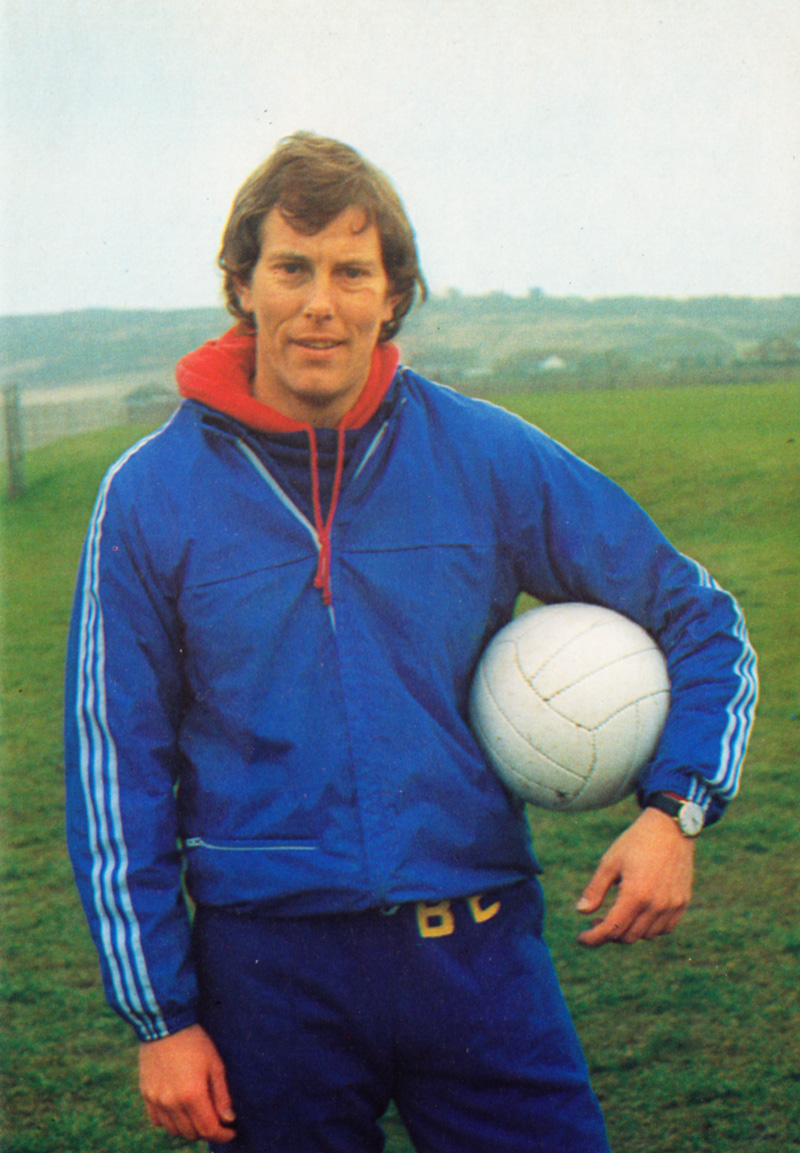
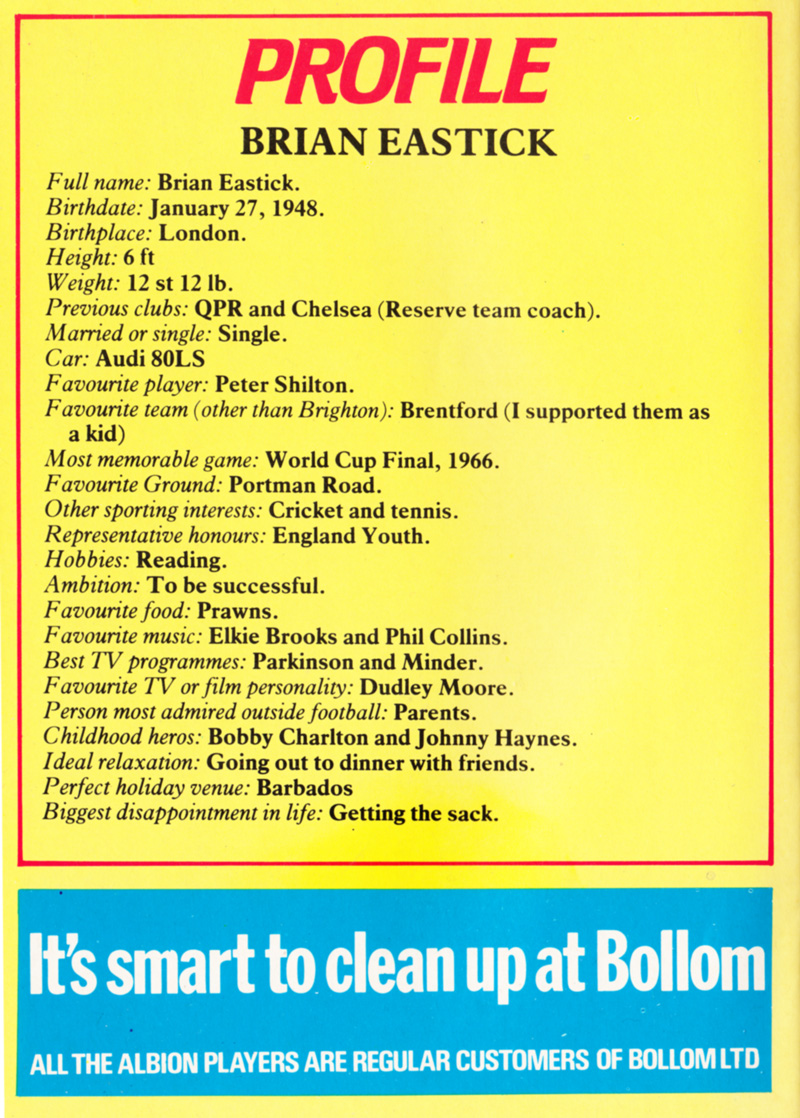
The players look at each other and wonder if they should believe what they have just heard. Standing on the training ground, they look askance at the Brighton youth team coach, Brian Eastick, who is taking the first-team training for he first time.
‘Right lads,’ he has just told us, ‘We’re going to have a game of football, so pick two sides. But what’s different about this game – and if you take this seriously it will be a great help to you – is that we’ll be playing with an imaginary ball.’
‘It’s twenty minutes each way – a practice game with a pretend ball.’
He senses a reluctance from the players and nobody moves. ‘Look,’ says Brian, ‘the boss is watching and it’s either this or he’ll have you running all morning – what’s it to be?’
Since anything’s better than running round a track for a couple of hours, we decide to go along with this rather unconventional training method. We’re about to start the 1982-83 season and this is undoubtedly the weirdest training session I have ever taken part in and that would go for the rest of the Brighton players as well.
We get ourselves into teams and line up to kick off. The former Arsenal star, Charlie George, has joined Brighton on a month’s loan and he’s in my team. I kick off by touching the imaginary ball to Charlie who makes an imaginary pass to our winger, ex-Manchester United player, Mickey Thomas, Mickey then makes a 20-yard run at full pace, slides along the touchline and jumps up to shout, ‘For fuck’s sake, Charlie, play it to my feet, will you?’
The players can hardly stand up for laughing and that’s the end of the game. Brian Eastick is not happy and, since we’re not taking his game with the imaginary football seriously, it’s back to running round the track.
Brian had been on the continent looking at how the European teams train and noting their coaching methods. He must have seen some foreign team trying out this practice match with no football and decided to introduce it to the British game. Brian had persuaded Brighton’s then manager, Mike Bailey, to let him take the first-team training for a morning and try out these new methods. Unfortunately, the British footballers weren’t quite ready for such progress and diversity of coaching methods.
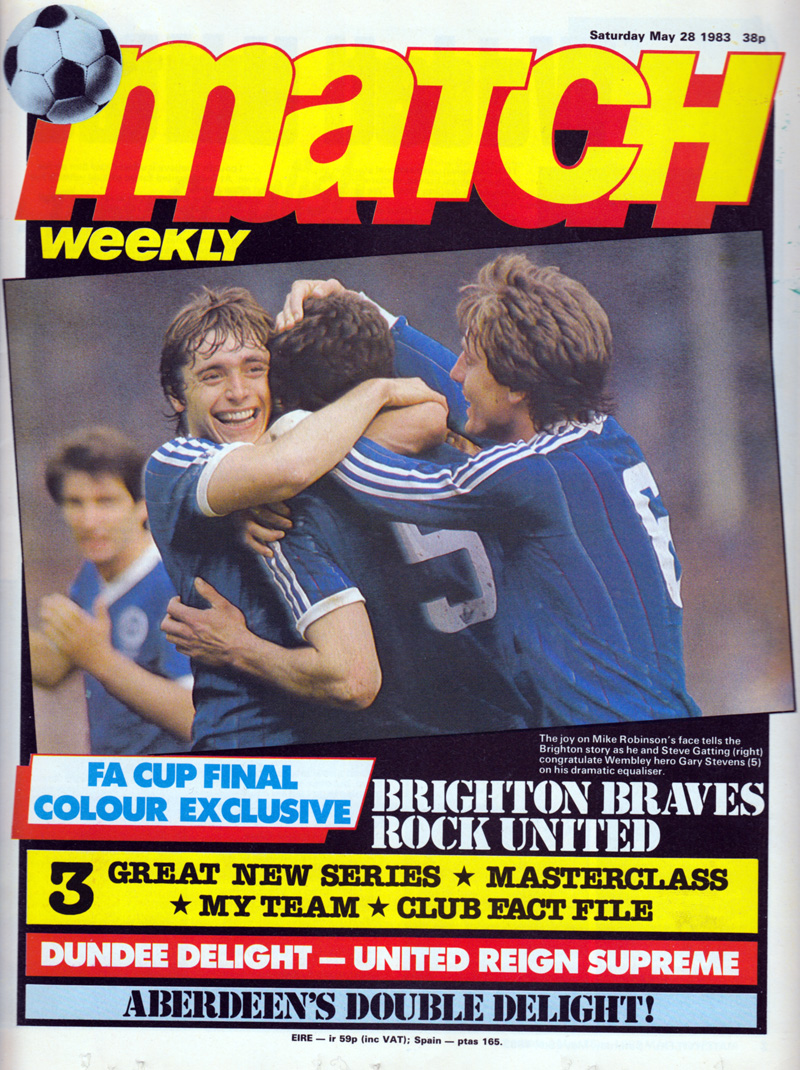
A quite magnificent cover capturing the joy of a Brighton team scoring at Wembley. Gordon Smith, in the background, gives polite applause. His moment of truth was still to come.
Inside the magazine, Tony Grealish declares, ‘We let United off the hook,’ while the magazine takes the credit for an uncanny prediction the week before:
It will have come as no shock to ‘Match’ readers that Brighton took an early lead against Manchester United. We told you it was on the cards last week in an exclusive guide to the goal power of each side.
This is what we said: ‘Brighton re the faster starters and may well go a goal up inside 15 minutes but United are worth an equaliser on past form.
After the break it could be United’s turn to go ahead, but ‘Seagulls’ fans shouldn’t despair if their team is behind with just fifteen minutes to go, because that’s when the underdogs from the South coast are most likely to hit the net.’
Uncanny! It sounds like the work of clairvoyant Eva Petulengro…
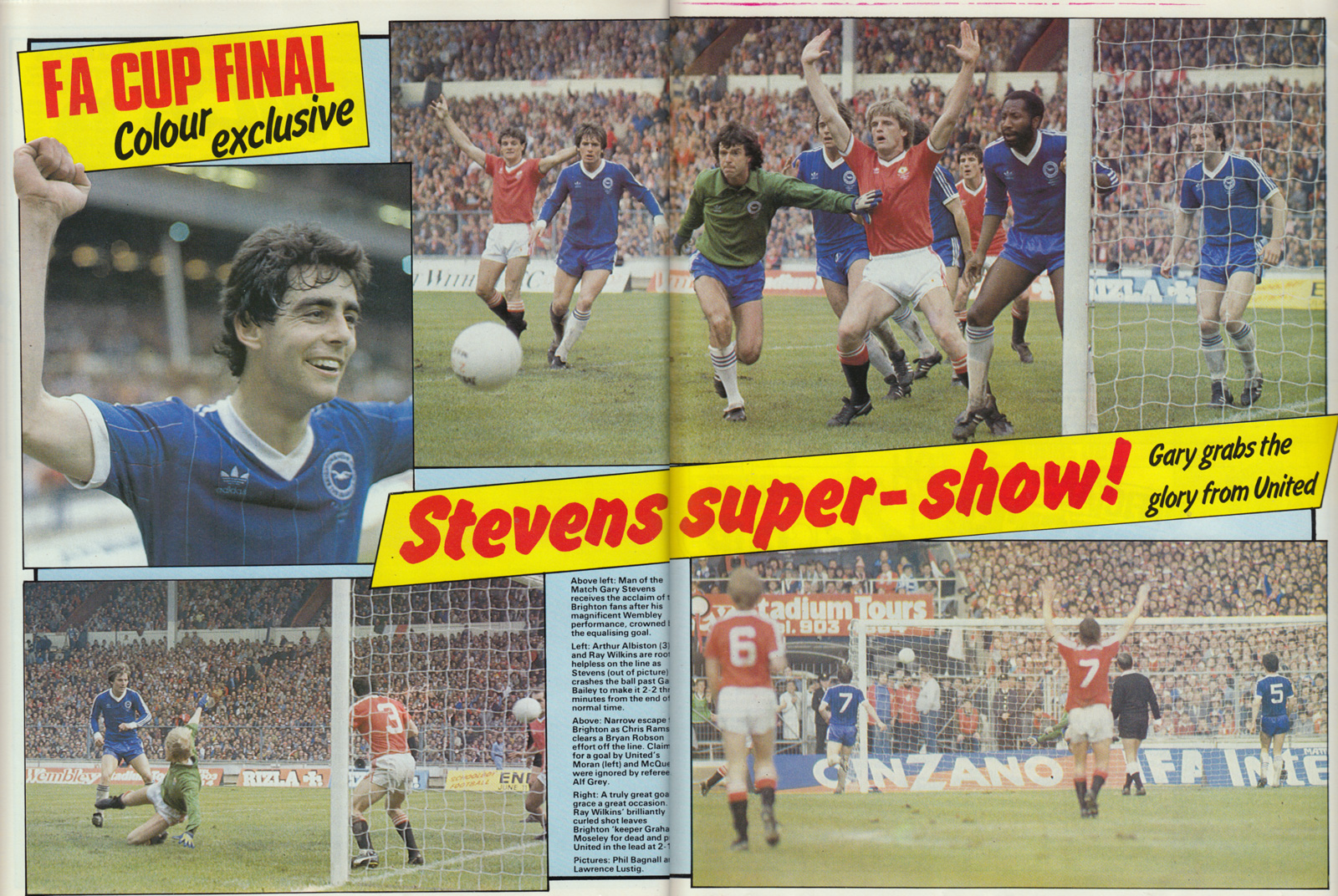
Inside, there is also a glorious colour two-page spread.
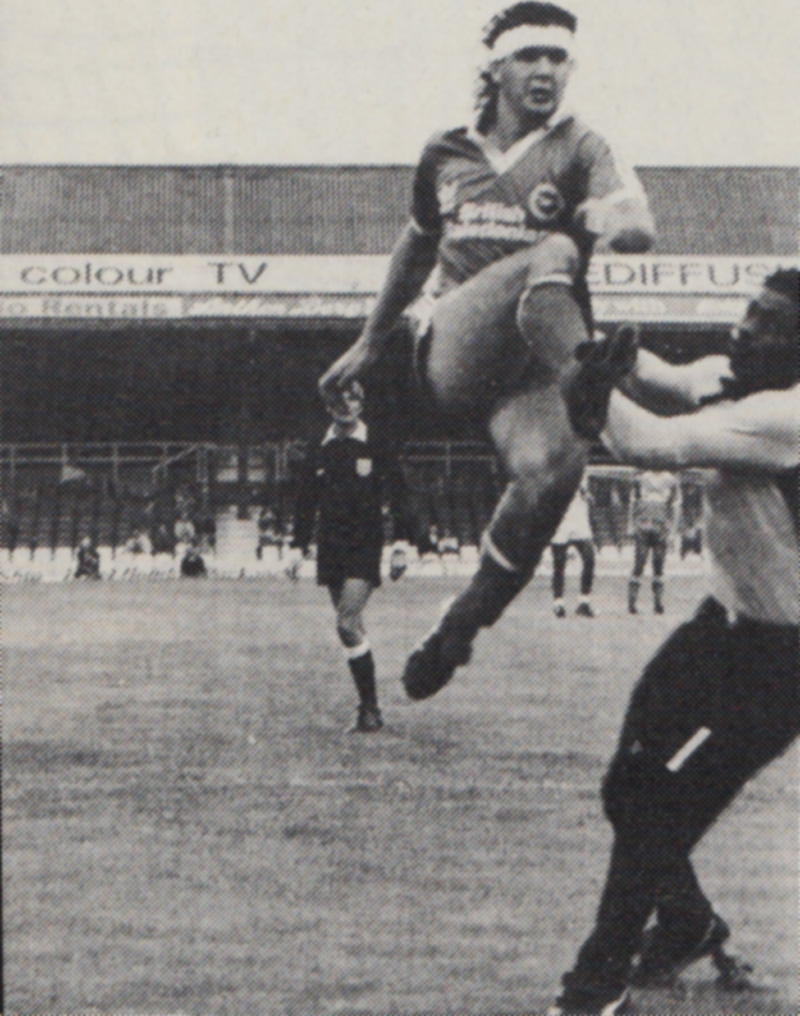
Amazingly, on 24th August 1981, Brighton played a friendly against the Nigerian national side.
Here’s Steve Foster’s high challenge that created the opening for Tony Grealish to get Albion’s first goal. So high, the cameraman almost missed it.
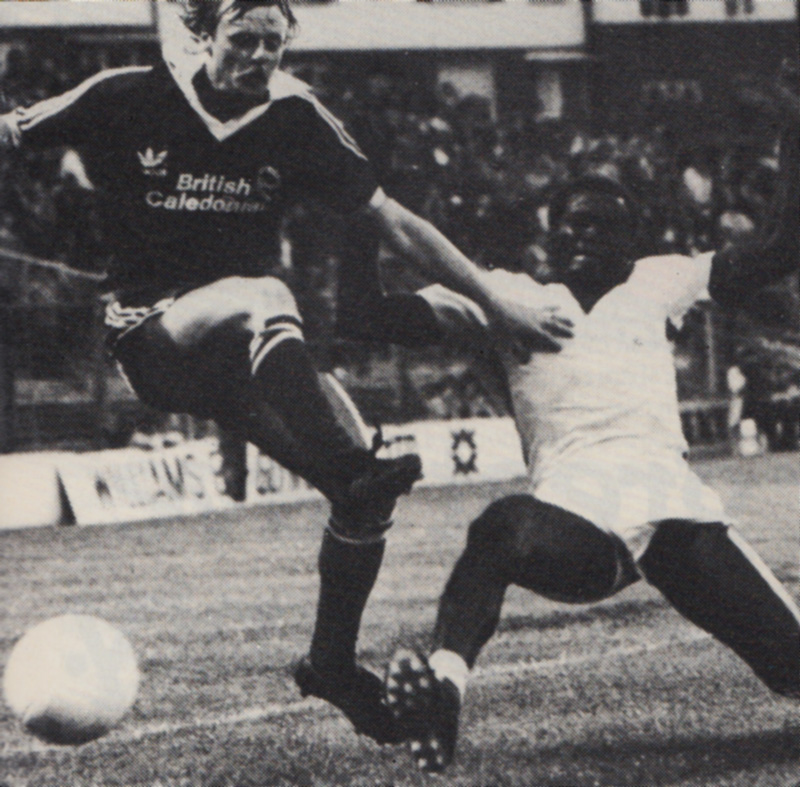
According the club’s match programme, Neil McNab was ‘always in the thick of the action against the Nigerians.’
In a match sponsored by British Caledonian Airways, Brighton & Hove Albion triumphed 5-1. Grealish, Foster, Ritchie, McNab (pen) and Smith got on the scoresheet. We beat a whole country at football, in other words!
In Gordon Smith’s entertaining autobiography, ‘And Smith Did Score,’ he writes vividly about the match:
We were playing a friendly against the Nigerian national side at Brighton and it turned into a real roughhouse. I was playing up front and we were winning 3-0 when their six-feet-four centre-half came up to me and said, ‘You are shit.’
‘What do you mean?’ I asked.
‘I said you are shit. You are a bad team. Liverpool are a good team but you are shit.’
‘Well, if we’re beating you 3-0 and we’re shit, what does that make you?’
And the giant centre-half answered menacingly, ‘I am going to get you. I’ll kill you.’
After some really bad tackles were going in and Tony Grealish got such a bad tackle you could see the bone and the ligaments in his leg through the gash. The whole Nigerian team were acting like maniacs and, at the final whistle after we had won 5-1, I said to the big centre half, ‘So who’s shit now?’
‘But we’re amateurs,’ he said.
‘Yes, we can tell,’ I replied.
That’s when he went off his head and came chasing after me. There was a huge scuffle in the tunnel and he had to be held back while I headed for the dressing room.
Abou ten days later, I walked into the club and was told to go to the treatment room to get an injection from the club doctor. When I asked what it was for, I was told I was going to play a return match against Nigeria, in their capital city, Lagos. I immediately said I wasn’t going. ‘It’s one of the worst places in the world,’ I said. ‘The land that time forgot.’
Mike Bailey said that, if I didn’t go, he would fine me two weeks’ wages.
‘Do you want to take it out of my wages or do you want a cheque now?’ I asked him.
I got back to the dressing room and the boys were wondering what was going on. I told them about Nigeria and why I wasn’t going. One by one, the rest of the team agreed they wouldn’t go either. A team meeting was held and we told the management we weren’t prepared to go to Lagos to play the Nigerians. The following day, the doctor was back in, giving the reserves their injections to go to Nigeria. Mike Bailey didn’t even go and no one was fined. The incredible thing was that, although the reserve boys didn’t enjoy the trip, they played in front of 90,000 people in Lagos – the biggest crowd most of us would have experienced at that stage in our careers. The reserves were used to playing in front of 200-300 fans.
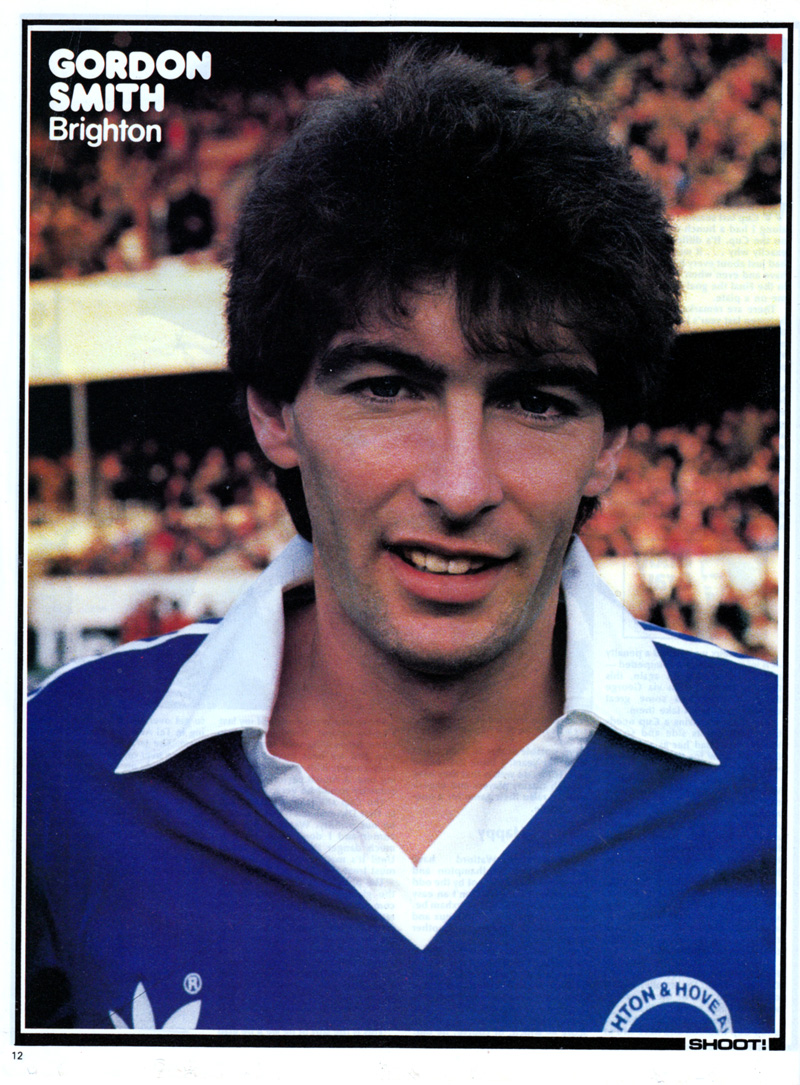
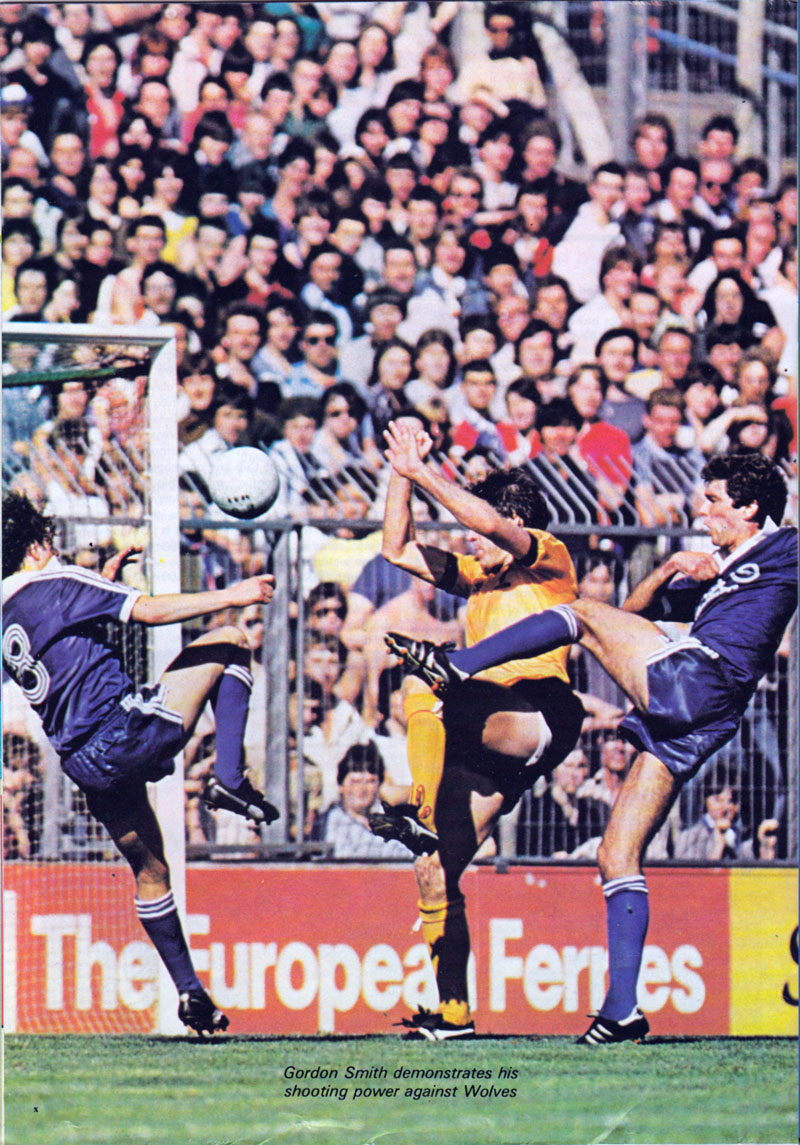
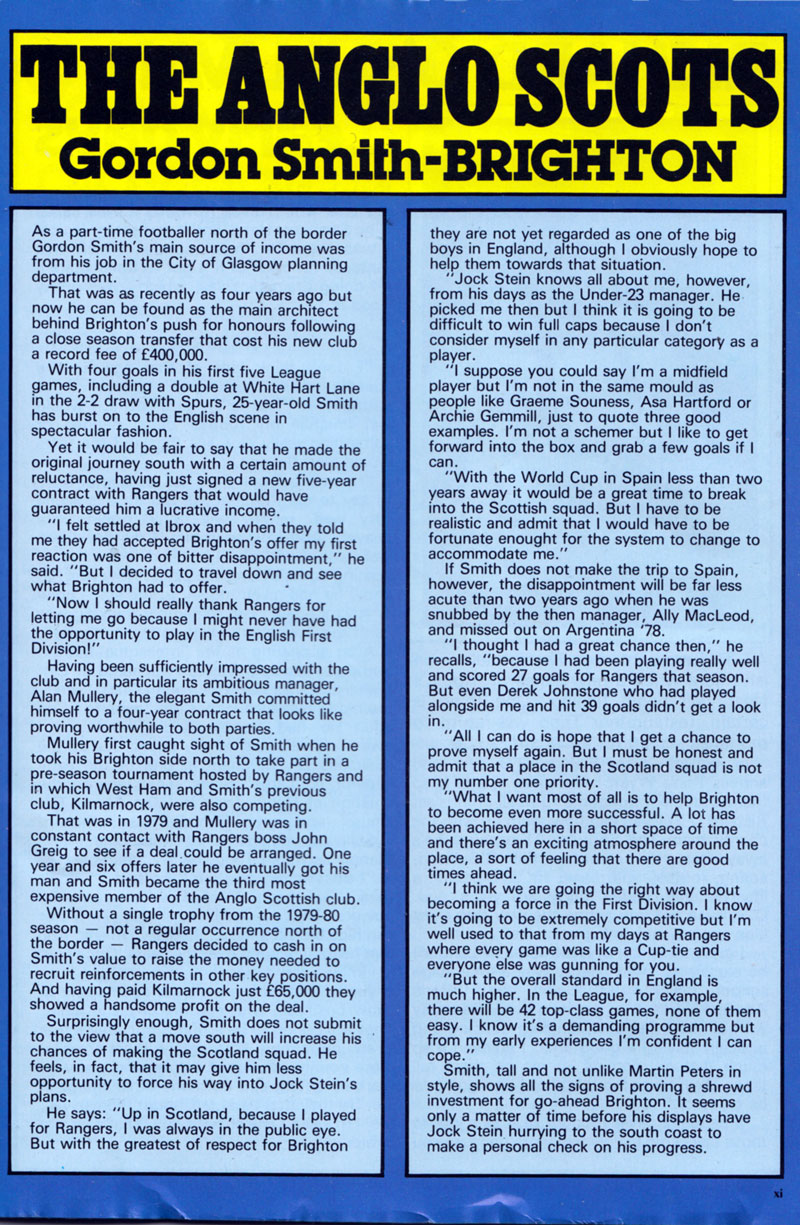
The above feature came in Programme Plus, a magazine insert that several clubs carried in their matchday programme in the early 1980s. While Brighton did not include it in its programme, there were occasional pieces that related to the club. Here’s an interview with Gordon Smith, including a wonderful photo of the match against Wolves on the opening day of the 1980/81 season. Just look at the faces of the crowd!
In the feature, Smith is in diplomatic mood:
I felt settled at Ibrox and when they told me they had accepted Brighton’s offer my first reaction was one of bitter disappointment, he said. “But I decided to travel down and see what Brighton had to offer. Now I should really thank Rangers for letting me go because I might never have had the opportunity to play in the English First Division!
“What I want most of all is to help Brighton to become even more successful. A lot has been achieved in a short space of time and there’s an exciting atmosphere around the place, a sort of feeling that there are good times ahead.”
It’s the kind of respectful attitude that meant Smith is not hated by Albion fans despite not sticking the famous chance away two seasons later.


 The Goldstone Wrap