Yearly Archives: 2013

Why Pat Saward had to go – by Mike Bamber

patsaward5

From the Evening Argus, 23 October 1973, by John Vinicombe:

The dismissal of Albion manager Pat Saward was confirmed today at the Goldstone Ground by chairman Mike Bamber.

Mr Bamber met Mr Saward and after a meeting with the players, he said: “Pat Saward has been sacked. The decision was made after the game with Shrewsbury on Saturday evening. The parting has been on the cards for some weeks but there is no ill-feeling between us,” said Mr Bamber.

“I have seen Pat Saward. He is very upset and very sick. I would also feel very sick. But we have had six home defeats and are down to crowds of 5,000 wonderful people. No club can live on such gates.

“The running of the team is the manager’s responsibility. I feel sorry for managers in a way but if they want to be managers it is up to them.

“Naturally, some of the players are upset at him going. But I have just had a meeting with the players and morale is high.

“We will come to an agreement with Mr Saward over his contract. We have not approached anybody and will be advertising the job and hope to get a really top manager.

“Money will be available for players. It is not easy to get them and we have been after half a dozen this year without success.”

Club captain Eddie Spearritt told me that Mr Saward was backed by the players and they did not want him to leave.

Spearritt himself communicated the same message weeks ago at the same time that joint chairman Len Stringer resigned from the Board.

It was then felt that Mr Saward was in a position of receiving full support from the directors and indeed this was the message conveyed when Mr Bamber took over as head of the club executive.

Mr Saward has three and a half years of his contract to run and today he visited the ground for the last time and told me he wanted to think about his position and whether or not he would comment on his departure.

Confessed Saward: “I still cannot believe it has happened. But I will say nothing to knock the club, nothing at all. Of what happened yesterday, I can remember very little. The reason I have been sacked is that they say I can no longer motivate the players. What I need now is a holiday to get away from it all.”

In the meantime Glen Wilson, the trainer, is responsible for running the playing side of the club, assisted by Ray Crawford, who is now youth coach.

Tomorrow night, Albion are at home to Southport and today the players were training very much down in the dumps.

The atmosphere in the dressing room was solemn, although Spearritt admitted that two players were not unanimous in their support of Mr Saward.

Saward’s departure was on the agenda as Brighton had suffered six successive home defeats at the start of the 1973/74 campaign.

It was a rude re-awakening to Third Division football, after the club had played such pulsating football to finish runners-up in 1971/72. This promotion had led to a calamitous season in Division Two, when the Albion finished bottom of the table. Now back in Division Three, the side’s slump continued. It was relegation, not promotion, that was on the horizon and this ultimately cost Saward his job.

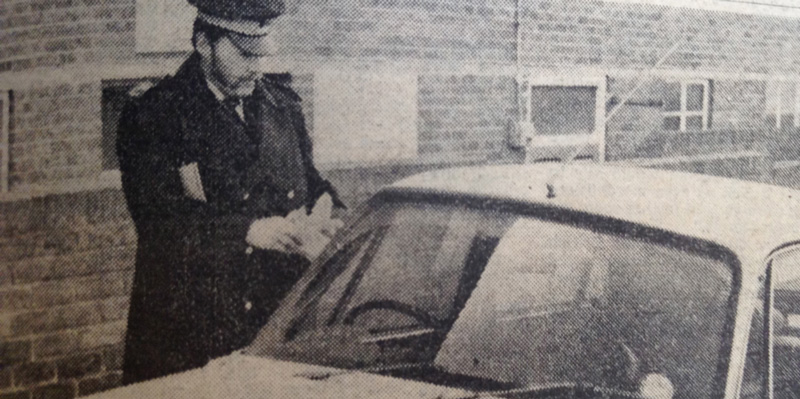
Other bad news was to follow that day when Saward’s club car received a parking ticket outside the Goldstone.
saward6

Tagged , ,

Glen Wilson, a great man of many guises

glenwilson1

glenwilson2

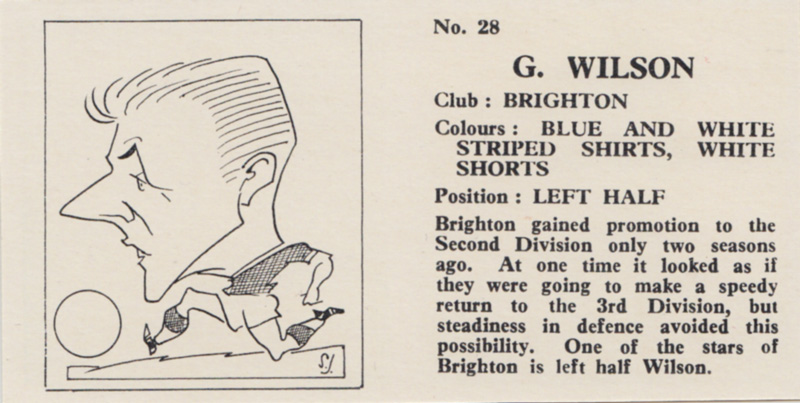
Glen Wilson, who died in 2005, became synonymous with the club during Goldstone Ground era, first as a player, then trainer, caretaker manager, physio and kit man. Although he was a Geordie, he was devoted to the Albion. He made his debut as inside-right in September 1949 against Bournemouth but it was as left-half where he clocked the most of his 436 appearances for Brighton. He was captain of the Billy Lane’s side that won the Third Division (South) Championship in 1958.

In North Stand Chat, Brighton fan nobody’s dupe recalls:

At The Dell I called something derogatory out to him as he was going down the tunnel at half time. He stopped and gave me a well-deserved verbal lashing. He saw me a few days later at a training session at The Goldstone and he continued the ‘conversation’. The next time he saw me was a couple of weeks later at Ashton Gate before a game against Bristol City. He got off of the team coach, came straight up to me and gave me a complimentary ticket for the match.

I also remember a game at Swindon. All through the game he and one Swindon player were giving each other physical stick. Glen was seemingly the only one to be punished with a string of free kicks against him. Towards the end of the game he was booked. Just after the final whistle the Swindon player held a hand out to Glen with a broad grin on his face. Glen stepped forward and delivered a beautiful left hook, and left the guy flat on his back. He then walked down the tunnel leaving a hell of a commotion behind him.

Sammy Morgan will tell you that when Glen was the physio he left him on a treatment table for ten minutes wired up to a heat treatment machine. The only thing was that Glen had forgotten to turn it on, but on his return he asked Sammy if he felt better for it. Sammy wholeheartedly agreed and got down from the table and did a little jig to demonstrate.

Apparently during this time his massages were delivered in a very zealous manner. The players nicknamed him after The Boston Strangler. Hence, Billy Boston.

I used to enjoy talking to him at the various dinners he attended. We used to jog each other’s memories about Albion matches. He loved The Albion through and through.

In 1978/79, Glen Wilson switched from being physio to kit man and, in this position, he was interviewed by David Bobin on the eve of the FA Cup Quarter-Final with Norwich City in 1983:

Tagged

Arsenal Annual 1982

arsenalannual

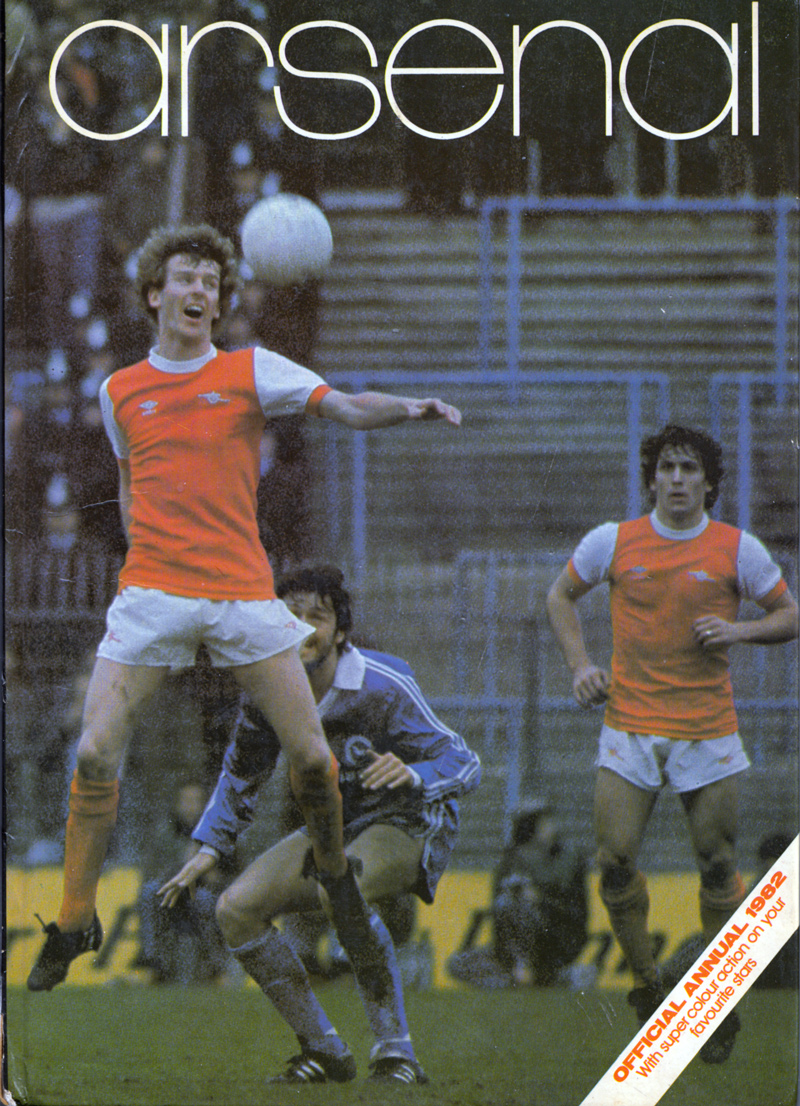
Here’s Graham Rix rising like a salmon while Giles Stille sniffs the visitor’s shorts, as Kenny Sansom watches in the background.

It’s an arresting image, and one that makes for a captivating front cover for the Arsenal Annual released in time for Christmas 1981.

The match was played in April ’81 at the Goldstone Ground, and ended in a 1-0 defeat, leaving Brighton’s First Division survival on a life support machine. It didn’t help that boss Alan Mullery’s managerial record against the Gunners was lousy. Played 7 Won 0 Drawn 1 Lost 6 Goals For 0 Goals Against 16.

Still, Mullery does get a mention in the annual:

We are now used to the idea that the fortunes of a football club depend very largely on the calibre of the man in charge, on his ability to recruit the right players, to make the right team changes, to plan effective tactics, to motivate his players. When Alan Mullery became manager of Brighton, the club entered the soccer elite for the first time in its eighty-year history.

However, although the annual is a fascinating read throughout there isn’t much in the way of Brighton interest, which was the initial motivation for buying it in the first place.

There are photos from Sammy Nelson’s testimonial match for Arsenal v Celtic before his departure to Brighton. Elsewhere, there is a bigging up of the John Hawley-Ray Hankin strike partnership. Hankin vowed forlornly, ‘I’ll make the fans forget Stapleton’. Maybe he could have competed against the 38 year-old veteran version of Frank Stapleton that helped out Brighton boss Liam Brady in November 1994 by playing two games, but not at a time when the Eire centre-forward was one of the most feared strikers in the Football League.

Also turning up at the Goldstone Ground in the 1990s was Raphael Meade, then a rising star at Highbury. In a profile of young Gunners, it says:

Raf got very close to a first-team game last season but finally got his reward this season. He’s got a hell of a lot of pace and is fantastically brave in the box. He’s got all the makings of a top player. However, he’s another one who has got to work on his control like Brian McDermott with tighter controls and lay-offs. But with his type of pace he will always be a threat.

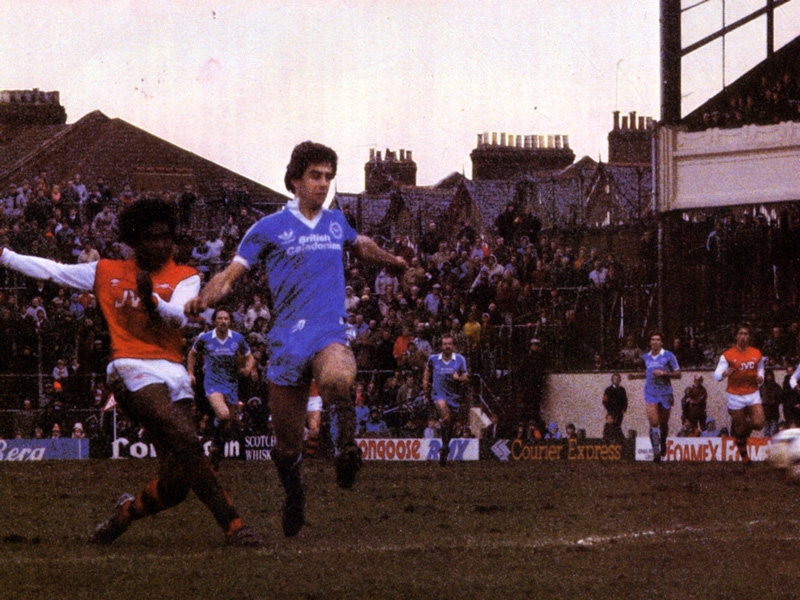
Showing his attacking prowess, here he is getting the better of Gary Stevens to score at Highbury, about a decade before Meade’s two short spells with Brighton:

meade

Tagged ,

Brighton’s Team Photo 1969/70

1969-70

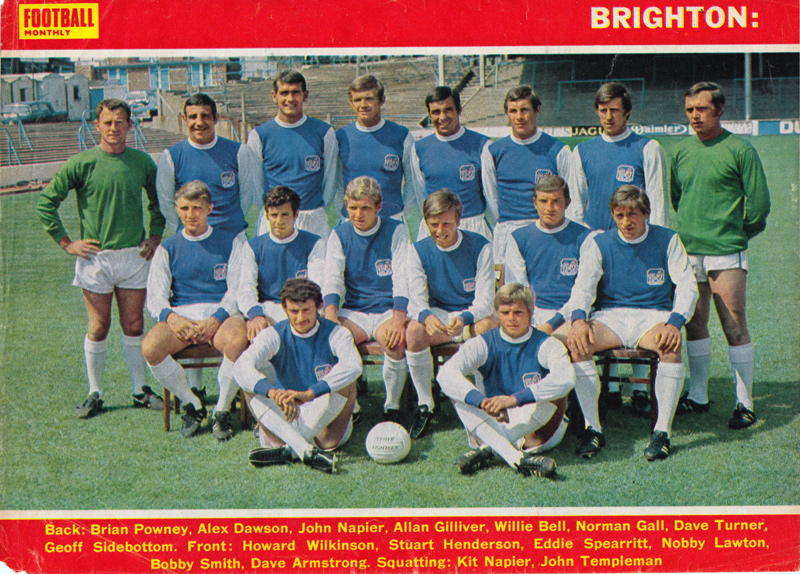
After getting knocked out of the FA Cup by Walsall in a long-running FA Cup 2nd Round tie that went to three replays in December 1969, Freddie Goodwin’s side embarked on a scintillating run of form of fourteen victories in nineteen league matches. Supported by new striker Alan Duffy, who had a sensational debut against Bradford in January, the team (dressed above in kit that made them look like a blue Arsenal) were sitting pretty at the top of Division Three at the start of the Easter schedule. However, four defeat in five games put paid to the promotion dreams. Goodwin left for Birmingham City in the summer.

Tagged ,

Stick your Muhren and Thijssen. We’ve got two Israeli internationals!

israelis

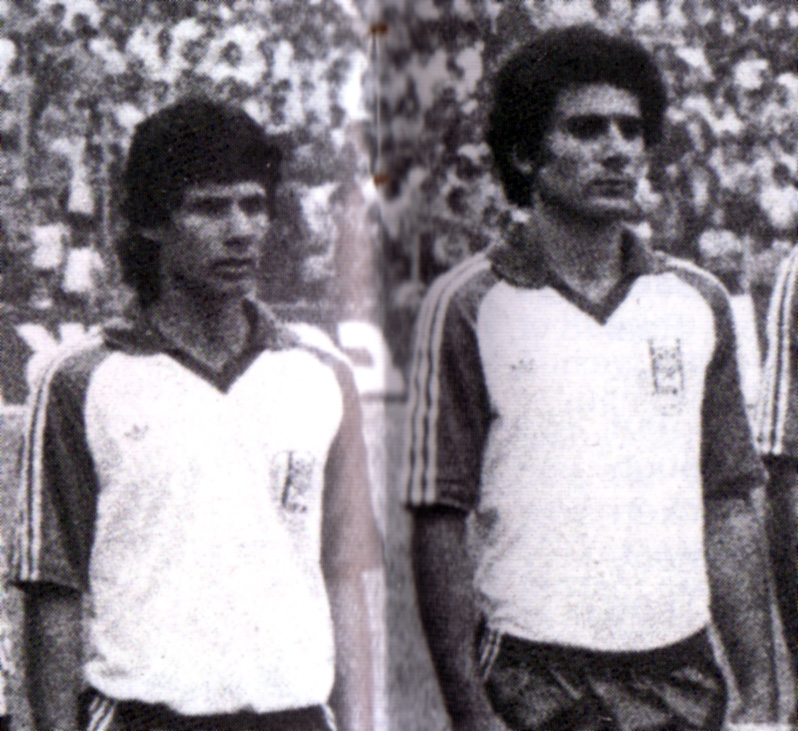
In the early 1980s, when foreign imports were rare, Tottenham had the duo Osvaldo Ardiles and Ricardo Villa, and Ipswich Town had Arnold Muhren and Frans Thijssen. Despite Brighton making a play for Peruvian World Cup stars Percy Rojas and Juan Carlos Oblitas in February 1979, nothing happened despite both featuring in a match behind closed doors at Hove Greyhound Stadium.

Eventually, though, we had Moshe Gariani and Jacob Cohen. You can see these two gods of Israeli football together in this image above, with Cohen on the right sporting the larger perm. I hope you’re grateful as, to track it down, it required much buying of Israel international football programmes from the 1980s, on the off-chance of a photo of the pair!

It took until May 1980 for Brighton & Hove Albion to join the growing trend of bringing ‘continentals’ into the First Division. The Seagulls had played a friendly match against the Israeli national team, managed by ex-Albion player Jack Mansell, in February 1980, triumphing 2-1 at the Ashkelon Stadium via goals from Mark Lawrenson and Peter Ward. Suitably impressed by the performance of opposition player Moshe Gariani, Mullery bought the 22 year old’s services for £40,000 three months later.

BBC reporter Alan Green (yes, that one) described Gariani as “one of Israel’s big successes. Looks very like Kevin Keegan and runs like him as well! Plays mostly on the left-hand side but always tries to keep in the thick of the action.”

Thanks to Paul from Cult Zeros, I’ve found this impressive footage of Gariani scoring for Maccabi Nathanya in the side’s 1979/80 championship-winning season:

As part of the transfer, Brighton played Maccabi Nethanya for the world-renowned Jewish Chronicle Cup in July 1980.

In 1980/81, Shoot! Magazine reported:

The club’s line-up is unlikely to bear the name of Mullery’s fourth signing in the early stages of this season. The club’s coaches reckon Moshe Gariani will take at least four months to adapt before he is tried in the First Division, but more than one of the experts is confident Gariani, an aggressive midfield player who runs hard at defenders, will be pushing McNab hard if the former Bolton player fails to produce the goods.

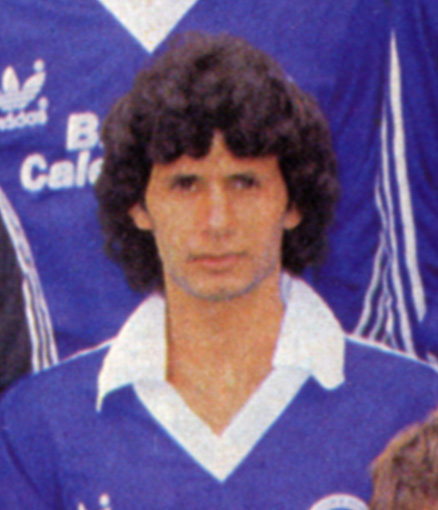
moshegariani

Much earlier than expected, Gariani was an unused sub in the 2-2 draw at Tottenham in August 1980 before playing seventeen minutes of First Division football at Southampton the following month, after coming on for Gerry Ryan in a 3-1 defeat. Three matches later, the Israeli was again an unused substitute in the 2-1 League Cup home defeat against chocolate shirted Coventry. And that was that. Gariani had no other opportunities to impress in the first team. Although he featured in some pre-season squad photo shoots for the following campaign, he was sold to Tel Aviv in August 1981.

In between Gariani’s one appearance and his departure, Brighton fans were treated to the similarly brief English football career of his Israeli compatriot Jacob Cohen.

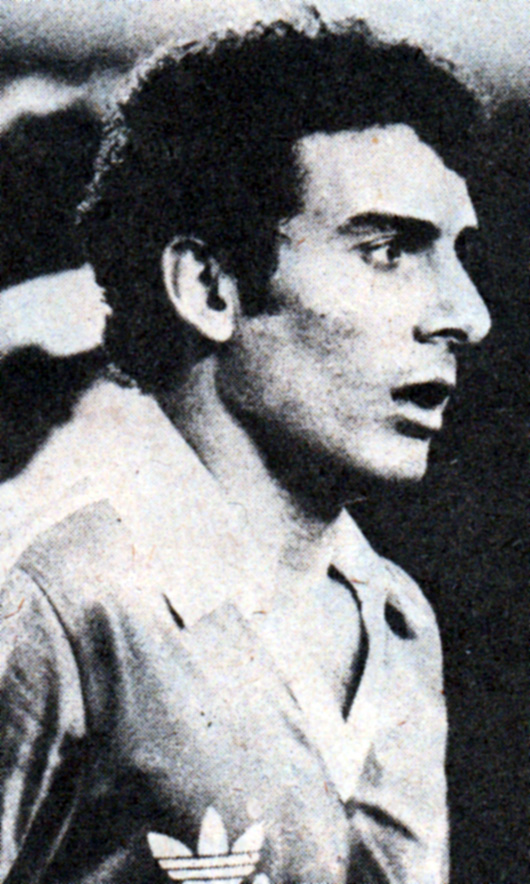
Jacob Cohen (or ‘Yaacov Cohen’ as he was often listed in international match programmes) had already been an Israeli international for four years by the time he arrived at Brighton in August 1980 for a trial. Once more, Jack Mansell played a part, recommending Cohen who was watched by Albion chief scout Jimmy Melia. Eventually, £40,000 was enough to buy him in October 1980. jacobcohen

Having made his debut as substitute in a 0-0 stalemate at Stoke City that month, Cohen (filling in for the injured Gary Williams) followed up with three successive starting appearances in the left-back position, against Manchester City, Arsenal and Middlesbrough. Unfortunately, all three matches were lost but still, that’s quite a lot of minutes more than Gariani managed at the Goldstone.

Having been substituted against Middlebrough, Cohen then lost the number three shirt to Gary Stevens and had to be content with two more substitute appearances, at Leeds in November and then a home win against Sunderland in early December, before his Albion career also petered out. He joined Israeli side Bethsheba FC after the 1980/81 season ended. In the Northern Ireland v Israel programme from November 1981, BBC reporter Alan Green says after his short stay at Brighton, Cohen “went back to Israel a very disappointed man.” He describes Cohen as “very much an attacking back in the Sammy Nelson mould but consequently leaves plenty of space for right-wingers.”

The following season, Brighton made do by signing the real Sammy Nelson, joining in a £30,000 deal from Arsenal.

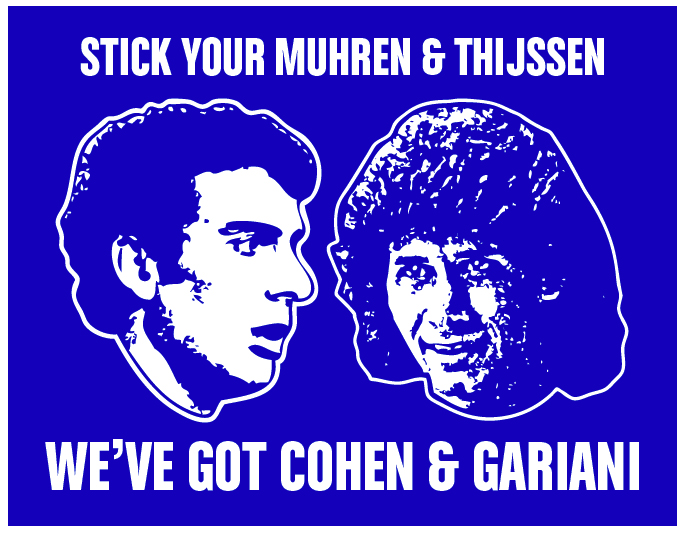
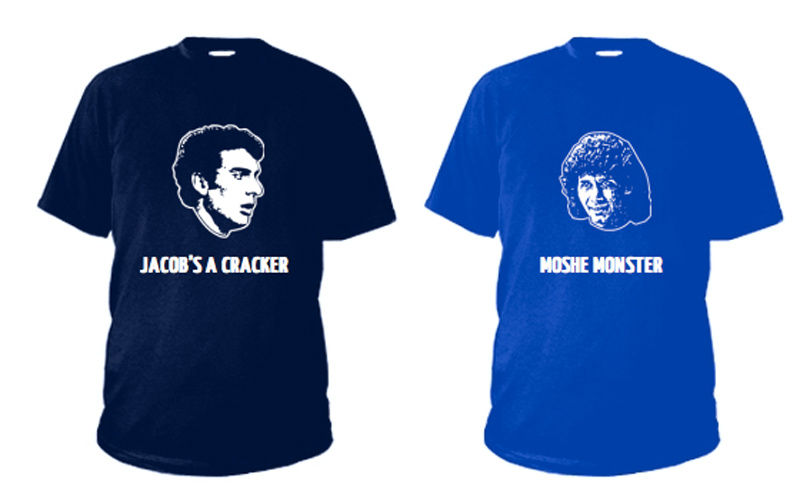
As for the homeward bound Israel internationals, not much is widely known about what happened to their careers after. Never mind, though. Because Cult Zeros, a company that specialises in custom-made football T-shirts of celebrated and not-so-celebrated players, have launched a range of Moshe Gariani and Jacob Cohen t-shirts. And they look fantastic! I went with this design:

cohen_gariani

You can buy the Jacob Cohen T-shirt here
http://www.cultzeros.co.uk/product/19918/jacob-cohen-brighton-and-hove-albion/

And the Moshe Gariani tee here
http://www.cultzeros.co.uk/product/19916/moshe-gariani-brighton-and-hove-albion/

I had some thoughts about some slogan ideas. How about these?

tshirts

And if you’re worried about space, you can make room in your wardrobe possibly by throwing your ‘Hola Gus’ T-shirt out.

Tagged , ,

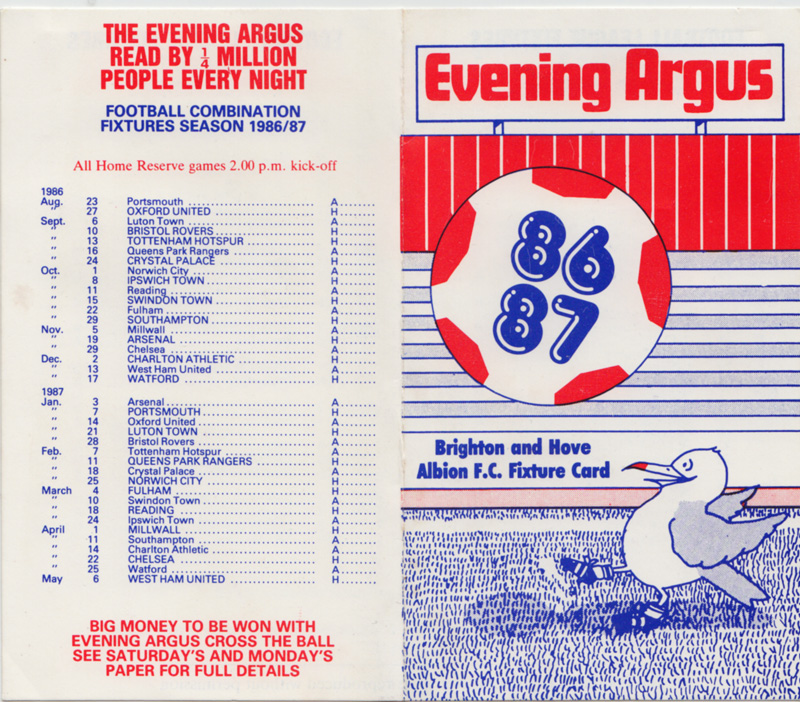
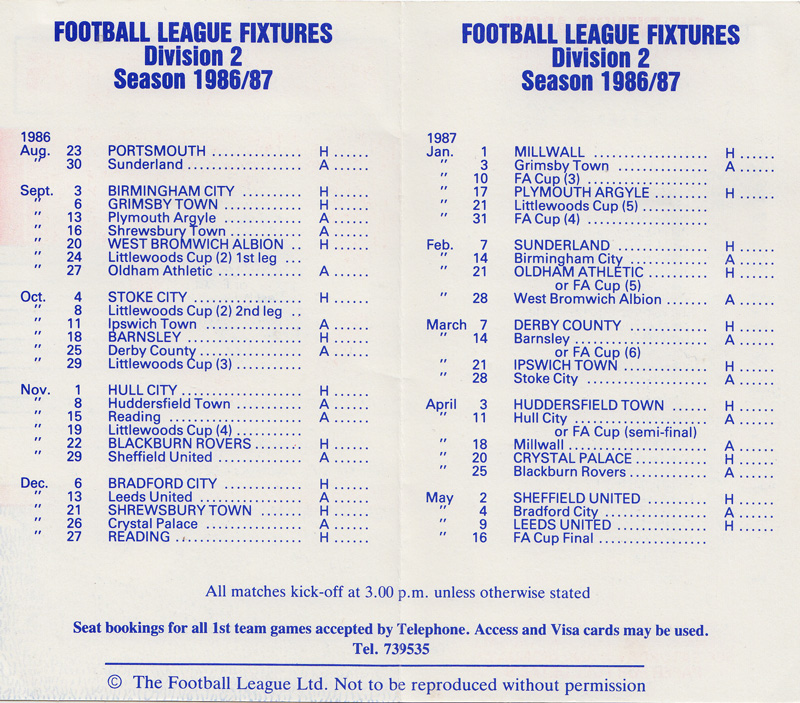
1986/87 Evening Argus Fixture Card

argusfixturecard86-87a

argusfixturecard86-87b

On the day the fixtures for the 2013/14 Football League season are announced (9am), I’d like to share with you an elegantly designed fixture card from the Evening Argus from the mid-1980s. You can also view the one for the 1982/83 season.

Fan anger at the sacking of manager Chris Cattlin was assuaged in summer 1986 by the announcement that Alan Mullery, Brighton boss during the glory years, was back at the helm.

As you can see, the 1986/87 campaign began with an exciting prospect of a south coast derby at home to Portsmouth (yes, it ended 0-0). By the season’s end, Alan Ball had led Pompey back to the First Division (probably the only club where the World Cup winner is considered a managerial success).

Brighton, however, headed in the opposite direction. Mullery was harshly sacked in January 1987 for lacking ‘commitment’ despite doing OK with having virtually no money to spend. Waiting in the wings, Barry Lloyd took his place. Of the fixtures in the second half of this card, only three were won.

Tagged , ,

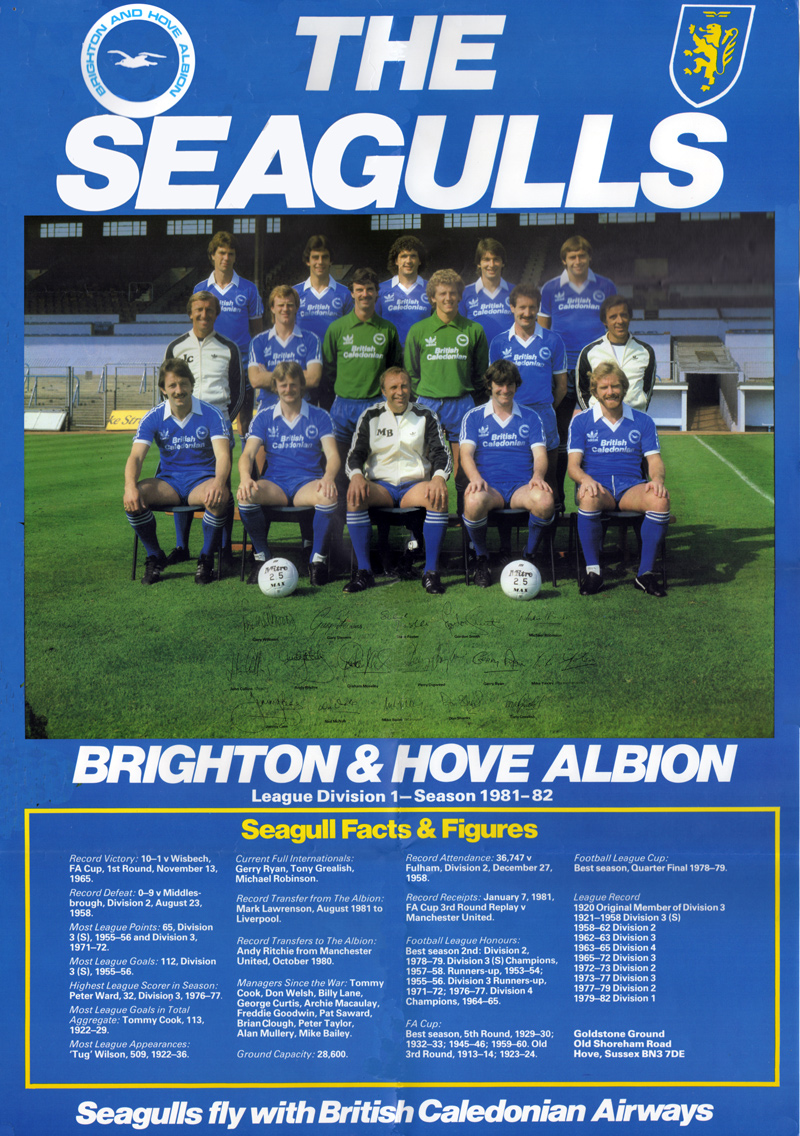
Official club team poster 1981/82

1981-82 poster

This glorious A2 colour poster from the Seagulls Shop would have been stuck proudly upon the bedroom wall of many Brighton fans. It would have helped familiarise them with the re-shaped team. In this very select team group photo with just eleven outfield players and two goalkeepers, new signings Jimmy Case, Don Shanks and Tony Grealish take pride of place in the front row with new boss Mike Bailey. As you can see, these were the good old days when the coaching staff had their initials printed onto their tracksuits. Very cute!

Just like his new buddy in midfield Tony Grealish, it is widely forgotten that Jimmy Case took some time to settle with the Seagulls. Grealish had a job to win over the fans as he had replaced club captain Brian Horton, who joined Grealish’s former club, Luton Town. After a long, successful career at Liverpool, Case’s form was indifferent in his first season at Brighton. Nevertheless, Case did manage to play 33 League matches. He scored just three goals, all in the early part of the season, the last of which was in November 1981.

Right-back Don Shanks (front row, fourth along) was a free transfer from QPR, and proved an instant hit, working his way up and down the line throughout the season in a way that many Brighton supporters remember fondly. This is illustrated by his great work down the right-wing that helped the Seagulls draw 3-3 against Liverpool in October 1981. His First Division know-how also made for a much meaner defence.

With Andy Ritchie and Michael Robinson banging in the goals, this tightly organised team never fell below 14th place and were able to play a whole season in the First Division without any relegation fears.

Tagged , , , ,

‘I lost my shoes because of Peter Ward’

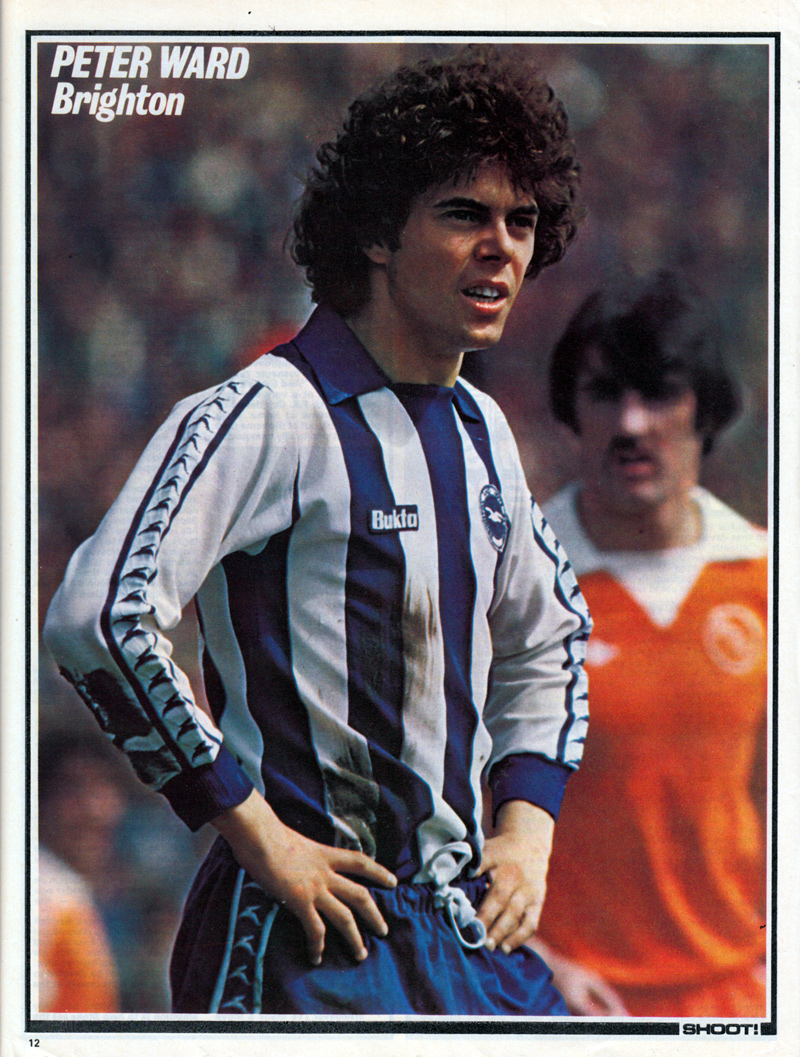
The pulsating atmosphere of the home match against Blackpool at the end of the 1977/78 season will live long in the memory. High-flying Brighton needed to win at the Goldstone Ground to stand a chance of eclipsing Southampton or Tottenham. Although they won 2-1 it was not enough to give the side promotion to Division One.

peterward5

Teenager Dave Jenkins, in an extract from ‘He Shot, He Scored’ by Matthew Horner, page 78:

During the Blackpool game, a few of my 17-year old mates and I were once again worshipping Wardy in the North Stand.

Yet again, in a desperate tense game, Wardy came to the rescue with a piece of typical fleet-footed magic. As the ball sped into the net, the North Stand erupted with even more thunder than had been usual in those fabulous years under Taylor and then Mullers. The surge from the back of the stand lifted us fully 10 steps down that crumbling terrace.

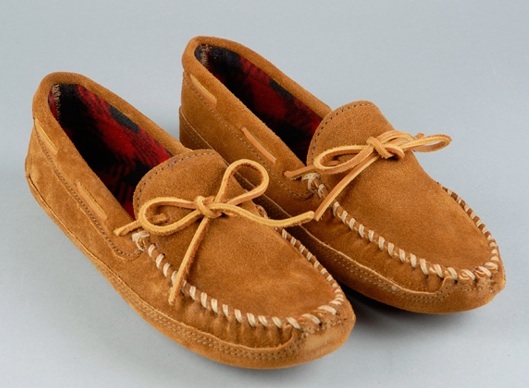
As I was being carried down towards the pitch in a state of delirium, I remember the feeling of my new and very expensive Ravel of Western Road moccasins being ripped from my feet by thousands of equally out-of-control Brightonians.

Needless to say, I never saw those shoes again: I had to walk back to central Brighton barefoot.

Not really feeling up to much, we decided to have a beer of commiseration in Shades (now the Pavilion Tavern). Unlike today, a bloke taking to the pubs and clubs without any shoes was a bit unusual in 1978.

It turned out to be a hugely successful evening with some of the town’s best-looking girls, and even the bouncers in the Queen Anne pub let me in shoeless in Wranglers (very unusual) – all because of my response to the obvious question ‘What happened to your shoes?’ My answer was, ‘I lost my shoes because of Peter Ward.’

moccasins

Tagged

Sponsorship heaven & hell: Oxford v Brighton 1988/89

oxford1

The gloriously manly Wang Computers are quite rightly hailed by The Football Attic as the greatest shirt sponsor of all time. Man, I wish Brighton & Hove Albion had the US computer company as our shirt sponsor in the 1980s. Instead, we wound up with the thoroughly embarrassing NOBO. I’m sorry, but boasting you are ‘Top of the First Division For Display and Training Aids’ cuts no ice with me.

When Wang Computer became the sponsor of Oxford United, a Division One club for the first time, in summer 1985, Brighton were still plying their trade in the Second Division. When the U’s, who had triumphed in the League Cup Final against QPR 3-0, won by the same score over Arsenal on the final day of the 1985/86 season, it inconveniently preserved the side’s top flight status. Their home kit, incidentally, looked strikingly similar to Brighton’s away kit for the forthcoming 2013/14 season.

oxford2

Hopes of a mirth-making Wang v NOBO football match were dashed by that Arsenal result, and frustrated again the following season when both Oxford and Brighton went down, preserving the league gulf between them.

It took until September 1988 for newly promoted Brighton to play in their NOBO-emblazoned shirts against the team in Wang.

Brighton lost 3-2 to Oxford in a Second Division fixture as part of a depressing start to the 1988/89 campaign where they lost their first eight matches. Oxford manager at the time was ex-Seagulls favourite Mark Lawrenson. His programme notes explode the myth that he has never acknowledged his time at Brighton since leaving the Goldstone. Instead, he wrote warmly:

“Welcome today to Brighton and Hove Albion, the players and officials and everyone connected with the club. Brian Horton and myself spent many happy years at the club and we have a great affinity for the club from the good times we had there. Indeed Brighton’s result is one of the first we look for on a Saturday night. Dean Saunders too, I am sure will wish to have a good game today as he had a successful time at the Goldstone Ground.”

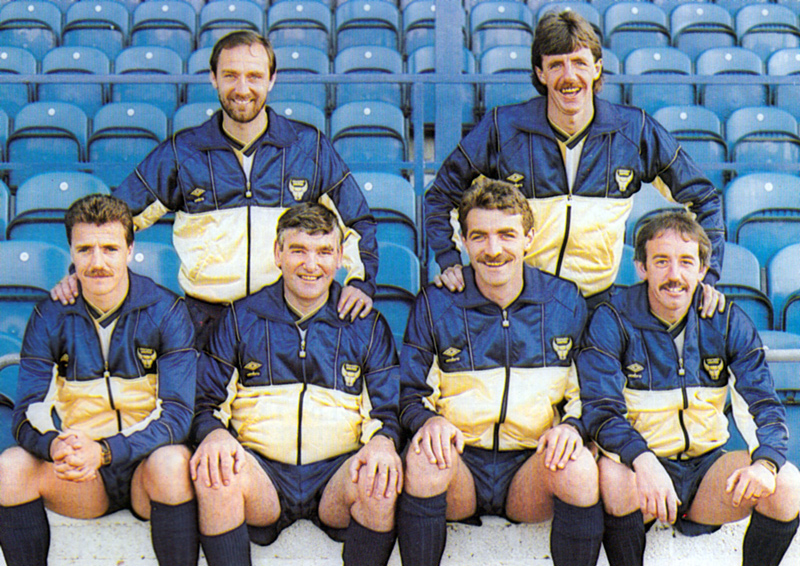
Due to the financial woes at Brighton, Saunders had been signed for a ludicrously low fee of £60,000 in March 1987. Sometimes, it is said by Brighton fans that Lawrenson took advantage of the difficulties at his former club to ‘steal’ Saunders from us, but the Oxford manager at the time was Maurice Evans (bottom row, second from left, in the image below), not Lawrenson.

oxford

Mark Lawrenson didn’t last long as manager, however. He was sacked the following month after making critical comments when Saunders was sold to Derby County against his manager’s will. The future complacent BBC armchair pundit was replaced by Brian Horton.

By the time of the return fixture, in late March 1989, Brighton had hauled themselves off the bottom of the table to 21st place, one place above the relegation trapdoor. They helped their cause even more by coming from behind to beat Oxford 2-1 at the Goldstone Ground.

The Seagulls eventually finished 19th, two places behind Oxford.

Tagged ,

Meet the Girl Behind the Man: Rita Irvine

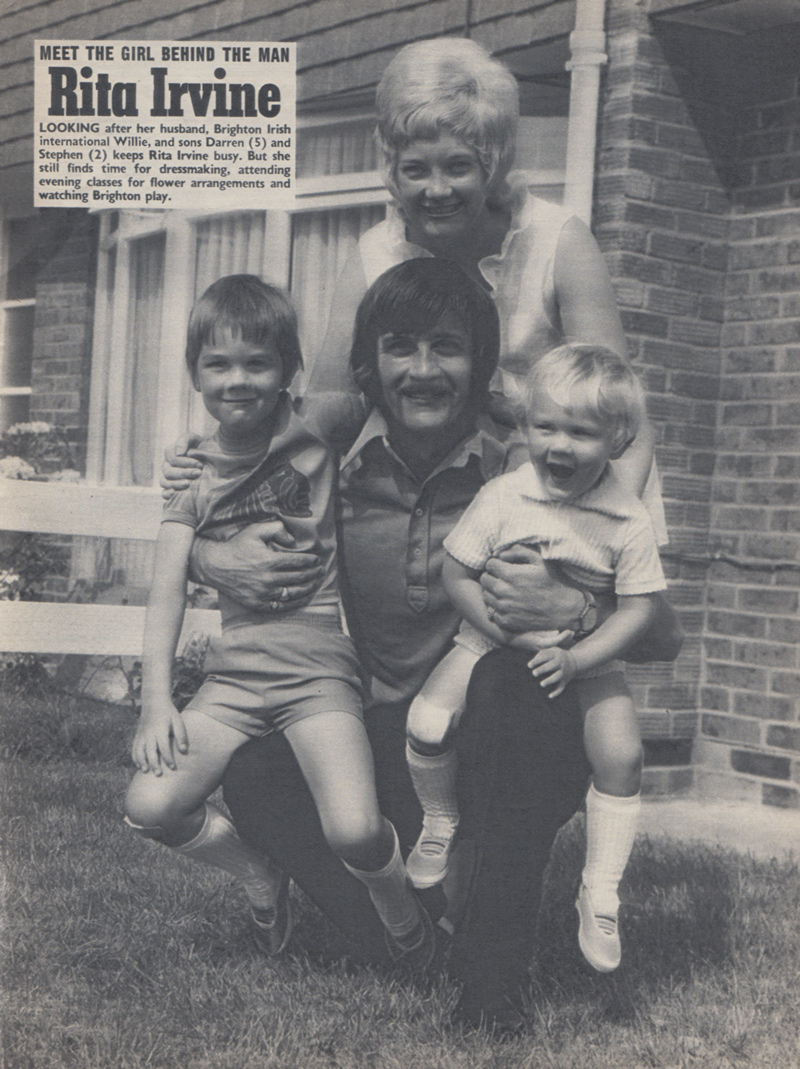
Northern Ireland centre-forward Willie Irvine was one of Brighton’s star strikers in the 1970s. He joined on loan from Preston in March 1971 and his six goals in fourteen League games helped to rescue the Albion from a Third Division relegation battle that season.

From Goal! Magazine:

ritairvine

Looking after her husband, Brighton Irish (sic) international Willie, and sons Darren (5) and Stephen (2) keeps Rita Irvine busy. But she still finds time for dressmaking, attending evening classes for flower arrangements and watching Brighton play.

A less rosy, but eventually happy, picture is painted in Willie Irvine’s autobiography, ”Together Again’:

The offer of a three-month loan to Brighton was made and Rita and I looked at each other. Against it was the fact that a move from Preston to Brighton would be 200 miles or thereabouts further than a move from Burnley to Preston. It seemed a huge distance for Burnley girl Rita, who would be leaving the closeness of family and relatives. The four of us – by now we’d had our second son – would be well and truly on our own. There’d be no bus rides home for the day like she could do from Preston to Burnley.

The club had promised to organise a rented property for us, a lovely flat in Shoreham-By-Sea. We kept the house in Preston for when we went back. The problems of being a football wife hit Rita hard. Strange place, strange flat, me away frequently. In the first week one of the boys took very ill while I was away for three days. All Rita could do, young, panic-stricken and frightened, was knock on the flat below and ask for help. She knew no one but the woman she begged for help, a total stranger, turned out to be a real saviour and called her own doctor who came every day for the next week. They became the best of friends and bit by bit we got to know other players and their wives. Only a footballer knows what the wife goes through at times like this. They are a special breed. Some are strong and can handle it. Others don’t. Rita might have had floods of tears on several occasions and suffered from my moods, but she coped, stuck it out and adapted every time we moved.

Tagged