Monthly Archives: July 2013

Double A-Side single: ‘In Brighton’ / ‘The Goldstone Rap’ (1982)

First Division footballers they may have been, but Brighton’s team of ’82 also made an audacious bid for pop fame and hip-hop credibility.

From left to right, here are the rather earnest-looking Gordon Smith, Steve Gatting, Perry Digweed, Andy Ritchie, Jimmy Case, Gary Williams, Gary Stevens, Gerry Ryan, Michael Robinson and Steve Foster seeking to set the world alight with their dulcet tones and Farah slacks, not to mention their previously unrevealed rapping skills:

goldstonerapstudio

In the Brighton v Tottenham match programme from March 1982, it was announced:

Last Wednesday our first team squad had a unique day out when they travelled to recording studios in South London to cut their first record. The record is entitled ‘In Brighton’ and should be available on general sale in early April.

Howard Krugar, who lives in Hove and specialises in organising concerts for some of the world’s biggest stars, is the man behind the idea and he is hopeful of the disc making the charts. In fact it is highly likely that the Albion squad will appear on ‘Top of the Pops’.

Also involved in the record is BBC football commentator Peter Brackley who livens things up with commentary on a memorable Albion goal… which one? Well, for that you’ll have to buy the record.

Thanks to the lads at We Are Brighton, you can hear ‘In Brighton’ here:

Based on the Drifters’ song ‘On Broadway,’ the song received a positive response from John Henty who gave it a spin at Radio Brighton on Sunday 4th April. With dubious lyrics such as ‘Big Fozzie keeps it tight for Brighton’ and the boast of ‘Playin’ at the Goldstone Ground, where good football’s always found’ (sadly, no football of any kind down there now), not to mention even dodgier singing, the song probably did not have much of a fanbase outside of Brighton supporters.

Nevertheless, it was also played by Peter Powell on Radio One. However, as notes that month in the Brighton v Manchester United programme lamented:

Last week Peter Powell played the disc on his Radio One show but allowed his own support of Wolves to colour his comments on the merits of the recording.

The song was also erroneously aired on BBC’s ‘Match of the 80s’ series in the 1990s in its coverage of Brighton’s FA Cup run of 1983, with Danny Baker hesitating about even calling it a ‘song’! And, just in case you are wondering, the Andy Ritchie goal that Brackley acts out a commentary on is almost certainly this swerving free-kick belter from the Brighton v West Bromwich Albion game in February 1982:

The other track on this Double A-side was ‘The Goldstone Rap’, which this very blog you are reading takes its name from. Looking at it now, it’s amazing to think that Brighton & Hove Albion were at the forefront of the UK hip-hop scene in 1982, especially as this was almost certainly the first ever football song to feature rapping.

Unlikely to win any prizes at the MOBO awards, the rap memorably includes such lyrical gems as:
‘When you make that cross you’re gonna cross it fine / Give the ball to the player on the dead ball line.’

Never mind the MOBOs, though. Were you at Busby’s Night Club on Kingswest, Kings Road, in Brighton on the evening of Tuesday 6th April 1982? If you were, you would have been present to the grand launch of the single, as Brighton & Hove Albion’s first team squad belted out their musical masterpieces on stage! Sadly, I have no video footage of this priceless moment.

When released to the general public, the colour sleeve of the 7″ looked splendid, with the players proudly posing in front of the temporary Lego Stand in all its glory:
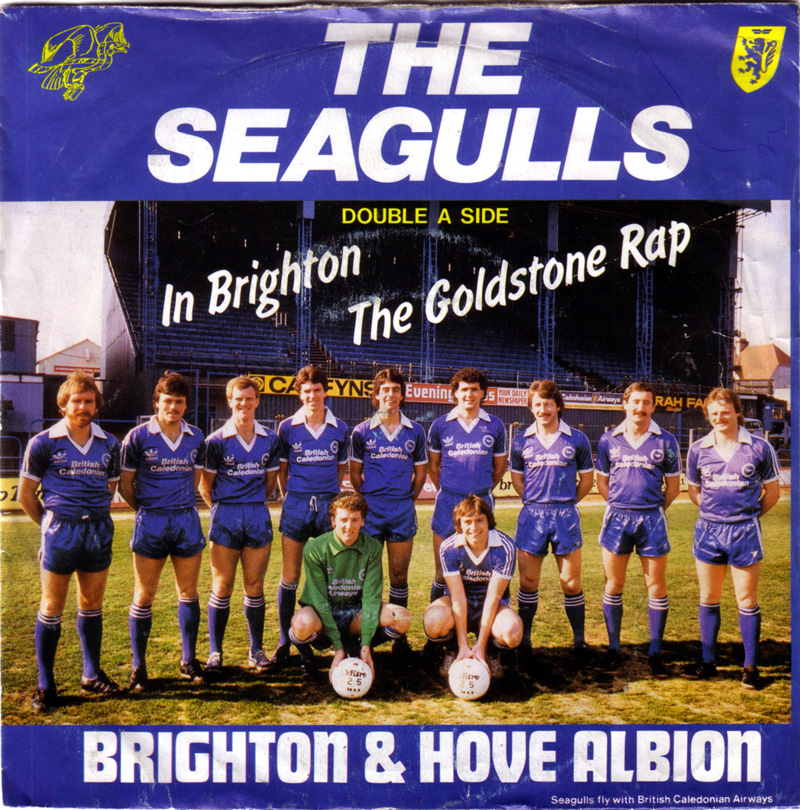
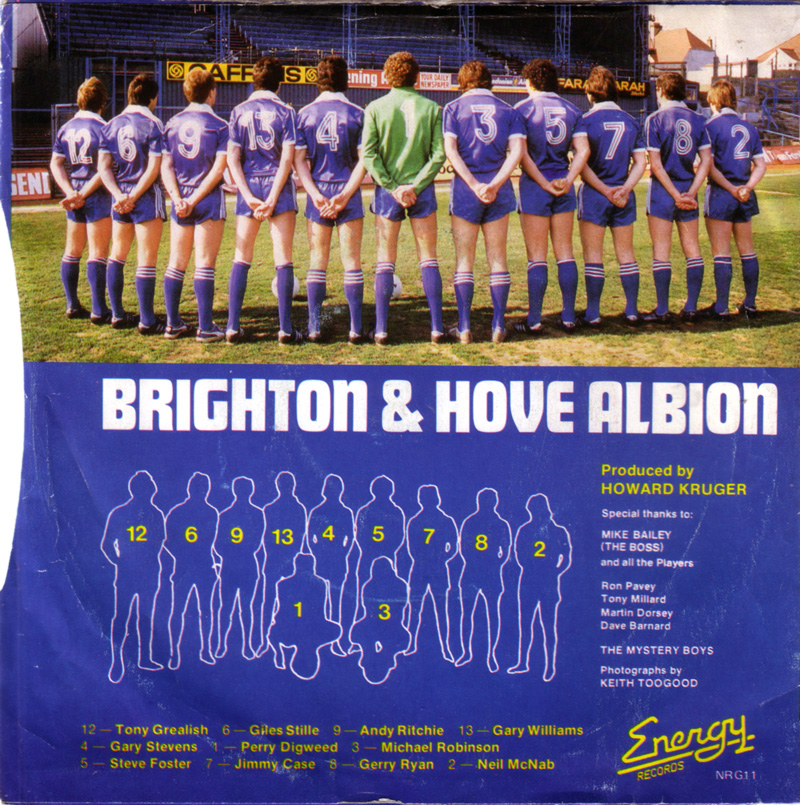
inbrighton-front

inbrighton-back

The price was a bargain £1.20. Buyers of the single from the club shop were also given a chance to enter a great competition to win two tickets to Dallas, Texas, with British Caledonian Airways.
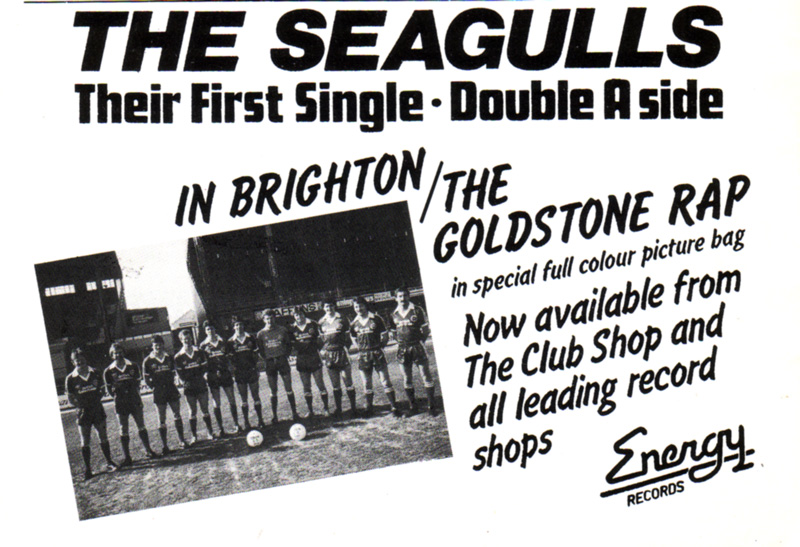
inbrightonad

So, was the Brighton release a launchpad to instant chart fame and fortune? Unfortunately, the single sank without trace but it gave Steve Foster (whose vocals also featured on the England 1982 World Cup song ‘This Time’), an opportunity to meet up with proper singer David Soul and wing a copy to the ‘Starsky and Hutch’ star:
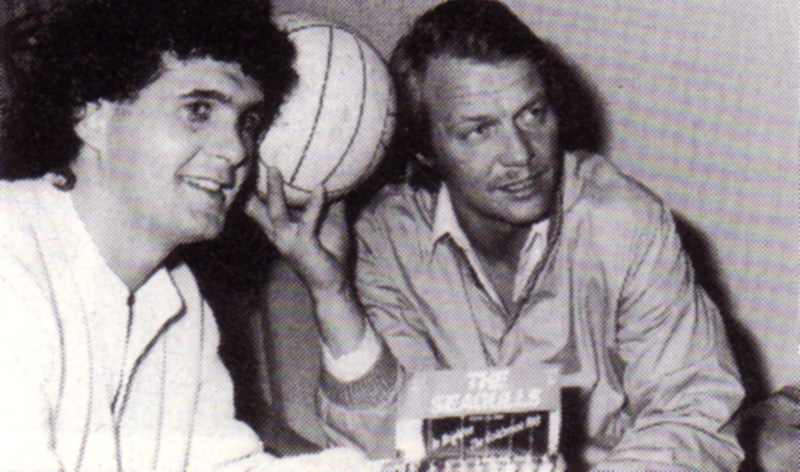
steve-foster-david-soul

Years later, I was wondering about ‘The Goldstone Rap’ and imagining what it would have sounded like if it adopted the electro sound of 1982’s other great hip-hop release, ‘The Message’ by Grandmaster Flash & The Furious Five. Thanks to the power of the internet, and due to a discussion on North Stand Chat, I got to find out.

Major props to Ian, the DJ who created this ‘Goldstone Message’:

A much enhanced version, I hope you’ll agree. In terms of pushing at the limits of what was possible for music and Brighton & Hove Albion footballers, it was certainly close to the edge.

Some MP3 files for your listening pleasure:
(right-click to ‘Save Target As…’ or ‘Download Linked File’)
In Brighton
The Goldstone Rap
The Goldstone Message

Other Wrap posts about Brighton & Hove Albion songs:
Carol Manns – ‘Seagulls’ (1979) – a video!
Tagged , , , , , , , , ,

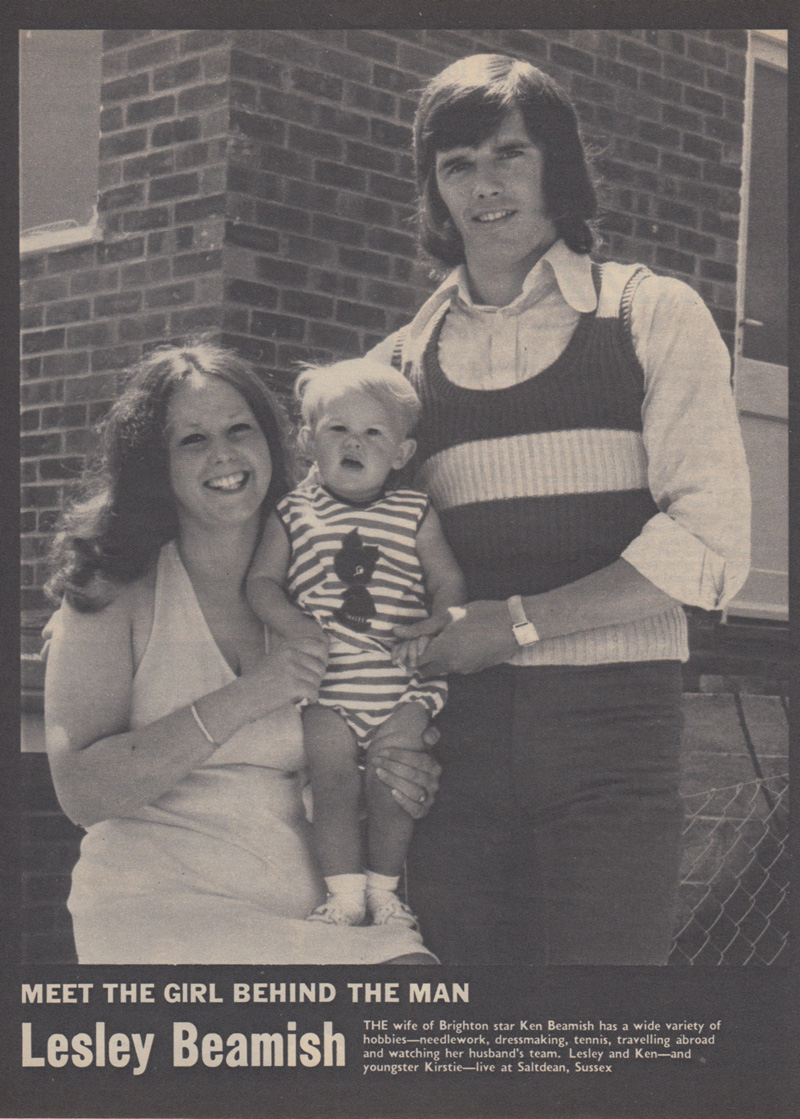
Meet the Girl Behind the Man: Lesley Beamish

From Goal Magazine on 4 August 1973:

lesleybeamish

The wife of Brighton star Ken Beamish has a wide variety of hobbies – needlework, dressmaking, tennis, travelling abroad and watching her husband’s team. Lesley and Ken – and youngster Kirstie – live at Saltdean, Sussex.

What an absolute beauty, showing the elegance, style and warmth that undoubtedly appealed to our goalscoring hero. I am, of course, referring to Ken Beamish’s magnificent tank top!

Beamish had joined Brighton from Tranmere in March 1972. As he told Backpass Magazine (issue 18):

“Pat Saward was the Brighton manager who took me down there and the fee was £30,000 [actually £25,000] plus a player, whose name now escapes me [Alan Duffy]. Brighton were very much on the up and the south coast had great appeal. When you add in the fact that I was also doubling my wages, then it made for a very exciting move for me.”

astonvilla1v1

Beamish quickly found his feet at the Goldstone. Above, he shoots for goal against Aston Villa in the crunch match of the promotion race in March 1972. He totalled six goals in twelve starts for the Albion in 1971/72 and was then joint top scorer with nine goals when Albion’s brief flirtation with the Second Division ended cataclysmically.

In the season that followed the Goal Magazine feature, 1973/74, Saward was sacked in October as Brighton faced falling attendances amid the prospect of a second successive relegation. Enter Brian Clough:

“I recall the first time I met Brian quite clearly. We were staying in a hotel in Lewes ahead of his first game and we had been told to expect the new manager to join us for dinner. We all trooped down to the dining room and finished the meal, but no sign of Cloughie. We were wondering whether he would show up and he suddenly appeared at the top end of the table and asked everyone what they wanted to drink. The first couple of guys said half-a-lager and I joined with the same order. I had never had alcohol from Wednesday onwards during the season.

“By the time the round had been completed I think we all had half-a-lager except for one lad who ordered a coke. I don’t know to this day what Brian made of us – the South Coast drinking gang or what – but he let it pass without comment.

“His managerial methods were unconventional. We trained down at Sussex University playing fields and sometimes he would have us there at 5pm, even in mid-winter when it was getting very dark. He only really joined in on us on Thursdays and Fridays and was a little distant.

“I was never quite sure what he made of me, but I certainly got the message at the end of my third season. I had finished top scorer and was looking forward to a team trip to Spain. The flip flops were out and ready to be packed up when the travelling party was announced my name wasn’t on it. To say I was surprised would not do justice to how I felt. I was gutted – and confused.

“I don’t think Cloughie spoke to me again and the local media down there was full of speculation that I would be leaving. I got most of my information from a next-door neighbour who was forever coming up to me to say what he had read about me in the local paper or heard on the radio.”

It was a sad end for Beamish, who had hit twelve League goals and had done so much to prevent Brighton falling into the Fourth Division. Indeed, it was the striker’s double at Southend in the 2-0 win in April 1974 that saw the Albion home and dry to fight another campaign in Division Three. As hotshot Fred Binney arrived at the Goldstone Ground, Beamish was sold to Blackburn Rovers for £26,000, becoming a favourite at Ewood Park after his two-and-a-half year stint as an Albion striker, and Saltdean resident, was up.

For more in the series visit:
Meet the girl Behind the Man: Rita Irvine

Thanks to Ian Hine from Seagulls Programmes and to Goals and Wickets for tipping me off about this very 1970s magazine feature.

Tagged ,

Worst Albion Kits: 1993/94 Home

In the Brighton v Stockport programme from October 1993, marketing manager Terry Gill writes:

The new Albion replica strips are proving very popular and we will be delighted to see any supporters in the shop to sort out your own size.

That’s funny, because I distinctly remember that the 1993/94 home kit as being one of the most unpopular ones that Brighton have had down the years!

1993-94home1

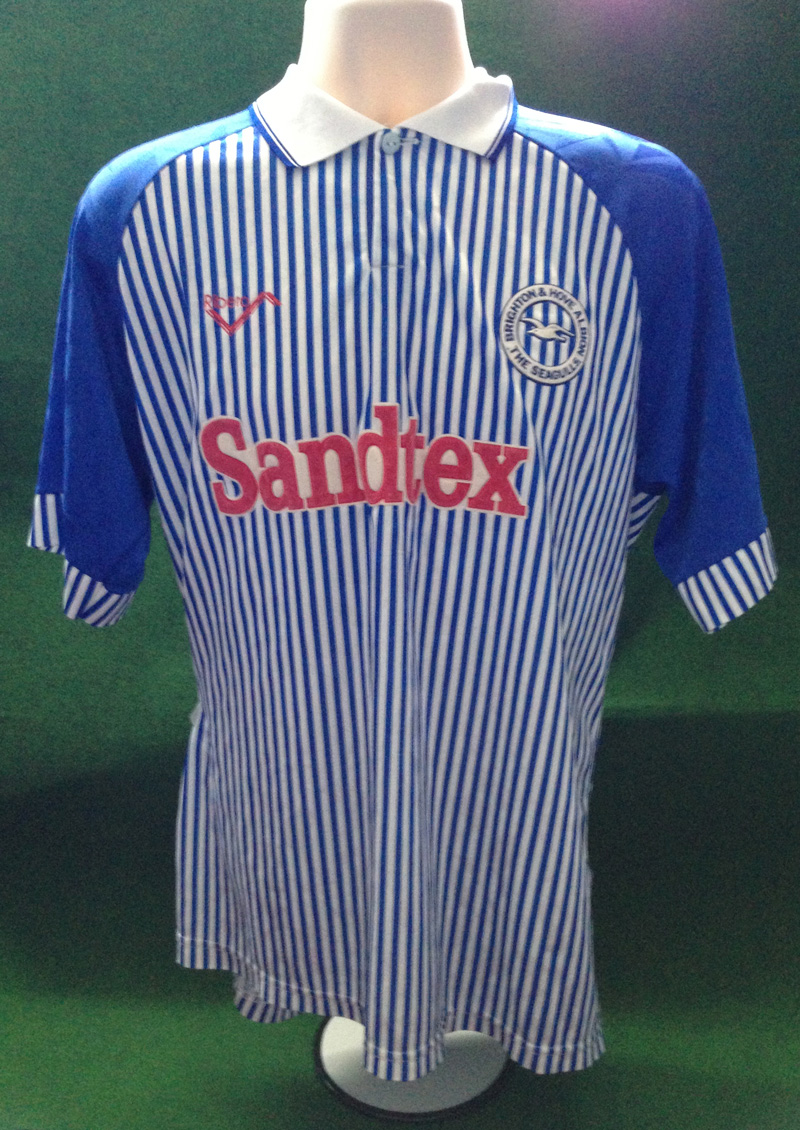
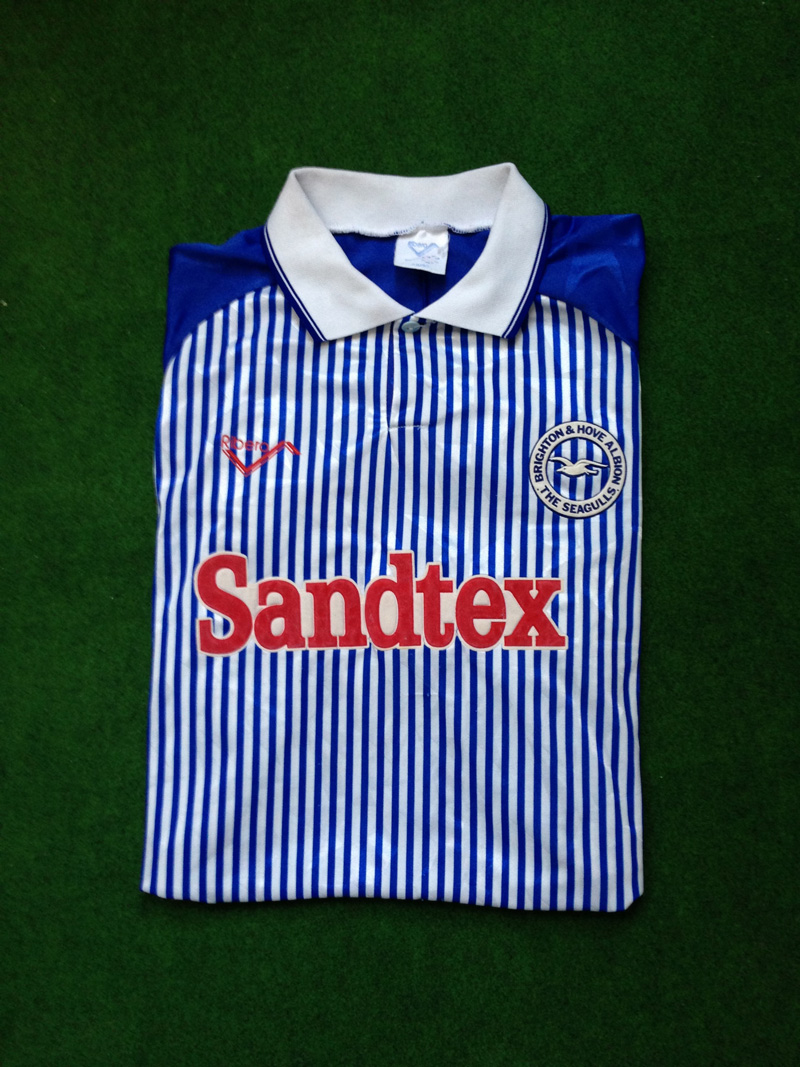
Retaining Ribero as the shirt manufacturer, the club entered the new season with a different shirt sponsorship deal. Out went TSB, in came Sandtex (or mispronounced as ‘Semtex’ by various jokers at the Goldstone. OK, that’s probably my teenage friends and me at the time!). Proving fluent in marketing-speak, Gill claimed: ‘The name brands what is arguably the top masonry paint available in this country and we are delighted that AKZO have backed us this season through the Sandtex brand.’

Leaving aside the questionable business wisdom of trying to increase the sale of masonry paint by entering into a commercial partnership with a struggling Football League club, the red Sandtex logo gives the shirt an unwanted ‘Tesco Value’ connotation when matched with the unfamilar pinstripes emblazoned vertically down the body and sleeve cuffs. By contrast, the royal blue sleeves, shorts and socks echoed the all-blue affair of 1980-83. It was certainly a very original design and was neither one thing nor another. But it remained largely unloved by the Goldstone faithful.

nogan

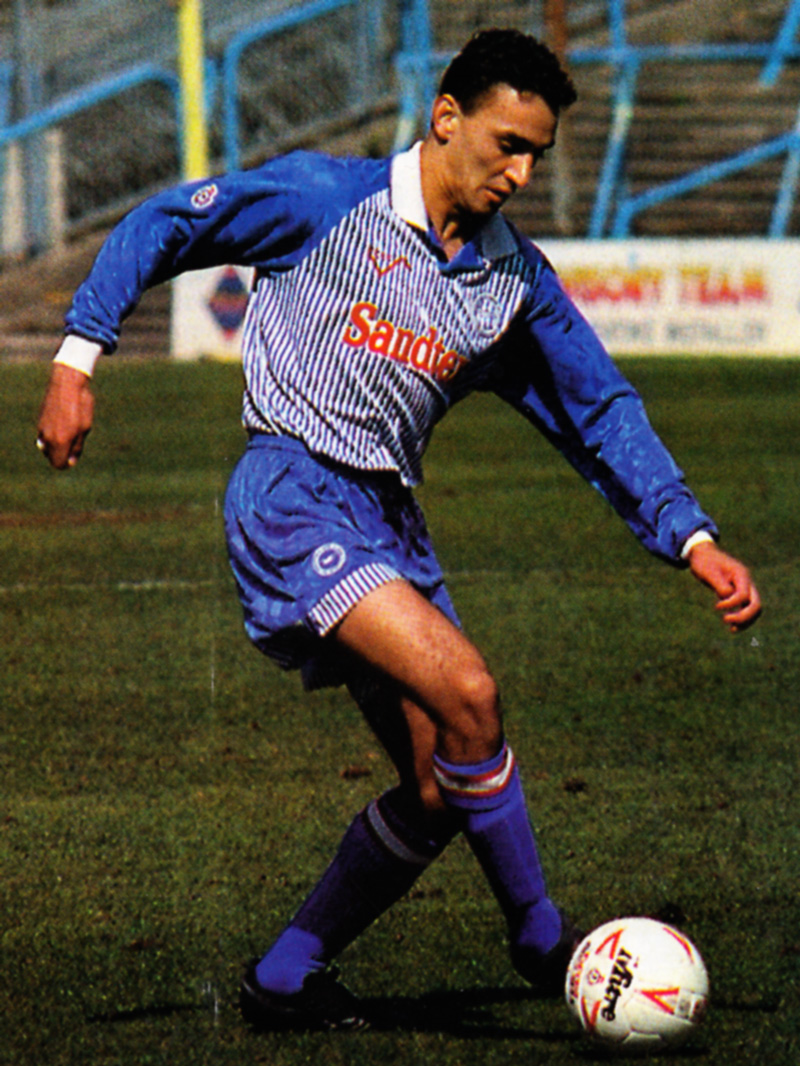
Despite the best efforts of the likes of Kurt Nogan (above), Jimmy Case, Steve Foster and on-loan Paul Dickov, memories of the kit were hardly helped by being associated with success. This is even though Brighton eased from a relegation battle in Division Two in the dying days under Barry Lloyd to mid-table mediocrity with Liam Brady at the helm in the New Year.

1993-94homeThe main reason for the cold reception was that it just didn’t look much like a Brighton & Hove Albion shirt. This was especially the case when watching the players from afar as the pinstripes combined to look more like a pale blue. And perhaps lack of success did play a part, in so far as not providing a buffer for the discontent with the design. Although there were some murmurings, fans were able to accept the transition from traditional stripes to all-blue in the 1980s when Albion were a minor force in English football. But with the going getting increasingly tough, such as when Brighton were second from bottom in early December, there was a general sense that supporters wanted a team in traditional Albion colours that they could unite behind.

After one season, this outlandish number was ditched in favour of the kind of kit that was quintessentially Brighton & Hove Albion.

Tagged ,

Alan Biley – a Law unto himself

alanbiley

From the Brighton v Leeds programme from April 1985:

It won’t take Alan Biley long to make friends in the Goldstone terraces and stands. There is always a sense of excitement and anticipation when the player in question is a man of proven ability who loves to entertain the fans.

Ask Alan Biley about his own heroes and he’ll talk enthusiastically about two men in particular: Denis Law and rock star Rod Stewart. Both men won fame as excellent showmen. Biley’s mind sees Law score a spectacular goal and wheeling away, arm aloft, to salute the Stretford End. Or Stewart, strutting the stage with style and confidence, oozing that indefinable quality, charisma.

‘I take enjoyment very seriously,’ he says. ‘By that I mean that I know how lucky I am to earn my money playing the game I love. When I was 10, my only ambition was to become a professional footballer and that has never changed. It was the only thing I ever wanted to do. I know there are millions of kids who dream of making the grade. I’m one of the lucky ones. Now I’m there, I love to make the most of every day.’

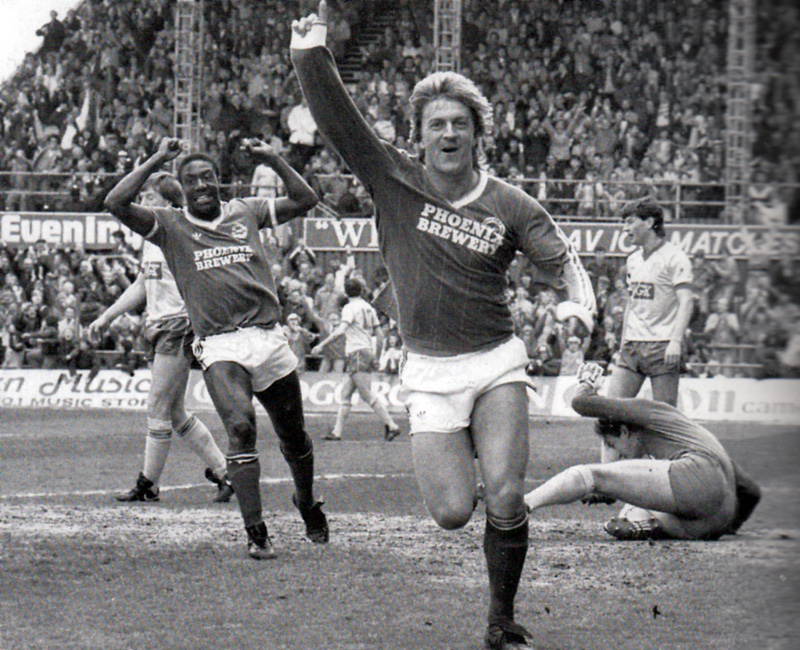
Biley was a small, very mobile striker who made great runs and had a deadly finish. His modelling himself on his idols was not just apparent from his attention-grabbing blonde feather cut hair, but also his Law-like habit of grasping onto the cuffs of his long-sleeved football shirt. A good example is this photo from this Leeds match, as he celebrates triumphantly after scoring in the 1-1 draw (wonderful expression on Terry Connor’s face too!).

alanbiley2

After a prolific spell with Cambridge, Biley had first come to the attention of many Brighton fans when his two goals for relegation-bound Derby County had stuffed the Seagulls 3-0 in the First Division five years previously in April 1980. He had a largely unsuccessful spell with Everton after a big £350,000 move in July 1981. After being loaned to Stoke City, the Leighton Buzzard-born striker rediscovered his goal-scoring touch when he arrived at Portsmouth in August 1982. On the South Coast, he hit 51 goals in 105 League games for Pompey.

When he joined Brighton in March 1985 for £50,000, the hope was that his goals would turbo-charge the Seagulls’ return to Division One. Sadly, it was not to be. Four goals in thirteen appearances in 1984/85 was not enough. Here you can see him back at Fratton Park in action for his new club against Portsmouth, losing his footing before a classy lay-off to set up Chris Hutchings’ chance:

Although not on the scoresheet there, Biley did get the equaliser against Grimsby when Brighton stormed back from 2-0 down late on to win 4-2 in the penultimate match of the campaign. In the end, Brighton missed out on promotion by three measly points.

As the next campaign dawned, Biley proved his goal-scoring credentials with a first half header against Nottingham Forest in a famous 5-1 pre-season win, as part of Warm Up ’85:

alanbiley3

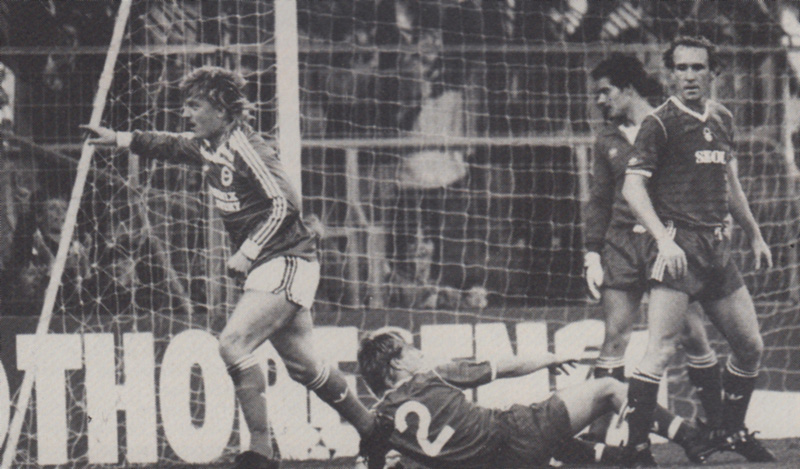
Despite hitting another quite opportunist goal against Grimsby in the League opener in 1985/86, Biley was in and out of the side as Cattlin had Dean Saunders, Mick Ferguson, Terry Connor and Justin Fashanu also competing to play upfront. Biley endured some very rough tackling at times, such as in the Barnsley away defeat in August. In the end, the extrovert with the larger-than-life persona had a goal ratio with the Seagulls that was anything other than larger-than-life. Perhaps he would have scored more with the protection that referees offer attacking players nowadays. Here he is getting chopped down by England defender Mark Wright after coming on as substitute against Southampton in the FA Cup Quarter Final home defeat in March 1986:

Biley amassed just four League goals in 26 League appearances in his second season with the Seagulls, which effectively spelt the end of his Brighton career, and he was loaned to New York Express and Cambridge before going on to play for Twente Enschede (Holland), Brest (France) and Panionios (Greece).

While some spells (such as his first at Cambridge with whom he was recently voted in their Team of the Century) were much more successful than others, Biley is still fondly remembered at most of his clubs, including ours. If you wish to declare your enduring footballing love for the blonde bombshell, you can get an Alan Biley T-shirt from Cult Zeros.

Tagged

Alex Dawson – the comic strip

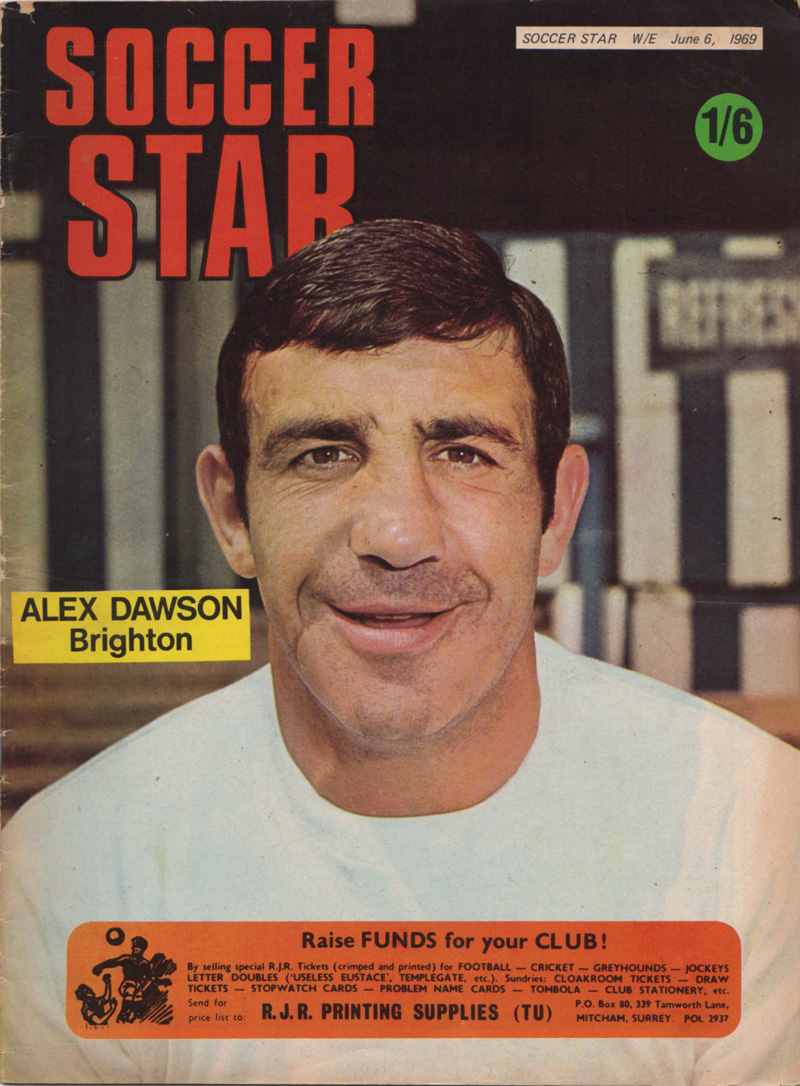
Albion fans would surely have been excited to see a colour photo of their swashbuckling centre-forward Alex Dawson gracing the front cover of Soccer Star magazine in June 1969.

Even though that’s a Preston shirt he was wearing, it clearly denotes the south coast club as his current side.

alexdawson

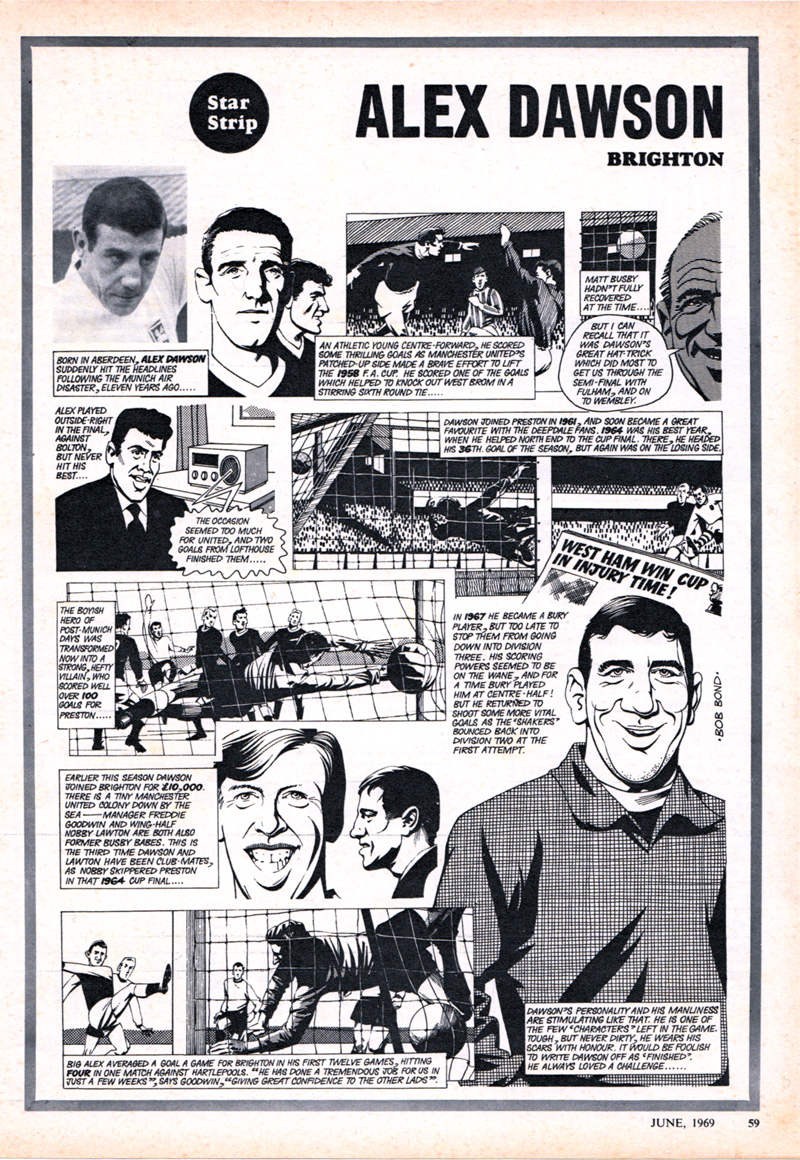
However, Brighton followers would be wasting their one shilling and sixpence if they were purchasing the magazine on the strength of the cover alone because sadly, there is absolutely no content on Dawson, or even the Albion side, inside the pages. As if to make up for this, the edition of Charles Buchan’s Football Monthly that month did carry a feature on Brighton’s larger-than-life striker, by way of this comic strip:

alexdawson2

Tagged

Des Lynam’s dream team

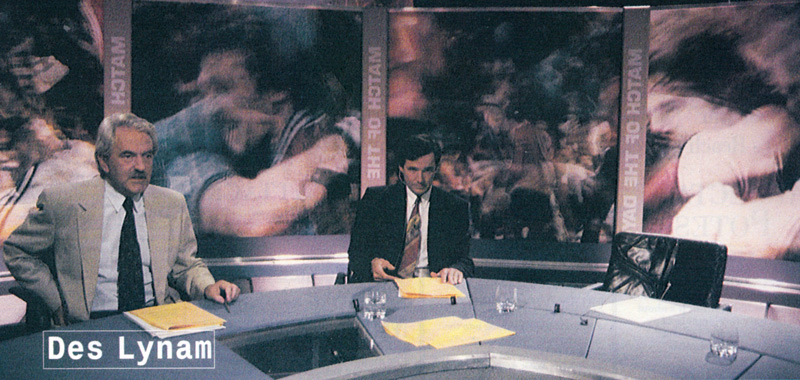
As a reader, having outgrown Shoot! and with Match dumbing down to becoming little more than a poster magazine, I became a big fan of 90 Minutes magazine in the 1990s. Irreverent and intelligently written, it’s a weekly magazine that I wish was still going. Here’s a fascinating read from its pages on 28th January 1995. Interview by Kevin Palmer:

deslynam2

Des Lynam may spend his Saturdays discussing the ins and outs of the Premiership with his Match of the Day colleagues, but what he’d really like to be doing is breathing in the sea air and cheering on his beloved Brighton at the Goldstone Ground. 90 Minutes dons a jacket and tie and asks our Des to spend an imaginary £8million on his Seagulls Dream Team.

Why Brighton?
My family originally come from Ireland, but when we moved over here and into the Brighton area I started going to watch and developed a real interest. I started to go to the Goldstone Ground more and more as time went on, but I did play on Saturdays for school teams which meant I missed some games. Since I’ve been working on TV I’ve become associated with Brighton and have even been offered a place on the board, although I wasn’t mad enough to take it.

First game?
I clearly remember the first game I ever attended at Brighton and it wasn’t especially for the football. It was around 1952 and they still used those big, heavy leather footballs. I went along to the game with a neighbour and his daughter and unfortunately a ball smashed the child in the face and knocked her out cold. We were dragged away from the game while they got treatment. I have always said it was the first time I had ever experienced a woman’s headache getting in the way of a lot of fun! We did manage to see some of the game in the end, but it was an interesting afternoon that was somewhat spoilt by the pre-match ‘entertainment.’

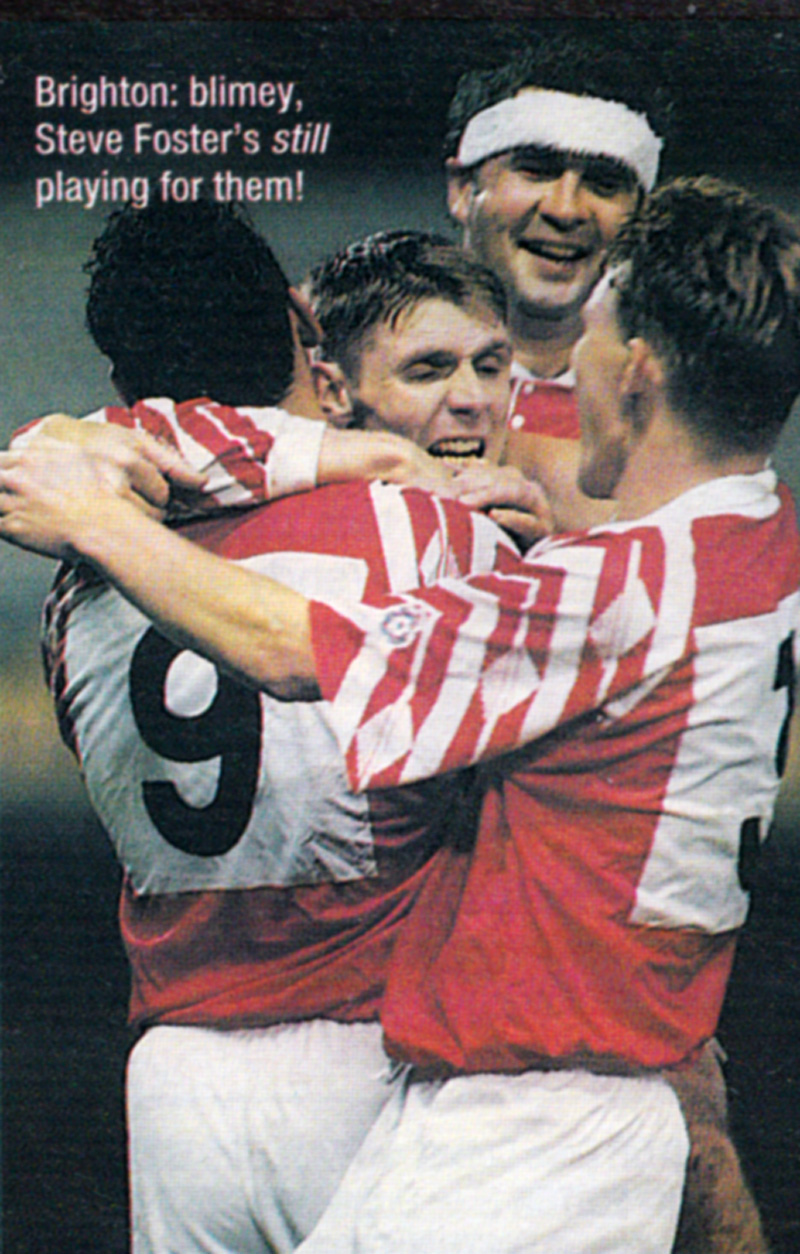
stevefoster6This season?
I don’t get to see the team as often as I like because I have to work every Saturday with Match of the Day, but I follow their fortunes very closely. I also live in the London area now which makes it a little more difficult to go. But a team like Brighton are always going to find it very hard in a modern football environment. Liam Brady is doing a good job, but they’ve had a bad run of late which has pulled them down somewhat. I still feel Brady has a lot to prove as manager, but Brighton is a great place for him to make his mark. There has been talk of him moving in as the new Arsenal manager if George Graham was to leave, but I don’t think Arsenal would want to make such an ambitious appointment with an unproven manager. The main aim for Brighton this season has got to be survival in the Second Division and then we can look to build from there.

An £8 million injection would surely have been enough to stop the club from selling the Goldstone Ground. But if it had to go on players who would Des have chosen?

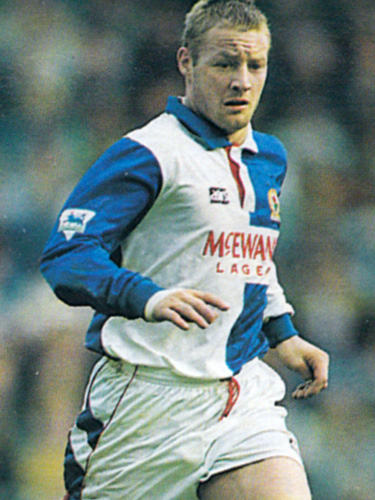
battyDavid Batty
Current club: Blackburn Rovers
Fee: £2.95 million

He’s a great competitor and would give us the extra edge we need in the midfield, although we do have Jimmy Case who’s still a good performer even if he is past his 40th birthday. Batty would win the ball for you and let the others play the football, though he has improved his passing game immensely in recent years.

harfordMick Harford
Current club: Wimbledon
Fee: £50,000

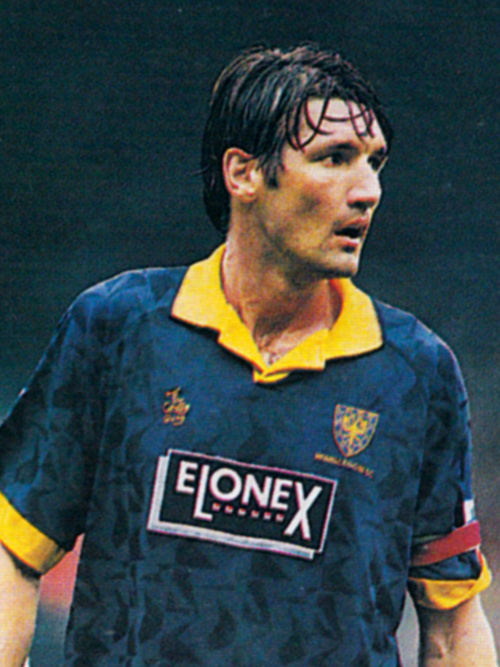
This will be a surprise choice for most, but he is perhaps the sort of player we could hope to sign with the financial situation at brighton. Harford would put the fear of God up the defenders in our division and would cause a lot of problems. He’s proved he still has the ability with his recent burst of goals for Wimbledon in the Premiership.

collymoreStan Collymore:
Current club: Nottingham Forest
Fee: £5million

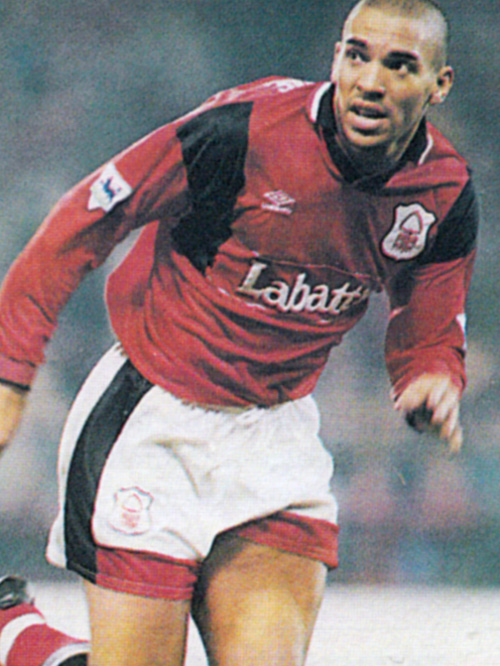
One of the most sought-after players in the Premiership and it’s not surprising. Everything he does makes him look like a class striker. I wouldn’t say he’s the best in the country, though. Alan Shearer’s the best striker around, but with just £8million to spend, I wouldn’t have enough to make a bid for him.

Tagged , ,

Getting to Division One: Alan Mullery’s budget

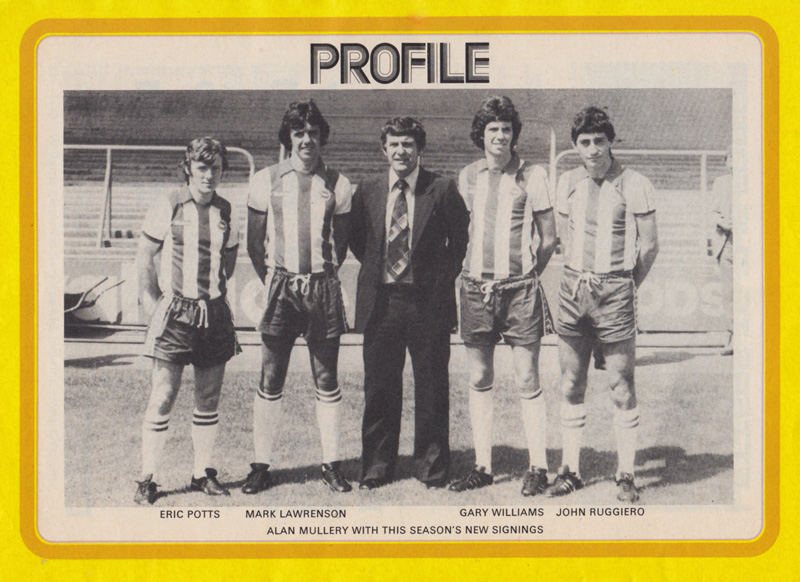
mullerysignings

The wheeling and dealing side of being a football manager was something that certainly appealed a lot to Alan Mullery. Luckily for him, he had far more cash to play with than, say, Pat Saward, at the start of the 1970s. It’s often commented that Mullery had a massive transfer budget. Trying to get beyond the opinion, I wanted to see to what extent this was true and have (to the best of my ability) tried to collate all the incomings and outcomings from 1976/77 to the end of 1978/79:

In
Steele £19,000
Lawrenson £112,000
Ruggiero £30,000
Potts £14,000
Williams swop
Clark £30,000
Maybank £238,000
Poskett £60,000
Sayer £100,000
Ryan £80,000
Chivers £15,000

Total: £700,000

Out
Beal free
Kinnear free
Morgan £15,000
Cross Swop
Wilson Swop
Binney Free
Towner £65,000
Ruggiero Free
Potts £37,000
Mellor £30,000
Fell Swop

Total 147,000

To my eyes, despite the over-inflated price for Teddy Maybank, a deficit of £553,000 at late 1970s prices seems a reasonable price to pay for a club going from the Third Division into the top flight. Still, it wasn’t me writing the cheques! Undoubtedly, the Albion boss’ best capture of the time was Preston defender Mark Lawrenson. In this article from Shoot! magazine, the Brighton manager explains how he tried to balance the budget in the summer of 1977 after a big outlay:

Brighton caused a bit of a stir in the close-season when they splashed out a club record £112,000 to buy unknown defender Mark Lawrenson from Preston. It was a bold move from a progressive club who are determined to make a big success of life now they have been promoted to the Second Division.

And manager Alan Mullery is the first to admit they had no intention of spending that sort of cash when they first decided to go into the market. Mullery – who capped his first season as a manager by steering Brighton to the Third Division top two – explains:

“At first all we were going was a standby for Graham Cross – someone to play in the reserves and come into the first team when necessary. “But clubs were asking a ridiculous amount for this type of player. They were demanding £40,000 or £50,000 – and there was no way we were going to pay that for reserves. So then we decided to change our tactics and go in and spend big on a player who could come straight into the first team. I called all the staff together to discuss names of likely prospects. And they all came up with the same one – Mark Lawrenson.

“My chairman, Mike Bamber, and my coaching staff had all seen the lad play and were all impressed. And I thought he was tremendous on the three occasions I had seen him last season – twice against us, once at Crystal Palace. With so many people raving about him, it was obvious he was the man we wanted – so we moved in and did the deal. I know a lot of people have not heard to much about him yet. But they all will – believe me, they will.

“He is only 20, is big and strong and will make his mark in a big way. he settled down as soon as he joined us for pre-season training and seemed to be enjoying life on the South Coast. The thought of spending that sort of money on an unknown does not frighten me. A football manager has got to be prepared to back his judgement and I’m sure Mark will turn out to be a huge success.”

Mullery’s only regret is the enforced change of deal brought Cross’s time at the Goldstone Ground to an end. Soon after Lawrenson arrived, Cross and full-back Harry Wilson moved to Preston as part of a deal that brought another defender, Gary Williams, to Brighton from Deepdale. “Graham had an absolutely tremendous 1976-77 season for us and I can’t speak too highly of him,” said Mullery. “When I started planning for the new term I reckoned on having him in the side for our step up into the Second Division. Then events overtook us as I have explained, and things worked out differently. I wish him well at Preston and can assure their supporters they are getting one of the most honest lads in the game in Graham.”

Tagged , , , , ,

First Day Cover – 1st Game in Division One, 1979

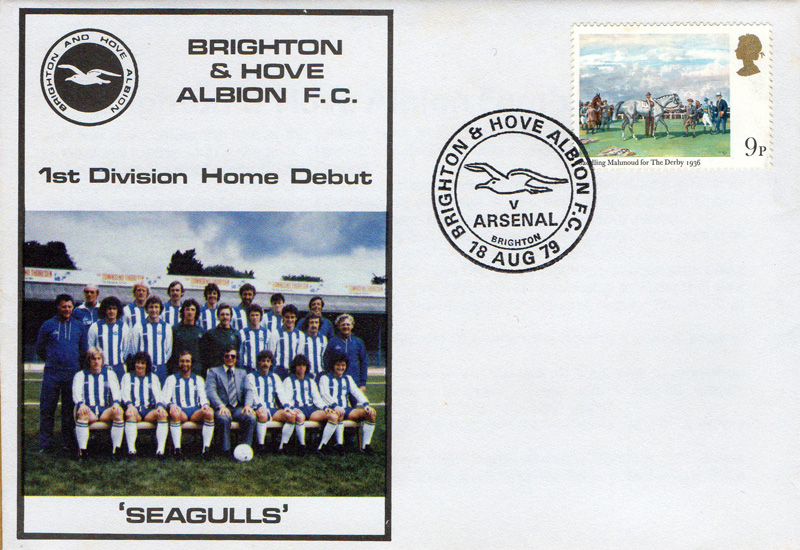
Paul from Cult Zeros has kindly sent me some scans of a first day cover to commemorate Brighton’s debut match in the top flight, against Arsenal in August 1979. According to British First Day Covers:

First day covers are specially designed envelopes with attractive postage stamps which have been postmarked on the day the stamps were issued by the Post Office.

bha_first_day_cover

How satisfying to see that Eurostile font combined with the round badge and team photo! The crest lends itself rather nicely to being adapted to form the postmark.

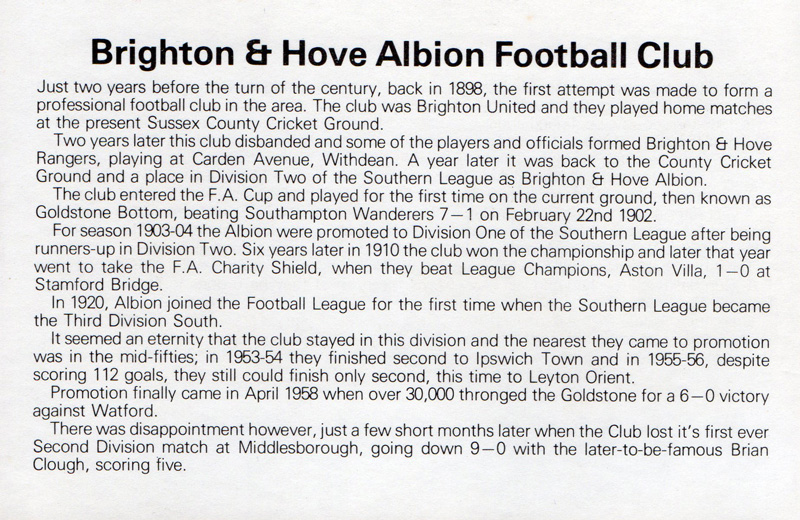
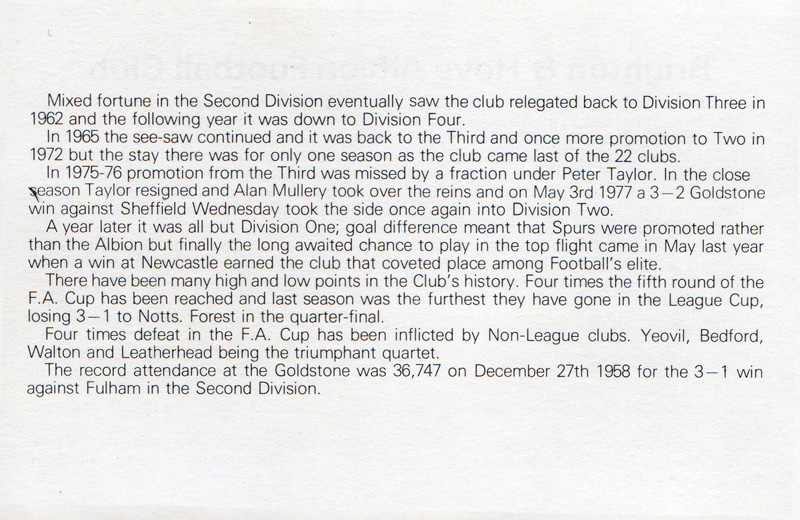
The envelope contained an insert that gave a brief history of Brighton & Hove Albion.

bha1

bha2

The record attendance still holds and Brighton still haven’t made it beyond the Quarter-Final of the League Cup. However, so much more is now part of our club history.

If anyone else has any Albion first day covers, and able to scan or take a photo, please get in contact.

Tagged

Seagull Line – Brighton 8049

seagullslinelaunch

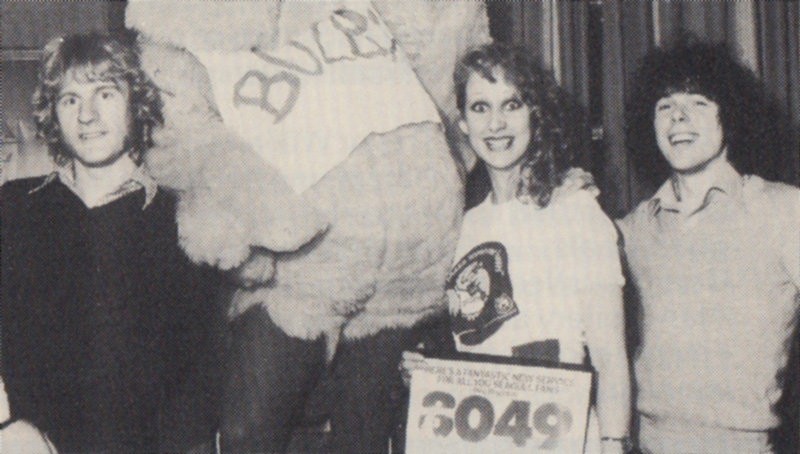
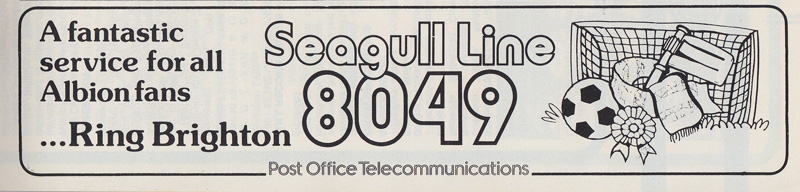
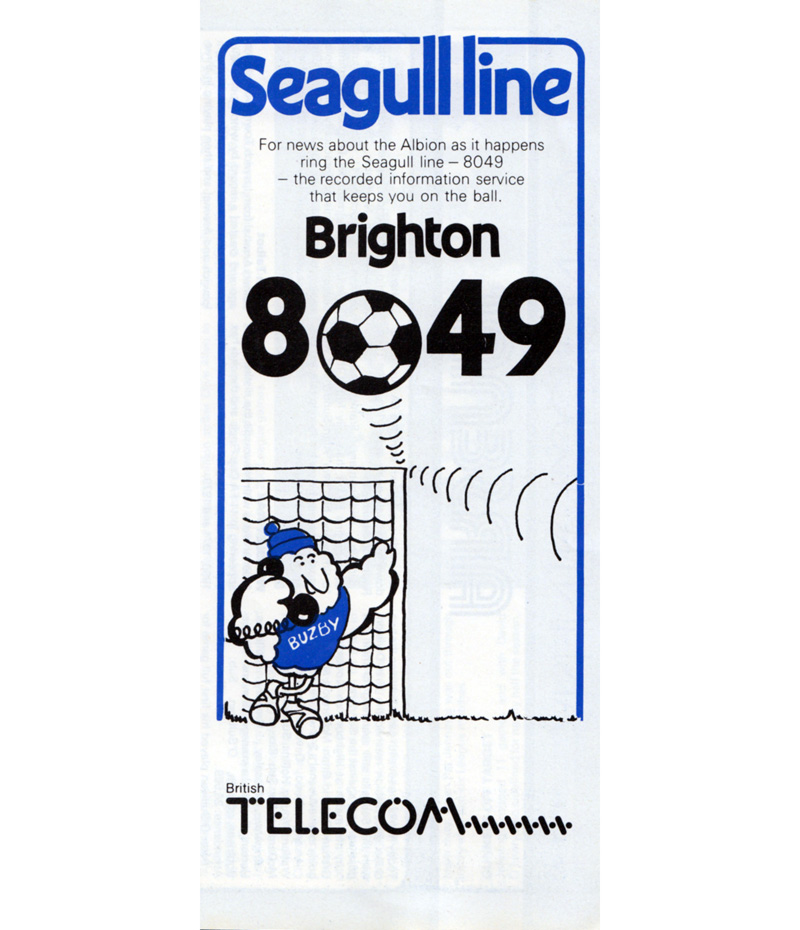
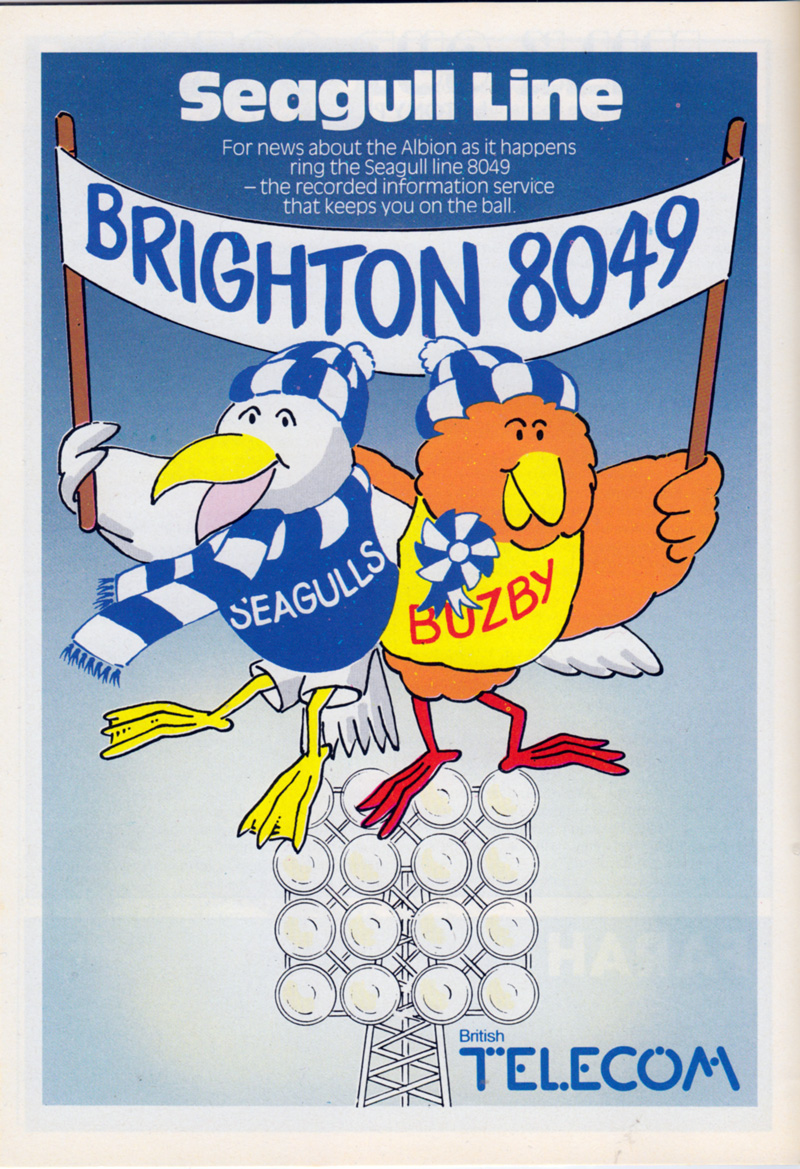
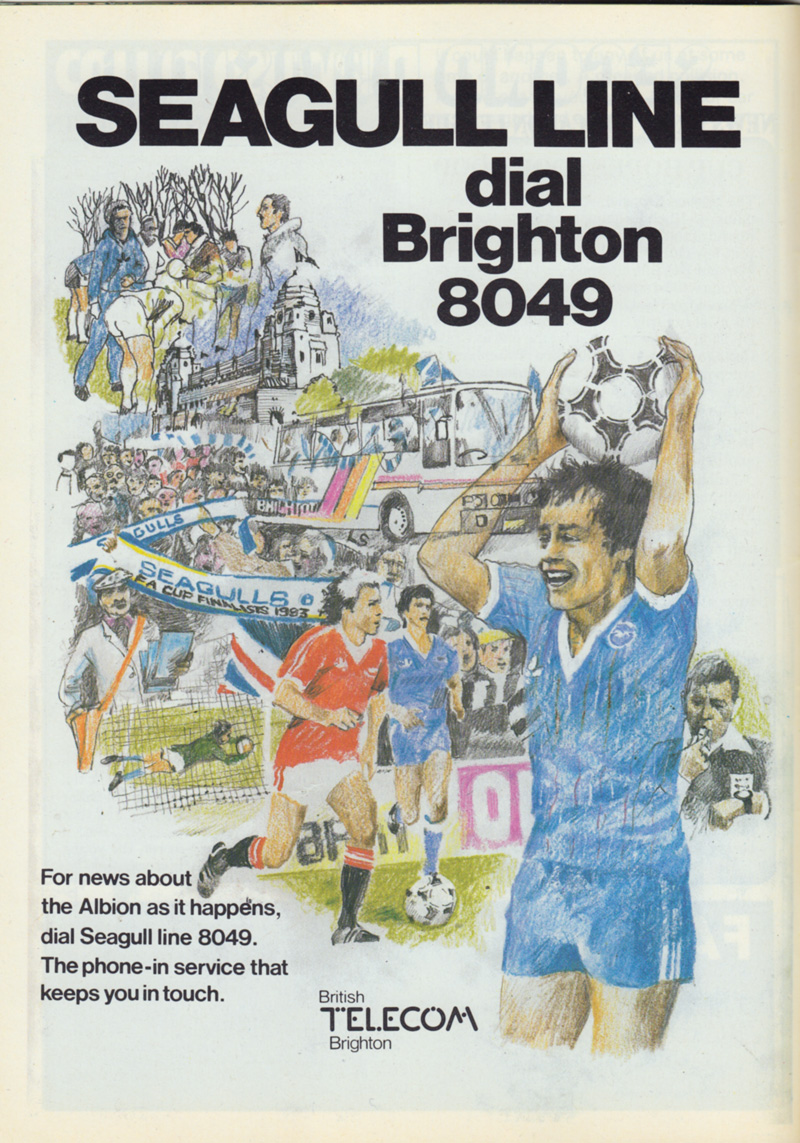
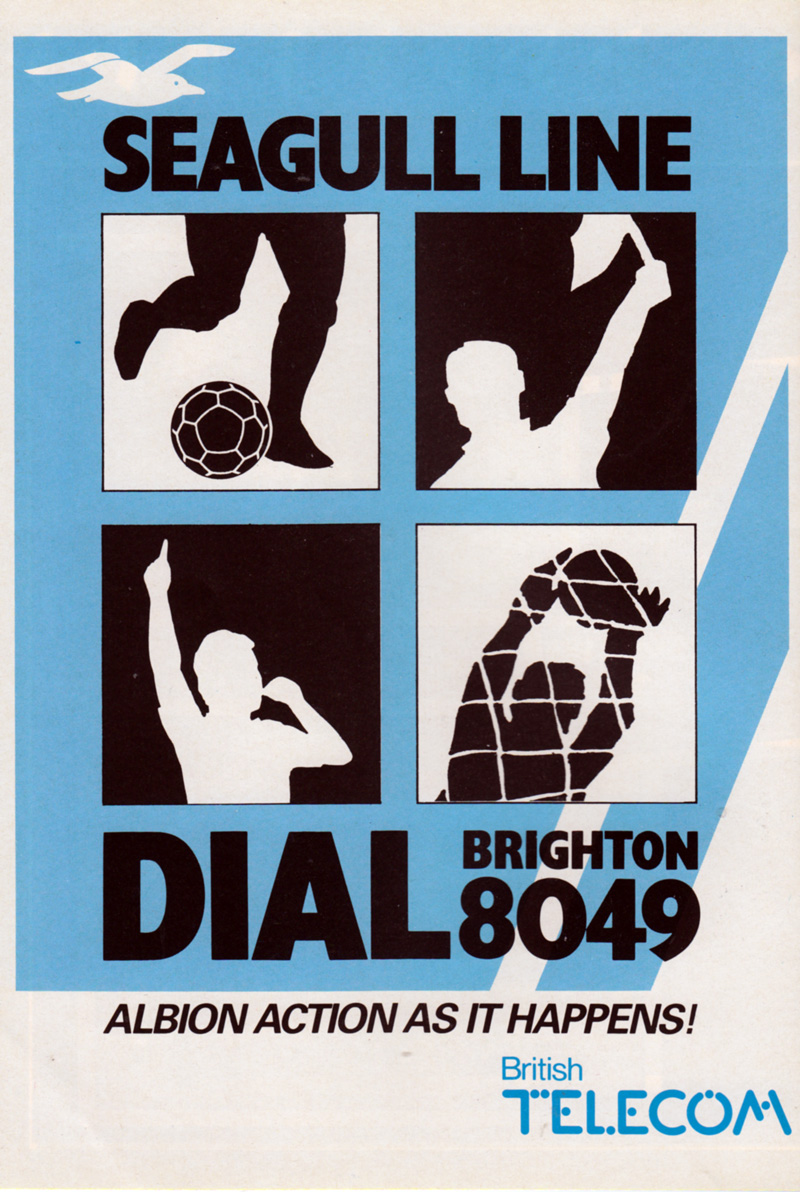
In the days before the internet took hold, finding out the up-to-date news about your club was a lot harder. The Seagull Line, Brighton 8049 was set up by the Post Office on 13 April 1979 and was one of the first of its kind in the country.

In the Brighton v Bristol Rovers programme from that month, it said:

The service started this week and 24 hours a day information may be heard on Brighton & Hove Albion, simply by dialling 8049… remember it rhymes… 8049, the Seagull line. Last Monday at the Adur hotel when our weekly lottery draw was held there was a chance to know just what Buzby is all about and to hear about the Seagull line. Our picture shows Paul Clark and Peter Ward happily accompanied by a young lady who is clearly hoping to ‘Make someone happy.’

Ahem!

With his catchphrase ‘And it’s bad news for the Albion’, often heard when reporting on an away fixture, commentator and programme editor Tony Millard is remembered as the mouthpiece of the premium rate service. He’d begin “You’ve called the Seagull Line on Brighton 8049, that’s the number for Albion information every day… 24 hours a day…” After informing fans of the telephone number that they know about because they’ve just dialled it, he would then precede to waffle on about various matters of little interest, such as how the reserves got on, the groundsman’s opinion on the state of the pitch before next Saturday’s game before… FINALLY!… giving supporters the news they wanted at the end. Devious tactics, Tony!

From the memory of Storer 68 from North Stand Chat:

“You’ve called the Seagull Line on Brighton 8049. The line for Albion information everyday, 24 hours a day. Later we’ll have news from Wembley where the Albion were playing Manchester United in the F.A. Cup final, but first, the results of Seagull Lottery number 762 drawn by assistant physio Mike Yaxley at the Swan pub in Falmer…”

With the high calls costs incurred, there are several stories of young Brighton followers getting into trouble with their parents for running up huge phone bills. Some fans even reminisce about their parents suspecting that they were calling premium rate sex lines! The mums and dads were only persuaded otherwise by calling the number themselves, ‘although Millard did breathe quite heavily if I recall,’ adds Easy 10, another Albion supporter.

Even though it was a premium rate service, this rather significant detail did not feature in the adverts in the matchday programme. Neverthless, some wonderful artwork appeared advertising the service. Seagull Line was replaced by a more general, premium rate service called Sussex Sportsline in 1987/88 before making a comeback two seasons later on 0898 and 0891 numbers. Anyway, enjoy this stroll down Seagull Line Memory Lane…

1979/80

seagullsline79-80

1980/81

seagullsline80-81x

1981/82 – 1982/83

seagullsline81-83

1983/84 – 1984/85

seagullsline83-85

1985/86 – 1986/87

seagullsline85-87

Tagged , ,

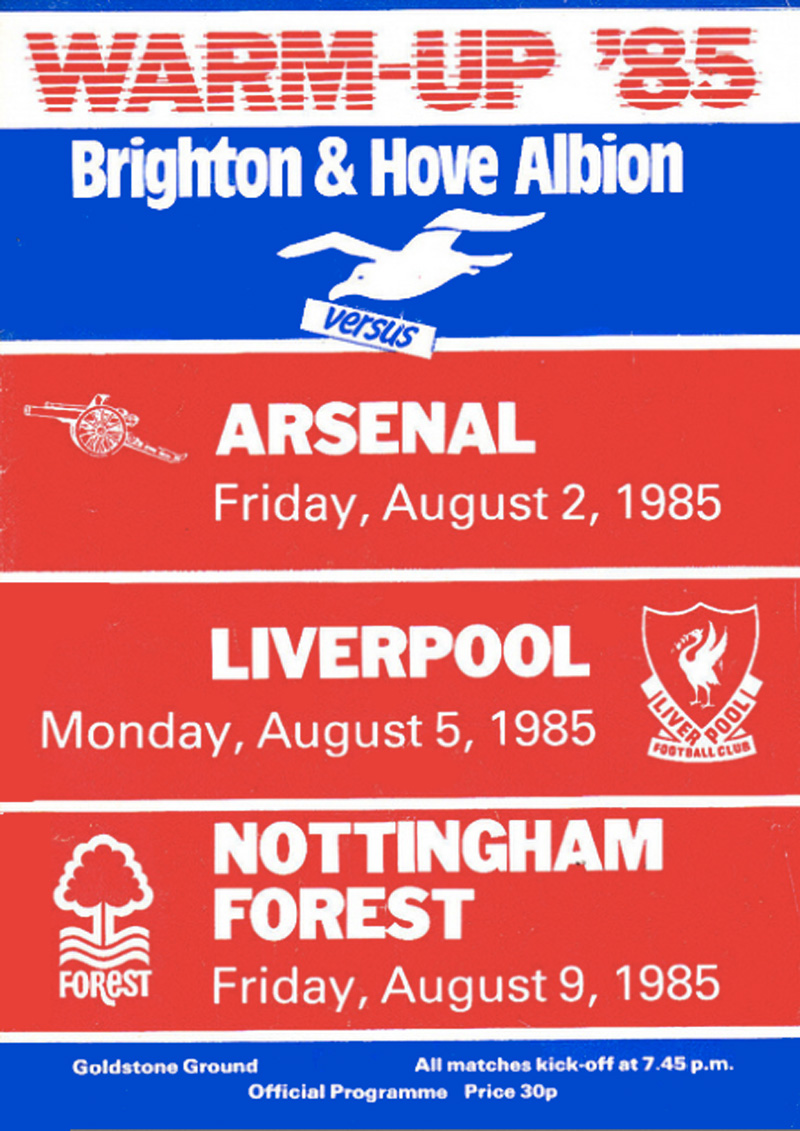
Warm Up ’85

warmup85

A mouth-watering pre-season programme in the summer of 1985 saw First Division giants Arsenal, Liverpool and Nottingham Forest make the journey to the South Coast.

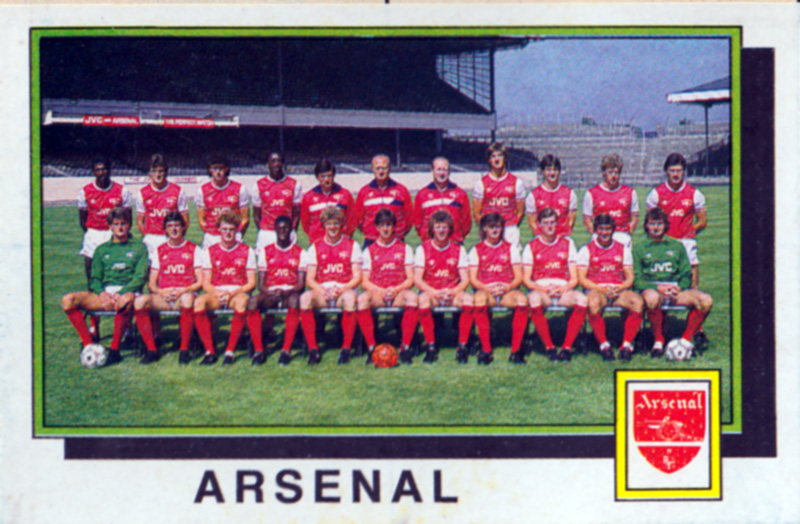
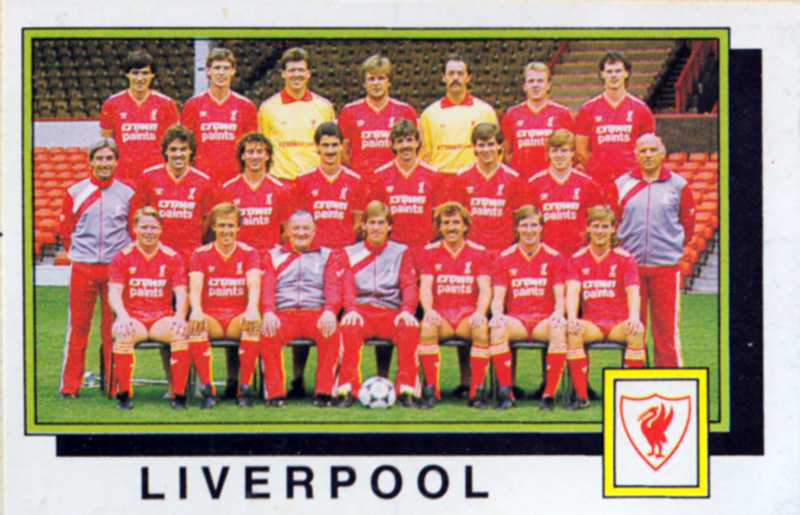
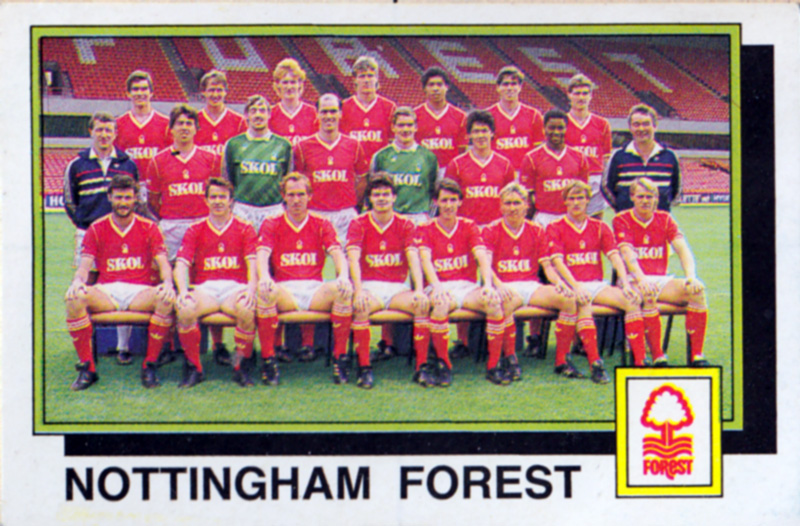
With the help of some Panini stickers from ‘Football 86’, I will let the words of Tony Millard from the Brighton v Grimsby programme from 1985/86 give you a sense of how Second Division Brighton fared against the big boys:

warmuparsenal

The first home game was against Arsenal on Friday August 2. A full-strength Gunners side came to the Goldstone, and among their substitutes was Martin Keown who is now back at the Goldstone on loan. Albion played with the wind and rain behind them in the first-half, and took the lead with a cracking goal from Dennis Mortimer. The former Villa man certainly looked the part when he gave John Lukic no chance in the Arsenal goal.

A defensive slip that saw Graham Moseley stranded gave Paul Mariner a simple chance to put Arsenal level, and a header from Stewart Robson provided the winner for the Londoners after the interval. They might have netted a third, but Charlie Nicholas missed from the spot after Eric Young had been penalised.

warmupliverpool

The biggest pre-season crowd turned out for the game with Liverpool on Monday, August 5. With new manager Kenny Dalglish also in action as a player, it was a full strength Liverpool side that was looking for revenge against the club that had, twice in three seasons, knocked them out of the FA Cup.

It took Liverpool just seven minutes to take the lead, with Dalglish playing a 1-2 with the Dane Jan Molby, before slotting home from some eight yards. Molby was also involved in the second goal. A precision pass set Steve Nicol away on the right, and he made no mistake. Before the interval it was perhaps predictable that Ian Rush would find the net. Dalglish took advantage of defensive hesitation, Rush showed typical perception and nodded in from only two yards out to score a third for Liverpool.

The fourth too came from Rush, once again Dalglish was the architect, and the Welsh striker found space-a-plenty in the Albion area.

Albion scored a late goal through Steve Jacobs, by now pushing forward in midfield, but by then Liverpool had shown that they will once again be among the best this season.

warmupforest

Albion reserved their best for last Friday at the Goldstone when they walloped First Division Nottingham Forest 5-2. The match was a real thriller for the fans, and no one except perhaps for Brian Clough and his team, went home unhappy.

Justin Fashanu had an outstanding game against his former team mates. Enforced changes had to be made in Albion’s side. Christ Cattlin had signed 22 year-old defender Gavin Oliver on loan from Sheffield Wednesday. He filled the number five shirt.

Albion took the lead when a short corner gave Mortimer the chance to cross from the right and Biley headed in. That provided the only goal of the first-half.

The second 45 minutes was a real thriller. Steve Hodge put Forest level after the Albion defence had been caught napping. Albion were soon back in front when Steve Jacobs crashed the ball in, after Fashanu had nodded on a right-wing corner. The joy was short-lived when an error by Perry Digweed presented Nigel Clough with a ‘sitter’.

The finale from Albion surely left the Goldstone regulars with an appetite for more. First Martin Keown pushed forward. His run produced a corner which Mortimer floated in, Fashanu’s header caused havoc and Dean Saunders provided the finishing touch.

Danny Wilson grabbed the goal he certainly deserve when Fashanu again provided an important touch, not to mention distraction to the visiting defence, and the final goal came from just about the most powerful shot seen at the Goldstone for years. Fashanu connected from 15 years out. Segers could only parry the ball, and O’Reilly tapped it over the line.

While Chris Cattlin gave his team guarded praise in the press room after the match, Brian Clough declined to be interviewed. The praise from Cattlin was well justified, and the performance of his team has surely whetted the appetite of supporters, to kindle that feeling of anticipation of an enjoyable and productive season ahead.

Tagged , ,