Tag Archives: alan mullery

Alan Mullery – Brighton’s best manager?

alan_mullery

On the Football League 125 website, it says:

As part of the celebrations of the 125th Anniversary of The Football League, this week we’re giving you the chance to vote for your club’s greatest ever manager.

As far as Brighton & Hove Albion bosses go, the choices are Billy Lane, Alan Mullery, Micky Adams, Mike Bailey and Gus Poyet. You can vote for who you think is the greatest here. However, while young fans will probably plump for Gus Poyet, one of the frontrunners in this vote, surely there is a much stronger case for Alan Mullery?

Poyet led the Seagulls to one glorious promotion and, of course, came very close to a second. But this is eclipsed by Mullery’s achievements. The former England international midfielder guided Brighton to promotion twice to usher the club into the top flight for the first time ever. Once there, he successfully kept Albion there for two seasons before leaving his job.

He resigned after a disagreement with chairman Mike Bamber in June 1981 over cuts to the coaching staff and the Mark Lawrenson transfer. Yet, in the middle of the glory years, Bamber was bold enough to praise Mullery as the ‘best manager in the country’ in an issue of Football Weekly News:

“People still try to tell me that this Brighton side is Taylor’s team – but they could not be more wrong,” says Bamber.

“He and Clough put Brighton on the football map when they came here. But it was Alan Mullery who has brought us success. He has had two fantastic years and there’s plenty more to come from the man I rate the best manager in the country.”

Mullery, a natural leader and born winner, won’t rest until he has steered Brighton to the top. And with the experience – and financial resources he has at his disposal – only a fool would bet against him doing it.

“This is a fantastic club to work for and I’m loving every minute of it here,” he says.

“I was out of work for three months after finishing my playing career with Fulham and had begun to give up hope of getting a job. Mike Bamber did me a favour by offering me the manager’s job here. I’m going to repay him by really helping this club to take off. And it’s a dead cert they will. They are going up in a big way – higher than the roof of the stand.”

Mullery certainly had a way with words and he kept his promise. His second stint at the Goldstone was creditable, but it is the meteoric rise of the club in his first spell that will live long in the memory.

Tagged ,

Fulham v Brighton, December 1977

digweed2

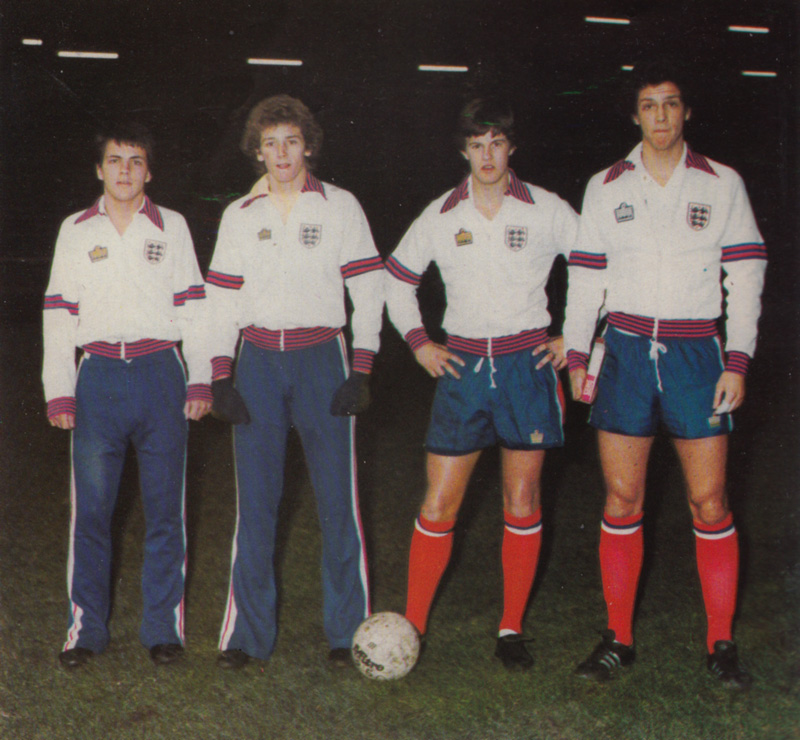
Looking for all the world like he’s dressed in a set of pyjamas, here’s a rather startled-looking Perry Digweed, second from left, showing off his Admiral England clobber along with fellow Fulham lads Mark Lovell, Tony Maloney and Tony Gale. While Brighton striker Peter Ward was banging in a famous hat-trick for England Under-21s against their Norwegian counterparts at the Goldstone around this time in late 1977, Digweed had played in the FA Youth team against Norway at Craven Cottage. The young keeper ended up joining the Albion three seasons later in a £150,000 deal, an incredible fee for a teenage reserve goalie. Nevertheless, he repaid the faith, serving twelve years with the club.

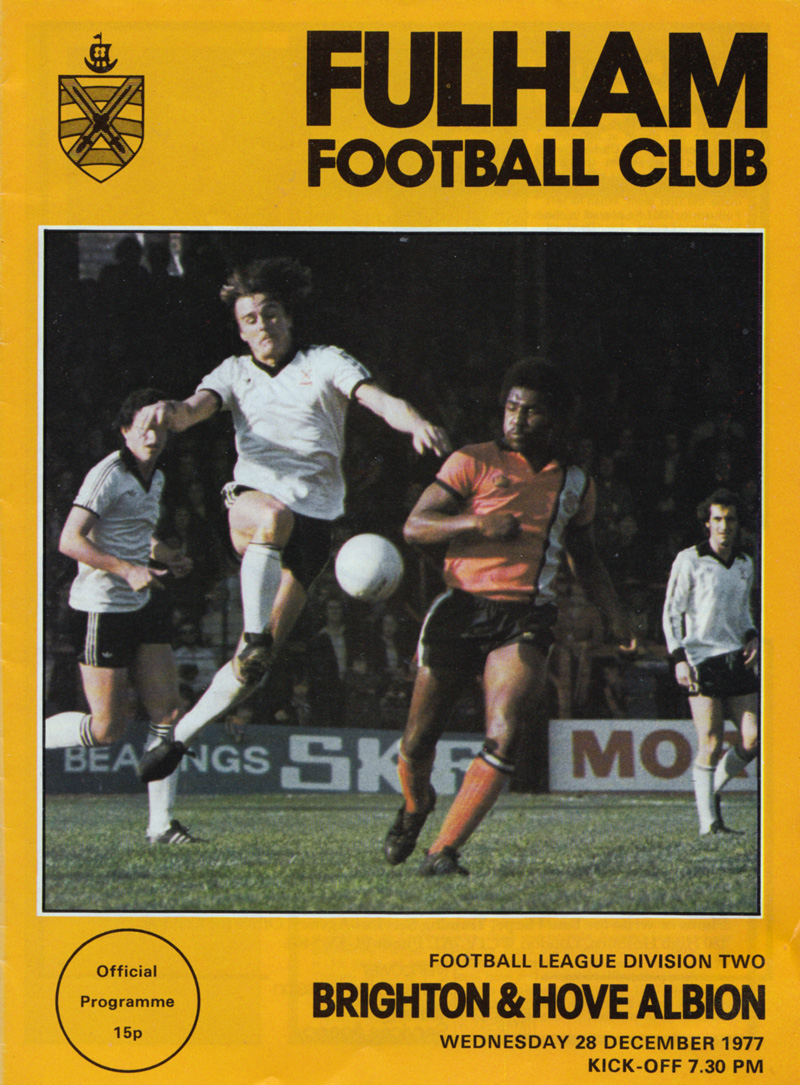
The photo above is taken from the Fulham v Brighton match on Wednesday 28th December 1977:

fulham

The programme has some nice tidbits, such as what a ‘TV Video-set’ for rental looked like in 1977, some colour photography of recent matches (rare at this time) and a half-time quiz asking which two former Fulham players have managed Brighton (Barry Lloyd and Micky Adams can now be added to the answers of Archie Macaulay and Alan Mullery). Some words and photos also shed some light on the lives of the Lilywhites’ assistant manager Ken Craggs and young apprentice professional Tommy Mason, 17, before they eventually arrived at the Goldstone Ground.

Unsurprisingly, there is a warm welcome offered to the Brighton boss:

The name of Alan Mullery is something of a legend here at Craven Cottage – and it was a sad moment both for Fulham and for English football when he decided to quit the playing side of the game at the end of the 1975-76 season.

It is rather prescient that the piece finishes:

One of Mullery’s biggest assets – and some say his faults – is single-mindedness. But he’s just single-minded enough to get Brighton into the First Division – and good luck to him if he does it.

Indeed he was. The point about being single-minded is particularly apt given that recollections of this quality of Mullery’s that led to his appointment as Albion boss in 1976. Brighton chairman Mike Bamber had been asleep, dreaming of the time the then Fulham midfielder had struck team-mate Jimmy Dunne in a Second Division match with Albion in January 1973. (Yes, because that’s what we all dream about when we go to sleep!) His wife, Jean Bamber, though, was rather startled when he woke her up by announcing Mullery’s name, declaring ‘that’s who we’ll get as the next manager.’ As Mullery wrote in his autobiography in 1985:

Fulham had been winning 2-0 when our centre-half Paul Went was concussed in a collision with Brighton’s centre-forward Ken Beamish. I told Dunne to change his role in the team until we could get Went examined at half-time, but he ignored the instruction and within minutes a ball was played over the head of a wobbly Went and Beamish scored. I argued with Dunne. He told me that Beamish wasn’t his man and so I hit him hard on the chin. Brighton did the same a minute later only this time goalkeeper Peter Mellor made a great save and I had another go at Dunne. The argument continued in the tunnel at half-time and I smacked him a third time, until at last he saw sense and we eventually ran out 5-1 winners.

Hitting a team-mate is something I’m not very proud of, but it was done in the heat of the moment, and that first punch got me the manager’s job at Brighton. Bamber felt that if I could hit a member of my own team, nothing would stand in my way. ‘He must be a winner.’ he added as his startled wife tried to go back to sleep.

Mullery certainly proved a success as manager at the Goldstone Ground and wasn’t afraid to pay big to enhance his squad. Starting his tendency of paying astronomical prices for Fulham players, that continued with Digweed, the Brighton boss had completed the £238,000 signing of Teddy Maybank from Craven Cottage the previous month. With the transfer being too soon to be dismissed as overly expensive, the match programme is optimistic about the striker prospects: ‘Teddy immediately started to repay Alan Mullery’s faith in him by scoring in his first two games.’

He also scored a consolation in this fixture from December 1977 against his former side. Unfortunately for him, though, the Seagulls went down 2-1.

maybank4

Tagged , ,

Getting to Division One: Alan Mullery’s budget

mullerysignings

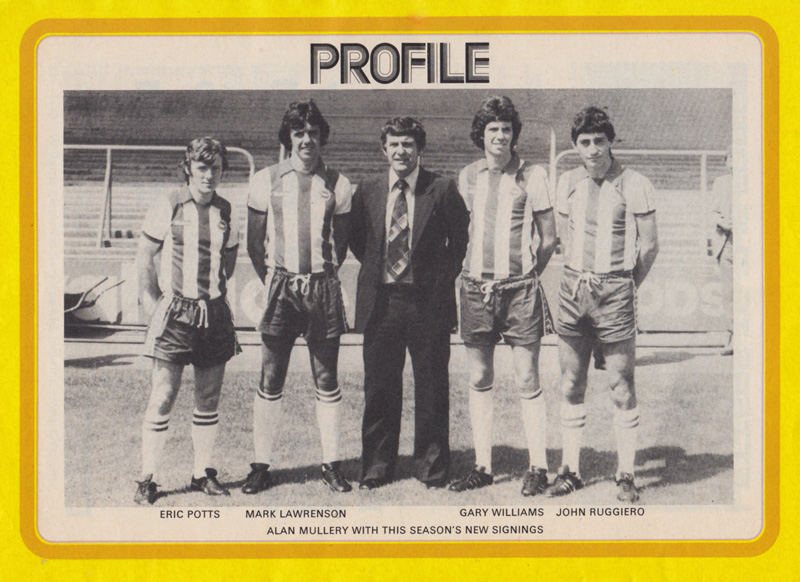
The wheeling and dealing side of being a football manager was something that certainly appealed a lot to Alan Mullery. Luckily for him, he had far more cash to play with than, say, Pat Saward, at the start of the 1970s. It’s often commented that Mullery had a massive transfer budget. Trying to get beyond the opinion, I wanted to see to what extent this was true and have (to the best of my ability) tried to collate all the incomings and outcomings from 1976/77 to the end of 1978/79:

In
Steele £19,000
Lawrenson £112,000
Ruggiero £30,000
Potts £14,000
Williams swop
Clark £30,000
Maybank £238,000
Poskett £60,000
Sayer £100,000
Ryan £80,000
Chivers £15,000

Total: £700,000

Out
Beal free
Kinnear free
Morgan £15,000
Cross Swop
Wilson Swop
Binney Free
Towner £65,000
Ruggiero Free
Potts £37,000
Mellor £30,000
Fell Swop

Total 147,000

To my eyes, despite the over-inflated price for Teddy Maybank, a deficit of £553,000 at late 1970s prices seems a reasonable price to pay for a club going from the Third Division into the top flight. Still, it wasn’t me writing the cheques! Undoubtedly, the Albion boss’ best capture of the time was Preston defender Mark Lawrenson. In this article from Shoot! magazine, the Brighton manager explains how he tried to balance the budget in the summer of 1977 after a big outlay:

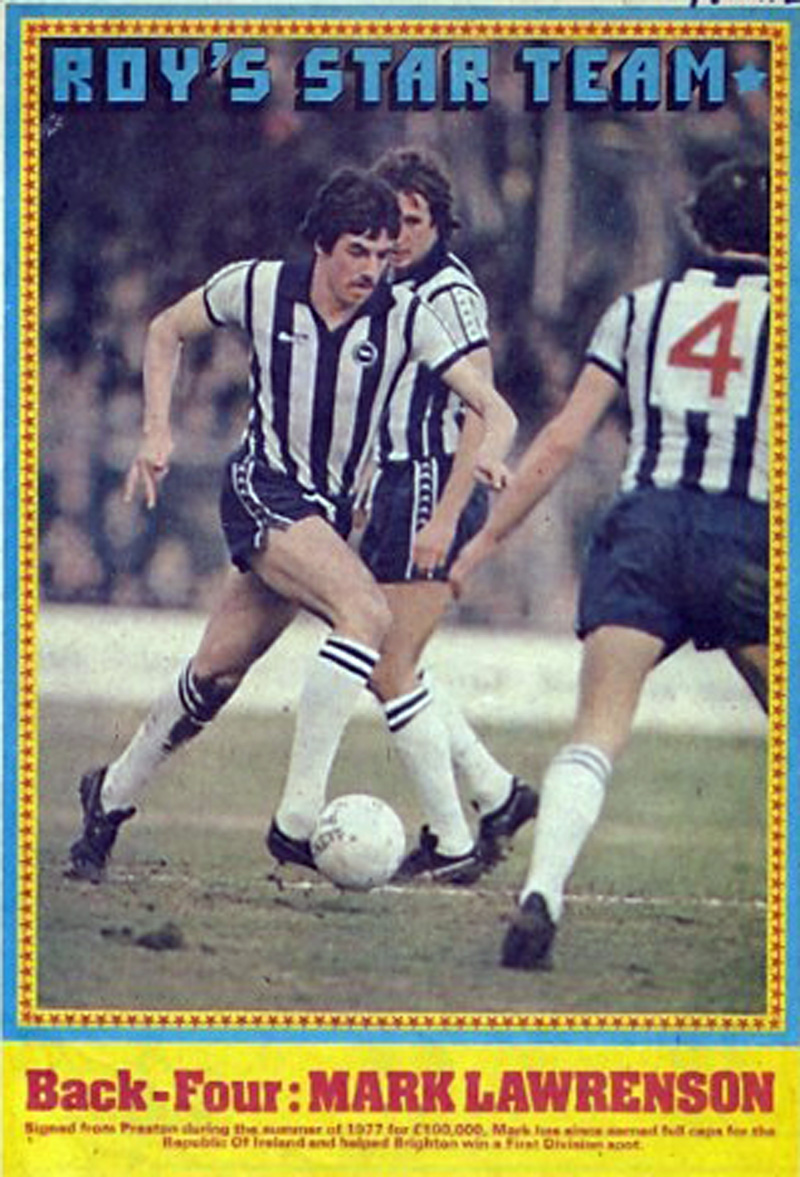
Brighton caused a bit of a stir in the close-season when they splashed out a club record £112,000 to buy unknown defender Mark Lawrenson from Preston. It was a bold move from a progressive club who are determined to make a big success of life now they have been promoted to the Second Division.

And manager Alan Mullery is the first to admit they had no intention of spending that sort of cash when they first decided to go into the market. Mullery – who capped his first season as a manager by steering Brighton to the Third Division top two – explains:

“At first all we were going was a standby for Graham Cross – someone to play in the reserves and come into the first team when necessary. “But clubs were asking a ridiculous amount for this type of player. They were demanding £40,000 or £50,000 – and there was no way we were going to pay that for reserves. So then we decided to change our tactics and go in and spend big on a player who could come straight into the first team. I called all the staff together to discuss names of likely prospects. And they all came up with the same one – Mark Lawrenson.

“My chairman, Mike Bamber, and my coaching staff had all seen the lad play and were all impressed. And I thought he was tremendous on the three occasions I had seen him last season – twice against us, once at Crystal Palace. With so many people raving about him, it was obvious he was the man we wanted – so we moved in and did the deal. I know a lot of people have not heard to much about him yet. But they all will – believe me, they will.

“He is only 20, is big and strong and will make his mark in a big way. he settled down as soon as he joined us for pre-season training and seemed to be enjoying life on the South Coast. The thought of spending that sort of money on an unknown does not frighten me. A football manager has got to be prepared to back his judgement and I’m sure Mark will turn out to be a huge success.”

Mullery’s only regret is the enforced change of deal brought Cross’s time at the Goldstone Ground to an end. Soon after Lawrenson arrived, Cross and full-back Harry Wilson moved to Preston as part of a deal that brought another defender, Gary Williams, to Brighton from Deepdale. “Graham had an absolutely tremendous 1976-77 season for us and I can’t speak too highly of him,” said Mullery. “When I started planning for the new term I reckoned on having him in the side for our step up into the Second Division. Then events overtook us as I have explained, and things worked out differently. I wish him well at Preston and can assure their supporters they are getting one of the most honest lads in the game in Graham.”

Tagged , , , , ,

Joe Kinnear’s short stay at Brighton

joekinnear

He is now known as the rather opinionated Director of Football at Newcastle United. Back in the 1970s, though, Joe Kinnear was a classy full-back for Tottenham and the Republic of Ireland, winning four major cup competitions in a glittering career lasting over a decade at White Hart Lane.

When the 28 year-old was signed by Peter Taylor for Brighton, part of the deal involved the defender enjoying a benefit match between his old and new club in March 1976. Tottenham won 6-1 at the Goldstone with Kinnear scoring a consolation penalty. While the score was not to their satisfaction, Brighton fans must have rubbed their eyes in disbelief to see Jimmy Greaves, Rodney Marsh and Terry Venables all appearing for their side.

In ‘Still Crazy,’ his biography with Hunter Davies, Kinnear’s account of his time on the south coast rather unintentionally gives an impression of a pampered professional footballer chasing one final pay cheque. When Peter Taylor departed for Nottingham Forest, new boss Alan Mullery was not impressed with his former team-mate. In Joe’s own words:

I signed for Brighton and Hove Albion in August 1975. The transfer fee was officially £40,000. That’s what was announced, a reasonably average sum for the times, but it was agreed that I would get it all. Normally, with a transfer fee at the time, a player only got a small percentage. I think it was really a sort of thank you, for the years of loyal service. I didn’t get it in one lump sum. It was to be spread over several years, as part of my salary. I paid tax on it all, in the normal way.

We kept on our home in London, in Woodside Park, Mill Hill, at least for the time being. I decided I could commute by train each day to Brighton, getting off at Hove, returning in the afternoon after training. On match days, Bonnie would come to watch me. We’d have a meal in Brighton after the match, then come back to London together. That was the plan.

When I arrived at Brighton for the first training sessions, I did still worry if I’d done the right thing. My pride had been hurt by being transferred. I still wondered if I should have stayed, played in the reserves, fought to get my place back. But I couldn’t have faced the reserves any more.

I knew it was a come-down, going to a smaller club, in a lower division, down in the third division, after the glamour of Spurs. Still, Phil (Beal) had told me the club was ambitious and had a good set-up. It turned out to be not quite what I expected.

First of all, Peter Taylor was hardly there. Dunno where he was, what he was doing, but we only saw him on Fridays after training, then on Saturday at the match.

Second, we didn’t have our own training ground. We’d assemble at the Goldstone Ground, the club’s stadium in Hove, which wasn’t bad, but we rarely trained there. Instead, we’d jog for 15 minutes or so through the streets and do our training on a public park. There would be dogs walking over the pitch, mums with prams. There weren’t even any goalposts. We just had cones on the ground or a pile of bibs.

Third, the coaching was mostly a joke, when you consider it was a so-called professional club with paid coaches. I don’t know how one of the coaches got his job. We called him the Spud Man. We were told that he sold potatoes, that was his real job. Apparently he’d been providing Cloughy and Peter Taylor with potatoes. He had a job as a coach. That’s what we heard anyway. I’m sure it was just a joke. But it was clear all the same that he had little idea about coaching.

In the first season I was there, we did quite well. We were on the fringes of promotion to the Second Division. Then in an away match at Port Vale, I got tackled by their left winger. Not a nasty tackle, but I did my cruciate ligaments. My knee got twisted round, ending back to front. I’d snapped the ligaments. That was it, stretched off.

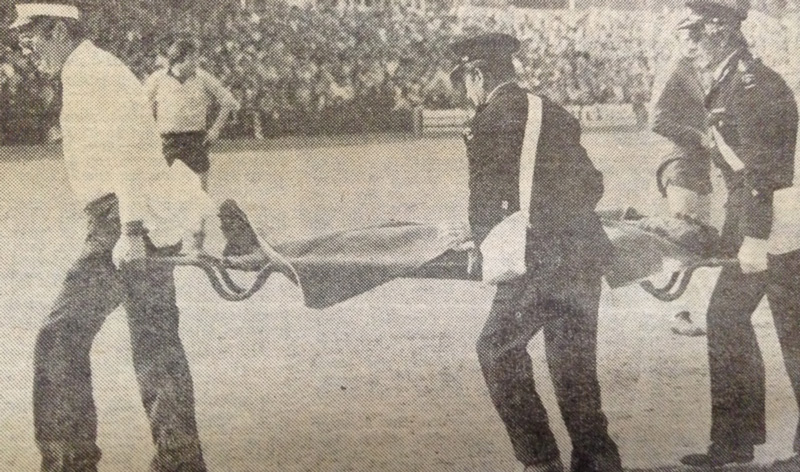
In fact, the match Kinnear refers to was the last-but-one of the 1975/76 season against Gillingham at the Goldstone in April. Here’s a photo of him being stretchered off in the 70th minute with what was reported by the Evening Argus’ John Vinicombe as a ‘locked knee that could mean a cartilage operation’:
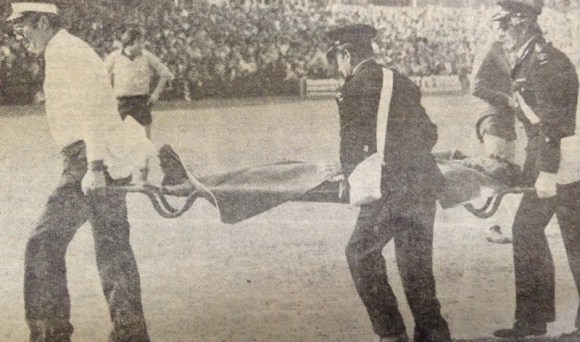
kinnear2

The injury capped a disastrous Easter 1976 for Kinnear. In the game with Millwall, Joe’s calamitous backpass to Peter Grummitt gifted Millwall’s second goal in a 3-1 defeat at The Den. In the match where he got injured, his eighteenth and last for Brighton, Joe had also missed a penalty against Gillingham after Dave Shipperley had handled. He hit the spot-kick to the goalkeeper Phil Owers’ right with insufficient power and the shot turned around the post.

Says Kinnear:

I couldn’t play for six months. I could have had an operation, but I was told the success rate was only 50-50. I did try to come back and started training again. I had my leg all strapped up but I was still limping. Then I had a brace, but it was agony every time and it just swelled up.

I’d begun by then to get on quite well with Peter. He’d call me in to discuss the team, who should be played, the tactics. We chatted generally about ideas, how football should be played, or discussed the opposition, the strengths and weaknesses. I did tell Peter that I fancied going into coaching. He was quite encouraging.

Then he left. I’m not sure if he got the sack or just packed it in. But anyway, that was it, he was gone.

If I’d been stronger at the time, as a person, and more confident, I might have asked what the chances were of me being considered for manager. But I didn’t say anything, I didn’t push myself forward. The chairman, Mike Bamber, did call me in and told me who they were thinking of appointing – Alan Mullery. He asked me what he was like, as I’d played with him at Spurs. I said his pedigree is terrific – Spurs captain, England captain – can’t get a better CV than that.

So he was appointed. I was looking forward to working with him again – I hoped that as I knew him, and had been his team-mate, he’d give me some sort of coaching job. That was my hope. But then when he arrived he’d brought his own coaching staff.

Kinnear never featured in a game under Mullery and instead left Brighton for Woodford Town becoming player-manager. Who knows how things would have turned out if the Eire international has become one of the coaching staff at the Goldstone? Would he have been with a chance of eventually progressing to the manager’s hot-seat at Brighton? Impossible to say. However, if you are puzzled as to why the new boss was not impressed enough to offer Kinnear a coaching job, you can find the answer in Mullery’s ‘An Autobiography’ from 1985:

“A few old pros had heard that under Taylor and Clough there was a few bob about and it was up to me to get rid of the driftwood, keeping the players I wanted and bring in some youngsters. It wasn’t an easy time and a few of the senior stars gave me a rough ride. Kinnear was the worst and, after watching him play in a friendly at Maidstone, I accused him of still behaving as if he was at Tottenham or in Europe and I ordered him to lose a stone in weight. We had a number of rows and so I threatened to end his contract only to discover from secretary Ken Calver that the club owed him £18,000. He continued to rebel and eventually left the club without getting all his money.”

So, that was that. Mullery won his first real test as a manager. Kinnear, for his part, proved to be a very different character as Wimbledon boss to his lackadaisical approach as a player, relying for much of his managerial success on his ability to motivate his players. In terms of priorities, at least this was something he and Mullery could both agree upon!

Tagged , ,

A greyhound called ‘Seagulls’

greyhound

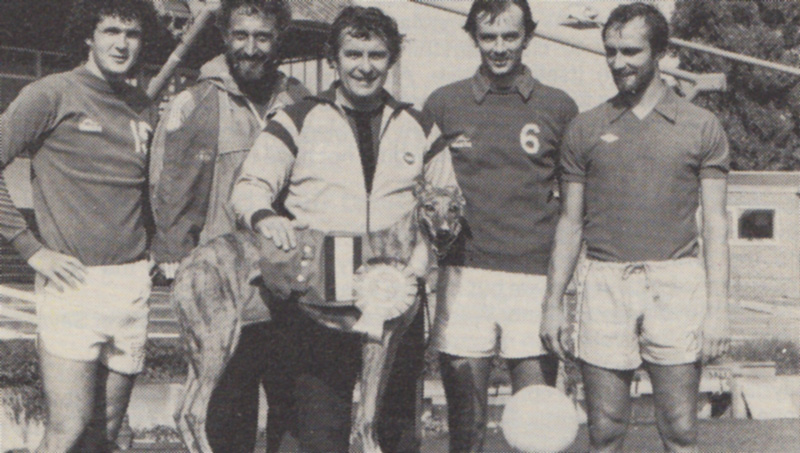
From the Brighton v Norwich programme in October 1979:

The greyhound recently adopted by the Albion and renamed ‘Seagulls’ has, since taking the Albion’s colours, been pretty successful. Despite being just about the youngest dog in the Grand Prix field she won her heat, came second in her quarter-final and then third in the semi-final to reach last Saturday’s final at Walthamstow.

Tagged , , , , ,

Brighton finish second in five-a-side tournament

From Match Weekly, December 13-19, 1979:

five-a-side

Not sure it would happen these days, but on 28th November 1979, Brighton & Hove Albion sent their first team to take part in a Daily Express national five-a-side tournament at Wembley Arena. The side defeated Rangers 1-0 in the first round, and then sweetly, ended the hopes of arch rivals Crystal Palace, winning 2-1. (It was the first win over Palace in ten attempts under Alan Mullery and provided the impetus for Brighton’s magnificent 3-0 win over the Eagles in the Division One game in December 1979).

In the Semi-Final, Brighton beat Mullery’s old club Tottenham Hotspur 2-1. Sadly, in the final, Sunderland proved too strong, triumphing 2-0 over the Seagulls.

Tagged

1986/87 Evening Argus Fixture Card

argusfixturecard86-87a

argusfixturecard86-87b

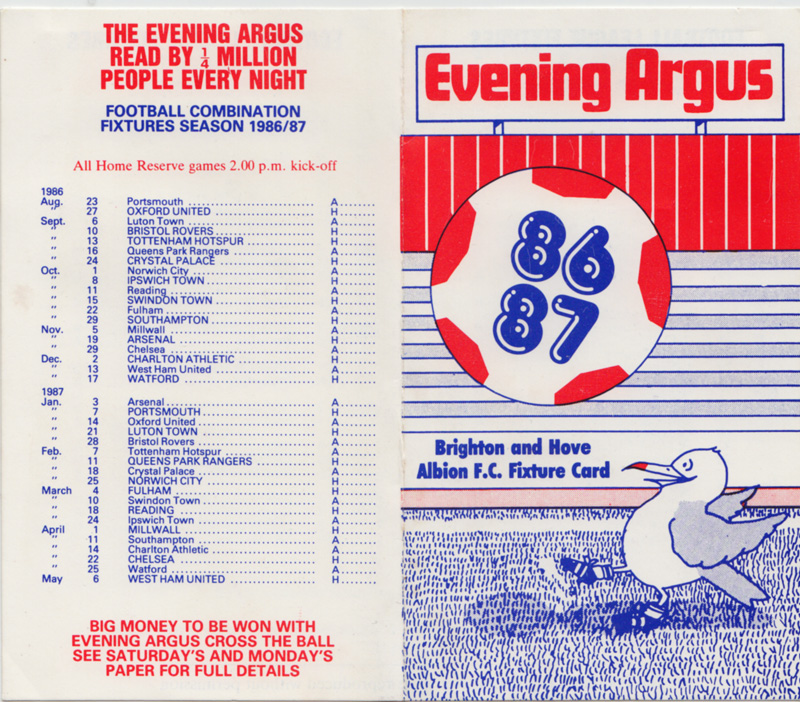
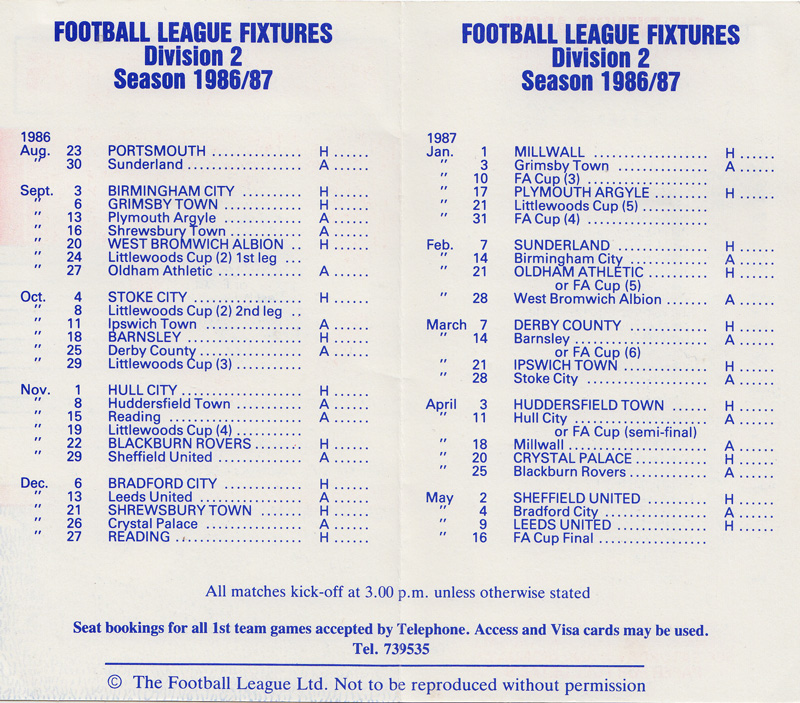
On the day the fixtures for the 2013/14 Football League season are announced (9am), I’d like to share with you an elegantly designed fixture card from the Evening Argus from the mid-1980s. You can also view the one for the 1982/83 season.

Fan anger at the sacking of manager Chris Cattlin was assuaged in summer 1986 by the announcement that Alan Mullery, Brighton boss during the glory years, was back at the helm.

As you can see, the 1986/87 campaign began with an exciting prospect of a south coast derby at home to Portsmouth (yes, it ended 0-0). By the season’s end, Alan Ball had led Pompey back to the First Division (probably the only club where the World Cup winner is considered a managerial success).

Brighton, however, headed in the opposite direction. Mullery was harshly sacked in January 1987 for lacking ‘commitment’ despite doing OK with having virtually no money to spend. Waiting in the wings, Barry Lloyd took his place. Of the fixtures in the second half of this card, only three were won.

Tagged , ,

The legend of Robin Friday

robinfriday

The recent consternation over excrement being used to write the words ‘We Hate Palace’ in the Crystal Palace changing room at the recent play-off match at the Amex stadium echoes some stories often told about the last-but-one match of maverick footballer Robin Friday, who played for Reading and Cardiff City.

Friday, the forward seen by some as one of the most gifted footballers of the 1970s, was involved in Reading’s epic League Cup 1st round tussle with Peter Taylor’s Brighton in August and September 1974. It stretched to three replays. Eventually, the Royals triumphed 3-2 at the Goldstone despite Ricky Marlowe hitting two goals for the Albion. In the Reading Evening Post, it was reported:

“When Murray’s shot hit the post, this time jubilant Robin Friday was there, sliding on his back to push it in the goal. When it was all over Friday lay stretched out on the turf…”

The performances of this colourful character helped Reading win promotion from the Fourth Division in 1975/76. In 1976/77, Reading made a great start to the campaign, reaching 3rd spot by early October, but began to falter and were eventually relegated. Friday played in Reading’s 3-1 home defeat to Alan Mullery’s Albion side in November 1976, with the Royals failing to make the most of their very good chances. As his dip in form and disciplinary problems continued, however, Friday joined Second Division Cardiff City in December 1976.

His star burned brightly at times at Cardiff but he suffered a mystery virus that laid him low for several months. His return match, his penultimate game for the Bluebirds, came against Brighton in October 1977. However, it was another Welshman who won the rave reviews. In the Daily Mirror:

Cardiff hit by Welsh wizard
Brighton 4-0 Cardiff

This was a case of a Welsh side torn apart by a Welsh international. Brighton’s Peter O’Sullivan scored twice and tormented a Cardiff team which looked to have big problems. To make things worse, Robin Friday, the striker Cardiff hoped would lift them on his return after a long illness, was sent off after 55 minutes. He clashed with Brighton’s Mark Lawrenson in midfield and got the red card from referee Alan Robinson after kicking out in retaliation. Alan Campbell, Cardiff’s most effective player, was booked for protesting. Said manager Alan Mullery: “Sully was brilliant – surely there is no midfield man in the country playing better.” Brighton’s other scorers were Peter Ward and Ian Mellor.

Friday had been sent off for kicking Mark Lawrenson in the face. From Bluebirds Banter:

Robin Friday was fed up. He’d been sent off after falling out with Brighton’s Mark Lawrenson at their old Goldstone Road ground in 1977 – and took it out on his own team-mates! They returned to the away dressing room after the final whistle and discovered that Friday had thrown all of their clothes, everything he could find, into the team bath.

“There had been quite a battle between Robin and Brighton’s Lawrenson,” said David Giles, who was in the Bluebirds squad. “I was on the bench and went on for Steve Grapes when we were 2-0 down in front of nearly 23,000 spectators.

“It all flared up just after half-time when Lawrenson tackled Robin and he didn’t like the challenge. So he kicked out and was sent off.

“We lost 4-0 and when we got back to the dressing room we knew Jimmy Andrews would have something to say. One of the lads went into the shower room to get out of the way and he shouted ‘Robin’s thrown all our clothes into the bath’.

“Brighton had a big plunge bath and all our gear was floating in it. We wrung our underwear out and had to put that on. The rest of our stuff was soaked and we borrowed tracksuits from Brighton to wear home.

“Robin got a club suspension for that.”

Legend also has it that Friday broke into Brighton’s dressing room and defecated in Mark Lawrenson’s bag! (See The Bleacher Report: Robin Friday.

Surprisngly, in Paolo Hewitt and Paul McGuigan’s book about Friday, ‘The Greatest Footballer You Never Saw,’ there is no mention of the incidents in the home dressing room and the away one.

Perhaps it’s because it didn’t happen. Roger Titford has put together a very wonderful 50-page photo-essay called ‘The Legend of Robin Friday’ which traces exactly how the legend of ‘the greatest footballer you never saw’ came about and where it’s turning into pure myth. Well worth the £3 price for the digital read. It says:

“It’s the mainly anti-hero charisma that drives the legend nowadays. Just as a terrorist of one generation becomes a politician of the next so today’s football world takes just the bits it wants from the legend of Robin Friday. This is where the legend takes its wings and flies into the world of myth, exaggeration and putting together incidents that happened separately. The thing with Bobby Moore – over in a moment. No, he didn’t kiss the policeman after the wonder goal, as it says on YouTube. And no, despite what it says on some punk football T-shirt website, he didn’t crap in Mark Lawrenson’s kit-bag after being sent off. Dishonourably, arguably out of character, he kicked the young Brighton centre-half in the face as he lay on the ground. No one then knew that Lawrenson would turn into an establishment BBC pundit of somewhat complacent and annoying nature – so maybe that’s what makes it ‘funny’ for some today.”

And yes, it mentions him doing a poo in the Mansfield bath but not in the Brighton bath in the game above.

Clearly, though, Mullery was not at all impressed with Friday:

“The foul by Friday was one of the worst I have ever seen. He kicked my player in the face when he was on the ground! How can you defend that sort of behaviour?”

But he was impressed by the performance of another Welsh Bluebird, Peter Sayer, who the Albion signed four months later. In April 1978, finishing fourth, Albion missed out on promotion out of Division Two by goal difference despite beating Blackpool on the last day of the season. The result relegated Blackpool, helping Cardiff to beat the drop by a single point.

buktabag

Tagged , ,

How it was then: Alan Mullery leaves Brighton in June 1981

At the end of ‘Up, Up And Away,’ John Vinicombe’s account of Brighton’s promotion to the First Division, he paints a rosy picture of the relationship between chairman and manager in 1979:

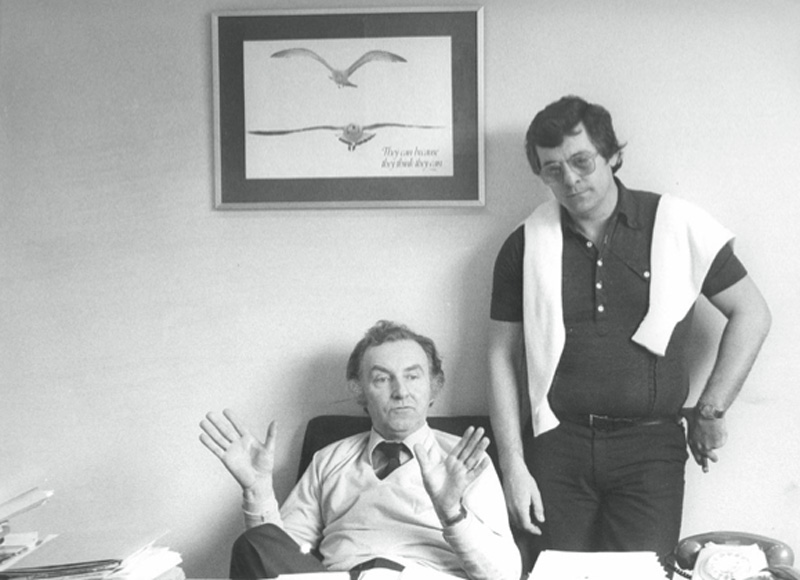
It took the arrival of Mike Bamber to bring about a new era, for, without Bamber, there would have been no Mullery – no promotion. They are twin architects of Albion’s success and the key to their thinking can be seen in Bamber’s motto on the wall of his Goldstone office – “they can, because they think they can”:

bambermullery

(In the photo above, from ‘Through Open Doors’ by Brian Radford, you can just about see the slogan).

However, by 1981, things had turned for the worse. Manager Alan Mullery resigned after disagreeing with Mike Bamber about the chairman’s plans to reduce the size of the coaching staff and how to resolve the Mark Lawrenson transfer saga. Mullery had cut a deal with Manchester United that involved cash plus a part exchange of a player, but Bamber had already set his sights on a money only £900,000 deal with Liverpool. Mullery decided it was time Bamber found a new club manager.

From Alan Mullery – ‘The Autobiography’ (2007):

Angry.

That’s how I felt in the days after I left Brighton. I thought I’d achieved more than any previous manager at the club. I’d started with a decent Third Division team and developed it into a Division One side filed with top-level players – Mark Lawrenson, one of the best defenders of modern times; John Gregory, Steve Foster and Gary Stevens, all of whom went on to play for England; Michael Robinson of Eire; Neil McNab and Gordon Smith, both Scottish internationals.

Plenty of that calibre would never have dreamed of joining Brighton and Hove Albion before I took over. My credibility helped me to sign them. I’m not saying I deserve all the praise for the rapid rise the club enjoyed during my five-year stay, but I sure as hell played my part. Our two seasons in the top flight were tough, there’s no denying that, but any club should expect a similar period of transition.

If I had continued to enjoy the backing I’d received while Harry Bloom was alive, I’m sure we could have consolidated our position as a First Division club. Instead I was out of the cold and Brighton went on to be relegated just two seasons later.

Did I regret walking out after my confrontation with Mike Bamber? Was I too headstrong? The honest answer is yes, I was fiery and prone to rush into emotional decisions. I should have taken my time to think things through before resigning, but it wouldn’t have changed anything in the long term. If I had backed down over the Lawrenson transfer, I believe Bamber would have walked all over me from that moment on. And my pride was too strong to allow that. Our split was inevitable.

As Mullery departed from Brighton & Hove Albion that summer, “the truth was,” he later wrote, “my best days as a manager were already behind me.”

lawrensonv2

Tagged , ,

Graham Moseley: My Brighton nightmare

moseley2

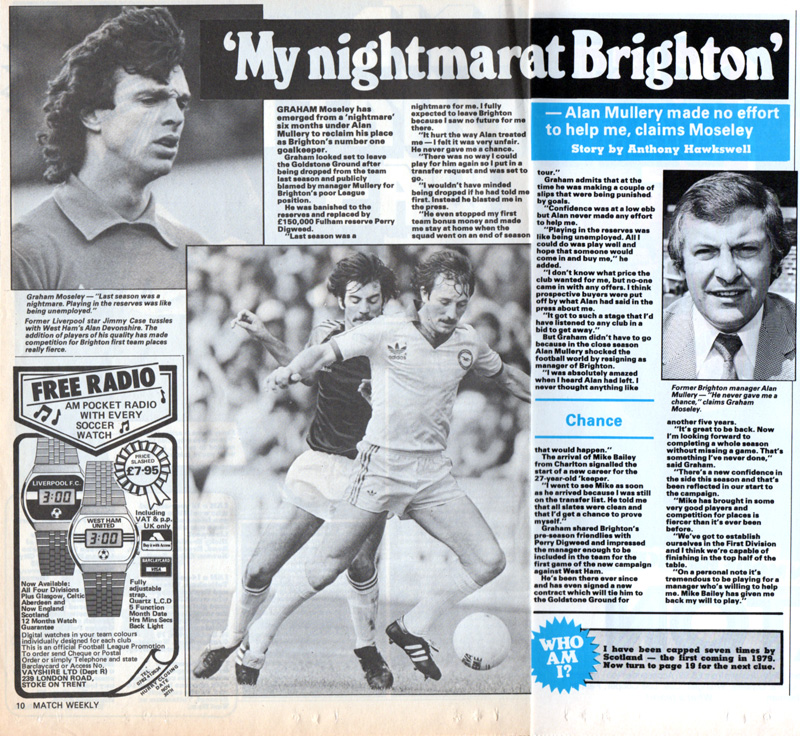
From Match Weekly in 1981/82:

Graham Moseley has emerged from a ‘nightmare’ six months under Alan Mullery to reclaim his place as Brighton’s number one goalkeeper.

Graham looked set to leave the Goldstone Ground after being dropped from the team last season and publicly blamed by manager Mullery for Brighton’s poor League position. He was banished to the reserves and replaced by £150,000 Fulham reserve Perry Digweed.

“Last season was a nightmare for me. I fully expected to leave Brighton because I saw no future for me there. It hurt the way Alan treated me – I felt it was very unfair. He never gave me a chance. There was no way I could play for him again so I put in a transfer request and was set to go. I wouldn’t have minded being dropped if he had told me first. Instead he blasted me in the press. He even stopped my first team bonus money and made me stay at home when the squad went on an end of season tour. Confidence was at a very low ebb but Alan never made any effort to comfort me. Playing in the reserves was like being unemployed. All I could do was play well and hope that someone would buy me.

When Alan Mullery resigned as Brighton boss in the summer of 1981, Mike Bailey’s arrival gave Moseley a second chance:

“I went to see Mike as soon as he arrived because I was still on the transfer list. He told me that all slates were clean and that I’d get a chance to prove myself. There’s a new confidence in the side this season and that’s been reflected in our start to the campaign. Mike has brought in some very good players and competition for places is fiercer than it’s ever been before. We’ve got to establish ourselves in the First Division and I think we’re capable of finishing in the top half of the table. On a personal note, it’s tremendous to be playing for a manager who’s willing to help me. Mike Bailey has given back my will to play.”

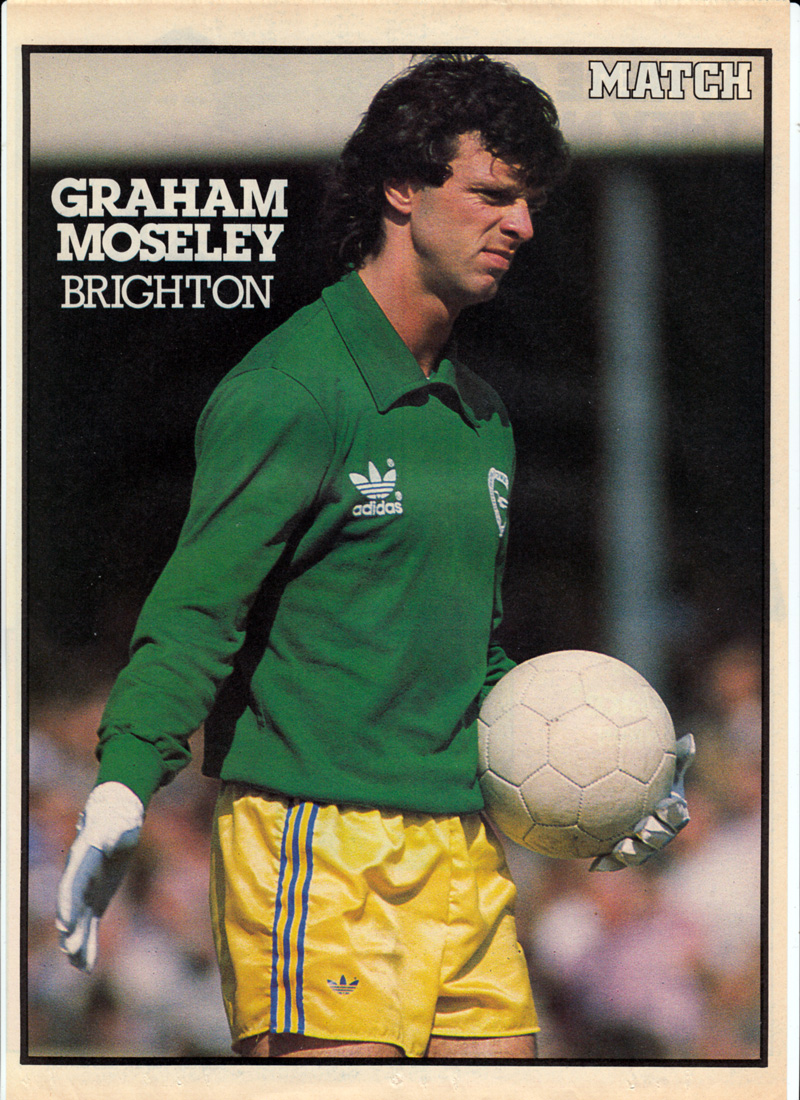
By the end of the season, Moseley had re-established himself at the club, playing 30 League games with Brighton in 13th spot in Division One, their highest ever finish.

grahammoseley-match

Tagged , ,