Author Archives: Goldstone Rapper

‘Trevor Brooking? I’m more like Martin Peters,’ declares Gordon Smith

gordonsmith1982

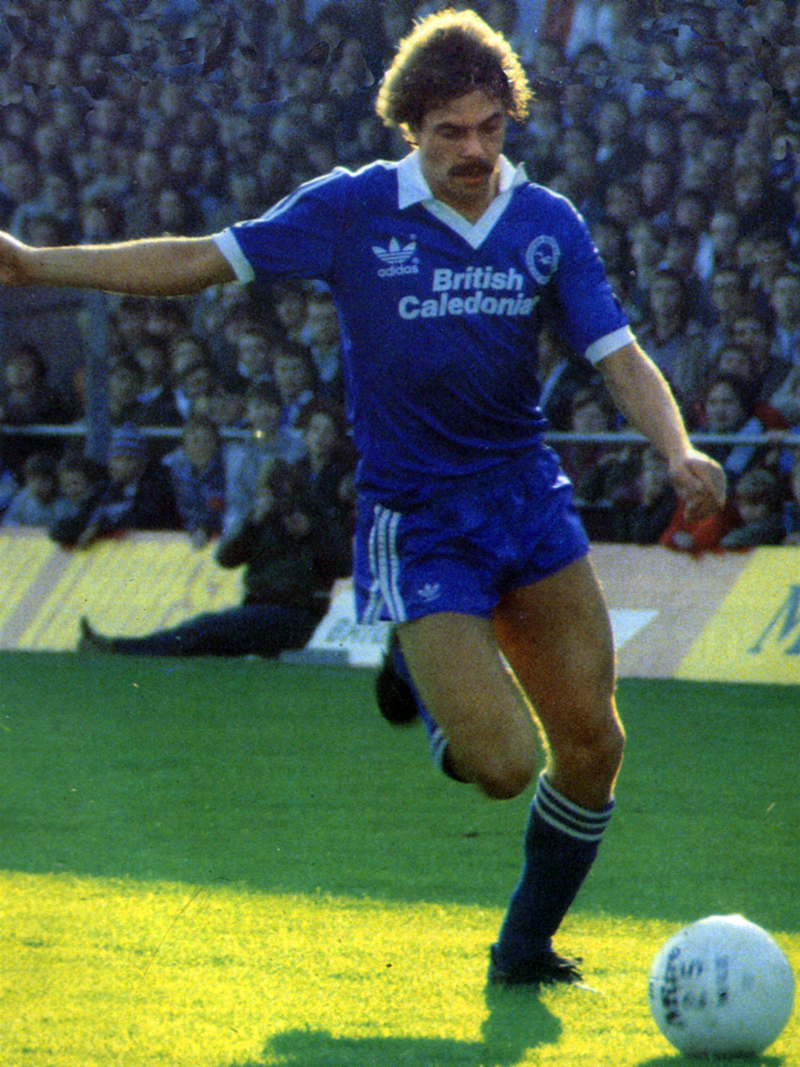
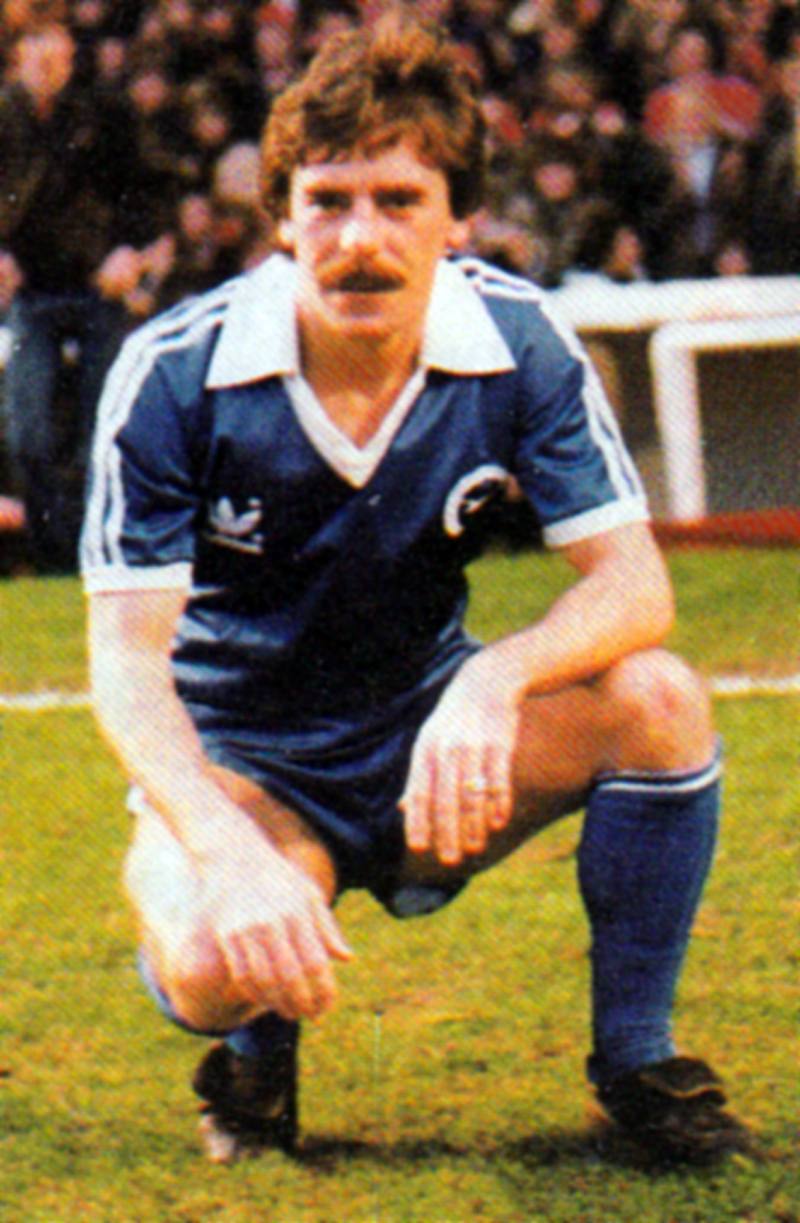
Having led his club to safety in Division One at the end of 1979/80, Alan Mullery went on an eye-watering spending spree as he sought to establish Brighton as a major force in the top flight. Together with Michael Robinson, Scotsman Gordon Smith ended up forming the striking partnership that took Brighton to the FA Cup Final in 1983.

However, when has bought, it wasn’t as an out-and-out centre-forward. Hence the comparison with the silky skills of subtle, creative English players:

Gordon Smith, Brighton’s £400,000 recruit from Rangers, was rather perturbed when some precocious, pressing journalist compared his midfield talents with those of England’s Trevor Brooking.

Here was a 25-year-old Scot, travelling south to play in the English League’s First Division without so much of a hint of a Scottish cap, receiving the full treatment from the media.

Smith flashed a smile and said wickedly: “Brooking? I’m no Trevor Brooking. He doesn’t have my pace!”
Gordon Smith has come to taste the good life in England with a talent and a diss-arming and essential sense of humour.

He treads the same path which has carried many young Scottish hopefuls south. Some, like Kenny Dalgllsh and West Ham’s Ray Stewart, stayed to fulfil the rich promise nurtured In the Scottish heathers, others never made the grade and returned to the homeland disillusioned.

Jim Bone went to Norwich and decided to use the second half of his return ticket shortly afterwards. Alfle Conn never made it at Spurs. Eamonn Bannon prefers to forget his Chelsea experience. Peter Marinello swept through the gates at Highbury more than a decade ago hailed as “the new George Best”. He failed to maintain the pace of his pre-publicity.

Now comes Gordon Smith, spotted by Brighton’s manager Alan Mullery in a four-team tournament at Ibrox with Rangers, Brighton, Kilmarnock and West Ham competing.

The difference between Gordon Smith and some of his predecessors is that the Rangers star has. harnessed a sense of humour to his abundance of elegant talents.

“I’ll be delighted to be thought of as Trevor Brooking,” says Smith, who has recently moved into a detached fourobedroomed house in Hove, Brighton, which would have cost him £20,000 less were he buying It north of the border.

“My game is different from Trevor’s: I like to run from deep positions, playing one-twos in the box in the hole or finding an opening which I can exploit.

“I’d say I am more like Martin Peters than Trevor. I love watching Peters. He relies on stealth and superb positioning.

“Like him, I am always looking for that blind side position which catches a defence unawares.” The player, whose simple name reveals nothing about his Scottish ancestry, confesses to knowing little about English football.

“1 would say that the Scottish Premier Division is more competitive than the English First Division if last season is any guideline.

“My main problem In the early weeks of the new season has been to adapt. My absolute priority is to make sure I keep my place in the Brighton team. It is all right commanding a big fee In the transfer market, but unless you fulfil the hopes of the club who have laid out that sum, you are useless.

“Forget me, think about others given an opportunity to make it in the big time. Mick Robinson, who left Preston for Manchester City, is a classic example.

“A good, honest, skilful, fast striker. His problem was he struggled In his first season, playing for a team struggling to survive in the First Division. People underestimate the demands of this game. A good player in a bad team can be terribly disappointingto men who have placed their confidence, and money, in his ability to dowell for them.” If the faithful who sing a chorus of “Seagulls” whenever they clamp eyes on a blue and white shirt expect the former Rangers player to combine construction with a demolition job helping out in defence they will be bitterly disappointed.

Smith is not a heavy tackler. He is a maker of goals who likes to get his name on the scoresheet as well. “Alan Mullery has told me that he wants me to get forward as much as possible this season. I am not a defensive marking player. I like to get into the box and get some goals. I am only 25 and hope to give Brighton the best years of my career. I reckon a player of my type doesn’t reach his peak until 28.”

Gordon Smith has a delightful penchant for coaching youngsters and maintains a ready ear for anyone wishing to exchange a technicality with him.

He wants to become a coach when he decides to quit the game in the latter half of the 1980s.

“Coaching is so important. People talk about becoming managers. Highly commendable – but the problem with British football is that the coaching has often been weak. British players often lack a lot of imagination. A great deal of natural ability is often coached out of them. How wonderful to see Van Moer, the Belgian, the Italian, and Rummenigge, West Germany’s cultured player.”

Smith has gained considerable experience against European opposition in several outstandIng years at Ibrox. He has played against PSV Eindhoven, Cologne and Juventus, gaining experience from those matches which should blend happily with Brighton’s line-up of experience and young talent.

He carries a firm ambition to win a full Scotland cap yet is realistic enough to realise that his style does not endear itself to the current managerial regime under Jock Stein.

“I think I would have to change my style to make the Scotland team,” he says. “The system does not allow for a player like me. They are often looking for two ball-winners In the middle of the pitch. I don’t win much ball. My strength is running off the ball into positions which can carry an attack forward. I like to attack and will take every opportunity to get forward. I don’t want to let Brighton down. I’m a good player, but will not find it easy fitting into the team pattern.

“Liverpool can afford to buy a player, stick him in the reserves, and allow him time to settle into their pattern of play. Brighton do not have the resources to do that. They want an early reward for their outlay.”

Fortunately, Gordon Smith has managed to settle down in the Brighton area within weeks of signing a contract. He and his charming wife, Marlene, have wasted no time moving their belongings to a £67,000 detached Georgian in Hove. Smith was determined to secure his home life down south, if only to provide a settled existence for their new-born baby Grant.

He admits to holding Alan Mullery, Brlghton’s manager, in great esteem.

“He is ambitious. He made it clear he wanted me and me alone. I shall do my utmost not to let him down,” says Smith, the joint-third most expensive Scot to cross the border in the wake of £800,000 Steve Archibald, Kenny Dalglish at £440,000 and Ray Stewart, £400,000.

“I am determined to show he is also a good judge!”

Smith and Robinson both settled at Brighton very early into 1980/81, while Ritchie was a regular scorer at the turn of the calendar. Even so, that expensive frontline of Robinson and Ritchie, with Smith just behind, despite costing £1.4 million, was not enough to turn Brighton into a side that could finish into the top-half of Division One.

With falling Goldstone attendances, cuts had to be made. Chairman Mike Bamber sought to slash the coaching staff wage bill and a cash-only sale of Mark Lawrenson. It led to the departure of Alan Mullery, to be replaced by Mike Bailey. However, Smith did not hold Mullery’s successor in the same esteem, particularly as the new boss seemed to regard the Scotsman as a luxury player that did not add much to the rigid system he sought to develop for the side. Loaned to Rangers in 1982/83, Smith seemed to be on his way out until the Jimmy Melia era restored his place within the starting line-up, in time for the FA Cup Final…
Tagged

Chris Ramsey – not exactly a star of the screen

chrisramsey1982

Taken from the Brighton v Stoke programme from February 1983, here is Tony Norman’s portrayal of the life and times of Albion’s young right-back:

The first time I met Chris Ramsey, he was a quiet, shy apprentice at Bristol City. Since then, City have fallen on hard times, but Chris has realised the ambition he talked quietly about at that first meeting.

‘Like any other young apprentice, my dream was to play in the First Division,’ he says. ‘I must admit that even after coming to Brighton, I had times when I wondered if I’d make it. But now I’ve got my chance and I’m keen to make the most of it.’

Regular fans at the Goldstone will have enjoyed seeing the progress Chris has made this season. His confidence has grown. He looks to have all the makings of a top class full-back. He has pace and agility, but can tackle like a demon too. Beneath that shy smile there is a sharp competitor.

Not that Chris is often shy at the Goldstone. When he does look serious, a joke from friends like Steve Foster, Michael Robinson or Andy Ritchie will soon bring a huge grin to his face. Chris is a popular member of the first team squad.

‘I think the Albion is a happy club,’ he says. ‘I like Brighton, but I still live at home with my family in Islington, London. There are five girls and two boys in all. At the moment, five of us are still living at home with mum.’ Needless to say, there’s never a dull moment!

‘I’m always joking around at home with my younger brother, Kevin.

He’s my best mate too. We spend a lot of our free time listening to music. I like Motown and reggae. We get records on import. I could tell you the names of reggae bands, but to be honest, I don’t think you would know any of them!’ Has Chris ever thought of joining a group himself?

‘Well, I did have a go at learning the drums once,’ he grins, ‘but I didn’t get very far. I think I’m better at listening than playing!’

One of his other interests is watching movies from the Golden Age of Hollywood.

‘I like the old musicals with stars like Gene Kelly, Fred Astair and Ginger Rogers, but my favourite actor is James Cagney. He made some great films.’ Chris is one of many talented black players making their name in the game. Does he think racial prejudice still exists in football?

‘Yes, it’s still there. You get stick from away fans. But the way I look at it, if they weren’t shouting about that, they’d find something else. Like, you’re too fat or too thin. They’ll always find something, so it doesn’t really bother me.’

Chris Ramsey has had his share of hard times, but like any good Hollywood movie, his story looks like having a very happy ending… here at the Goldstone.

Ramsey had a chequered history in front of the TV cameras that season. He was sent off against Spurs in April for some very reckless tackling:

Then, while feeling down about being suspended for the FA Cup Semi-Final, he had his pockets picked by Everton’s Kevin Sheedy for the Toffees’ first goal a week later:

Finally, in the second-half of the FA Cup Final against Manchester United, Norman Whiteside’s horrific tackle put Chris out of the game and the replay:

Tagged

Mullery quits after bust-up

mullery1980-81

This week, the story playing out is of Oscar Garcia’s resignation as head coach. Back in the summer of 1981, the man quitting the Seagulls was manager Alan Mullery. Both very different men, with very different personalities and strengths, but both felt moved to quit the Albion. Here is how Steve Curry and Philip Osborn from the Daily Express reported things on 13th June 1981:

Brighton manager Alan Mullery walked out on the club yesterday over a point of principle.

The former Spurs, Fulham and England player severed his five-year relationship with Brighton after a stormy disagreement with his board of directors about the future running of the club.

And Mullery, who flies off to Malta today for a two-week holiday with his family, described his feelings about leaving the side he led from the Third Division to the First.

He said: “At the end it was a matter of principle regarding certain things at the club. The directors wanted something to happen that I was not prepared to accept.

“It was nothing to do with the terms of a new contract or anything financial. I don’t really believe there would be any purpose going into details about why we have split. I am not one for mind-slinging.

“I didn’t think it would come to this because I had five very happy years there. We have had some great times, memorable days that I shall remember for the rest of my career.

“I shan’t forget it was Brighton who gave me my chance in management when I decided to pack in as a player at Fulham. I think I have been good for them and they have been good for me. But maybe the time has come to move on.”

Bamber, who offered Mullery a new three-year contract five weeks ago, flew out for a golfing holiday in Spain after the meeting, unaware of his manager’s decision.

He said from Spain last night: “I am shocked and absolutely amazed to learn of this but I will not stand him his way if that is what he wants. I can only presume he had something on his mind. Perhaps someone has tapped him for another job, but I don’t know that.”

Mullery, whose sometimes abrasive manner does not hide a talent for management, is unlikely to be out of work for long. He would appear to be a natural successor at West Brom to the extrovert Ron Atkinson, who moved to Manchester United.

In his autobiography from 2006, Mullery described proposed changes to his backroom staff as a bone of contention with Bamber:

“At the end of the season, he called me in and told me to sack all my backroom staff, including Ken Craggs and George Aitken who had worked so hard for the club. He even wanted to get rid of the kitman Glen Wilson who had been at Brighton for years. The club meant the world to him. I couldn’t have lived with myself if I’d fired these people. Bamber knew that; he was doing all he could to undermine me.”

There was also a disagreement over the sale of Mark Lawrenson. Although he accepted the need for a sale to raise money, Mullery had cut a deal with Ron Atkinson at Manchester United involving a player coming to Brighton from Old Trafford, whereas Bamber had done a cash-only deal with Liverpool.

With Mullery’s departure, it was a very sad and uncertain time for Seagulls’ fans.

Just like it is with Oscar Garcia in 2014, Alan Mullery felt that budget cuts at the club were undermining his ability to do his job in 1981. He also disliked how he was not able to get his voice heard and acted upon in the buying and selling of players. However, the Lawrenson deal apart, the axe in 1981 seemed to be falling more on the coaching staff rather than the players, although that may have been Bamber participating in mind games.

In their respective resignations, there are also parallels between Mullery’s thanking of the club for giving him his first opportunity in management and Garcia’s appreciation to Tony Bloom for his first chance in England. Lastly, it’s pure coincidence that upon leaving, both were tipped by some for the vacant position at West Bromwich Albion.

The fallout from Garcia’s resignation is still playing out. Now as the club ambassador, and as someone who has been through it all, I wonder what Alan Mullery makes of the situation today.

Tagged ,

Whatever happened to Peter Ward?

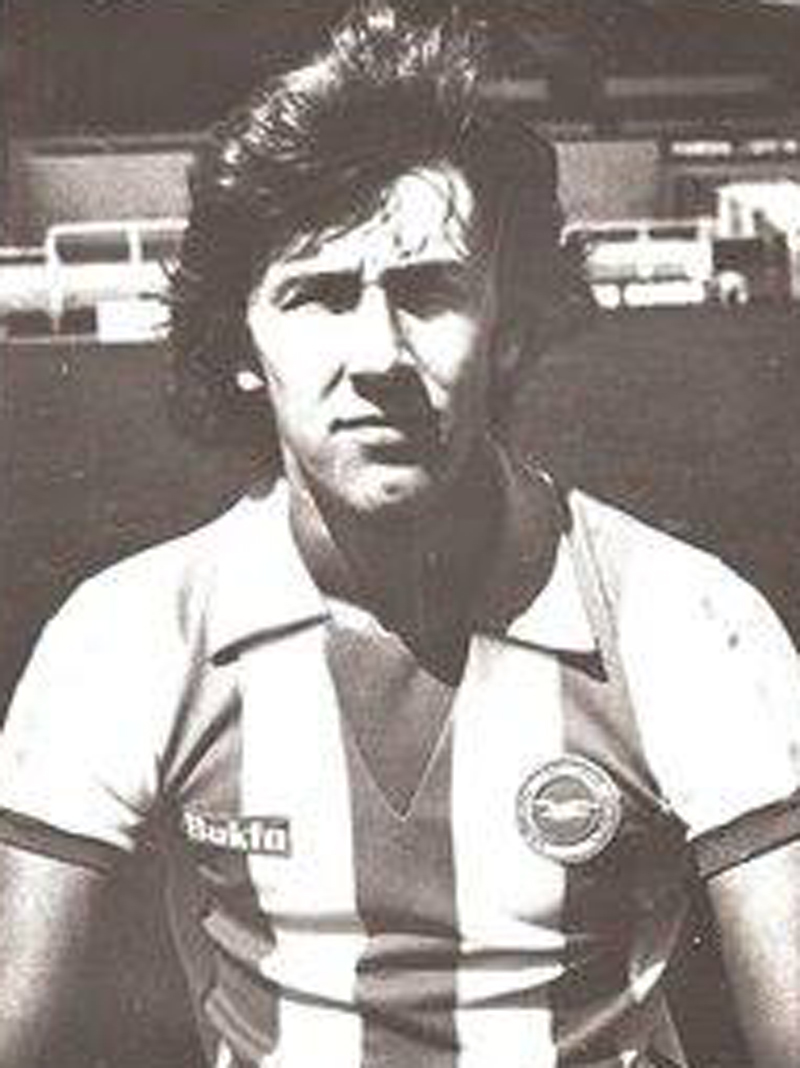
In summer 1986, Match magazine began a series tracing the top flight players who suddenly disappeared from the scene. On 26th July, it ran ‘Forward with the Force’, a feature on Brighton’s most celebrated striker:

ward65

The name of Peter Ward still sets Seagulls fans chirping on the South coast.

They remember the nonchalant way he waltzed around defenders and turned goalkeepers into quivering wrecks with his lethal finishing.

But it’s the followers of America’s Cleveland Force who are being delighted by the skills of the former Brighton favourite.

It’s more than three years since the Goldstone witnessed a Peter Ward goal ~ which has become so familiar in the Major Indoor Soccer League he now graces.

The United States has become Peter’s adopted home since he quit English football and admits: “I’ve loved ever of it.

“The indoor game here is thriving, I enjoy the lifestyle and I’m more financially secure than I would have been in England.”

But Peter does confess that, while he has never regretted making the move, there are times when he yearns for the English First Division.

The American indoor season only runs from November to May, and he says: “We have the rest of the year off and the family and I spend it travelling around the States.

“It’s such a long break from football, and now and again I do wish I was back playing in England.

“In fact it would be great for me if the American season ran during the summer and I could return home to play in the winter.

“But having said all that, being off during the summer does provide an opportunity to travel that we wouldn’t have had otherwise.

“And of course the money is good. I would be lying if I said that hasn’t been a factor in keeping me out here.”

Peter had his first taste of Stateside soccer in the summer of ’82 and after one successful season with Seattle he was hooked.

Following the disappointment of his spell with Nottingham Forest – a big-money move which had promised so much – his American adventure provided a heaven-sent opportunity to lift his flagging spirits.

He was voted the NASL’s top player in his first season and although he returned to Brighton for a brief loan spell he was convinced his future lay overseas.

“That first summer in Seattle was so enjoyable that I had to go back,” says peter. “I played for them again the following year and I’ve been in America ever since.

“I also had a spell with Vancouver and since the NASL folded a couple of years ago I’ve been playing in the Major Indoor Soccer League with Cleveland.

“It took a while to adapt to the six-a-side indoor game but it’s been a great experience.”

Instead of the normal 90 minutes MISL matches consist of four 15-minute quarters played at frenetic pace.

“It’s very exciting for the fans and exhausting for the players,” he admits. “In fact it’s very rare for anyone to play more than half a match.

“The usual thing is to have a couple of minutes on the field and a couple off to catch your breath. The teams are always being switched about so it’s non-stop stuff.

“The atmosphere inside the magnificent stadiums we play is tremendous, especially when there are about 20,000 excited fans chanting and screaming.

“I’ve really enjoyed playing indoor soccer but I think I’ll probably stay here for just one more season before moving on.

“Coming back to England has always been at the back of my mind and that’s what I’d like to do when my contract with Cleveland runs out.”

Tagged

From Alan Young’s autobiography: Keegan’s farewell

keeganbrighton

Writer Simon Kimber was kind enough to send me an extract from Alan Young’s autobiography in collaboration with him. It was the striker’s sat match for the Seagulls, but the game is best remembered for another farewell, not to mention Beardsley’s masterpiece:

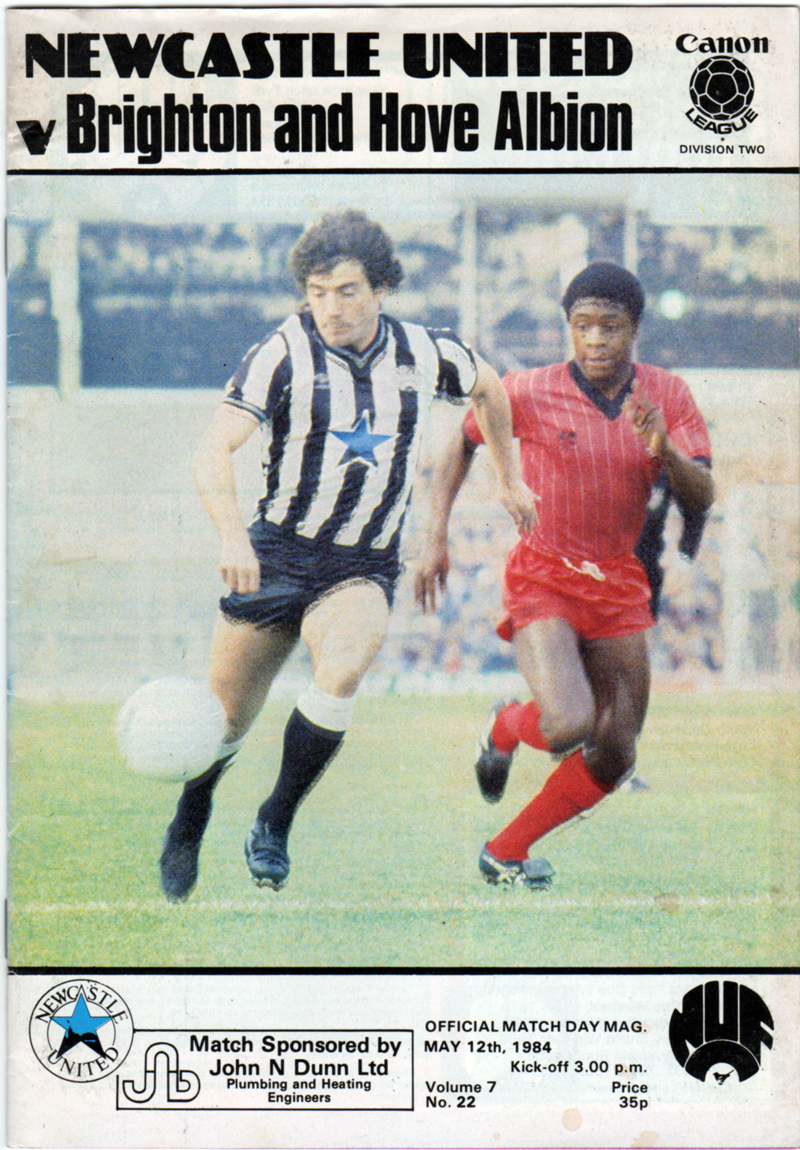
One match that sticks in my mind was the final game of the season in May 1984 when Brighton flew up to Newcastle to play at St James Park. It was Kevin Keegan’s last match for them and there was a lot of fuss and attention on Kevin because of this and I think we lost 3-1 but I had a great day.

I know that Chris Waddle chipped big Joe Corrigan and I set up Gerry Ryan up for his goal. I spent a lot of time at right back trying to retrieve the ball and tackling back, doing all the stuff that I shouldn’t have been doing. I know that Jock Wallace would have kicked my arse for it!

After the game we went back to Teeside Airport and we were preparing to fly home. We got to know some of the British Caledonian stewardesses quite well because they all lived in Brighton and all went out to the same wine bars and clubs that the players went to.

Anyway, when we got on the plane there was a crowd of us that always sat near the back. I know we had lost but we had played well and the season was now over so he should have left it alone.

While Brighton supporters are full of praise for Cattlin, it’s interesting to hear another player (along with Joe Corrigan and Gordon Smith) who have been less than complimentary about the Cat’s man management skills in their autobiographies.

Tagged

Derby delight for the Seagulls

Smith does score!

Smith does score!

It was time to stop the rot. After opening with three successive defeats, Gordon Smith converted a penalty as relieved Brighton under Jimmy Melia picked up a very welcome 1-0 victory against Derby County at the Goldstone in September 1983.

At the time, the Rams had seasoned players of the calibre of Roy McFarland, Archie Gemmill and John Robertson. However, they were all past their best. County were managed by ex-Albion boss Peter Taylor, who had returned to the Baseball Ground in November 1982, having ended his long partnership with Brian Clough by quitting Nottingham Forest six months previously. Together, Clough and Taylor had shocked the world by leading the Midlands side to the League Championship in 1972. However, going it along a decade later, Taylor struggled, although he did put one over Ol’ Big ‘Ead when the Rams beat Forest in the FA Cup in January 1983.

By the return match between Derby and Brighton at the Baseball Ground in March 1984, County were on their way towards Division Three and Taylor heading towards the sack. Helping them on their way was the Rams’ emphatic defeat to Cattlin’s Brighton side. Here’s how John Vinicombe of the Evening Argus reported it at the time:

Chris Cattlin’s rebuilding programme, aimed at promotion next season, continued apace at crisis-ridden Derby.

A wholly satisfying 3-0 victory also stilled any criticism at selling Steve Foster and Tony Grealish. Dissenting voices, always a minority, must now be faint echoes in the light of this latest performance.

Displays like this beat out Cattlin’s promise that the last two and half months of the campaign will not be allowed to peter out.

Amazingly, Peter Taylor axed four key players, including skipper Archie Gemmill and, before Gordon Smith scored the third and best goal of the match after 75 minutes, the Baseball Ground was a scene of bitter rancour.

Peter Taylor, who with Brian Clough, threw Albion a precious lifeline a decade ago, is himself in need of rescue.

Second from bottom, this grad old club, a founder member of the Football League, face relegation to the Third Division for only the second time, in their centenary year as well as today’s Inland Revenue winding-up petition in the High Court.

Perhaps Robert Maxwell will save Derby after all, but the prospect of charing a Third Division club cannot be that attractive. If he were to pay the preferential creditors in full, Derby could be had for under £1m.

Vinicombe blamed Derby’s poor financial affairs on poor housekeeping and contends that Brighton will never suffer such problems under Chris Cattlin, whose financial acumen was being demonstrated by his opposition to long-term contracts and the sale of senior players. Their opponents had the look of a veterans’ side, with Kenny Burns and Dave Watson also recruited to fight Derby’s relegation battle. Of the Rams, Vinicombe wrote:

Derby, this time shorn of not only Gemmill, but Paul Futcher who says he never want to play for Taylor again, John Robertson and Steve Cherry, had only endeavour to offer.

This is really only a polite way of saying their football was nothing but kick and rush, but there was a moment in the first half when the game might have gone their way.

That is did not was entirely due to Perry Digweed rectifying Willie Young’s mistake and preventing a certain goal by Bobby Davison. Digweed smothered the ball at Davison’s feet after Willie’s ill-timed pass back, and a few minutes’ later, when there didn’t appear to be a call, collecting one of Eric Young’s size 11 boots in the face.

For at least ten seconds, Digweed didn’t know what time of day it was. This was his first game for Cattlin, and only re-affirmed the manager’s high opinion of his second-string keeper.

A first ever Albion goal for Steve Penney.

A first ever Albion goal for Steve Penney.

Brighton took the lead on 54 minutes when Alan Young’s header found Steve Penney. The Ballymena-born winger turned Steve Buckle inside out and finished off the far post just as goalie Yakka Banovic tried to close the angle.

Striker Alan Young turned from provider to goalscorer eight minutes later, latching onto Gary Howlett’s pass to fire the ball home off Banovic’s foot.

Finally, Gordon Smith wrapped up the match with his last ever goals for the Seagulls, and it was a good one too. Danny Wilson caught ex-England defender Dave Watson at sixes and sevens and fed the Scotsman who rifled the ball into the roof of the net.

At the end of the season, Brighton finished ninth and Derby in 20th. However, it was a brief stay in the Third Division for the Rams and they returned to the Second Division in 1986 under the canny leadership of Arthur Cox.

Tagged , , , ,

Sully keeps in the swing

osullivan

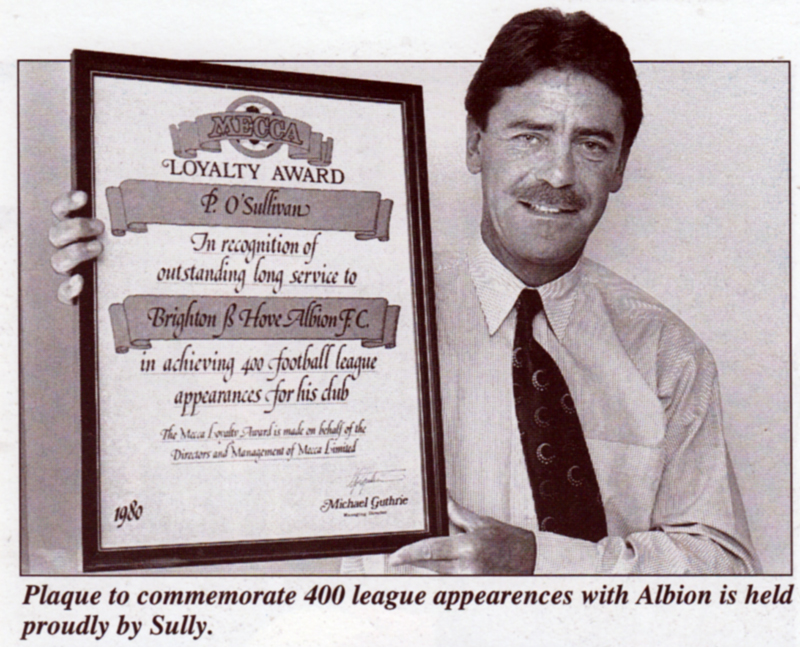
A retro piece from ‘Seagull News’ from its Autumn Edition 1991 gave the rundown on what Peter O’Sullivan was up to after hanging up his boots:

A former Albion star who thrilled thousands with his displays of attacking football is now providing cover in his role as an insurance consultant.

Peter O’Sullivan, known affectionately as Sully, was the Seagulls’ longest serving post-war player with over 400 League games to his credit.

The former Welsh international – he played three matches, two against Scotland and one against Malta scored over 40 goals while with the Albion in his position as a raiding left-winger.

Now living with his wife in Shoreham, Sully reflects happily on his years with the Albion, when he served under five managers who included Freddie Goodwin, Pat Saward, Brian Clough, Peter Taylor and Alan Mullery.

“Often when fans see me they recount the times I appeared to them to tear along the line with the ball in pursuit of a goal,” he says, adding modestly: “I always have a quiet smile at their memory of the events. The truth is I never had any real pace at all.”

He had his debut with the Albion in August 1970 with a Division 3 home match against Torquay and scored his first goal for the club two months later against Rochdale.

Sully, who was on Manchester United’s books before joining Brighton, was part of the team which won promotion from the Third to the Second Division while with the Albion.

After leaving Brighton he had spells at Fulham, and San Diego, where he played against such players as Becenbauer, Cruyff and George Best.

Looking trim and spritely for his 40 years, Sully returned to the game last year when he provided valuable support in helping County Leaguers Newhaven get promotion.

He played with the team because of his friendship with Andy Rollins, a former Albion team-mate. “I thoroughly enjoyed myself and it was good to help a friend, but I haven’t any future ambitions in that direction. Not at the moment, anyway,” added Sully.

The only patch of green grass he currently plays on can be found on a golf course. Always a keen golfer, he now plays off a single-figure handicap.

sullyswing1

Tagged

Seagulls swoop for £250,000 Austrian World Cup star

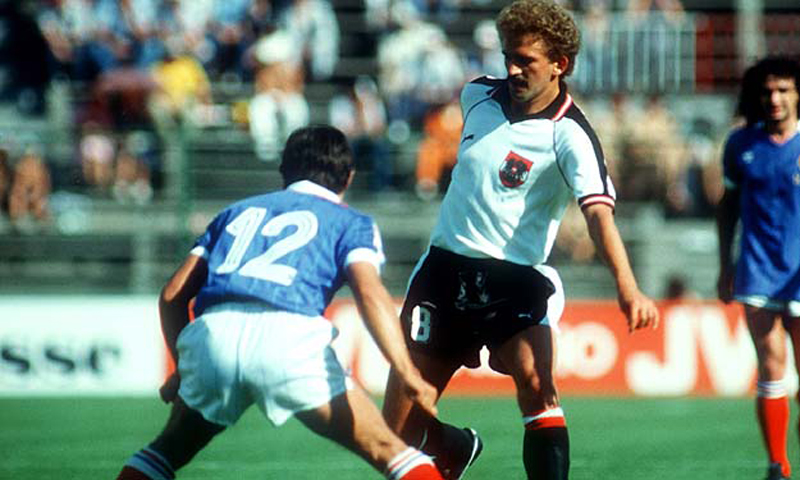
Juan Carlos Oblitas and Percy Rojas were not the only World Cup stars that Brighton & Hove Albion tried to sign in their glory years. According to Wikipedia, Prohaska was a deep-lying playmaker who is considered one of the best Austrian footballers of all time.

In January 1980, the Daily Express carried reports that the Seagulls were swooping for Prohaska’s services:

prohaska

Brighton are set to make a spectacular swoop for Austrian World Cup star Herbert Prohaska (writes Ray Bradshaw).

The 24-year-old KF Austria (Vienna) midfield ace flies over for talks with Brighton chairman Mike Bamber on Tuesday after Albion moved in quickly to beat off a challenge from Leeds.

Brighton secretary Ken Calver confirmed last night that negotiations for Prohaska’s transfer have been concluded and they hope to clinch the deal next week.

Said Calver: “We have been given permission by his club to speak to him and we are confident we can persuade him to join us.”

Prohaska, who has won 35 caps for his country, is expected to sign a £250,000 deal if terms are satisfactory.

Brighton have collected £500,000 in transfer sales in the last two months and will still have cash in hand for another big signing if they land Prohaska.

Sadly, it was Inter Milan that proved to be Prohaska’s destination in 1980. He joined Roma in 1982 before returning to Austria Vienna year later. For his country, he earned 83 caps and played in both the 1978 and 1982 World Cups.

Tagged

Vaughan’s great leap forward

Vaughan in a pre-season photoshoot

Vaughan in a pre-season photoshoot

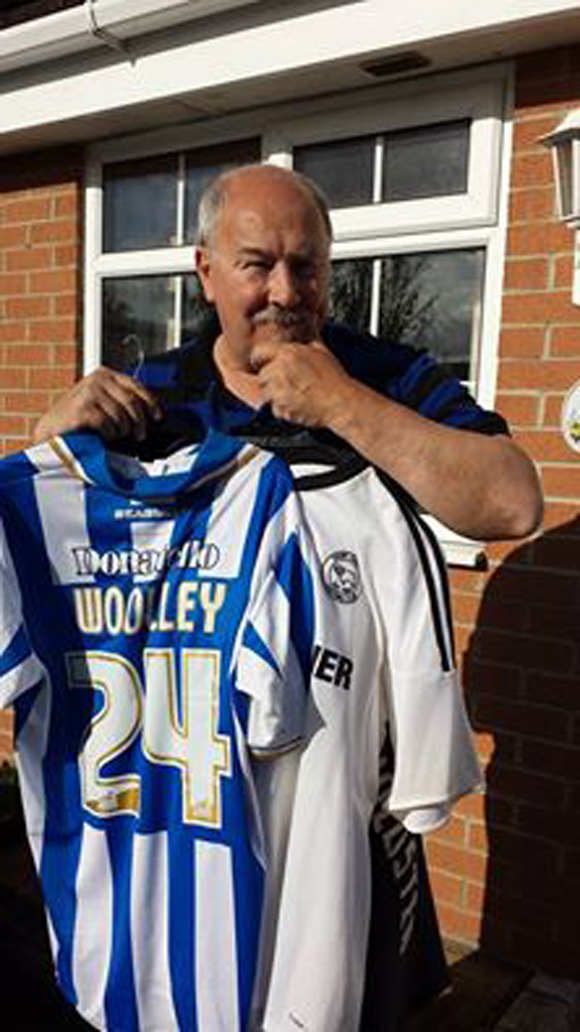
“I’m slightly torn between two teams that are very close to me. In a way I’ve got to be happy if either team goes through. I had great memories at the Albion, but Derby is where I grew up and my home town.”

So says Vaughan Woolley, a reserve centre-back on Brighton & Hove Albion’s books between 1975 and 1978.

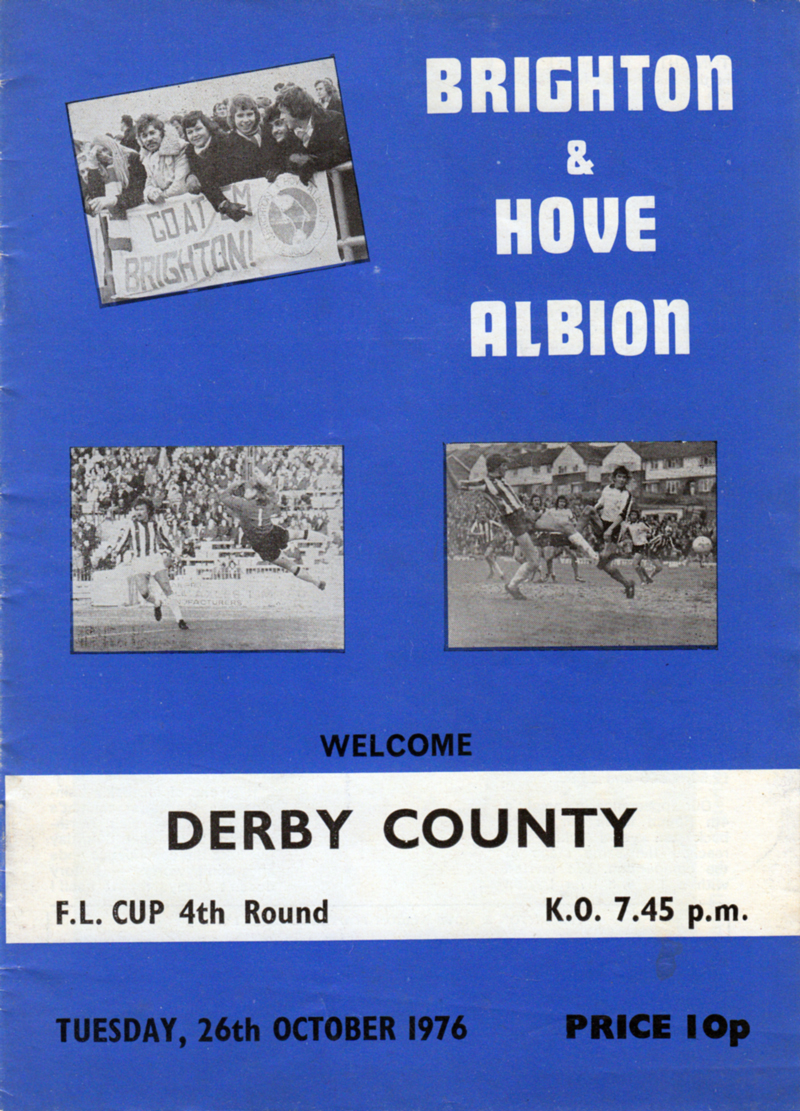
He has Derby County partly to thank for his most unforgettable experience in Albion colours. In the League Cup in 1976/77, Alan Mullery’s high-flying Brighton first team had knocked out Ipswich Town and West Bromwich Albion, both formidable First Division sides at the time. In the fourth round in October 1976, the Third Division outfit faced a star-studded Rams team featuring seven internationals including Roy McFarland, Colin Todd, Charlie George and Leighton James.

derby

With demand for cup tickets running high, the Albion’s marketing team came up with the novel idea of making them available at the reserve match with Charlton that month. In all, 17,554 watched as Brighton reserves ran out 3-0 victors against the Addicks’ reserves.

“We only used to get around 800 to 1,000 fans for normal reserve matches at the Goldstone, but they were selling cup tickets for the Albion match against Derby County,” Vaughan says. “When I ran out the ground looked full. The Argus published an article about me in 2009 about the match and the fact that so many fans went to see the reserves when the first team at Withdean was only getting around 8,000.”

And to cap it all, Vaughan got on the scoresheet and spectacularly dived into the fans! “Chris Cattlin, who latterly became the Seagulls manager, also scored one. I remember mine clearly. It was just before half-time. I was playing left side midfield on that occasion. We won a corner. Tony Towner took it, and I rose high to head into the top right corner. I was ecstatic, so I just continued running past the goal and lunged into the celebrating fans. Great memories, I just loved playing at the Goldstone Ground.”

Not that left midfield was his normal position: “I came to Brighton as a centre-back. I remember Peter Taylor who was the manager of Albion at the time told me that he wanted to build the future Brighton team around me and Robin Madden, another reserve team player from the Worthing area. It didn’t work out unfortunately for either of us.

“I was quite versatile as I could kick as well with either foot. So I ended up playing in midfield as well. I was gutted in a way when Albion signed Mark Lawrenson as he played in my position, plus he was a record signing at the time so it made things difficult for me.”

Peter Taylor and Brian Clough both knew Vaughan from Derby as he was captain of Derby Boys when at school. Another Brighton reserve, Stephen Ward, and Vaughan grew up together, went to the same school, Noel-Baker, and played for Derby Boys at the same time. Vaughan reminisces: “Steve Ward was my best friend at school. He was very skilful but not the quickest of players. He went on to play for Halifax Town and Kettering Town. I lost touch with Steve in recent years as he moved out of the Derby area.”

“Steve joined Albion in June 1975. As for me, I was originally asked to go on trial at Brighton for six weeks that August. After the first week I was asked to sign as an apprentice. Of course, I said yes and loved every minute of it. Moving to the south coast was possibly the toughest thing, moving away from my family and not able to travel home that often. I guess I was a little home sick.”

You must have encountered the subsequently more well-known Ward, Peter (no relation to Steve!), in the reserves, just before he broke in the first team?

“I loved my time at the Albion and frequently in training had the pleasure of marking Peter Ward. I thought I always did quite well in marking him but his history speaks for itself. He was certainly a legend of the club. I used to get on with Pete really well. He was also from Derby. I saw Pete several times in Derby in subsequent years and since then I bought and read his autobiography. Very interesting!”

Vaughan believes he also got close to making a breakthrough: ‘I think I was being thought of for first team, I had scored the home reserve game the week before the Charlton game. We played Northampton Town and I scored a header in a 2-2 draw. I also played in Brighton & Hove Albion ‘Select’ 11 when we played local town teams in the Sussex Cup matches. As well as this, I also played in a behind closed gates friendly against Fulham. This was mostly consisting of first teamers and I started the match. It was unfortunately marred when Sammy Morgan went into a tackle with the Fulham left-winger and unfortunately broke the lad’s leg. It was a nasty compound fracture.”

Apart from the two Wards, which other reserve players does Vaughan remembers most vividly? “There was a decent young lad join as apprentice from the Brighton area, Glen Geard. He went to school in the Brighton area. He was a real laugh, a bit cocky and full of himself but genuinely a nice lad. I think he might have gone on to play for the firsts. There was also Mark Elliott, a Welsh lad, really nice. He made his debut but didn’t play much. After I left, another of my friends from the Derby area joined the Seagulls, a lad called Tony Vessey. He was a centre-half who made an appearance for the first team. Not sure where he ended up afterwards. Might have gone to the States to play!”

Well, Tony Vessey had an illustrious non-league career with Crawley. He also played for them against Brighton in the FA Cup 3rd Round at the Goldstone in January 1992. To which, Vaughan replies: “Crawley, that’s interesting because I was in digs or lodgings in Portslade by Sea with two other guys, Eric Steele who helped teach me to drive. Now he’s the goalkeeping coach at the Rams. Also, a lad named Carmine Porpora, He also played for Crawley. He was released by the Albion after his apprenticeship. I met up with him and my old landlady for a meal down at the Marina a couple of years back. ‘Pop’ as he was known played for time in Italy, in their second division, I think. He played in same team as Claudio Ranieri apparently. He went on to play for Crawley Town in the 80s, I believe.”

Sadly, Vaughan Woolley didn’t make any appearances for the Seagulls’ first team: “I made a decision to leave Brighton in the summer of 1978. On reflection I was foolish but I had no agents, mentor or father figure to guide me. I asked Mr Mullery to pay me more otherwise I would have to leave. He said he wasn’t paying me any more, so I’d set myself up. I wished I hadn’t.”

After Brighton, Chesterfield were interested in signing Vaughan. However, he became disillusioned after leaving the Seagulls and really wanted time out: “I signed for a local team and played in the East Midlands Regional league mainly playing teams in Derbyshire and Notts area. I enjoyed my football and was with my old friends. I think, on reflection, I needed guiding by someone but that didn’t happen. I was basically on the dole. I joined Rolls-Royce and have worked there ever since. It’s all history. As I say, you have to accept what you do and the decisions you take in life. But if I have one regret it is leaving Brighton. If I could have played the way I did in the years following my departure, who knows what might have happened?”

How did you develop as a player after leaving the club? “I matured in the years after that and became a better and stronger player,” Vaughan contends. “However, I seriously broke my leg in two places in 1984 and that finished my playing career, aged 25. Oh well. I cannot get too regretful as many lads just don’t get the chances that I did.”

Have you been back to watch Brighton & Hove Albion? “I have been to the Amex, I went to one of the first games there with my son against Gillingham. I would have played to have played there. What a stadium! But it doesn’t hold the memories of the Goldstone. Anyway, I look forward to watching the Play-Off semi-final game this next week and hope whoever wins go on to promotion.”

Any predictions? “I think it will be 1-1 at the Amex and 2-0 to the Rams at the iPro,” Vaughan reveals. “Sorry to all Seagulls fans, but my head is ruling my heart. Best of luck to all involved, though.”

vaughanwoolley2

Tagged , , , , ,

Gully is a girl!

As you can see, Gully looked rather different in its early 1990s form:

gully

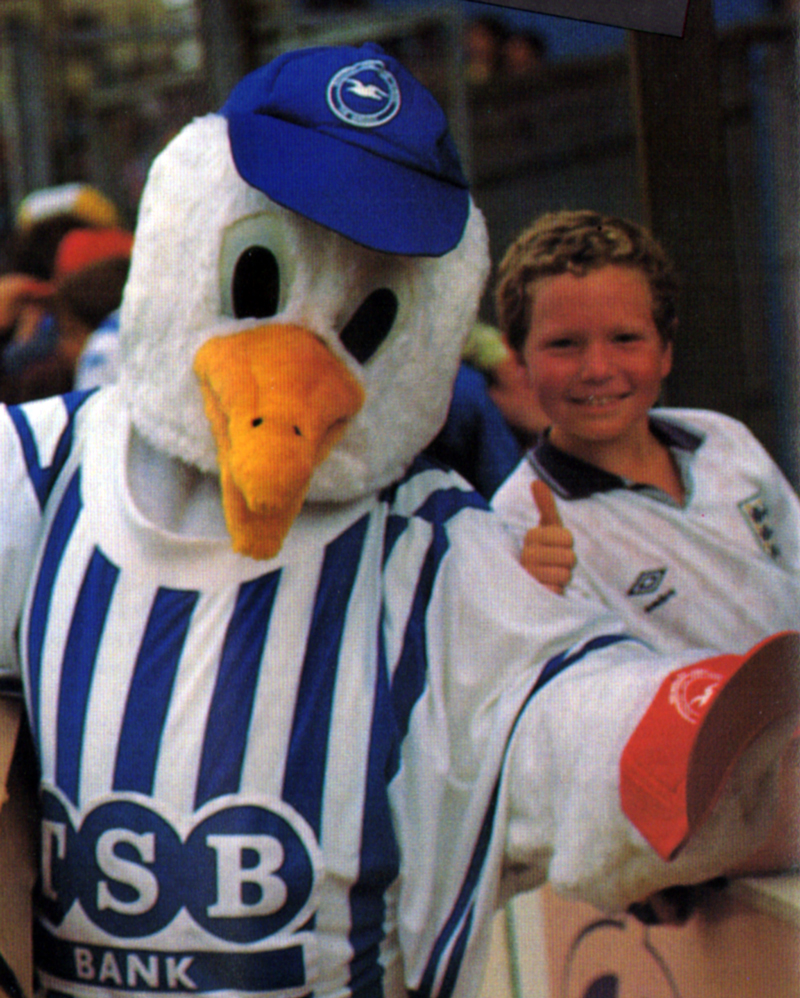
In the Seagulls News Autumn Edition 1991/92, the origins of Gully, the Brighton & Hove Albion mascot, was revealed:

gullyidea

Gully has been brought to life at the Albion by Mike Cuerden, the newly-appointed Press and Public Relations Manager.

Last year the character was used for the first time as a cartoon character in leaflets produced by Albion’s Lifeline Club.

Said Mike: “There was a good reaction to the character and I thought the club could benefit if the character
became life-size and was able to appear at various functions.”

He added that it was important that Gully should become a warm and friendly character which would enable the fans to identify with the image which “we at the Albion want to portray”.

“We are a friendly club who care very much for our fans, and if this enables us to get over the message all the better,” explained Mike.

According to the PR Manager, Gully also has an important role to play in ‘warming up’ the crowd before the kickoff. The appearance of Gully by the ‘dug-out’ heralds the arrival of the teams, encouraging enthusiastic support.

And to top it all, the magazine then shattered a million childhood illusions by revealing that Gully was a mere costume worn by a young woman:

Alison Norris

The secret is out! Gully, the Albion’s friendly, feathery mascot, is pretty 24-year-old Alison Norris.

The cheeky Brighton character introduced at the Goldstone Ground at the beginning of the season has become the darling of the fans and an established part of the soccer scene.

Performing different roles is no new activity for Littlehampton-born Alison, who went from her local comprehensive to the Cardiff Drama School six years ago.

“I really enjoy playing the part of Gully and I look forward to the home matches so that I can don the outfit and go out and about around the pitch,” said the slightly-built actress.

Alison, who currently manages a local restaurant, explained that she has appeared in plays ranging from dramas to comedies. She has already written six shows that have been performed for children and young adults.

“When I was asked to do Gully I was delighted,” explained Alison, who added: “I love making children happy and there is no doubt that Gully is a real personality that the fans look forward to seeing at home matches.”

It takes Alison just five minutes to don the outfit that consists of yellow tights, plastic feet, body outfit and head.

She added: “I’m getting to know many of the fans by name now. They even feed Gully. They have found out how to push sweets and crisps through the beak!”

* And just a quick reminder: This blog is coming to an end as a daily blog in 49 days, on 25th June 2014. The entire archive will remain online, and there will be occasional new posts but it won’t be a daily beast any more!

Tagged ,