Yearly Archives: 2013

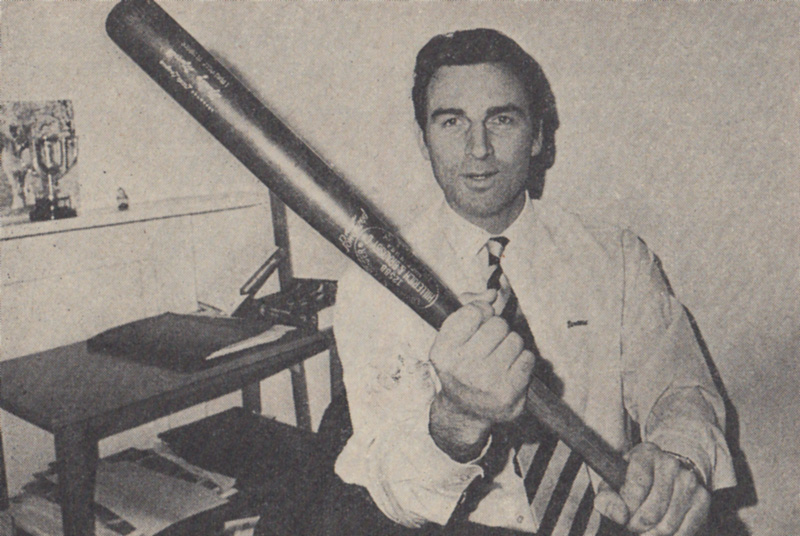
Think big! Pat Saward wields his baseball bat

patsaward

Here’s manager Pat Saward showing off a momento from an American trip that went a long way towards changing his football thinking. As he said in Football League Review in 1972:

“I asked a lot of questions from people in the know. They told me you have to think big to get anywhere. We think big. We may be a Third Division team but we all think in terms of being a First Division outfit. If you don’t think big in football you’ll never win anything.”

Saward was a highly respected player with Millwall, Aston Villa, Huddersfield Town and Coventry City before hanging up his boots at the age of 33 to break into management as assistant to Noel Cantwell at Coventry. There his re-education in the game began. On a close-season tour to the United States, he realised the extent to which English football has to catch up on the public relations side. “I learned a hell of a lot out there. They get into a frenzy about the game in America because they’re so involved. This is how I want everyone at Brighton to be now.”

“My big mistake when I came here was still thinking in terms of the First Division. I had a First Division outlook and did not adapt at first to the differing problems of the Third Division. But it was a natural mistake to make. We’ve had no money to speak of for rebuilding. Everyone is looking for the best, aiming for Mount Everest, but you have to adjust your sights. Even so, not every player will do for me. I want players with character, the Maurice Setters type.

“We loaned Brian Bromley from Portsmouth before eventually signing him permanently and it was the best move I’ve made. You know, I look on players in two ways. There are some I feel uneasy about when they get the ball, others I sit back and watch quite relaxed. Brian is one of the latter. He’s an exceptional player, one who instils and builds confidence in those around him. He can do anything I ask for because he has both ability …and character.”

bromley_large

“I realise now how teachers feel when they see all their thoughts and ideas, all their long hours of patient work bearing fruit. Management is a vocation. You get wonderful satisfaction out of moulding players to your ideals. When you see young kids coming through and developing you get a fantastic feeling of satisfaction. It’s great.”

Saward’s positive approach spurred Brighton to winning promotion to the Second Division in 1972, after a season of all-out attacking play that yielded 43 away goals in the League.

Tagged ,

Psycho’s brother bother

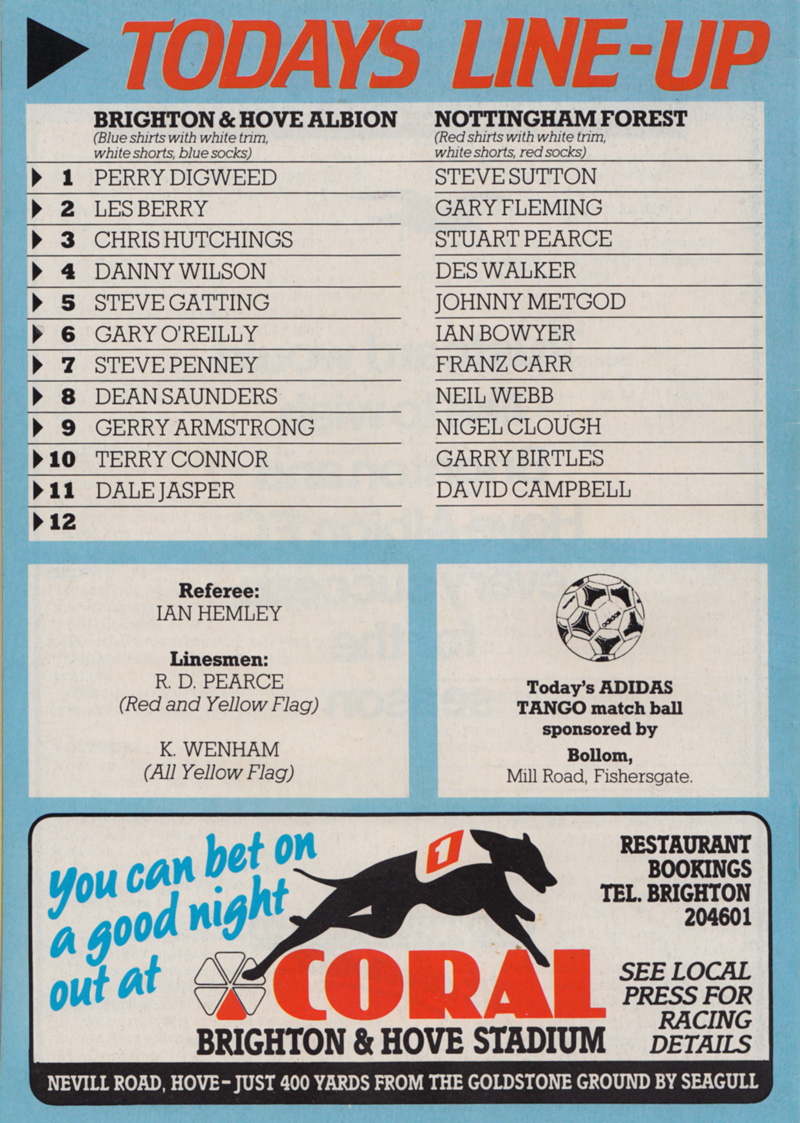
Here’s the back of the programme for the first leg of the Brighton’s cup tie against Brian Clough’s Nottingham Forest in the Littlewoods Cup in 1986.

rdpearce

Take a glance at the name of the linesman with the red and yellow flag, R.D. Pearce. Surely just a coincidence that he has the same surname as Forest’s left back? Or is it?!

Writing in ‘Psycho,’ his autobiography, Stuart Pearce explains how his brother Ray took up football officiating, eventually finding his way to running the line at the Goldstone Ground:

He progressed through non-league into the Football League and ran the line in top matches. The big age difference between us meant that when he was asked the usual questions about whether he had any relatives in the game he answered quite truthfully that he had not.

I’m not sure that makes complete sense, unless Ray Pearce was only ever asked the question only once, before Stuart became a pro…

Anyway, the punk-lovin’, tough tacklin’ Pearce continues:

stuartpearce2

A trivia question that would flummox even the most knowledgeable football fan is when did two brothers take part in the same game with one playing and one officiating? It happened to us when he ran the line in a Nottingham Forest League Cup tie at Brighton. He disallowed a goal for Brighton! I had no fears, however, about his honesty. He would err on the side of Brighton rather than favour me.

No one knew, apart from the Forest team. It was funny running up the wing and having my brother alongside me on the touchline. He could have booked me because I kept taking the mickey out of him – ‘Oi, you ginger dickhead,’ is one thing I remember calling him. Perhaps it is a good thing that he never became a League referee because it would have come out eventually that he was my brother.

Is it too late to demand a replay?

Tagged

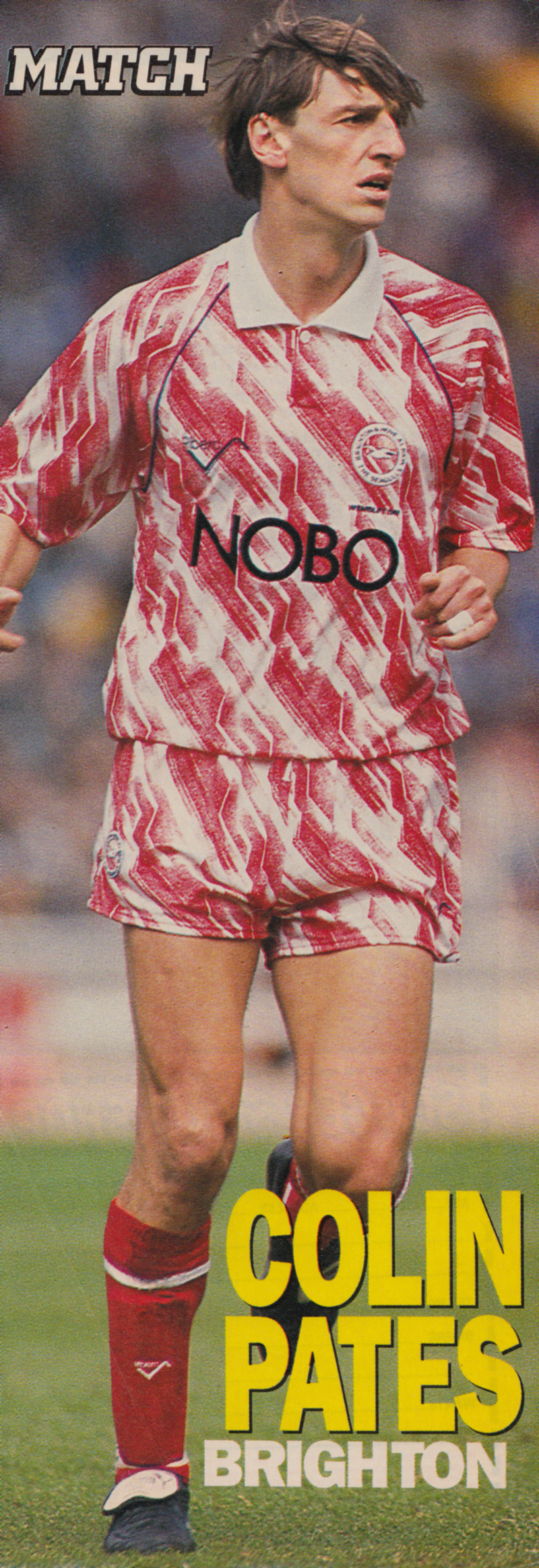
Colin Pates in Chewits wrapper circa 1991

colinpatesOne of the worst kit designs in Albion history. Its unveiling at the 1991 Play-Off Final at Wembley to Notts County ensured the Brighton team waved goodbye to their chances of top division football.

On the day, despite hitting the woodwork through Clive Walker, the Brighton side flattered to deceive. Perhaps it was because they were snookered by the five-man midfield that County boss Neil Warnock employed. Or maybe Notts County simply had a psychological edge from facing an embarrassed Albion team dressed up as sweet wrappers. Say what you like about the intricate patterns and unusual hues – it was hardly going to strike fear into the opposition to be dressed like that!

Central-defender Colin Pates had joined Brighton on loan from Arsenal. After finding it hard to crack into the Arsenal side with competition from the likes of Tony Adams, David O’Leary and Steve Bould, he arrived at the Goldstone Ground and was ever-present from his debut in March 1991 to the Wembley final. However, even with Pates’ first division experience and the knowhow of Stefan Iovan, European Cup winning captain of Steaua Bucharest in 1986, they couldn’t stop the Seagulls from tasting defeat.

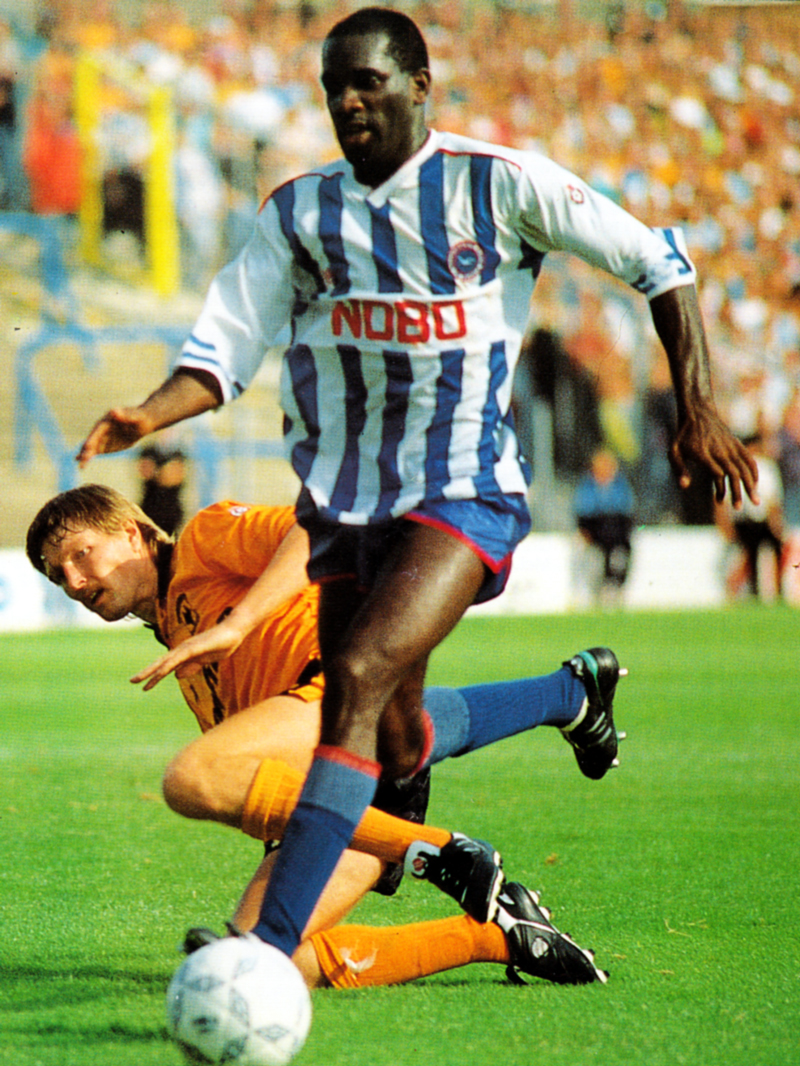
The trend that continued into the following season with Albion turning into relegation candidates. This shirt – with TSB replacing NOBO as sponsors – was worn on Brighton’s travels during wins at Millwall, Newcastle and Grimsby. However, it wasn’t enough. The Seagulls went down to the Third Division where they at least managed this win at Wigan, courtesy of a cock-up by the Latics keeper.

Nigel Adkins, look away now…

Tagged , ,

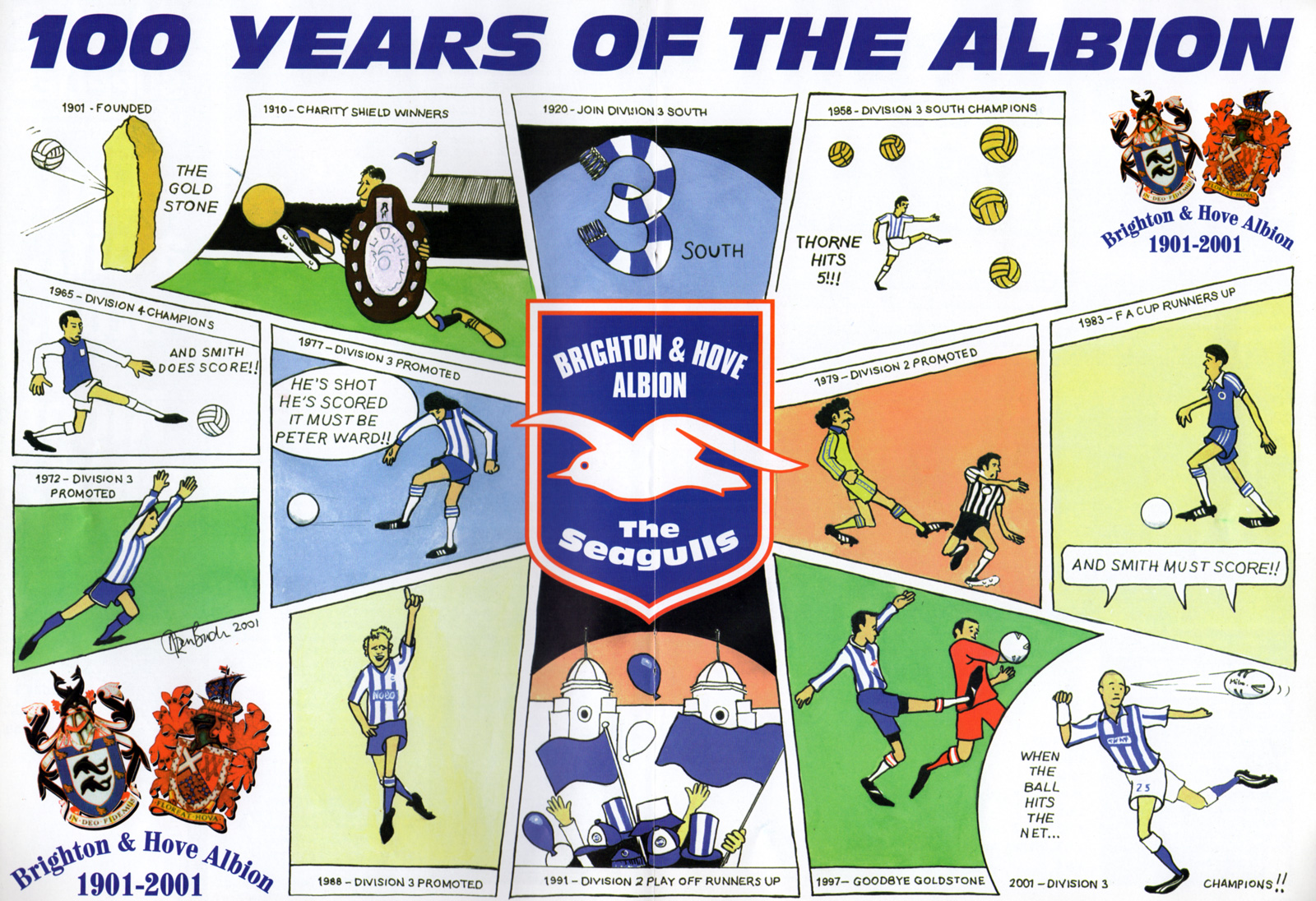
100 Years of the Albion

A pleasant illustrated history of the Albion, from the Brighton v Bournemouth programme from September 2001:

100yearsofthealbion2

Click image to expand it.

Tagged , , , , , ,

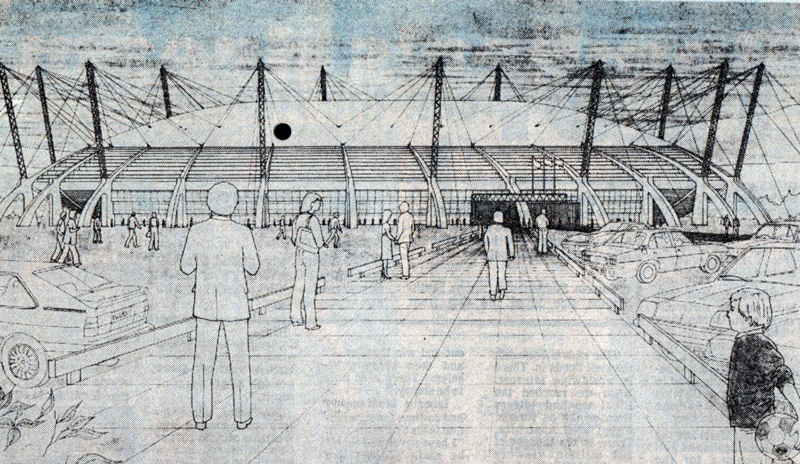
Bamber’s dream of a future stadium

newstadium

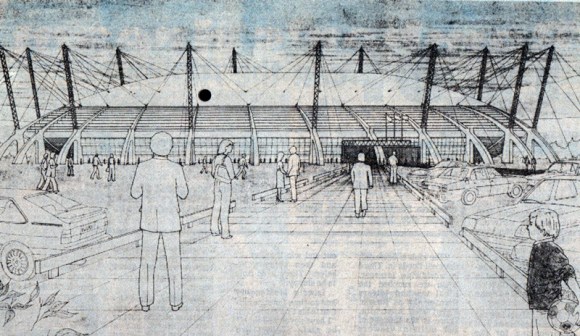
I found this amazing artist’s impression of the club’s proposed new home in a copy of the Evening Argus in 1983. It’s rather laughable now to see the suggested design captured by this rather primitive looking sketch. Even more laughable that it’s so talked up:

Architects will tour the United States before drawing up final plans for Albion’s £8 million super stadium.

Henry Carn, of the Hove firm of Morgan, Carn and Partners, believes a two-month stay would be needed to catch up with advances in design.

They are determined not to make mistakes like that which occurred with one U.S. stadium which generated its own atmosphere… and thunderstorms.

Albion’s planned stadium is currently designed with 25,000 seats, although Chairman Mike Bamber might opt for 20,000 seats and space for 10,000 standing fans.

Areas under the seating would be for office use or other sporting activities. Around the playing pitch would be a running track to attract local and regional athletics meetings.

I wonder at what point was a consensus reached that athletics tracks spelled bad news, with the cost to the atmosphere at football games eclipsing the financial gain of athletics events. Certainly not in 1983. At least not here. Of course, Brighton fans did end up watching home games on a pitch surrounded by an athletics track – at Withdean Stadium from 1999 to 2011.

The structure above ground would be ringed by precast concrete arms. Between these would be overlapping concrete planks which allow in air but keep out rain. The roof cover would be made of polycarbonate translucent sheeting hung from steel masts and cables.

That would be some eyesore! If we had got this design, would we have been stuck with it?

The sheeting would allow natural light through to the playing area while artificial lighting would be slung below the inner edge of the overlapping concrete roof planks.

Like Mr Bamber, Mr Carn believes fans now demand much better facilities than the Goldstone Ground offers.

“It’s not necesarily just the men who want to see matches now. Soccer is much more a family activity and you need facilities that accommodate families and cut out the aggro we see at grounds today,” he says.

In April 1983, East Sussex County Council’s Policy and Resources Committee offered to hold talks with the club on a new home. It was envisaged that the stadium could be built at any of half a dozen sites on the outskirts of Brighton. Mike Bamber most favoured the site of Waterhall, off Mill Hill:

Close to the proposed Brighton bypass and the main Brighton-London rail line, the site would be easy for fans to reach. But it’s not just soccer fans that would benefit from the development, Sitting in his plush American-style offices in Hove Street, the property millionaire outlined his thoughts on how the stadium would be financed and its variety of uses.

“All we would need from council is the land – the rest won’t cost a penny,” he said.

A supermarket concern would pay for the stadium in exchange for approval to build a giant superstore. Parking space for thousands of cars would be provided for shoppers in the daytime and fans in the evening or at weekends. The development would be set low in the valley to protect the natural beauty of the surrounding Downs. And with soccer being played only once or twice a week, the complex would become a multi-purpose community centre.

Gyms, squash courts, athletics tracks and clubs could be established at the stadium and the main hall would cater to community events and major entertainment. It’s a concept well advanced in North America and one the Government in this country is thought to favour. There would be other benefits for Albion. The sale of the Goldstone would wipe out the club’s debts and put them back into black.

Youth team football pitches adjoining the new stadium could provide valuable prospects for the team. Mr Bamber rejects the idea that the complex would drive trade out of the town centre and he insists the facilities will generate their own business. “I expect to get opposition but I believe we will win through in the end,” he said. “We have a team in the FA Cup Final. All that’s missing is a decent ground. The new stadium will be great for the community and I’m convinced it will bring back the missing fans.”

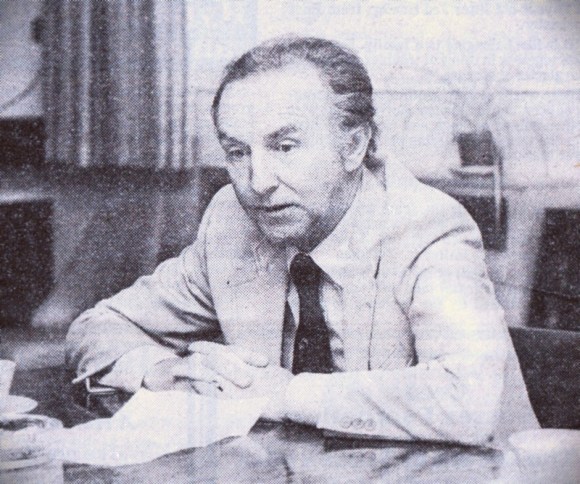
His big dream since becoming chairman eight years ago, Mr Bamber believes the stadium could be the first of many in Britain and would rival some of the greatest centres in Europe. “People are much more upmarket these days,” he said. “The days of the cloth-cap terraces and the cup of tea and hotdog stands are over.”
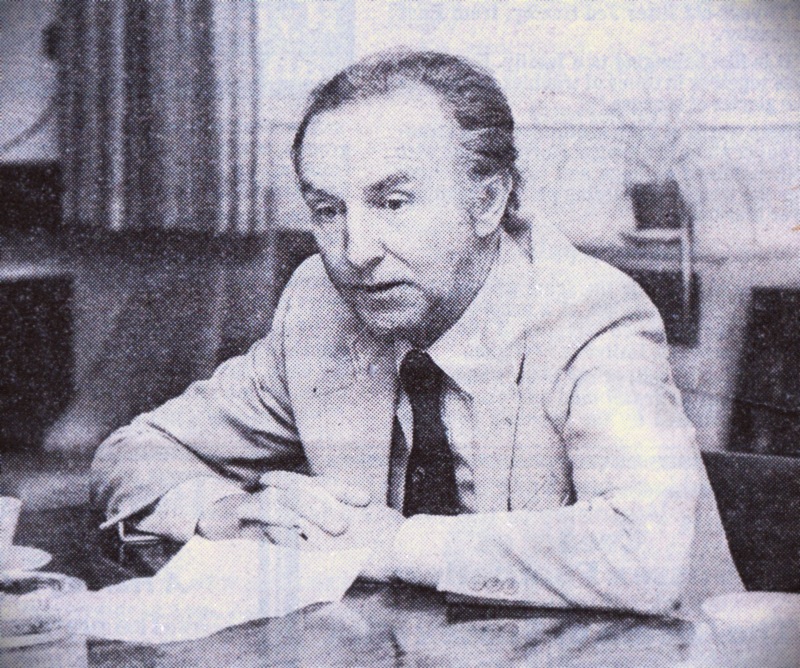
mikebamber2

Sadly. relegation from Division One, financial difficulties and boardroom unrest took their toll on Mike Bamber. He suffered a heart attack in March 1984 and resigned as chairman and director in July, citing ‘major and mutual disagreements on policy.’ As a result, his plans for a stadium never got off the ground.

Tagged ,

Small, Codner, Wilkins

Here’s Mike Small

mikesmall

Here’s Robert Codner

robertcodner

And here’s Dean Wilkins

deanwilkins

All excellent players on their day. All plucked from non-league football or as English players brought back from abroad, hallmarks of a Barry Lloyd signing for the club at the time.

On Saturday 15th September 1990, all three players scored for Brighton in a 3-2 victory over Charlton Athletic at the Goldstone Ground. Small, Codner, Wilkins. Nothing unusual about that.

The following Wednesday, 19th, Brighton played their next match, against south coast rivals Portsmouth, again winning 3-2. And you’ve guessed it, the scorers were… Small, Codner and Wilkins. In that order. I wish I could say the attendance was exactly the same for both games, but that wouldn’t be true!

Then, the next Saturday, Brighton were away to Bristol City, 2-0 down at half-time. Could the miraculous happen again with a stirring 3-2 comeback courtesy of our famous goalscoring trio? Sadly, it was not to be. Although Mike Small scored, Codner and Wilkins didn’t and Brighton ended up losing 3-1.

Tagged , , ,

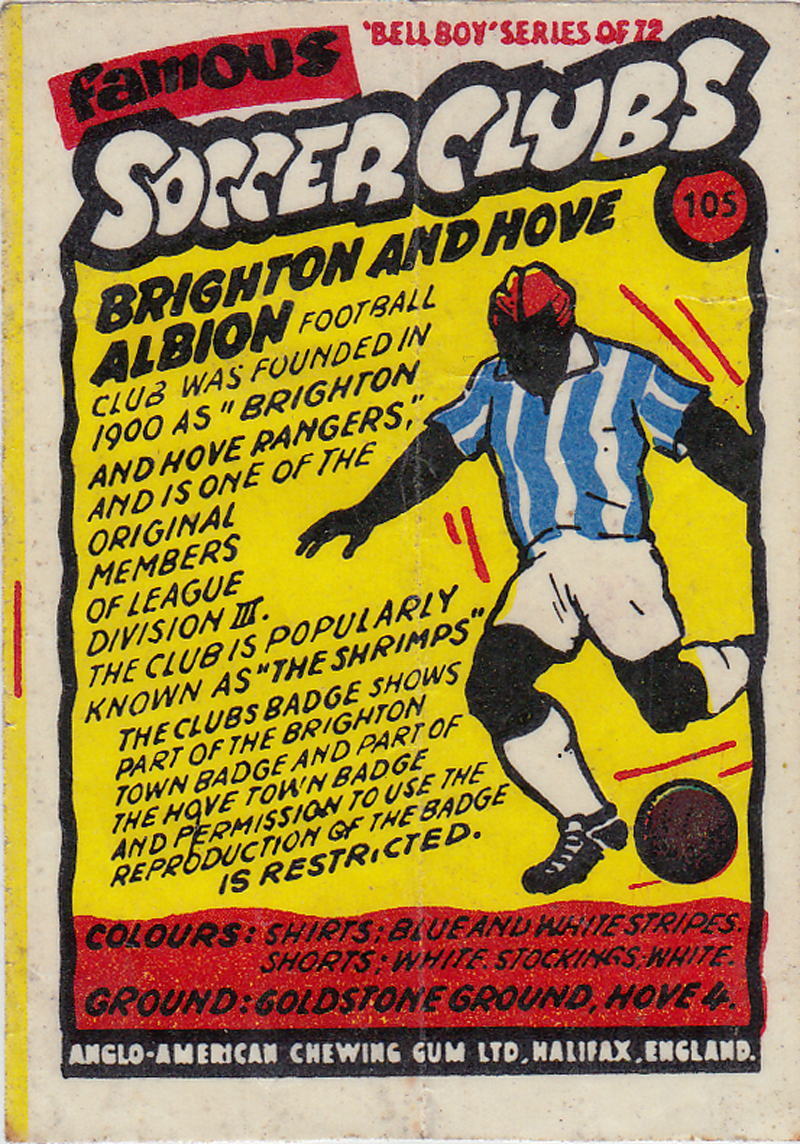
Rare chewing gum wrapper featuring Brighton

angloamericanchewinggum

Would it be churlish to point out how a lot of the ‘facts’ of this chewing gum wrapper are wrong? I’m not sure when this item produced by The Anglo-American Chewing Gum Ltd came out. We didn’t have a combination of shirt, shorts and socks that exactly looked like that. However, I guess it’s the late 1950s or early 1960s judging from the rough approximation of our kit design.

Tagged

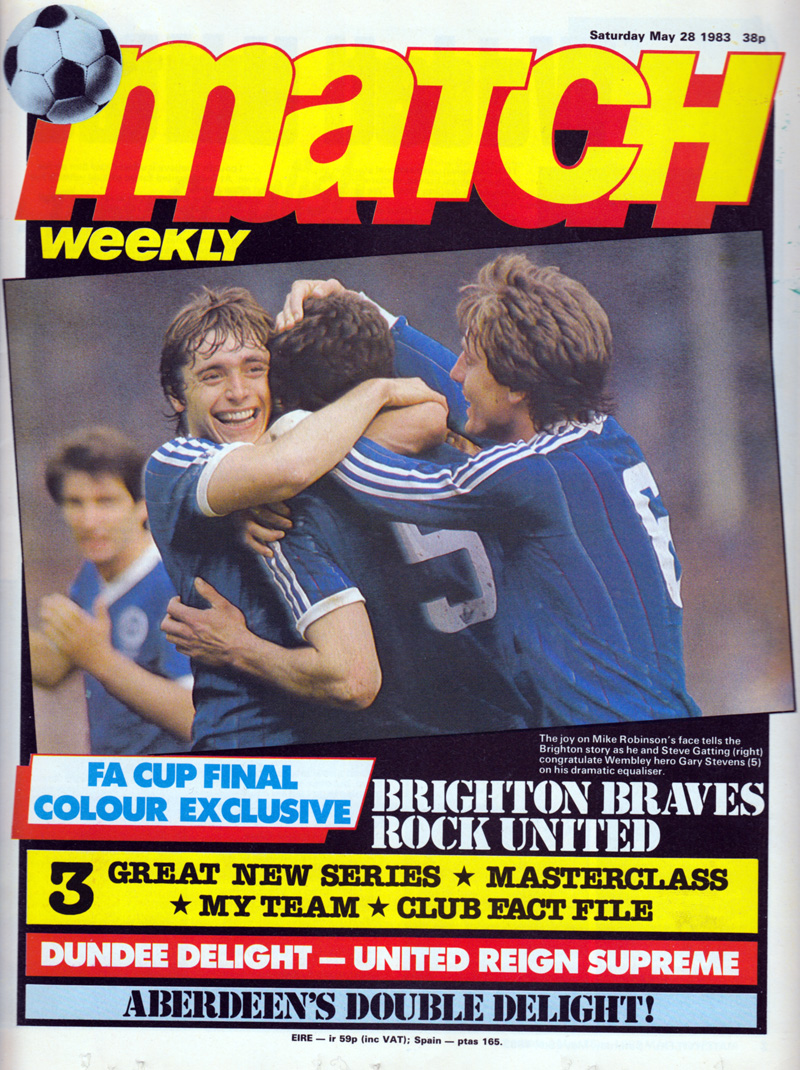
Match Cover: Michael Robinson, Gary Stevens and Steve Gatting (28 May 1983)

Match cover 2

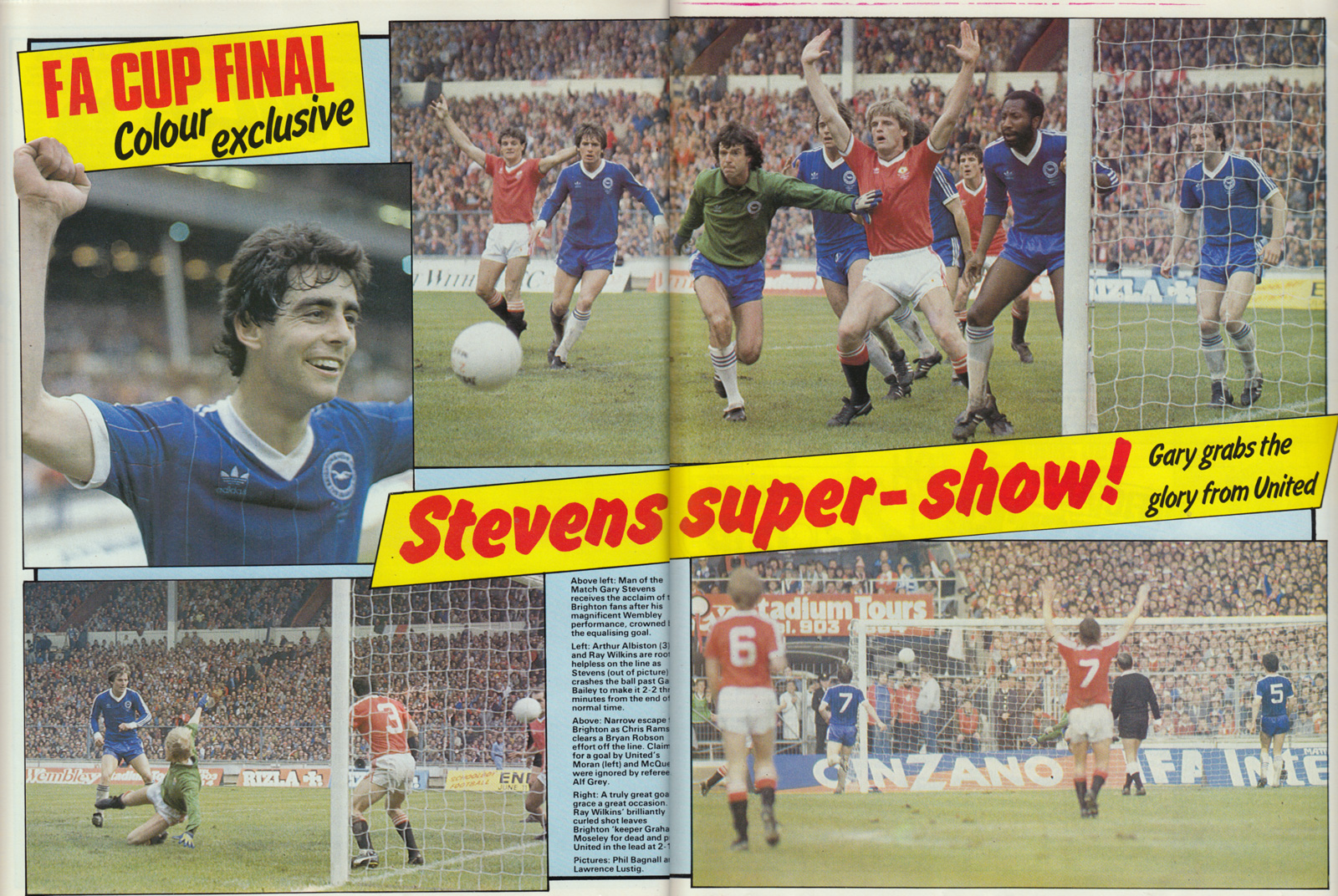
A quite magnificent cover capturing the joy of a Brighton team scoring at Wembley. Gordon Smith, in the background, gives polite applause. His moment of truth was still to come.

Inside the magazine, Tony Grealish declares, ‘We let United off the hook,’ while the magazine takes the credit for an uncanny prediction the week before:

It will have come as no shock to ‘Match’ readers that Brighton took an early lead against Manchester United. We told you it was on the cards last week in an exclusive guide to the goal power of each side.

This is what we said: ‘Brighton re the faster starters and may well go a goal up inside 15 minutes but United are worth an equaliser on past form.

After the break it could be United’s turn to go ahead, but ‘Seagulls’ fans shouldn’t despair if their team is behind with just fifteen minutes to go, because that’s when the underdogs from the South coast are most likely to hit the net.’

Uncanny! It sounds like the work of clairvoyant Eva Petulengro…

Inside, there is also a glorious colour two-page spread.

match final coverage

Tagged , , , ,

Albion Ladies in the 1970s

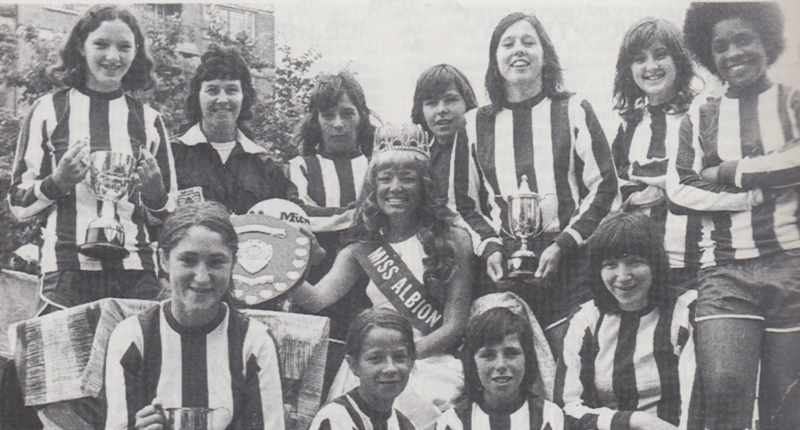
ladies team

From the Brighton v Oxford programme in 1990/91:

The photograph was one of the first that was taken of the Albion Ladies team founded in 1969 by long time Brighton supporters Christine Read (née Basilio) and Jean and Alf Walker and financed by the Supporters Club. Christine and her mother, Janet, played in the team in 1971 and are still season ticket holders, as is Christine’s 11 year old daughter who hopes to play for the Albion Women’s team.

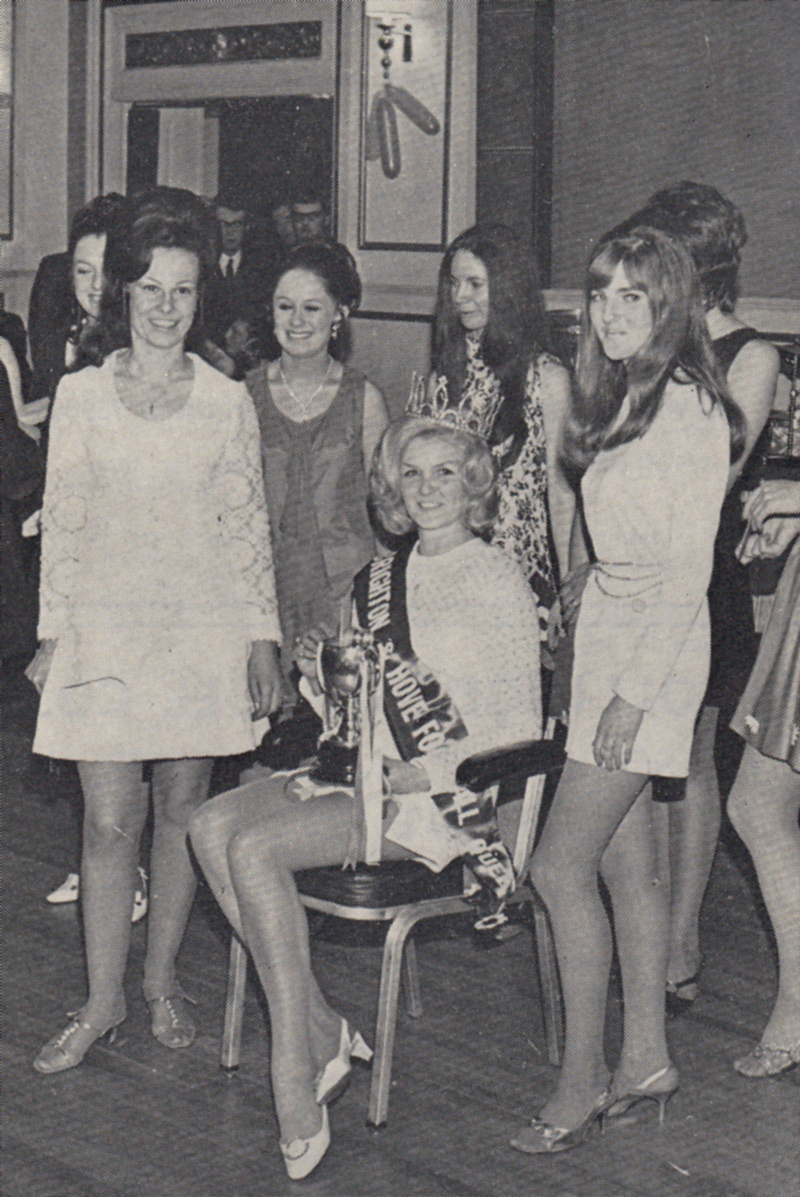
Pictured with the team in the above photo is Miss Albion, Maureen Beech (centre in the photo below), who won despite competition from runner-up Sandy Straw (right) and third-placed Patricia Leahy (left).

missalbion

OK, it’s not quite up there with Coventry City’s match programme’s rather salacious ‘Girl of the Match’ feature. Even so, the above photo came about via a valiant attempt to smuggle some sex interest into the pages of the Brighton & Hove Albion Supporters’ Club Official Handbook for 1970/71. Not sure the club would get away with such a competition these days!

Tagged , ,

Brighton rocks with Steely Dan fan Giles Stille

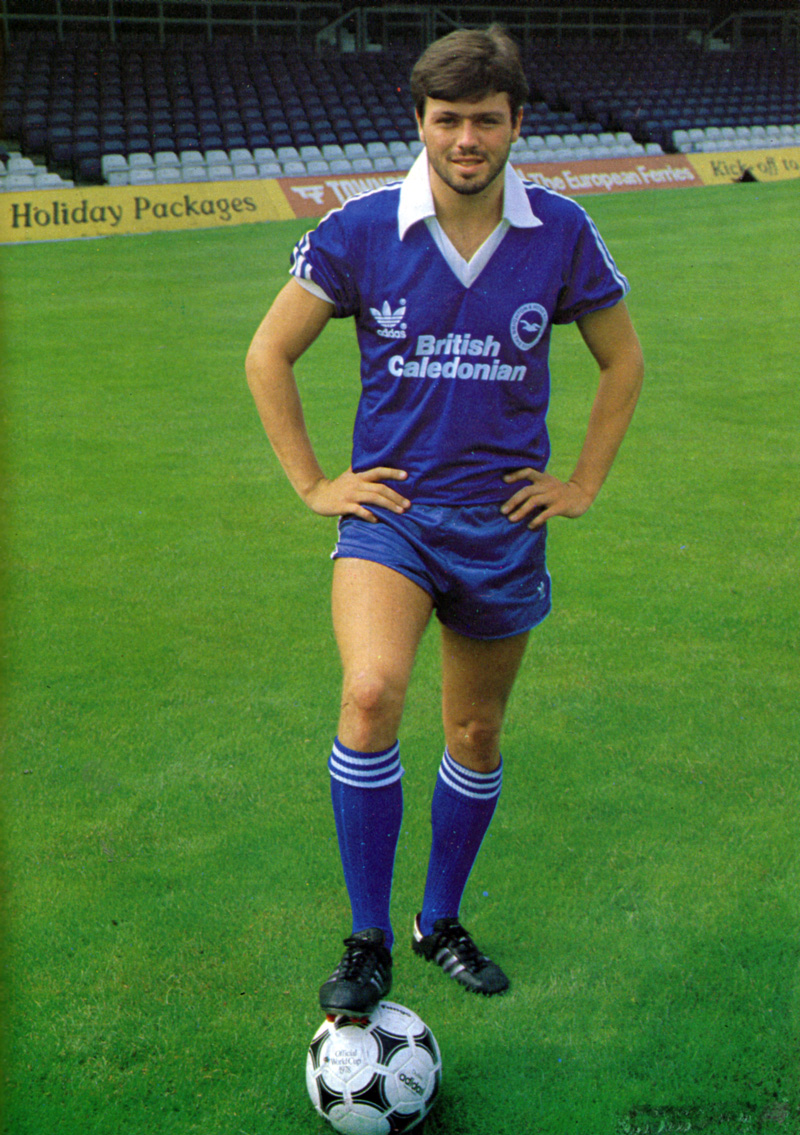
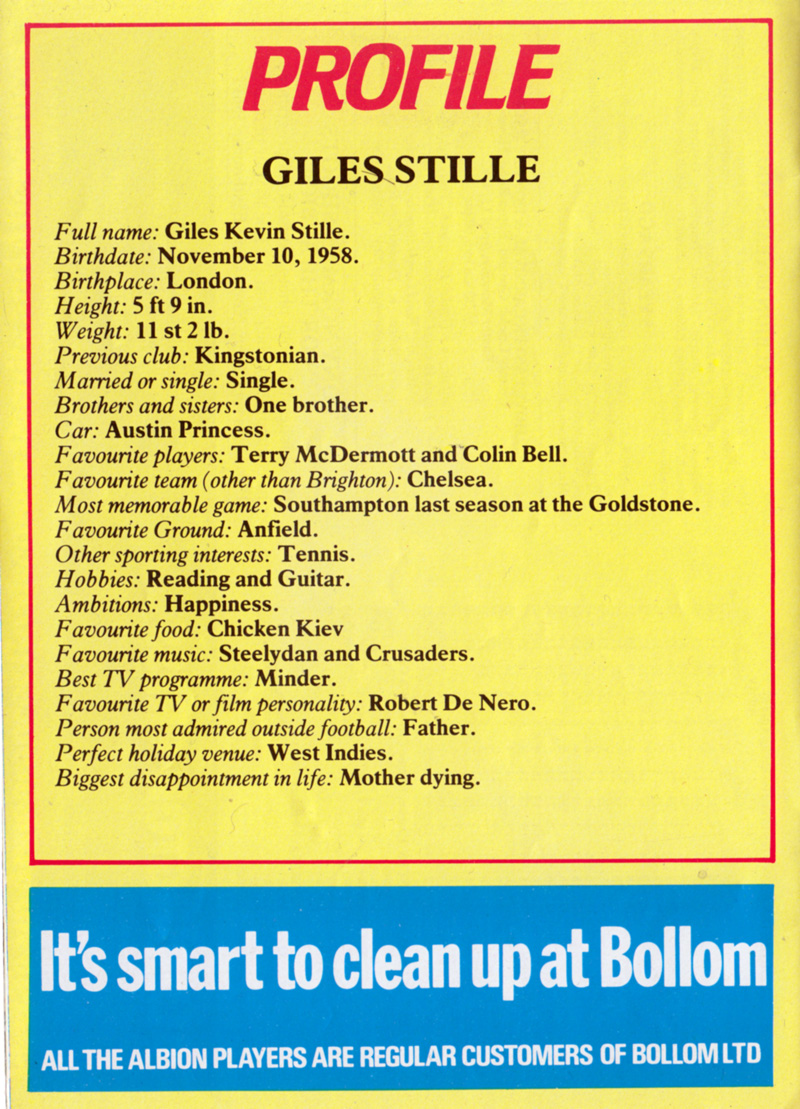
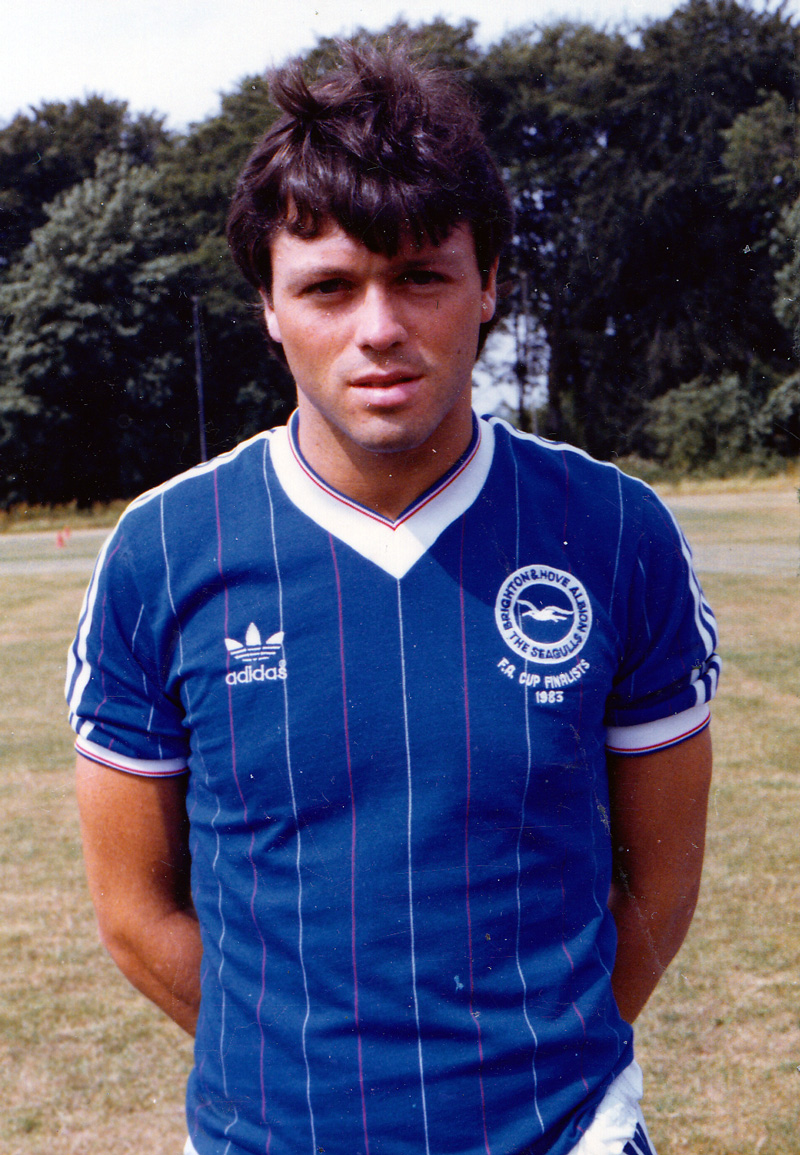
Here’s the magnificently named Giles Stille, fan of Steely Dan, chicken kiev and Minder, proudly showing off the resplendent flared collars of the adidas British Caledonian kit of the early 1980s.

The young bearded Brighton midfielder made his debut as a substitute in December 1979 against Manchester City. Then he really made an impact the following season with a burst of three goals in five matches as he enjoyed an extended run in the side in February and March 1981.

stille

gilesstille2

Shoot! Magazine took up the story:

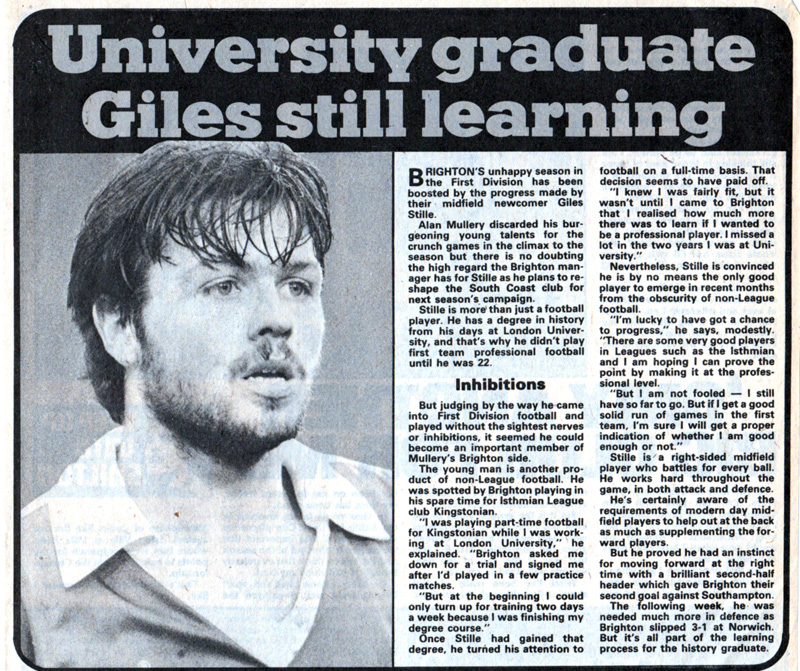
Brighton’s unhappy season in the First Divsion has been boosted by the progress made by their midfield newcomer Giles Stille.

Alan Mullery discarded his burgeoning young talents for the crunch games in the climax to the season but there is no doubting the high regard the Brighton manager has for Stille as he plans to reshape the South Coast club for next season’s campaign.

Stille is more than just a football player. He has a degree in history from his days at London University, and that’s why he didn’t play first team professional football until he was 22.

“I was playing part-time football for Kingstonian while I was working at London University,” he explained. “Brighton asked me down for a trial and signed me after I’d played in a few practice matches. But at the beginning I could only turn up for training two days a week because I was finishing my degree course. I knew I was fairly fit, but it wasn’t until I came to Brighton that I realised how much more there was to learn if I wanted to be a professional player.”

Stille is a right-sided midfield player who battles for every ball. He works hard throughout the game, in both attack and defence. He proved he had an instinct for moving forward at the right time with a brilliant second half header which gave Brighton their second goal against Southampton.

stille3

There was to be no new season for Mullery to help develop Stille as Mike Bailey became Albion boss, and Stille only made three League starts in 1981/82. The first of these was a home game with Leeds United, and Stille’s first half winner kept Albion soaring high in ninth position. In 1982, he had to cope with being diagnosed as diabetic. Nevertheless, Stille stayed on as a fringe player in the side before a back injury forced his retirement from League football by December 1984.

Stille currently works as a football coach in Sweden. If you’re a Giles Stille fan, I’ve seen that you can buy a t-shirt featuring him at Cult Zeros.

gilesstille4

Tagged