Category Archives: Photo Opportunities

From Alan Young’s autobiography: Jimmy Case goes AWOL

During 1983/84, Brighton & Hove Albion had three Youngs in their squad: Eric Young, Willie Young and Alan Young, none of whom were related! In a seldom seen aligning of the stars in March 1984, all three made the starting line-up in the fixtures against Manchester City, Derby County and Leeds United. It proved a winning combination as Albion drew 1-1 against promotion-chasing City before thrashing both Derby and Leeds 3-0.

Scoring a powerful volley from a Gary Howlett cross in the second half against Derby was Alan Young, a burly striker who was exceptional in the air, yet also had fine technique on the ground. The Scot had been signed by Jimmy Melia in a £150,000 deal for Brighton from Sheffield United in August 1983 as a replacement for Michael Robinson. He announced his arrival at the south coast club in September 1983 with a spectacular overhead kick in his debut against Chelsea.

alan_young

Although he had only one season at the Goldstone Ground, and was in and out of the side with injuries, he was regularly on the scoresheet when playing for Brighton. Thanks to Simon Kimber, who has allowed me to share an extract from Alan Young’s autobiography ‘Youngy’:

I didn’t realise until I looked recently that my goal return at Brighton was pretty decent; I got 12 goals in 26 matches and I really enjoyed my time at Brighton.

The supporters were still recovering from losing the FA Cup Final to Manchester United in 1983 (this was the game when Gordon Smith should have won the Cup for Brighton with a late chance when he was one on one with Gary Bailey) and the whole euphoria of the day and the occasion. I’m not saying that Brighton isn’t a proper football club but in Brighton the football was viewed as part of the entertainment industry. The football they tried to play reflected that and if the fans weren’t being entertained then they got at the players and the manager.

At Brighton we played with a lot of freedom. There were no restrictions. We were allowed to make our own decisions on the pitch. We had the players with the right experience to do that and I’m thinking of international players like Corrigan, Ryan, Grealish and experienced lads like Jimmy Case and Steve Foster. The football was very enjoyable there and never more so than when Jimmy Case and I were playing together; I loved playing with Jimmy. He was very quiet and has a hearing aid because he doesn’t hear too well.

I remember we finished training one day and headed off to Woody’s as usual and then on to the gentlemen’s club for a game of pool. Then everyone starting to drift away and by ten o’clock in the evening there are only about six of us left. (Bear in mind that we didn’t have mobile phones back then so you couldn’t phone up to let anyone know you were going to be late.)

jimmycase9

So I got home and Karen asked me where I had been so I told her and then she asked me if Jimmy had been with us because Lana (Jimmy’s wife) had been on the phone asking if we knew where he was. I told her not to worry because he left same time as me and would probably be home any time soon. The next day Jimmy is nowhere to be seen and nobody knows where he is. So there is a little bit of panic around. Nobody has a clue where he has gone until the following morning at training when Jimmy saunters in, whistling and acting as if nothing is wrong. So I asked him: “Jim, where the f*ck have you been?” and he looks at me and says “What do you mean?.”

I said “Jim, nobody knows where you have been, we’ve been panicking”.

Then he smiles and goes. “Ha! The Avenue” and I’m like “The Avenue? What Avenue?” and he says “The f*cking Avenue de Champs Elysee!.” Then he tells us how, after we all went our separate ways that night he fancied going to Paris! So he went up to Gatwick and jumped on a plane to Paris. He showed us the stamp in his passport to prove it – he had gone to Paris for a day just because he could and he fancied it.

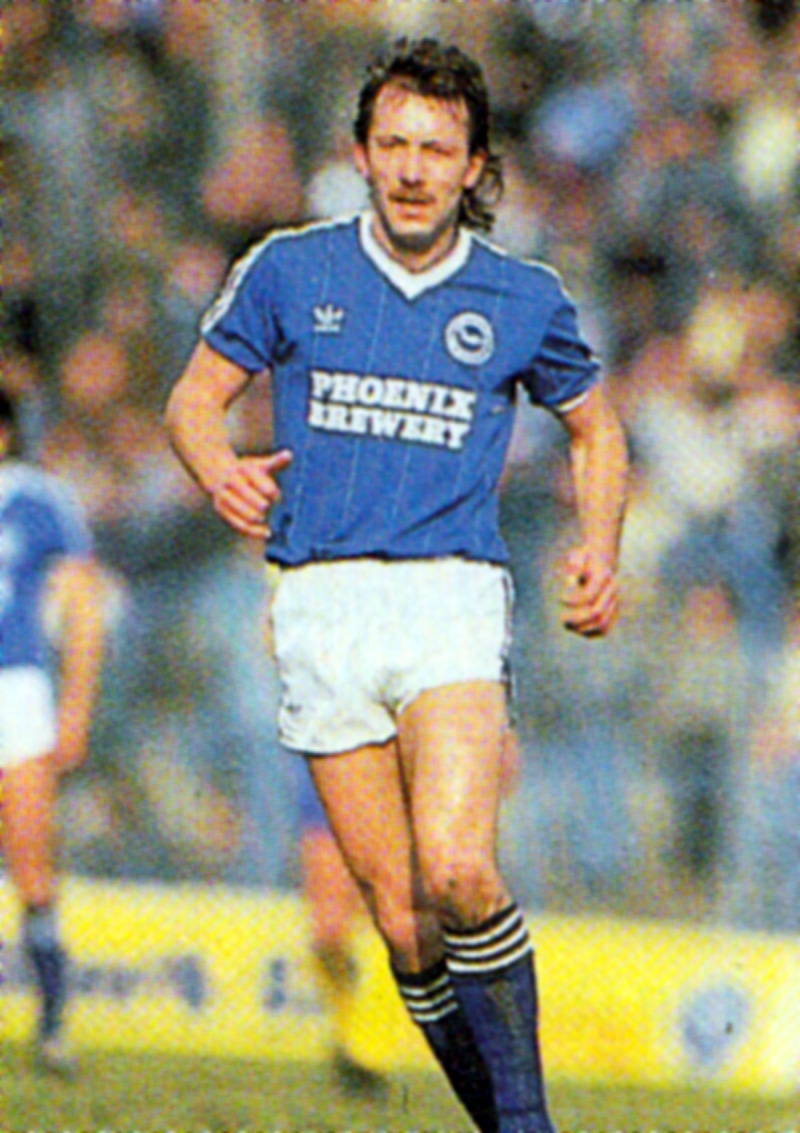
On the pitch he was different class though. I once saw him on the receiving end of a dreadful challenge when a guy (I forget who) tried to get the ball off him and put his studs down the back of his calf and Achilles. That really bloody hurts and Jim just let the ball roll away and turned on this guy and, through gritted teeth, said “Don’t you ever, ever f*cking do that to me again!” and then he turned and went after the ball and got it back before it went out. I watched this going on and the guy was sh*tting himself. That is the only time I have really seen one professional footballer genuinely scared of another. Because Jimmy could be a hard bastard and really knew how to look after himself.

He used to do about two hundred sit ups every days after training. He would wear one of those polystyrene bags that you get from the dry cleaners when he did them. He got me in to it as well!
If you are interested in reading more, you can buy ‘Youngy,’ the Alan Young autobiography here on the accompanying site.

You can also order a rather wonderful Alan Young t-shirt from Cult Zeros.

1984-85v3

Back row: Mark Jones, Steve Penney, Steve Jacobs, Alan Young, Graham Pearce, Kieran O’Regan, Gary Howlett;

Middle row: Sammy Nelson (coach), Hans Kraay, Eric Young, Joe Corrigan, Perry Digweed, Frank Worthington, Terry Connor, George Petchey (youth development officer);

Front row: Neil Smillie, Chris Hutchings, Jimmy Case, Chris Cattlin (manager), Steve Gatting, Gerry Ryan, Danny Wilson.
Tagged ,

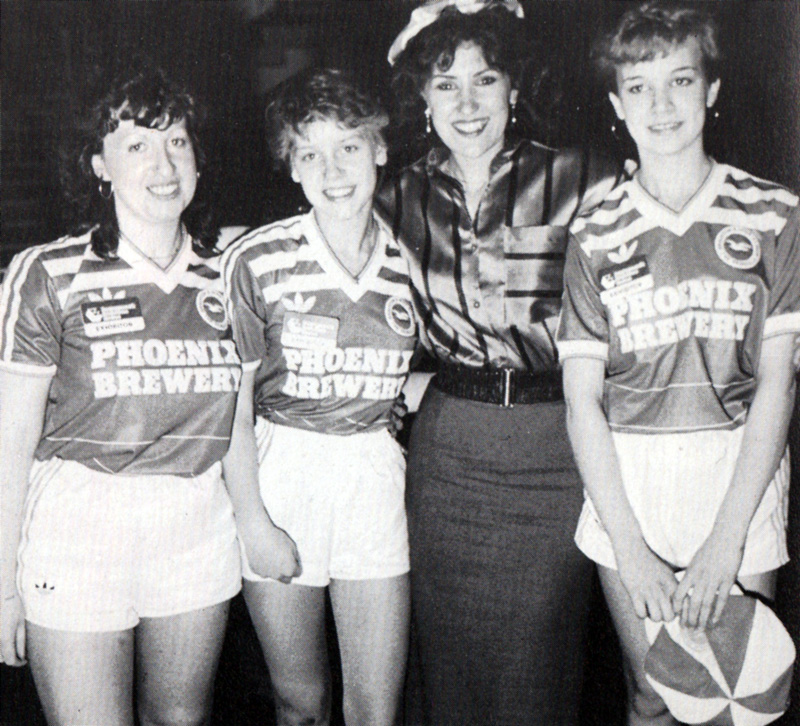
EastEnders’ Anita Dobson meets Albion gals

angie

From the Brighton v Peterborough programme in March 1986:

Our feature photo shows some very attractive young ladies on the Supporters’ Stand at the Brighton Ideal Home Exhibition three weeks ago. Gill Lacey, Claire Williams and Kieron Dorey are wearing the Albion shirts but the ‘gal with a smile’ in plain clothes is Angie from EastEnders, screen wife of ‘Dirty Den’, otherwise (known as) actress Anita Dobson.

Maybe the fans could have interested her in securing a deal for Phoenix Brewery at the Queen Vic!

Tagged

Mark Fleet – from soccer scrapheap to Skipton success

In Lawrie McMenemy’s ‘Book of Soccer’ from 1981, it gave an insight into the world of the football apprentice back then:

Life as an apprentice footballer is a hard slog – have no doubt about that. The basic hours are nine to five from Monday to Friday, with a game on Saturday morning. The social life is very limited. You still want to be an apprentice? Well read on, because if you love football, then – at the risk of repeating myself – it’s a wonderful life. Whatever you earn, you are being paid for doing what you enjoy. You have free lodgings and meals. You ‘play games’ for most of the time. And, if you’re with a big club, you mix with, and learn from, the stars.

The chapter went on to state that in the Football League, clubs were permitted a maximum of fifteen apprentices at any one time. At 16, the wages of an apprentice at the time were about £16 a week, rising to £20 at 17, the maximum the Football League would permit in those days. At 18, an apprentice would find out whether he will be retained or not. According to the book, these young hopefuls had a full programme of training in the morning and afternoon, with chores fitted in before or after training. Famously, the biggest chore was cleaning boots, which apprentices nowadays no longer do. However, as the old-school voice of McMenemy argued:

The chores that apprentices do are all connected with the cultivation of pride in the club. They are not provided just for the sake of finding them something to do. All are necessary jobs and someone has to do them. An apprentice is not a groundstaff boy, as youngsters used to be, although there are jobs connected with maintenance that he might occasionally help with.

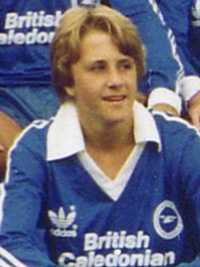
At the Goldstone Ground, Mark Fleet was one of several Brighton & Hove Albion apprentice footballers in the early 1980s. Here he was proudly wearing the club colours:

markfleet2

Hailing from Southport, he came to the club as an apprentice in September 1980, featuring regularly for the Albion in the youth side that won both the Hampshire Youth League and Youth Cup in 1980/81, before playing for Albion reserves in the Midweek Football League. A left-back by trade, he had a strong robust physique for one so young. He was picked for the Irish youth trials in Dublin in November 1980. At the age of 16, he eventually became an Eire Youth International when he played in the number 3 shirt in a 2-2 draw against Wales in Swansea in February 1981 as part of the European Youth Championship. Despite international recognition, he suffered with his knees, and it soon blighted his progress.

Goalkeeper Simon Steele (below left), who was to play for Brighton against Real Madrid in a pre-season friendly in 1983, joined a little later than Fleet, around 1982 and he and Fleet were originally quite close friends and they both received support with their progress from Jimmy Melia, then working as chief scout and as part of the coaching staff.

simon_steeledannydeansmatthewwiltshire

Out of an intake of about nine second-year apprentices in 1982, Mike Bailey signed Fleet and Danny Deans (central photo above) on a year’s professional contract and Matt Wiltshire (right) on a two year pro deal. Although a matchday programme from March 1983 mentioned that Fleet had been “improving steadily among the defenders”, he had to have a knee operation that summer and then suffered a recurrence of knee trouble following a very crude tackle on him in a reserve game with Arsenal in the September that followed. It was his last ever game for the club. Fleet and Deans didn’t gain a further contract, and Wiltshire left too after his two year deal expired.

The matchday programme vs Portsmouth in December 1984 announced Fleet’s retirement along with Giles Stille’s. Regarding Fleet:

During the summer he had another operation, but unfortunately the specialists have decided he can no longer play full-time football. We hope each of these lads find a successful career outside the game.

Nowadays, Mark Fleet has certainly made a name for himself outside the game. Unlike midfielder Giles Stille who now works as a coach and manager in Swedish football, it’s in the world of financial services where Fleet has proved himself. He is currently Distribution Director at Skipton Building Society, having previously held been managing director at AWD Moneyextra and Skipton Financial Services.

Having done a Google search, I found that there are quite a few interviews and quotes of his on various financial news sites. As you can imagine, it’s mostly almost unrecognisable from the lingo you usually hear from professional footballers.

I did try to contact Mark Fleet at Skipton by calling his office to see if I could grab an interview and ask about his memories of his playing days as well as charting the dramatic change and upturn in his career. Sadly, I didn’t get a reply!

Tagged , , , , ,

Autographs – Brighton & Hove Albion 1970s

Very occasionally on The Goldstone Wrap, I will reblog articles from other blogs that help to celebrate the history of the club. In Jackie Dinnis’ lovely nostalgic blog, she recalls collecting autographs of Brighton players in the Pat Saward era. A very wonderful colour photo of the 1971/72 promotion side is here too. Please click the link above.

Jackie Dinnis's avatarMeeting my family

After collecting signatures from my friends at school in the late 1960s I progressed to the next level – famous sporting stars.  I managed to get some when we were on our family holidays, as visiting sports stars made appearances once a week.  Then I began collecting some from my local football team – Brighton & Hove Albion.  I first went along there in 1972, and I think these autographs came from around that time.  I have very little recollection of obtaining these signatures, it was during the time the players would be ‘warming up’ before the game, when they could be persuaded to come over to the side of the pitch and scribble their name on a programme or in a book.  I managed to get several signatures, but I’m sure this was mainly due to Dad pushing my book in front of the players for me.  I also had a team photograph…

View original post 11 more words

Tagged ,

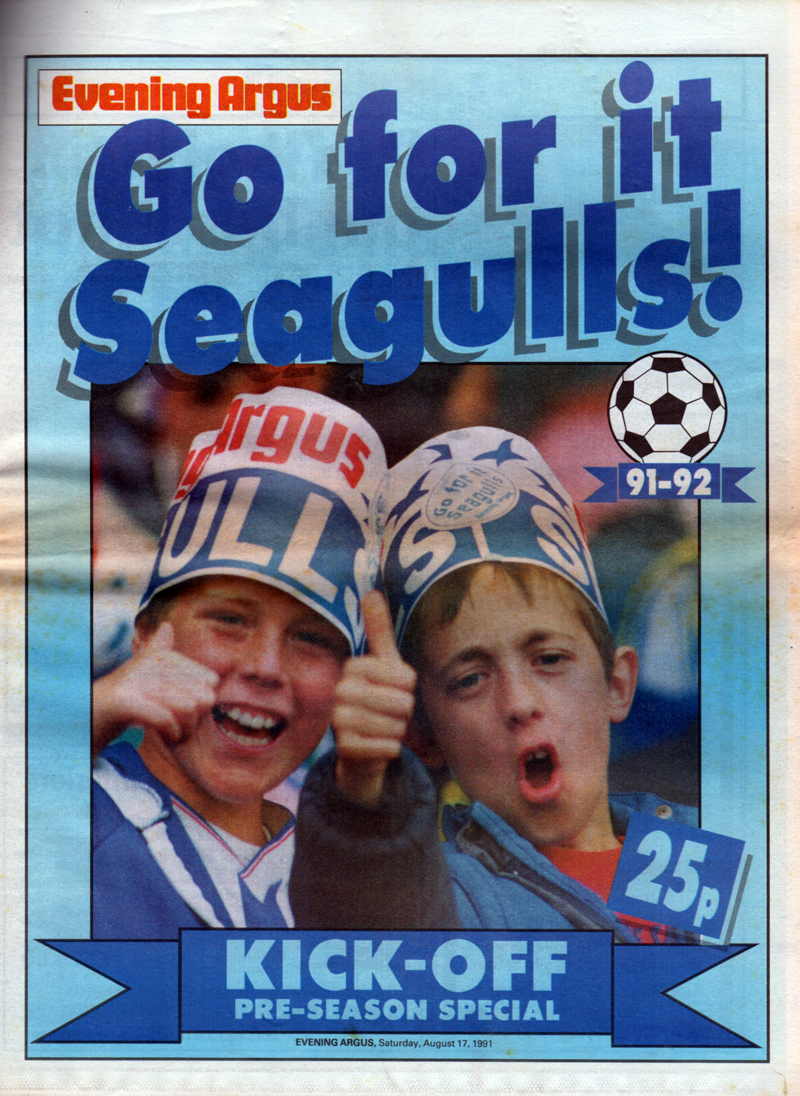
Evening Argus Pre-Season Pull-Out: ‘Go For It Seagulls!’

This blast from the past is a spectacular illustration of how high hopes from pre-season can prove wildly off the mark.

Look at these two daft-looking chaps with Argus banner rolled around their heads. They’re clearly imbued with the kind of elevated expectations that hadn’t yet been ground down by decades of disappointment as a Brighton supporter!

1991-92argus

In the pre-season to 1991/92, manager Barry Lloyd, although hatless, was also very optimistic about the season ahead. As John Vinicombe wrote:

Albion embark on their fourth successive season in the Second Division after going so close to promotion only two months ago.

This campaign, the Seagulls aim to recover the championship place they lost in 1983 by gaining an entry place outright instead of an ordeal by play-off.

“It is more important now than ever before to get into the First Division,” says manager Barry Lloyd.

“I believe that, in the not to distant future, some clubs will not be able to keep going, and will drop out of the Football League through shortage of money. Very few clubs these days have got any cash to spare, and even some of the big ones are having to count their pennies and make cuts. The First Division is the only real place for us and our supporters, and we will be giving it our best shot.”

Brighton certainly didn’t need the Play-Offs this time around – they were relegated! In 1990/91, the final home league match against Ipswich secured Brighton’s Play-Off position. A year later, the final away match against Ipswich secured Brighton’s relegation, and to rub Albion fans’ noses in it, it was also celebration time for Ipswich Town who had achieved the dream that continues to elude the Seagulls – promotion to the Premier League.

How is that a club that had previously reached the Play-offs, now found themselves relegated? On the outset, many supporters point to what a fluke the 1990/91 season really was as Albion conceded more goals than they scored in the League and yet were almost promoted. Even so, a side that gave Liverpool such a run for their money over two FA Cup games must have had something going for it. Yet once star strikers Mike Small (to West Ham) and John Byrne (to Sunderland) departed the Goldstone in 1991, there seemed to be only one direction for Brighton to head, and that was downwards. The less-than-stellar performances of their replacements Mark Farrington and Raphael Meade did little to halt the slide.

Nevertheless, Barry Lloyd still proved himself capable of unearthing a gem of a signing on occasion, such as with Mark Gall, a £45,000 bargain from Maidstone United, who rewarded his manager with his skill and strength, not to mention fourteen goals. However, when Lloyd was appointed to the Board as managing director in December with the task of the day-to-day running of the club, it most certainly took his eye off what was happening on the pitch. It also led to Martin Hinshelwood’s influence on first-team matters increasing. A recipe for disaster?

Tagged ,

Rare video: Summer of ’81- team photo shoot at the Goldstone

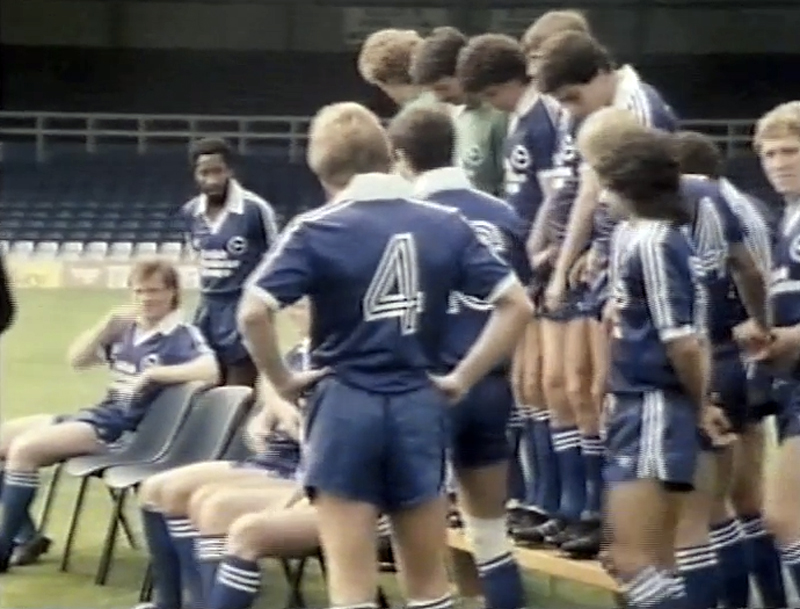
summer81photoshoot

A wonderful glimpse of life at the Goldstone in the summer of 1981, with a shot of Moshe Gariani and co getting it together for the pre-season photo shoot, plus interviews with new Albion men Mike Bailey and Tony Grealish.

And, blimey, Michael Robinson signs a ten year contract! Whatever he was doing in pre-season in 1991, it was certainly not at the Goldstone Ground.

Tagged , , ,

‘Peter Ward, the Soccer Prince of Sussex’

peterward7

An insightful piece by Tony Norman, capturing what it was like being a famous footballer in Brighton in the late 1970s, courtesy of an interview with Peter Ward:

“You should have got here earlier, Wayne,” said the street kid, outside the Goldstone.

A smile creased his grubby face, as he held out a battered autograph album in triumph. “I got Peter Ward. Magic!”

There’s only one star in Brighton. In the bars along the shoreline, they’ll nod approvingly of Gregory, or the skill of O’Sullivan. But there’s only one Peter Ward.

“He signed twice for me,” crowed the street kid. “You should have been here, Wayne.”

Wayne said nothing. He just shuffled awkwardly, trying to hide his disappointment and envy. He felt like a losing captain at Wembley, when the wrong man walks up the stairs and lifts the Cup. Deep inside, Wayne was sick as a parrot!

“Most of the supporters are with me, said Ward later, as we drove back along the south coast to his home. “I know they’re on my side. They expect a little more from me. They want me to turn it on every week, but that’s impossible. Extra pressure? I suppose so, but it doesn’t worry me. I go out there and do my best. It’s as simple as that.”

But, of course, it really isn’t so easy to live with the pressure of being a being a star, in a town where First Division football is still a novelty.

“When I go out, they’s always someone asking for an autograph. If I go to a club for a game of snooker or darts, I can hear people saying: ‘Look over there, it’s Peter Ward’. But if you go to the same places a few times, the novelty wears off and people leave you alone.”

It seems to be Ward’s policy to play down his star status in Brighton. But he lives the kind of goldfish bowl life that drove Best to drink. perhaps the biggest steadying influence on Ward is his happy home life, with his wife, Sue, and their two daughters, Rachael, 3, and Rebekah.

Best lived in a magnificent, empty shell. Ward’s home is his haven.

“I try to forget everything, when I get home. I’ve got my family to think about. Brighton’s a nice place to live. We’re buying a new house and we’ll be even nearer the Downs then. I like going up there and taking our dog, Sumi, for a run. I’ve joined a local fishing club too. I’ve only been out a few times, but that’s another good way to relax.

“I think I’m pretty easy-going. Nothing really bothers me, I enjoy taking it easy at home, doing a crossword, listening to records, or watching TV. I’ve bought one of those video recorders, so I can watch my favourite shows, like Fawlty Towers anytime I like.

“When you’re well-known, things can cut into your private life. You get reporters ringing you at home and that sort of thing, but I don’t mind. The only time it bothered me was when I was on the list, last summer. I took the phone off the hook. I knew I’d be inundated with calls.”

peterward8

Tagged

Dean Saunders leaves himself exposed

If you type ‘Dean Saunders’ and ‘willie’ together in a search engine nowadays, you are most likely to see references to the football manager’s dealings with agent Willie McKay. Had Google been around in summer 1986, you would have got a very different outcome!

I imagine that pre-season photo shoots are probably quite an enjoyable time for everyone involved. Unsullied yet by the taste of defeat, there is usually a buzz around and a sense of optimism in the air about the season ahead. Basking in the sunshine, players excitedly get to try on their new kit, pose with new team mates and have a natter with the local media. In the pre-season of 1986/87, while there was no big spending going on, Brighton did have a new boss as a returning Alan Mullery came to the club, along with Dale Jasper and Gerry Armstrong, two ex-First Division players. While the magnificent adidas kit design remained the same, the club did have a new shirt sponsor… yes, NOBO.

1986-87squadv3

Perhaps getting rather too in the spirit of the new sponsor moniker emblazoned on his chest, star striker Dean Saunders made this a photoshoot to remember by not wearing any pants underneath his shorts and, as a consequence, left part of his genitalia showing for all to see…

deansaundersv2

Could he have argued that in going commando, he was let down by the short shorts of the 1980s? Or was it a deliberately cheeky act to gain cult hero status?

Whatever the (ahem) ins and outs, Deano’s dangling display made it into the centre-spread of the programme from Gerry Ryan’s testimonial match between Brighton and Spurs in August 1986. It also made it into the double page team group in Shoot! magazine before it was discovered.

I hope the club saw the funny side, although the existence of a censored version of the photo suggests not.

Tagged

Getting to Division One: Alan Mullery’s budget

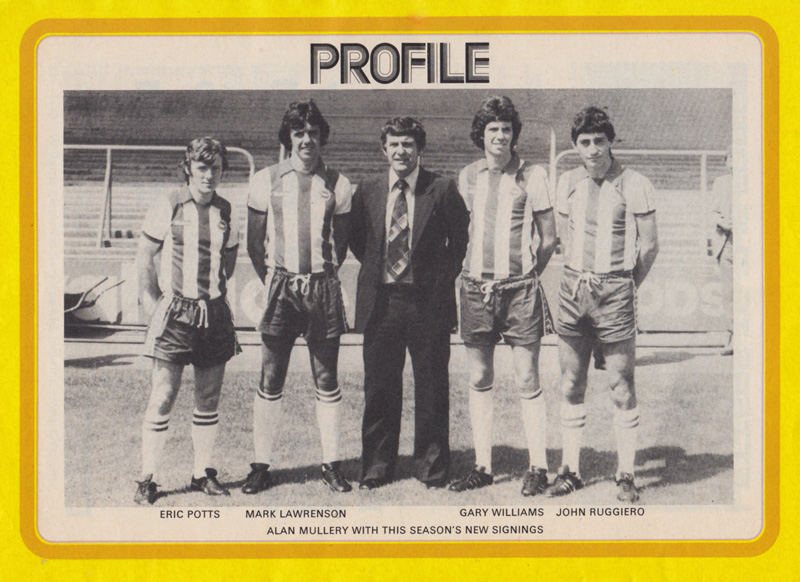
mullerysignings

The wheeling and dealing side of being a football manager was something that certainly appealed a lot to Alan Mullery. Luckily for him, he had far more cash to play with than, say, Pat Saward, at the start of the 1970s. It’s often commented that Mullery had a massive transfer budget. Trying to get beyond the opinion, I wanted to see to what extent this was true and have (to the best of my ability) tried to collate all the incomings and outcomings from 1976/77 to the end of 1978/79:

In
Steele £19,000
Lawrenson £112,000
Ruggiero £30,000
Potts £14,000
Williams swop
Clark £30,000
Maybank £238,000
Poskett £60,000
Sayer £100,000
Ryan £80,000
Chivers £15,000

Total: £700,000

Out
Beal free
Kinnear free
Morgan £15,000
Cross Swop
Wilson Swop
Binney Free
Towner £65,000
Ruggiero Free
Potts £37,000
Mellor £30,000
Fell Swop

Total 147,000

To my eyes, despite the over-inflated price for Teddy Maybank, a deficit of £553,000 at late 1970s prices seems a reasonable price to pay for a club going from the Third Division into the top flight. Still, it wasn’t me writing the cheques! Undoubtedly, the Albion boss’ best capture of the time was Preston defender Mark Lawrenson. In this article from Shoot! magazine, the Brighton manager explains how he tried to balance the budget in the summer of 1977 after a big outlay:

Brighton caused a bit of a stir in the close-season when they splashed out a club record £112,000 to buy unknown defender Mark Lawrenson from Preston. It was a bold move from a progressive club who are determined to make a big success of life now they have been promoted to the Second Division.

And manager Alan Mullery is the first to admit they had no intention of spending that sort of cash when they first decided to go into the market. Mullery – who capped his first season as a manager by steering Brighton to the Third Division top two – explains:

“At first all we were going was a standby for Graham Cross – someone to play in the reserves and come into the first team when necessary. “But clubs were asking a ridiculous amount for this type of player. They were demanding £40,000 or £50,000 – and there was no way we were going to pay that for reserves. So then we decided to change our tactics and go in and spend big on a player who could come straight into the first team. I called all the staff together to discuss names of likely prospects. And they all came up with the same one – Mark Lawrenson.

“My chairman, Mike Bamber, and my coaching staff had all seen the lad play and were all impressed. And I thought he was tremendous on the three occasions I had seen him last season – twice against us, once at Crystal Palace. With so many people raving about him, it was obvious he was the man we wanted – so we moved in and did the deal. I know a lot of people have not heard to much about him yet. But they all will – believe me, they will.

“He is only 20, is big and strong and will make his mark in a big way. he settled down as soon as he joined us for pre-season training and seemed to be enjoying life on the South Coast. The thought of spending that sort of money on an unknown does not frighten me. A football manager has got to be prepared to back his judgement and I’m sure Mark will turn out to be a huge success.”

Mullery’s only regret is the enforced change of deal brought Cross’s time at the Goldstone Ground to an end. Soon after Lawrenson arrived, Cross and full-back Harry Wilson moved to Preston as part of a deal that brought another defender, Gary Williams, to Brighton from Deepdale. “Graham had an absolutely tremendous 1976-77 season for us and I can’t speak too highly of him,” said Mullery. “When I started planning for the new term I reckoned on having him in the side for our step up into the Second Division. Then events overtook us as I have explained, and things worked out differently. I wish him well at Preston and can assure their supporters they are getting one of the most honest lads in the game in Graham.”

Tagged , , , , ,

A greyhound called ‘Seagulls’

greyhound

From the Brighton v Norwich programme in October 1979:

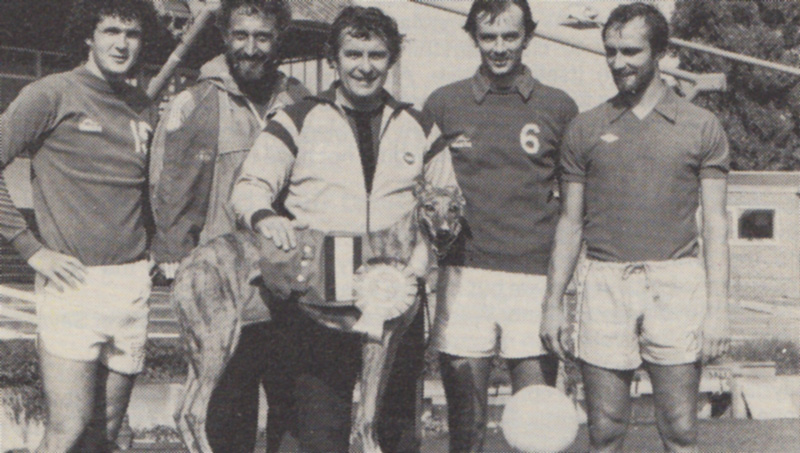
The greyhound recently adopted by the Albion and renamed ‘Seagulls’ has, since taking the Albion’s colours, been pretty successful. Despite being just about the youngest dog in the Grand Prix field she won her heat, came second in her quarter-final and then third in the semi-final to reach last Saturday’s final at Walthamstow.

Tagged , , , , ,