Author Archives: Goldstone Rapper

Blame the players, says Foster

stevefoster1983

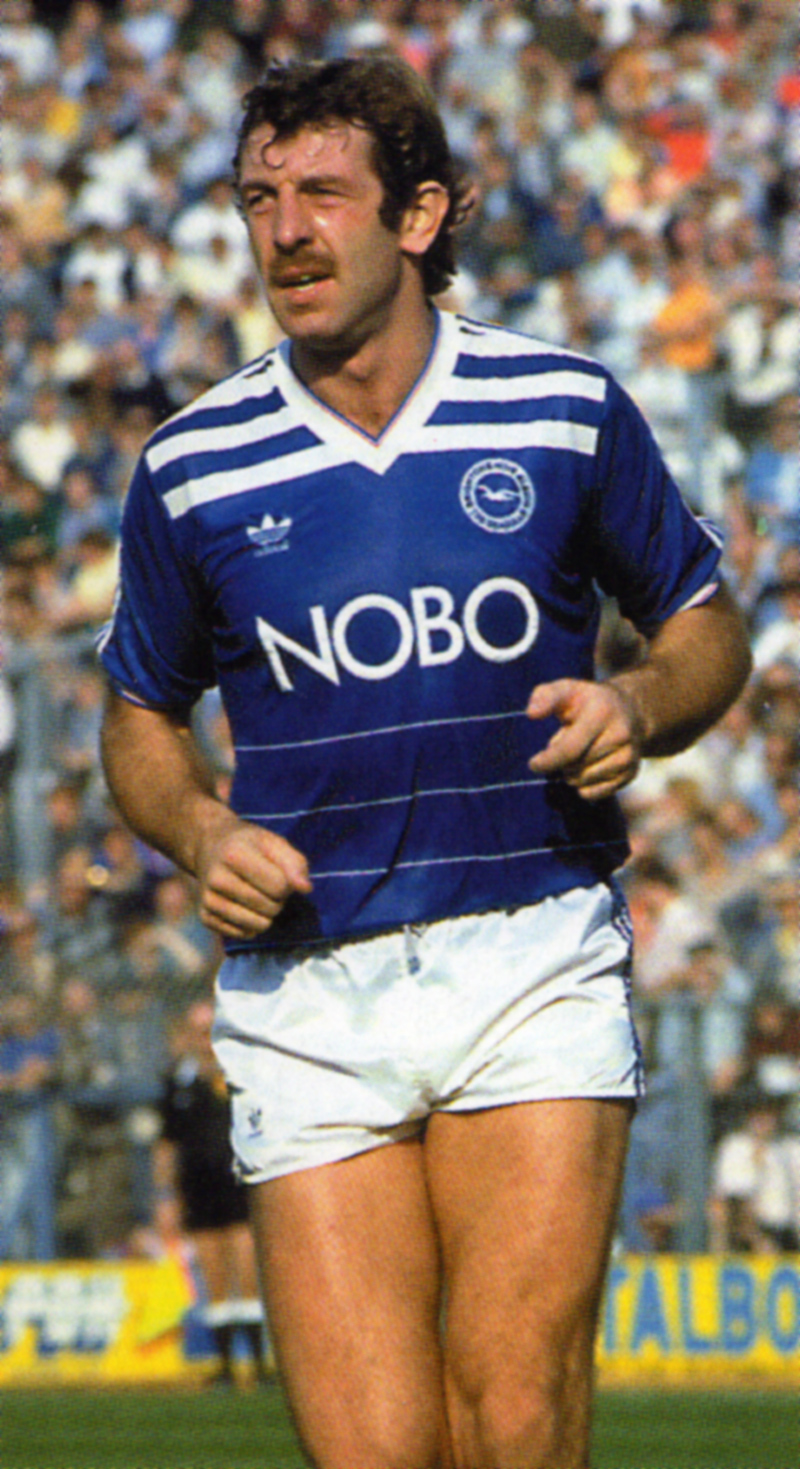
Playing the blame game? Yes, it’s straight from the Steve Foster school of captaincy! Well, that’s according to the pages of Shoot! magazine in 1982/83, where Fozzie is in no way inclined to suggest that the buck stop stops with him:

Composure and commitment – those are the qualities Brighton need in their fight to secure a First Division future.

Skipper Steve Foster, who no one can accuse of a lack of effort, believes the work-rate has not been up to scratch in Brighton’s battle against the drop.

The England central defender warns: “We need to be more composed, even if we add the commitment. It’s no good playing 100 miles an hour football in the First Division. You have to be cool, calm and calculated.”

As for effort, Foster criticises certain team-mates for producing below par displays in that area. He says: “I have the feeling we could have done better and given more, particularly away from home. I don’t intend to name names, but the players themselves know who I mean.

“We have been put under a lot of pressure at home by our dreadful away results. And that’s daft because our away form was good last season.”

Foster believes Brighton’s new attacking approach away from home is responsible for the need for greater effort.

“Certain players have not been fully committed within the new system.”

Foster sees improved form by his club as the key to his own prospects of earning further England international honours.

“I think someone has told Bobby Robson I had retired,” jokes Foster. “But seriously, I don’t think it’s likely I shall be chosen while Brighton are struggling near the bottom of the table.

“We have got to improve, climb the League and start playing consistent, successful football.

Then I might have a chance of adding to my three England caps.” Foster denies he has been put into the international wilderness because of any question marks against his own form.

“A player knows when he is playing well and when he is struggling,” says the Brighton man.

“1 believe I have been playing as well as before I went to Spain. But I didn’t expect Brighton to struggle
near the bottom.

“All I can say is, I hope to change Bobby Robson’s mind.” But any disappointment Foster may hide at his England exclusion since the World Cup will not be allowed to interfere with Brighton’s important last few months of the season.

“This club worked very hard to get into the First Division and now we’re here, we want to stay, not let it all slip.

“We have about three months to start getting the right results. If they don’t come soon, we could be back in the Second Division next season.”

* Here’s a reminder that The Goldstone Wrap will finish as a daily blog in 100 days’ time, on its 500th post. That’s June 24th 2014. There’s no significant reason – I haven’t even run out of archive material yet – it just feels like a good place to stop! All The Goldstone Wrap archives will remain online, and articles will continue to appear – only not on a daily basis.
Tagged

Clubbing… with Jimmy Case

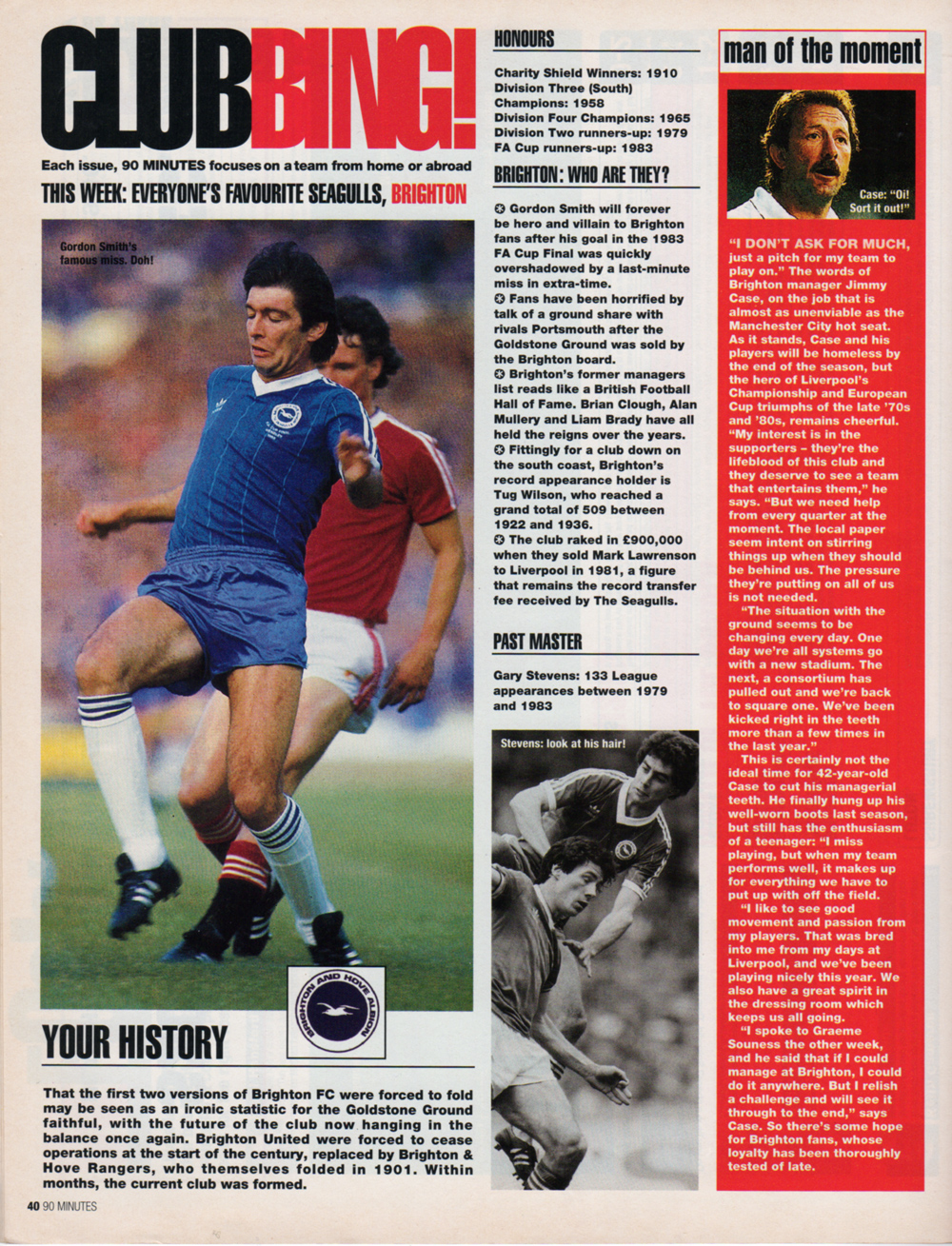
Regretfully, this is not an article about visiting the 1980s nightspots in Brighton with the Scouse midfielder. In the mid-1990s, 90 Minutes magazine ran a page feature every week profiling the ins and outs of football clubs home and abroad. In the 12th October 1996, it was the turn of Brighton & Hove Albion. Rather than be all guns blazing for a night on the razzle, manager Jimmy Case was undoubtedly in sombre mood, while doing he best to stay positive:

clubbing

“I don’t ask for much, just a pitch for my team to play on.” The words of Brighton manager Jimmy Case, on the job that is almost as unenviable as the Manchester City hot seat.

As it stands, Case and his players will be homeless by the end of the season, but the hero of Liverpool’s Championship and European Cup triumphs of the late ’70s and ’80s, remains cheerful.

“My interest is in the supporters – they’re the lifeblood of this club and they deserve to see a team that entertains them, he says. “But we need help from every quarter at the moment. The local paper seem intent on stirring things up when they should be behind us. The pressure they’re putting on all of us is not needed.

“The situation with the ground seems to be changing every day. One day we’re all systems go with a new stadium. The next, a consortium has pulled out and we’re back to square one. We’ve been kicked right in the teeth more than a few times in the last year.

This is certainly not the ideal time for 42-year-old Case to cut his managerial teeth. He finally hung up his well-worn boots last season, but still has the enthusiasm of a teenager: “I miss playing, but when my team performs well, it makes up for everything we have to put up with off the field.

“I like to see good movement and passion from my players. That was bred into me from my days at Liverpool, and we’ve been playing nicely this year. We also have a great spirit in the dressing room which keeps us all going.

“I spoke to Graeme Souness the other week, and he said that if I could manage at Brighton, I could do it anywhere. But I relish a challenge and will see it through to the end,” says Case. So there’s some hope for Brighton fans, whose loyalty has been thoroughly tested of late.

The Brighton job, with all the problems surrounding the sale of the Goldstone, and the club’s general financial plight, would have been a tough nut to crack even for an experienced manager. It clearly proved beyond Case’s abilities at the time to turn around the fortunes of the side. At first, he enjoyed the support of the fans but this ebbed away, with the defeat to Sudbury Town in the FA Cup 1st Round replay underlining how far the club fallen. However, it was the League position that was all-important. When Brighton stood nine points adrift at the bottom of the Football League in December 1996, Case was sacked.

Tagged ,

Debutant Mark Elliott helps put Albion on top

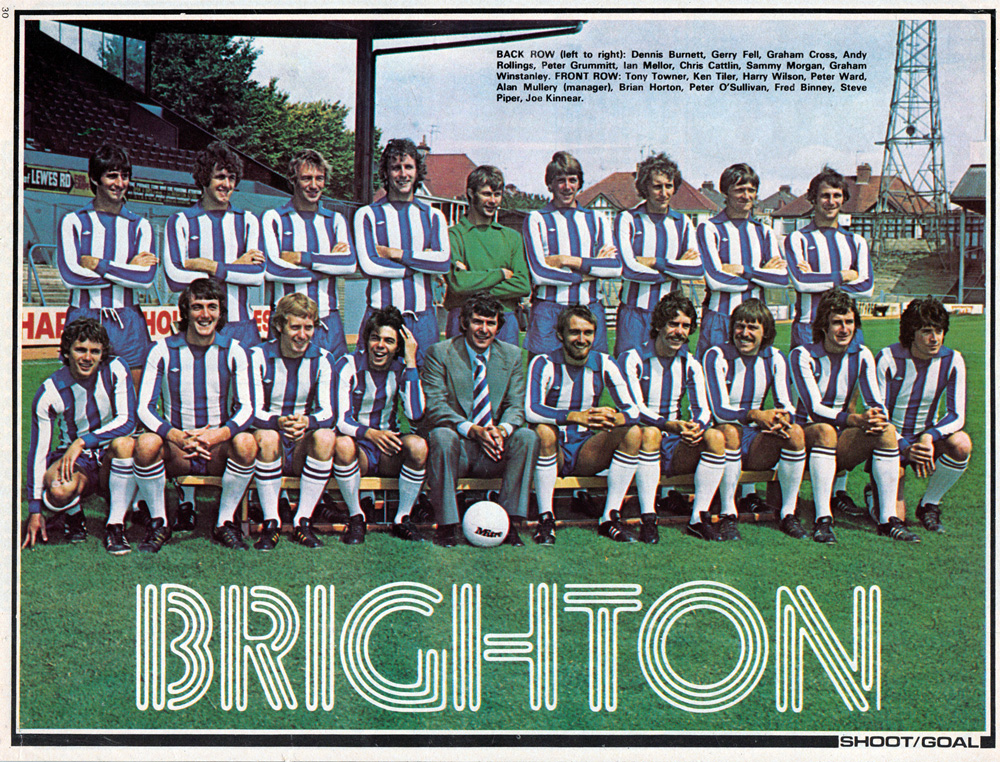
The 1976/77 Brighton promotion squad is one of the most celebrated in the club’s history. Undoubtedly, its most famous names are that of strikers Peter Ward and Ian Mellor, along with captain Brian Horton. Tony Towner, Gerry Fell, Fred Binney and Peter Grummitt are also fondly remembered by many supporters of that vintage. Even the names of those that were not quite its headline-making players still endure in the memory bank: Ken Tiler, Harry Wilson, Graham Cross, Andy Rollings, Graham Winstanley…

1976-77

But what about Mark Elliott? Who?!

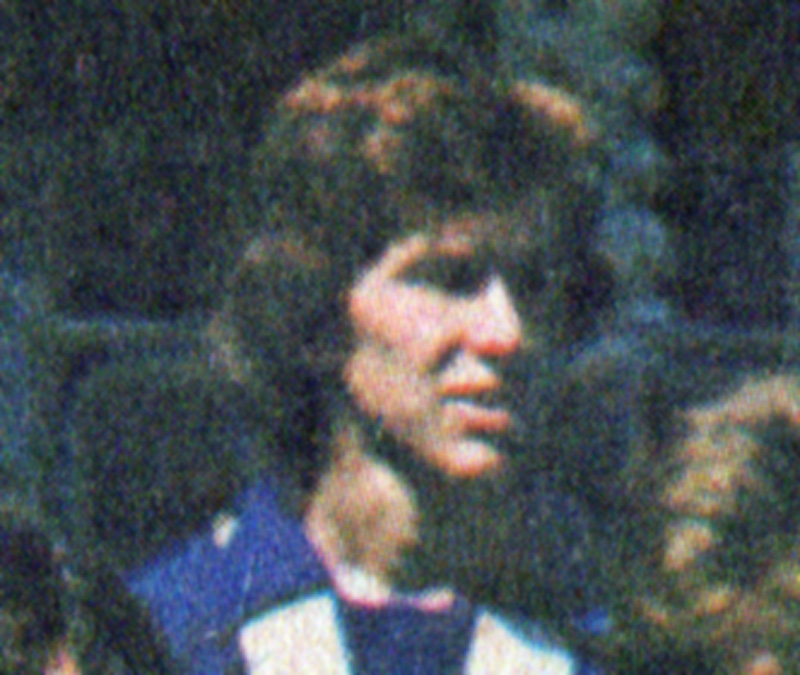
markelliottOn this day in 1977, Brighton thrashed Shrewsbury 4-0 in front of 17,404 fans at the Goldstone. A teenager with that name made his Albion debut on that Tuesday evening. He was a Welsh winger who played for Ton Pendre before he was recommended to Brighton by his trainer John Stead. After a successful trial, Elliott was snapped up in February 1977. Three days before his 18th birthday, Elliott had his Brighton baptism on 15th March 1977. As the Daily Mirror reported, the young attacker did very well:

Brighton stormed back to the top of the Third Division by shattering Shrewsbury with a four-goal burst at the Goldstone Ground.

What a night for 17-year-old winger Mark Elliott to make his senior debut!

The Swansea youngster, brought in to replace Tony Towner, repaid manager Alan Mullery’s faith with a fine all-round performance.

Shrewsbury, once promotion candidates, but now slumping rapidly, somehow survived until half-time.

Then, just when the home fans were getting a bit edgy, Steve Piper had them cheering. He beat two men and split the defence with a perfect pass for Brian Horton to score.

Peter Ward made it 2-0 with a penalty after Elliott had been toppled by Ian Atkins. Five minutes later, are hit his 27th goal of the season.

And Mellor completed the scoring near the end.

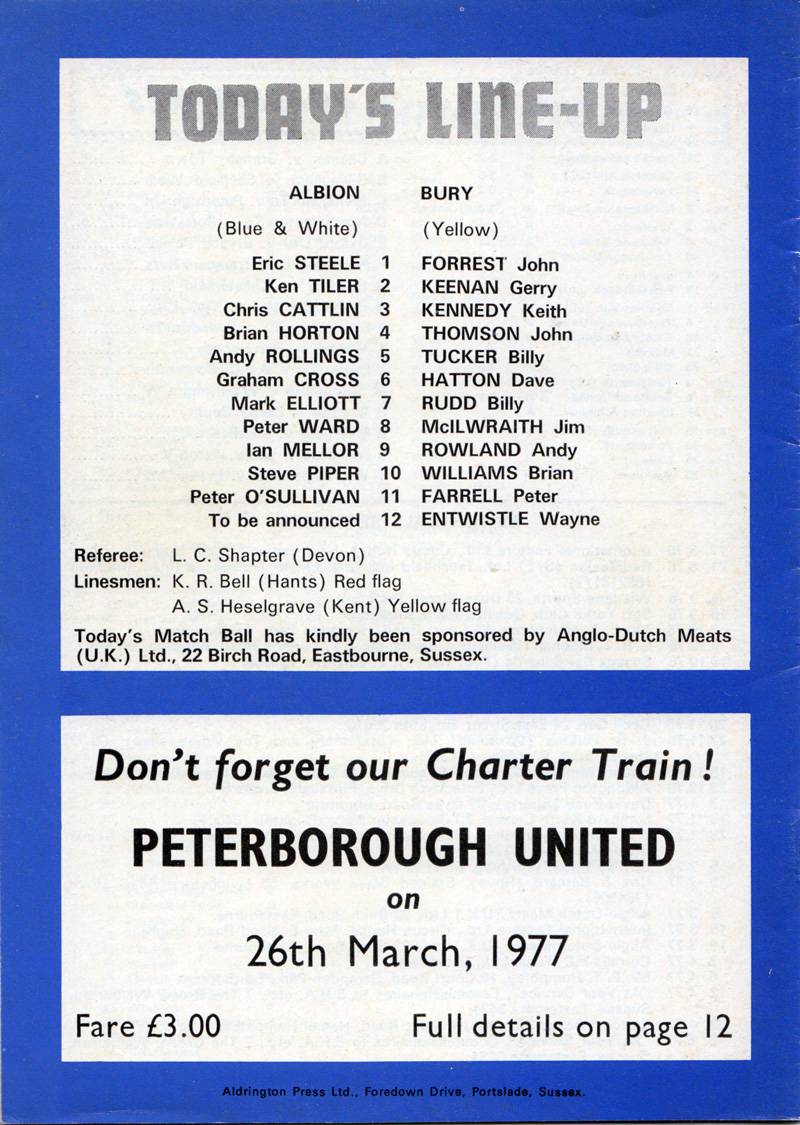
Elliott kept his place for the following two matches, against Bury at home and Peterborough away, but on both occasions he was withdrawn during the game.

bury

Although he was chosen for the Welsh youth squad in September 1977, he never featured in another Brighton first team match and moved to Cardiff on a free transfer in September 1979. He subsequently played for AFC Bournemouth (loan), Ton Pendre, Wimbledon, Walton and Hersham, and Tonyrefail.

Tagged

Armstrong’s answer

gerryarmstrong

As a retrospective article from a Brighton v Rotherham programme from 1994/95 put it:

Few Albion fans believed it when, in July 1986, Alan Mullery starting his second stint as manager, announced that he would have two World Cup players in his Second Division side about to start the new season.

Just in case you thought he was going all out to revive the mothballed Juan Carlos Oblitas and Percy Rojas deal from 1979, the result was less exotic. Northern Ireland winger Steve Penney was already a Brighton player, of course. Then, Mullery’s next move was to sign Gerry Armstrong, Penney’s compatriot, who had famously scored the winner against hosts Spain in the 1982 World Cup:

By summer 1986, Armstrong was aged 32, having played for Bangor, Tottenham, Watford, Real Mallorca, West Bromwich Albion and Chesterfield. That he was in the twilight of his career was underlined by the fact that the Belfast-born centre-forward hardly set the Goldstone alight. He took until December to get on the scoresheet for the Seagulls. He broke his duck following in Darren Hughes’ blocked shot from close range against Leeds in a 3-1 defeat. Although he scored again in the next match, a 3-0 thumping of Shrewsbury, a writer for the Grimsby Town matchday programme was moved to state:

Rumbustrious Gerry Armstrong, the Northern Ireland World Cup hero, has failed to make an impression following his summer move from Chesterfield. Despite his international exploits, Gerry has never delivered the good consistently in the Football League. Earlier in his career he commanded a £250,000 price rage when moving to Watford, but arrived at the Goldstone on a ‘free.’

I don’t know whether Armstrong read this comment before the Brighton team left the dressing room for their match with the Mariners on Saturday 3rd January 1987. If he did, it might have fired him up. His winner at Blundell Park showed his ability to tidily convert a loose ball was still alive. After pressure from Dean Saunders, Armstrong capitalised after the ball had hit the woodwork. The sweet 2-1 result put clear blue water between 15th place Brighton and the relegation battlers. However, two days later, the man who had brought Armstrong to the Goldstone, Alan Mullery, was sacked.

Armstrong was then loaned to Millwall before returning to the Goldstone to coach the youth team, as well as taking the number nine shirt in a highly depleted Barry Lloyd-led Brighton side towards the end of 1986/87.

Tagged

Those Cambridge copycats

With former Brighton favourite Bill Cassidy in superb goalscoring form, Cambridge United entered the Football League in 1970 after struggling Bradford Park Avenue were voted out. Helped by the versatile Scot’s experience, the new boys quickly established themselves in that debut season. Even after he left in 1971, they eventually progressed to third in the Fourth Division in 1972/73 to win promotion.

During the following season in Division Three, Brighton’s first ever visit to the Abbey Stadium ended 1-1 in January 1974. Mick Brown’s only ever goal for the Albion helped gain a valuable point for Brian Clough’s side against their fellow strugglers. Then, in April, a handsome 4-1 victory for the Sussex side, with goals from Bridges, Welch, McEwan and Ron Howell (pen), at the Goldstone took Albion as high as 14th, and Cambridge closer to the abyss.

The U’s were relegated later that month while Brighton survived. However, it wasn’t long before the two locked horns again. Indeed, games involving both clubs curiously became a highly frequent affair towards the end of the decade, particularly at the start of a campaign.

Take August 1977 when Brighton and Cambridge played out two 0-0 draws in the League Cup 1st Round legs before two goals from Horton (1 pen) and Ward settled the matter in the replay at the Goldstone at the end of the month. Future Albion striker Alan Biley responded on the scoresheet for Cambridge in that replay. In that August, Biley was also joined up front by centre-forward Sammy Morgan. Morgan, who left Brighton for the U’s, and eventually made 37 League appearances, playing his part in the club’s second successive promotion season.

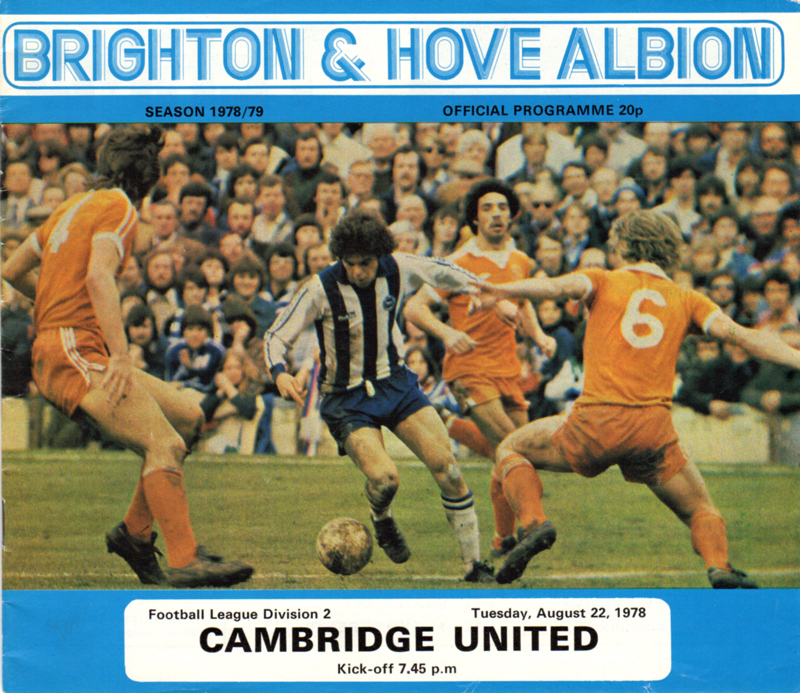
During the following August, in 1978, with Cambridge now a Second Division side for the first ever time, they humbled promotion-chasing Brighton 2-0 at the Goldstone in front of 21,548 fans. This upset came thanks to a couple of soft goals, one to Floyd Streete and then a Graham Winstanley own goal after confusion with Eric Steele. It was the Brighton’s first home league defeat since October 1977 and left some pessimistic supporters scratching their heads as to whether the Seagulls really could make it to Division One after a shaky start.

Here is the matchday programme cover:

ward-brighton-cambridge

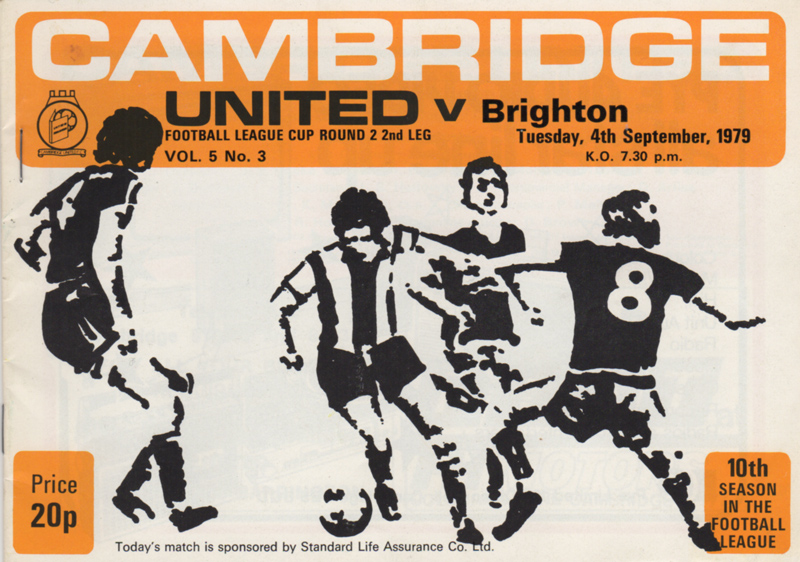
Not only did Cambridge steal the win, they seemingly got hold of our lovely matchday programme, and traced the Peter Ward image with blotchy felt tips to use on their own publication cover for the following season. Here is the end product for 1979/80, a sight that Albion fans saw when Brighton drew the U’s in the first round of the League Cup once more:

ward-cambridge-brighton

In August 1979, Brighton won the 1st leg 2-0 thanks to a Horton wonder goal and a last minute Ward effort at the Goldstone. A month later, they then beat Cambridge and their programme cover copycats 2-1 in the away leg. It proved that cheats don’t always prosper, at least not ones armed with felt tip pens and a high level of temerity.

* Cambridge weren’t the only programme copycats at the time. Notts County’s illustration for their cover in the early part of 1982/83 was based on a photo of players of rivals Nottingham Forest celebrating John Robertson’s goal in the European Cup Final in May 1980. With the Forest influence becoming widely known, by the time Brighton visited Notts County in April 1983, the illustration had been replaced by an action photo.

Tagged

Cool Case

jimmycasenorwich2

jimmycasenorwich1

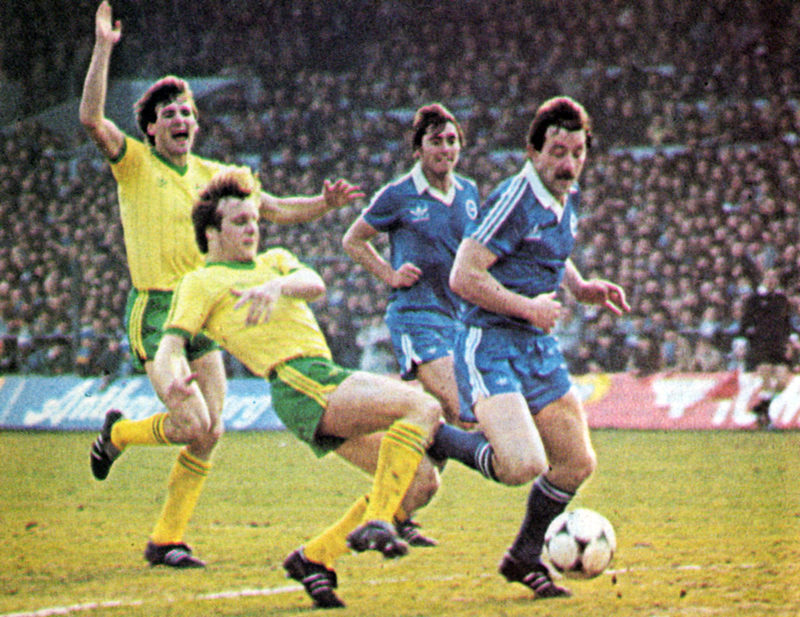
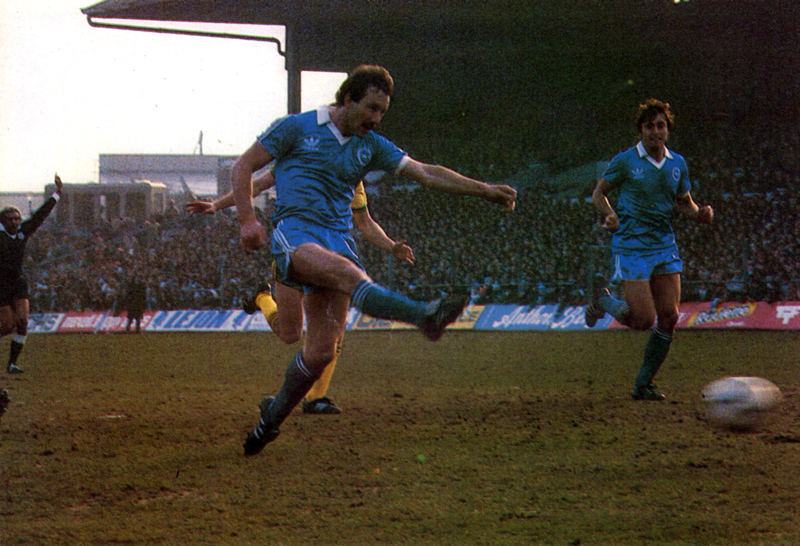
Here’s the Daily Mirror’s report of the first ever FA Cup Quarter-Final to take place at the Goldstone Ground, with the Seagulls victorious on 12th March 1983:

By Harry Miller: Brighton 1, Norwich 0

Jimmy Case knows how to keep his cool when the jackpot is only a shuffle and a shot away.

That priceless asset, picked up in a decade of Cup fighting on every front with Liverpool, explains why Brighton are heading towards Wembley and Norwich are among the also-rans.

In Norwich this morning they are probably still muttering and moaning about the legacy of Case’s 67th minute winner and whether he should even have been around to score it.

Yesterday, referee Alan Robinson, from Waterlooville, cleared up one point while the Mirror’s Footballer of the Month for February revealed another.

Norwich protested furiously and pointed to a linesman’s raised flag when Case went past Paul HayIock, shuffled and shot past Chris Woods for the goal that takes Brighton into the FA Cup semi-finals for the first time in their history.

But referee Robinson answered Norwich claims that Haylock had been fouled by saying: “When I spoke to the linesman he said he was fiagging for a foul on Case. I decided to play the advantage.

Norwich manager Ken Brown said: We were done by an old pro who was lucky to be on the field at the time.

“He had already been booked for one foul. His second one, on Mick McGuire, was diabolical.”

Case, who is still only 28, admitted that after the clash with McGuire referee Robinson had-gone to him and said: “You’re going the right way to go towards the tunnel.”

The midfield ace whose goal had knocked out Liverpool in the previous round answered: “I know. I’ll calm down.” To Norwich’s cost, he did.

Case told me: “I’m not a dirty player. I caught McGuire as he was going away from me. There were incidents in the game far worse. Anyway, my record speaks for itself.

“I’ve never been sent off.”

He added: “Really, I don’t remember much about the goal. But looking at it on the video I Certainly don’t think I fouled anyone.”

A tie played at a frantic pace and without much pattern gave a reasonable insight into why these sides are at the bottom end of the First Division.

Brighton manager Jimmy Melia was honest enough to call it “a poor scrappy game,” which it was.

In the end, reality ruled.

Brlghton’s impressive skipper Steve Foster, judged the game’s best player by the match sponsors, admitted: “I would still swap our place in the Cup for a spot halfway up the First Division.”

Tagged

Mark’s fire and skill

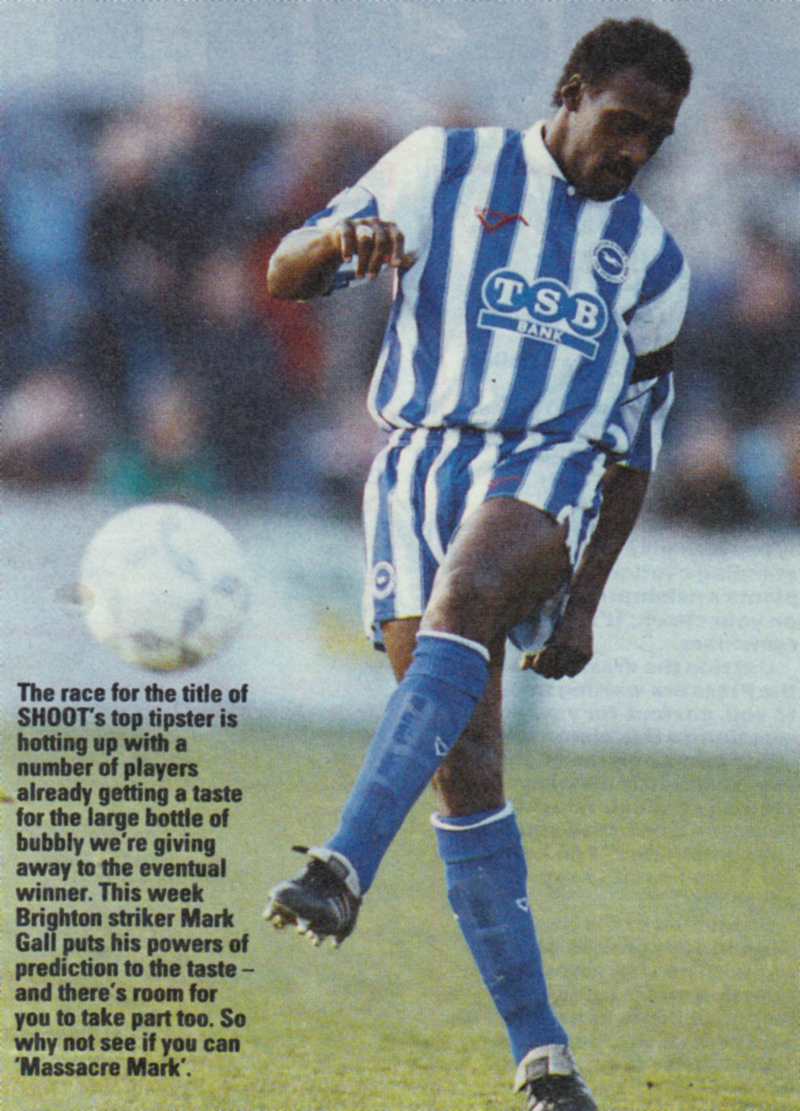
Brighton striker Mark Gall was a guest tipster in Shoot! magazine for one week in 1991/92, vying with readers to accurately guess the scores of the forthcoming fixtures:

markgall

With the Seagulls struggling, defeat was probably a ‘safe’ prediction for Brighton during most weeks. But with Gall fighting fit, there was always the chance that his influence could turn some matches in Albion’s favour.

While ultimately, Gall was unable to stop the Albion from suffering relegation, his strength, trickery and goal touch ensured the club had a fighting chance right up to and including the last day of the season. Signed from Maidstone for £45,000 in October 1991, he immediately lifted the Goldstone crowds that were still mourning the departure of John Byrne and Mike Small. Gall’s 13 goals from 30 League appearances for the struggling south coast side was an excellent return for a mid-season signing.

Emphatically, he also scored the opener in the FA Cup match with Crawley in January 1992:

Two months later, he notched the only goal at St James’ Park in a victory over Kevin Keegan’s Newcastle United. Strangely, it was the only League fixture where Gall’s scoring contributed to an Albion victory. Indeed, when the Londoner hit a goal in each of the first four games in April 1992, Brighton only secured a single point.

One of his most telling performances came in the 2-1 victory over FA Cup Semi-Finalists Portsmouth later that month:

Although he did not score, Gall repeatedly gave the Portsmouth defence the runaround.

Unsurprisingly, he was voted Albion Player of the Season at the end of 1991/92. A knee injury from early on in his career then sadly caused problems that forced him to retire, aged 29.

Tagged

Sun Soccer Stamps 1971/72

sunsoccerstamps

As Nigel’s WebSpace puts it:

Following on from the undoubted success of the Swap cards the Sun followed up in 1971/72 with the ambitious Soccerstamps collection. The Soccerstamps were stamps, rather than cards, and came in a wide variety of sizes, shapes and colours. The tokens for Soccerstamps appeared in the Sun each day. The Sun only accepted tokens in lots of six, plus 5p, to get your 12 Soccerstamps by return post.

The stamps were to be mounted in the spaces for them in the 164-page Football Encyclopaedia and Soccerstamp Album (available from newsagents for 10p). The album suggests that you stick them in with stamp hinges. Collectors of these stamps therefore distinguish between those which were (a) never stuck into an album, (b) stuck in with stamp hinges or (c) stuck in as stamps.

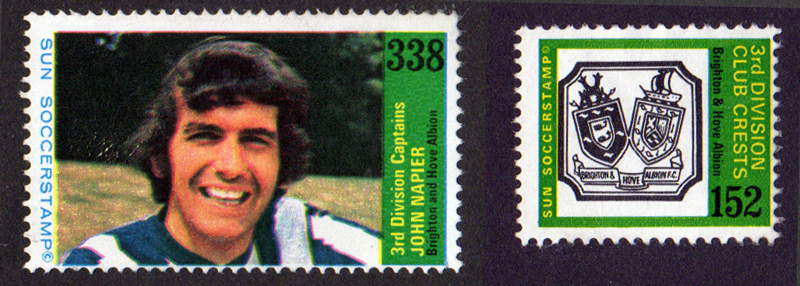
With 504 stamps in the collection, Third Division clubs such as Brighton & Hove Albion were afforded three stamps. Here is the team photo stamp:

sunsoccerstamps1

Captain John Napier and the old style coat of arms also appeared on two smaller stamps:

sunsoccerstamps2

Despite getting promoted in 1971/72, I’m pretty sure Brighton don’t feature in the 3D star cards that The Sun ran with the following season.

Tagged ,

Meridian TV: Goodbye Goldstone

Bill Archer gives the show a touch of the surreal

Bill Archer gives the show a touch of the surreal

Yesterday on North Stand Chat, a user called The Great Gatsbt answered a request by posting the infamous hour-long special on Brighton’s plight, on Sunday 9th February 1997:

It makes for remarkable viewing. As Foster’s Headband remarked:

Bellotti and Archer were on telling the usual lies and a few very irate fans. Tony Millard, John Vinnicombe, Atilla, Paul Samarah, Alan Mullery, Mark Lawrenson, Gerry Ryan all had their say and Ivor Caplin who proved that both Archer and Bellotti to be lying about a supposed planning application they had put in, but Caplin informed the programme this had already been refused.

Here is an extract from Stephen North and Paul Hodson’s ‘Build a Bonfire’ (p.166-167) about the show:

WARREN CHRISMAS: We’d all had such a great time at Fans United and everyone was still buzzing on the coach going over to Meridian to record the programme. We weren’t made to feel very welcome and it was a bad programme. It was bad PR for Albion supporters, it just didn’t go right. At the beginning of the programme Geoff Clarke says there will be plenty of opportunity for Albion’s fans to ask questions, and there never was and before we knew it, it was over and it wasn’t until it was over that everybody started to get really angry.

PAUL SAMRAH: Fans United on the Saturday was a brilliant day – the Sunday, the ‘Goodbye Goldstone’ debate on Meridian TV, was a disaster. We went in there rather naively thinking that all the facts surrounding the furore about the club will be explained in a balanced view and it wasn’t. Dick Knight was not going to attend because Bill Archer wouldn’t attend. Well, to our surprise Bill Archer was there, David Bellotti had the cheek to turn up and also arrived with his wife which was even more galling because in our negotiations with Bellotti he’d asked us to refrain from any verbal or other attacks on his wife and we naturally assumed that, really, she would take a back seat.

Regrettably things got out of hand and we didn’t get our case across in a professional way and it ended up being a shouting match and I was glad the programme ended when it did because I think we could have done our cause an awful lot of harm.

Bellotti is brilliant in front of the cameras, he’s a superb guy in an interview – he can answer a subsidiary question and miss the main question.

Archer came across as a nice guy sitting in a studio in Liverpool.

As soon as I came out of the debate I rang Dick Knight and said, ‘Did you know that Archer was appearing?’ and he told CEDR because it was a CEDR agreement that they wouldn’t go. Driving back the 60 miles from Southampton we felt cheated, we felt hijacked and the most annoying thing was that we knew it was down to us. It wasn’t anybody else really that had let us down, it was ourselves that let ourselves down.

LIz COSTA: The ‘Goodbye Goldstone’ programme was a total triumph for Archer and Bellotti. And this having taken place a week after Bellotti had said to us, ‘Please leave my wife alone’, he brought her into that studio. She had nothing whatsoever to do with that programme – she had no input, was not expected to have any input.
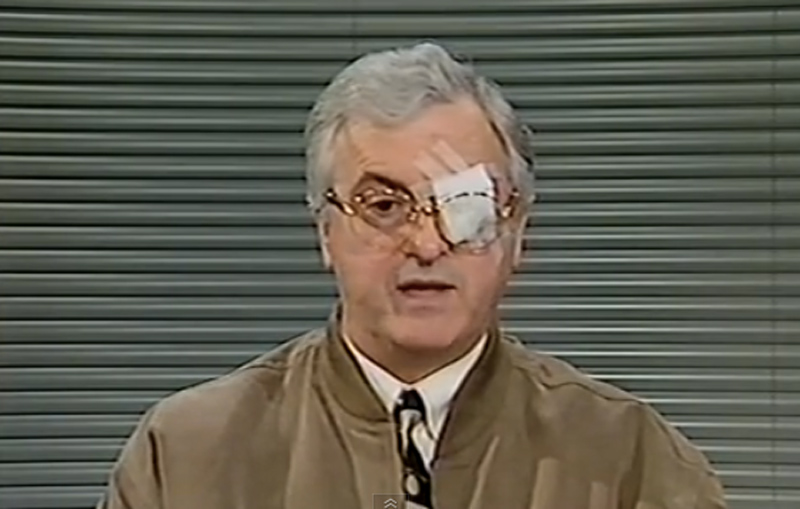
Archer was there with a patch over his eye, we were told, because he had corneal problems. The neutrals, the people who didn’t really know what was going on or had chosen not to take any notice, must have thought, ‘What the hell are the supporters on about? Archer and Bellotti are so totally feasible.’ Well, that’s how they bloody wriggled their way in in the first place, by being feasible.

TONY FOSTER: To some extent we were stitched up on that – as far as I’m concerned so was Dick Knight and the consortium. Things were edited, we had to re-do quite a bit and at the end of the programme re-record certain bits that probably didn’t come across on the programme.

PAUL SAMRAH: I am afraid it was the low point of our campaign.

Tagged , , , ,

Shattered dreams

jimmycasesouthampton

Having been sold to south coast rivals Southampton a year before, Jimmy Case came back to haunt the Seagulls in the FA Cup Quarter-Final at the Goldstone on 8th March 1986.

In the first half, the Saints seemed to be first to every loose ball, and quickly gained a foothold against a rejigged Brighton side. Chris Cattlin dropped Chris Hutching at right-back, shifted Steve Jacobs from midfield to fill his place, and gave Mick Ferguson his first home start since November 1985. Suffice to say, it didn’t work:

Brighton did make more of a fight of it in the second-half but the two goals in the first half had given First Division Southampton an unassailable lead. A pity that Ferguson and Biley couldn’t have stuck those chances away here:

Chris Cattlin’s programme notes the following week reflected on the emphatic defeat:

“I would like to start this afternoon by saying what a great disappointment it was to us all that we failed to do ourselves justice last Saturday, against Southampton. That disappointment is, I know, shared by all our supporters and I appreciate how you feel. We had done so well to get so far in the competition, with battling displays in all the other rounds, but to be honest, the way we played last Saturday did not justify our presence in the Quarter-Finals. We did not play anything like we can on the day.”

Tagged , , ,