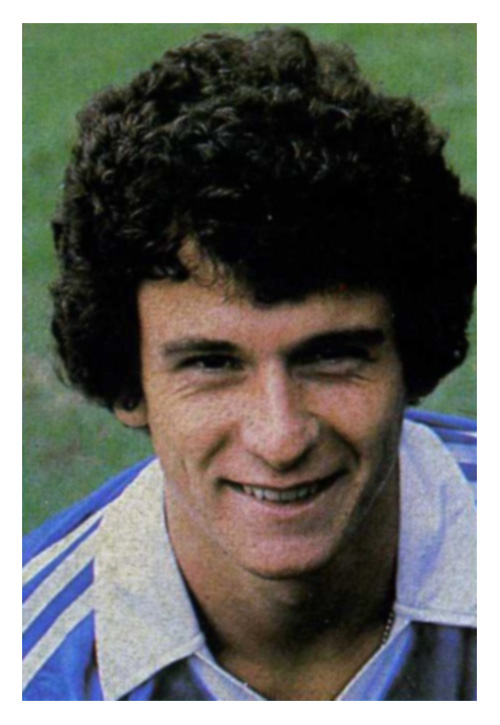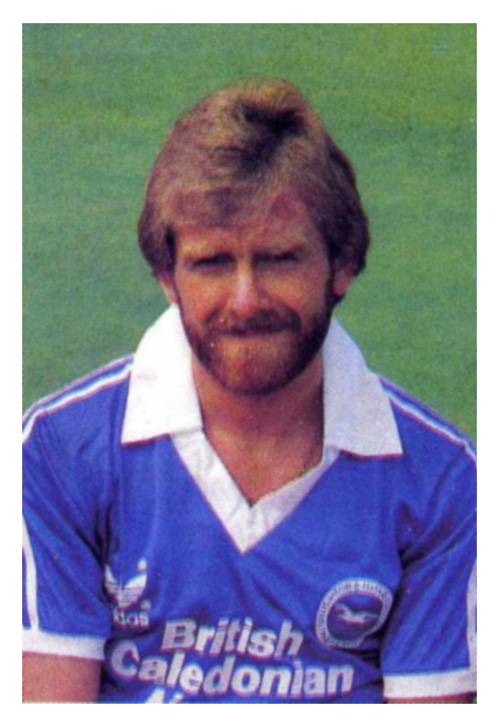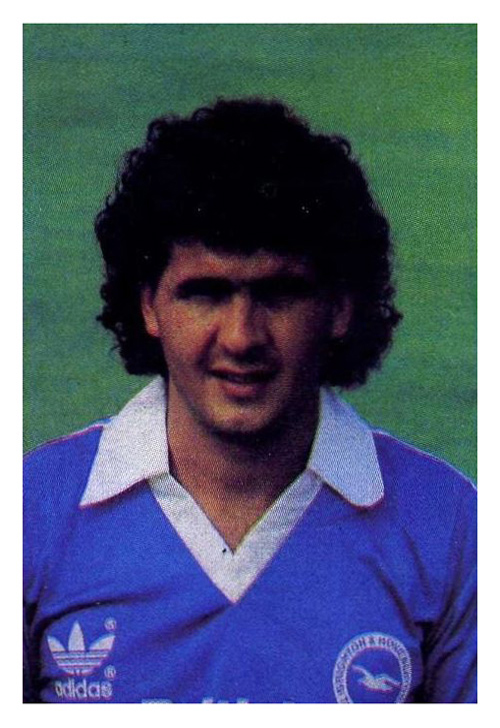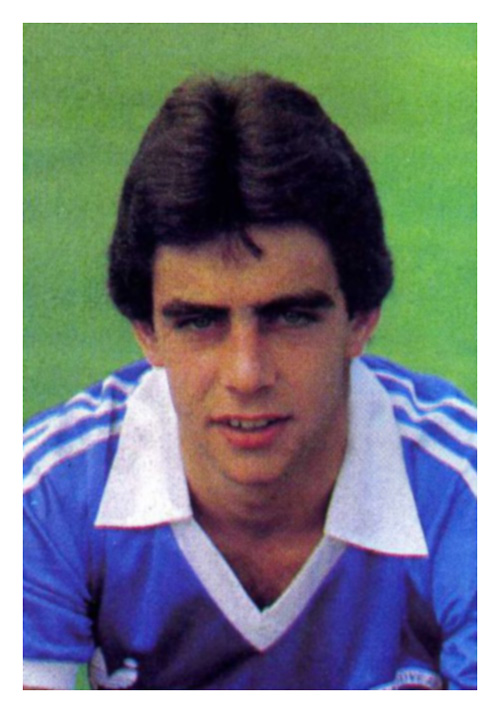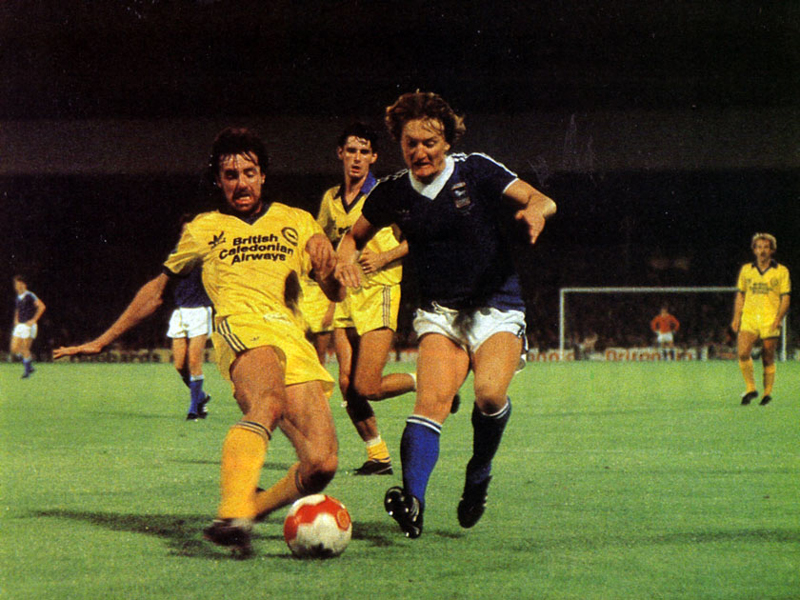
Tag Archives: steve foster

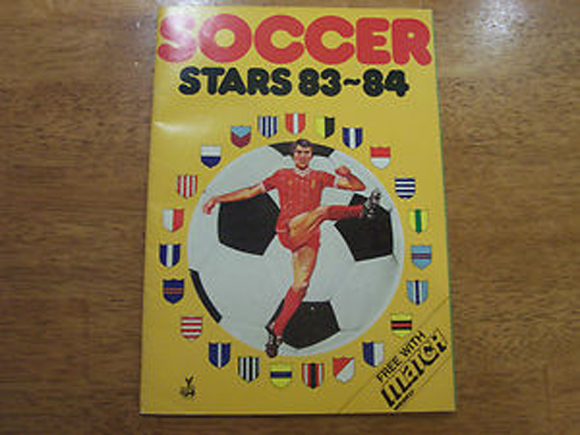
FKS’ last hurrah: Soccer 83-84 stickers

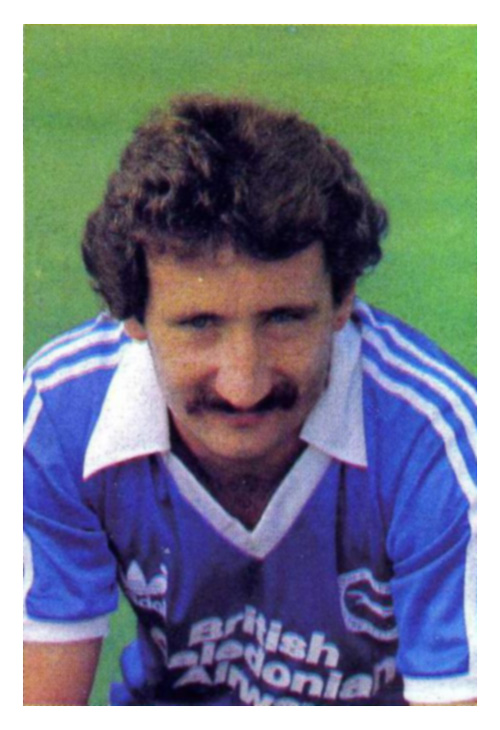
Poor FKS. They once dominated the ’70s football sticker scene with fabulously grandiose album titles such as ‘The Wonderful World of Soccer Stars Gala Collection.’ Which suitably sideburned and flared young kid wouldn’t want to be in on that? By 1983/84, probably due to the intense competition from Panini, FKS had reached the end of the line with the rather dubious ‘Soccer 83-84’ series. Following on from their ‘Soccer 82′, it appears that they were trying to cover two seasons’ worth of top flight soccer with this inept collection. Here are the Brighton players:

Graham Moseley

Graham Moseley

Chris Ramsey

Chris Ramsey

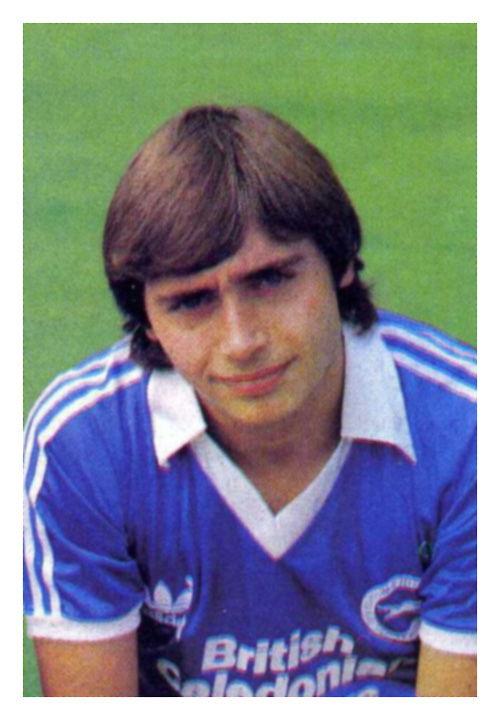
Graham Pearce

Graham Pearce

A stray ball seems to be trying its darnedest to try to muscle in on the limelight behind Moseley’s shoulder. But is this really true? As you can see, the grass behind Moseley and Ramsey looks suspiciously unnatural in its greenness, especially as the unaltered green on the side of Ramsey’s arm rather gives the game away. The mixture of the head and shoulders shots of these players and the zoom-in on Graham Pearce’s head bestow an untidy look for this collection. No wonder Chris Ramsey looks uncomfortable.

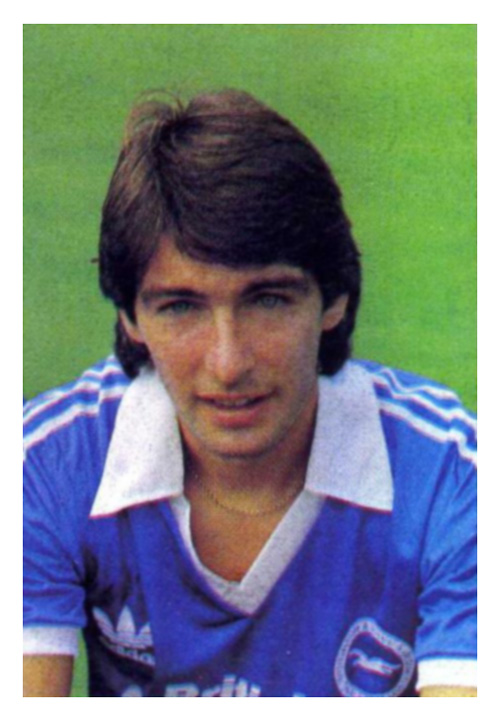
Steve Gatting

Steve Gatting

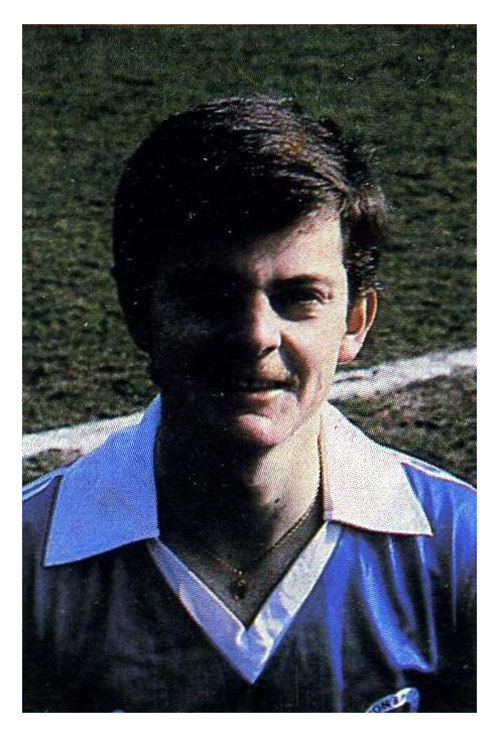
Tony Grealish

Tony Grealish

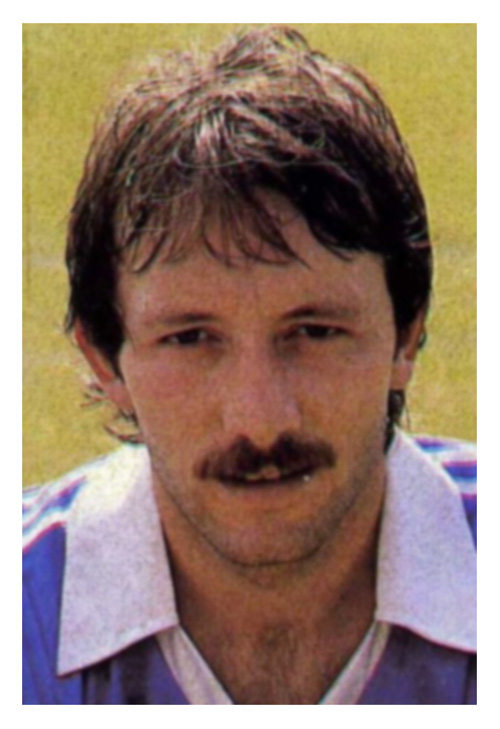
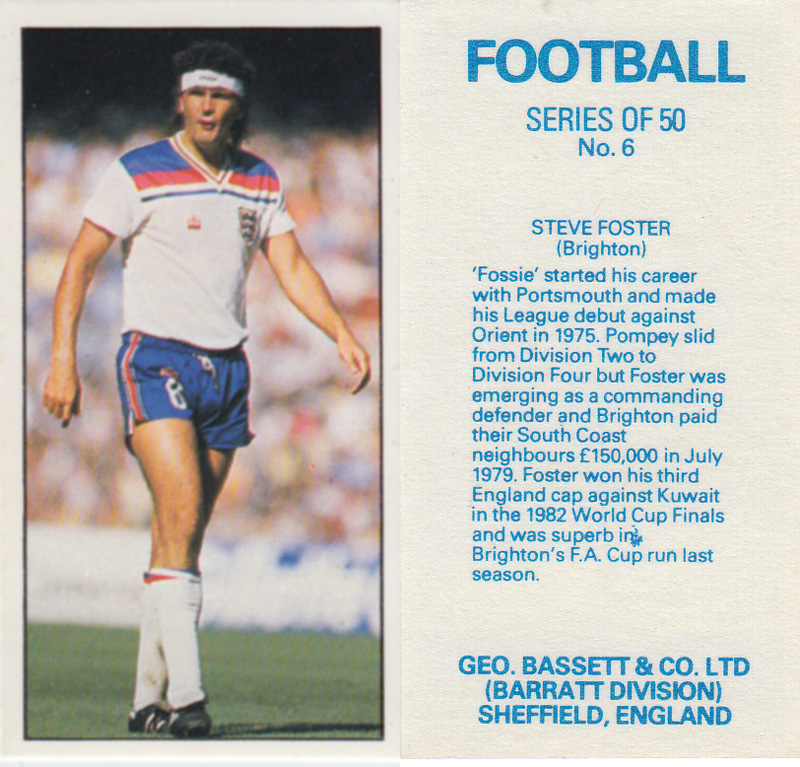
Steve Foster

Steve Foster

Similar gripes with Messrs Gatting, Grealish and Foster here. Given where FKS had appeared to have swiped their photo shot of Tony Grealish from, you can understand why they had to put on a faux-grass background.

Gary Stevens

Gary Stevens

Jimmy Case

Jimmy Case

Gary Howlett

Gary Howlett

A nice, genuine photo of Jimmy Case, fresh from the barbers, follows another manipulated one of Gary Stevens. And whoa! An intensely dim shot of a young and rather frail-looking Gary Howlett. Suffice to say, if you met him in a dark alleyway, I don’t think you’d be that scared.

Michael Robinson

Michael Robinson

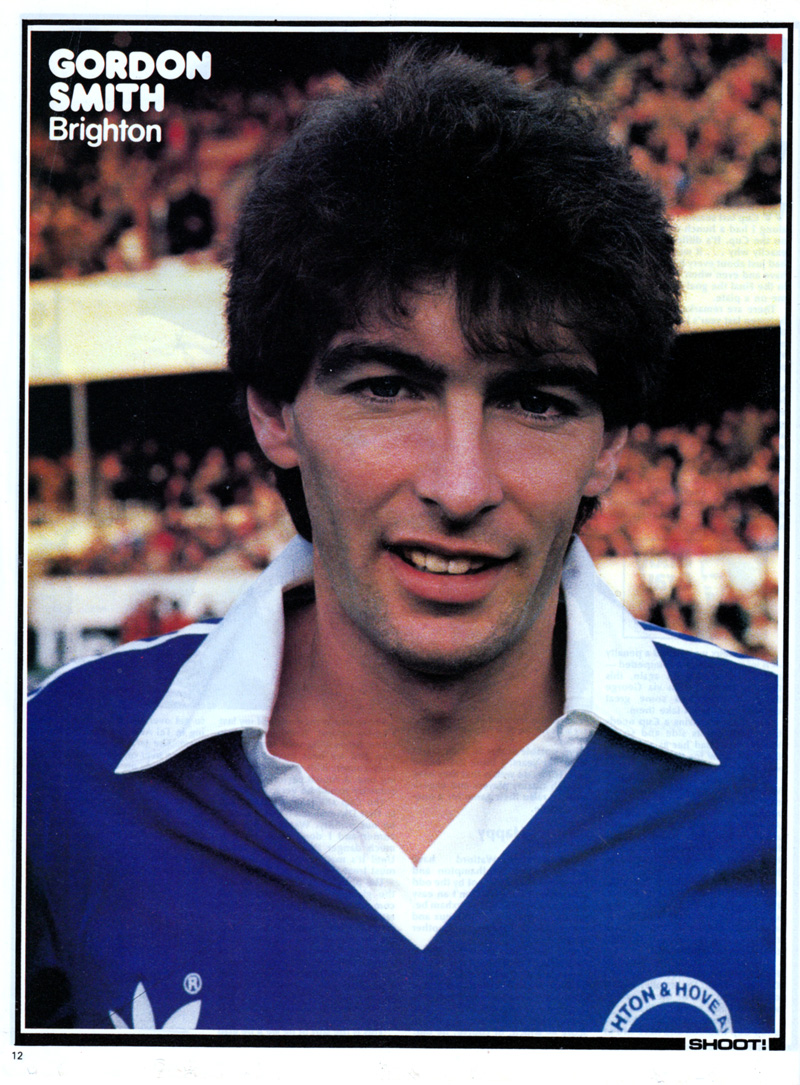
Gordon Smith

Gordon Smith

Gerry Ryan

Gerry Ryan

Some more bog-standard and doctored head and shoulders shots of some of Albion’s attackers follow. It’s like FKS were trying very hard to emulate Panini here, whereas some of the action shots that the company had previously used would probably have been more interesting to the young collector.

Neil Smillie

Neil Smillie

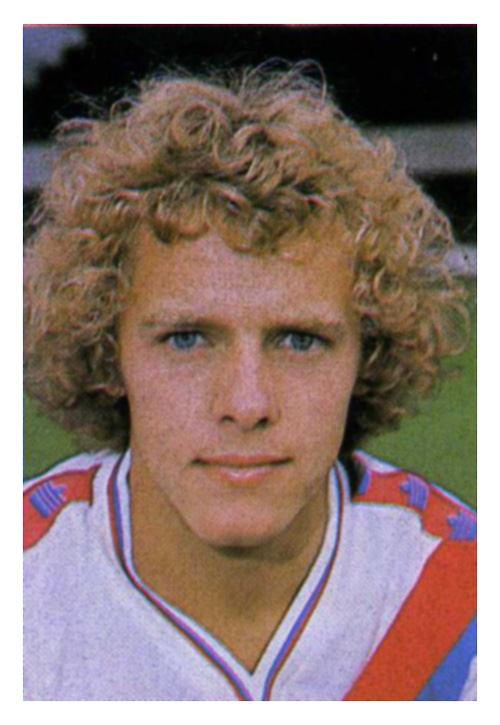
And then the final insult! Sticking in a shot of a player in a Crystal Palace kit on a Brighton page. Yeah, thanks, FKS! A bit like putting a sticker of Mo Johnston in a Celtic shirt within a Rangers sticker double-spread, I don’t think that would have gone down too well on the south coast at the time.

No need to be too resentful to FKS, though, after a stay that had lasted since the late 1960s. The company had introduced new ideas such as actual albums for affixing your stickers, something we take for granted today. Now, though, the game was up.

soccer83-84

Tagged , , , , , , , , , , , ,

New arrivals hold the key in 1980/81

newsigning1980v2

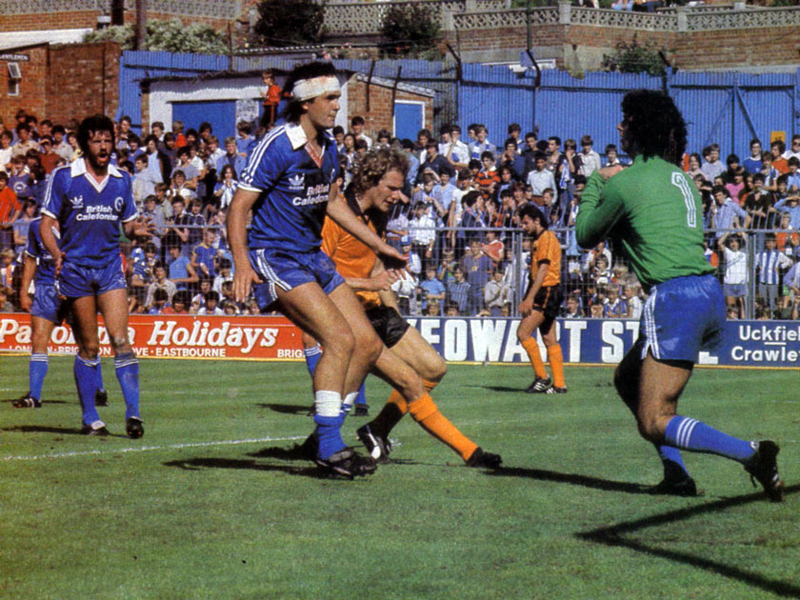
The 1980/81 Albion squad was probably the strongest in the club’s history. At least on paper. With their first season of top flight football behind them, Brighton looked to build on their experience, and were bolstered by Michael Robinson and Gordon Smith, two £400,000 captures. The Robinson-Ward striking partnership appeared to promise an avalanche of goals while Mark Lawrenson and Steve Foster seemed likely to keep things solid at the back.

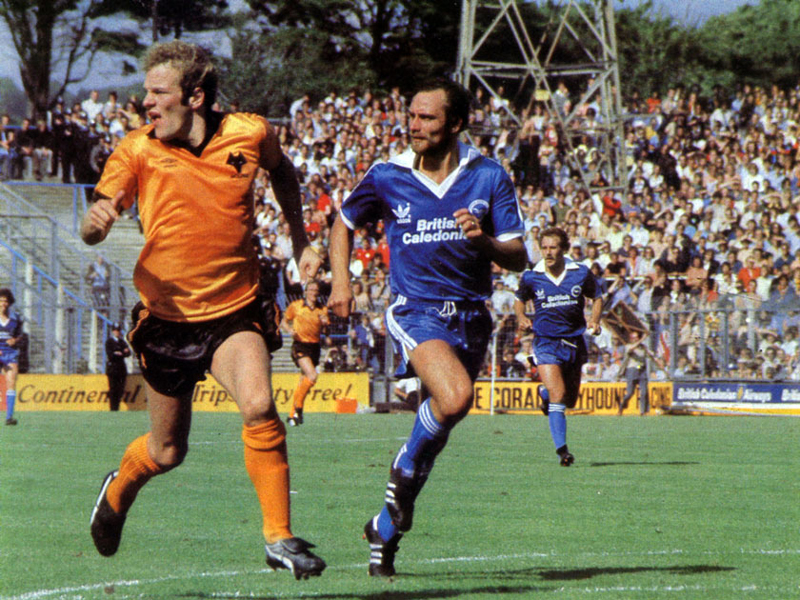
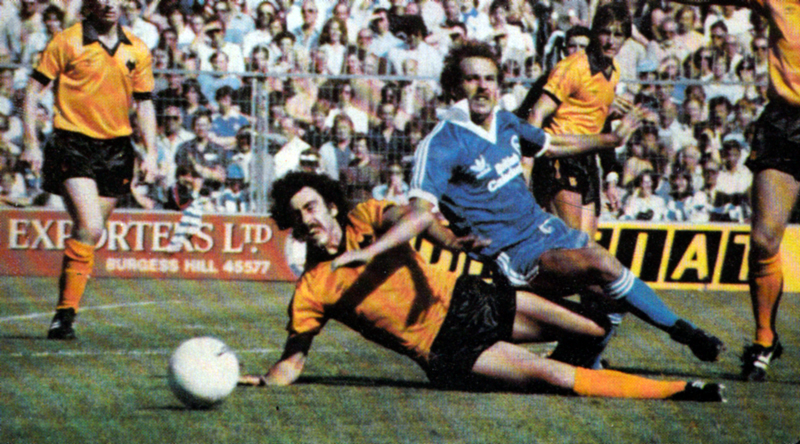
It certainly didn’t pan out that way, which is perhaps testament to the outstanding contributions that Ray Clarke and Peter Suddaby made to the Brighton side. They both had a profound effect on Albion’s season when they joined mid-way in 1979/80. Their departures certainly coincided with a downturn in Albion fortunes, despite the opening day success, a comfortable 2-0 victory over Wolverhampton Wanderers in the sunshine at the Goldstone in August 1980.

An outstanding article by Dave Spurdens dissects the functioning of the Brighton team at the time:

Last season the First Division induced in Brighton the sort of timorous insecurity common to squatters awaiting removal from their borrowed abode.

No mean appraiser of life’s realities in the big league, Alan Mullery saw clearly that reinforcements would have to be moved up if Brighton was to grow from a rather crotchety tenant to an established mortgagee.

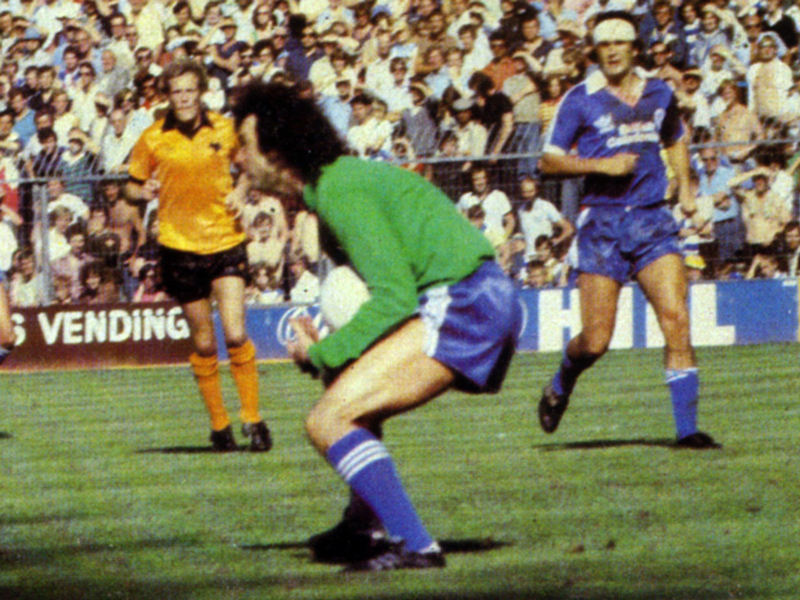
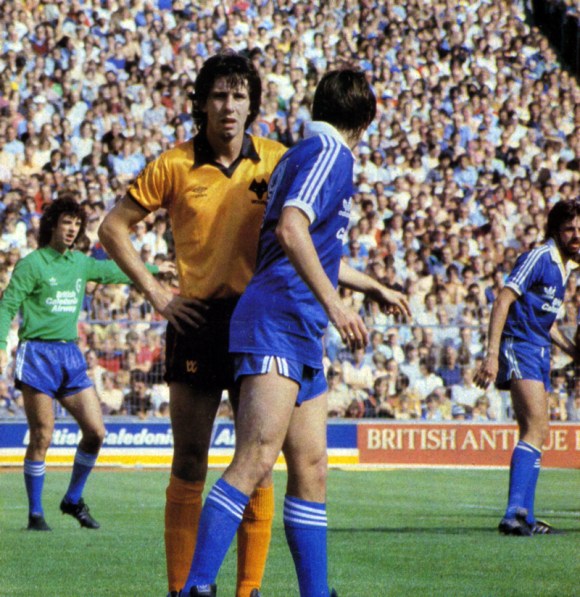
The departures of Ray Clarke, Peter Suddaby and Andy Rollings to pastures new heralded the expected re-jig and after a series of wrangles Mullery forked out a million pounds and came up with Gordon Smith, signed from Rangers, Ray McHale, the generator behind Swindon’s surge, Moshe Gariani, spotted in Israel during a club trip and finally, after much ado, Michael Robinson (below, middle), the Manchester City reject, unloaded by Malcolm Allison in a cut price deal.
wolves3

Robinson went to the Goldstone Ground hopefully to prove that Allison had been right to buy him in the first place, but hopefully remiss in sending him packing after one short season.

Apart from those four it’s the same Brighton and at the end of the day success will depend on these players being better than those they have replaced, coupled with the experience of more prolonged First Division status.

Mullery’s prognostications that Brighton will cause a few surprises started off with a bang when Wolves, the team many tip to challenge the leaders, were reminded that the supposed no-hopers from the south would certainly not help them in their aspirations and were duly beaten by them 2-0.

The blend looked good. Smith, everybody in Brighton averred, was another Trevor Brooking. McHale’s industry was commendable and Robinson, if nothing else, confirmed that he was unlikely in the next few years to halve his value again. Robinson, whom nobody apart from Malcolm Allison thought a near million-pound player, now has to prove that he is a near half-million player.

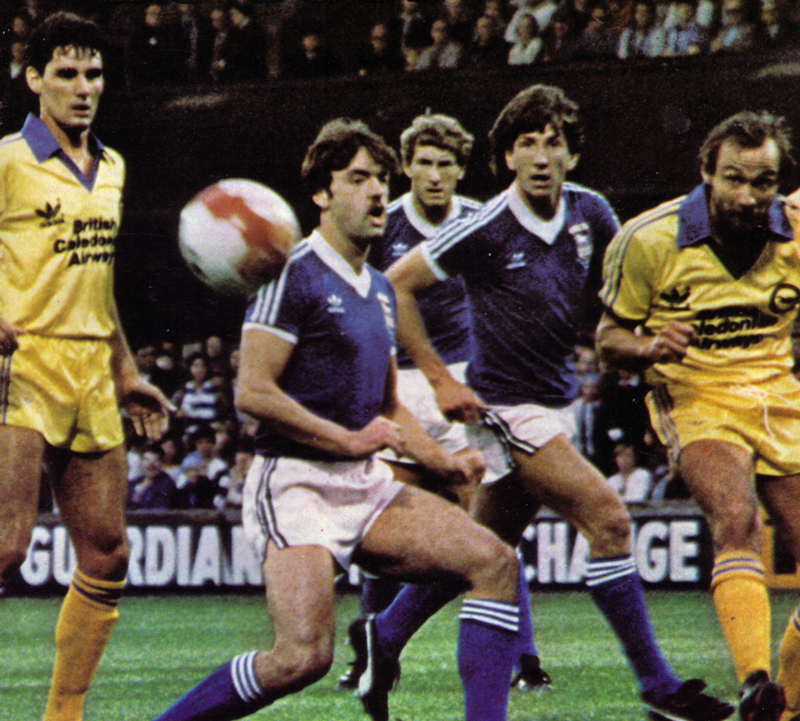
The next game was not so auspicious but nevertheless, despite defeat, demonstrated Brighton’s senior status against another of this year’s tips for the great ‘Nick the title off Liverpool’ campaign, Ipswich.

Taken all round in victory and defeat, this new-look Brighton is a tight outfit with a very solid back four, a midfield that is directed by skipper Brian Horton and a front line that once gets to know itself could produce problems for even the best.
wolves7

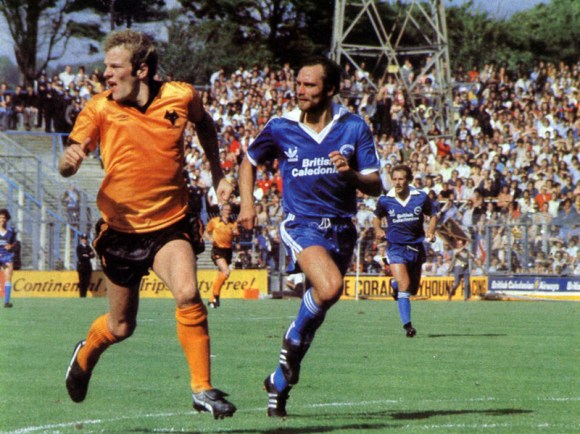
Horton (above), a ubiquitous character, has an influence in the three lines slotting into the back whenever Mark Lawrenson takes off for advanced territory, running the midfield and going on occasional forays behind his front three whenever the opportunity presents itself.

In four seasons at Brighton, since he arrived from Port Vale, he has matured into an integrating force with a strong sense of how to exploit time and space. His influence gives Brighton a varied tempo and a less predictable pattern of advance.
ipswich

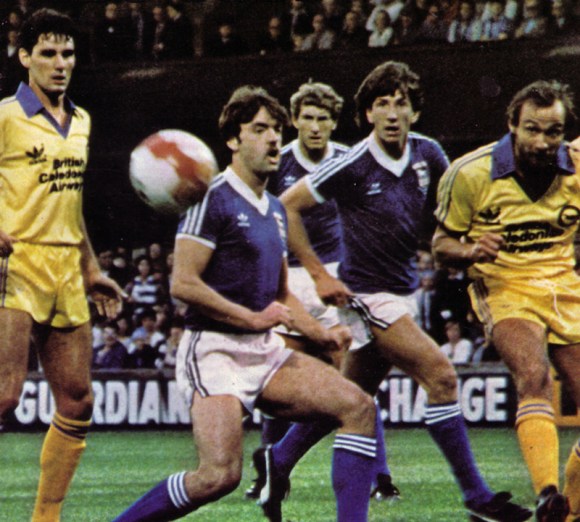
Horton (above) plays a complete midfield role and his defensive work is tenacious and very professional.

Unlike his two midfield colleagues, who allow players to steal goalside oblivious of the pressure it puts on the back four players, Horton is an expert tracker and uses his experience to transfer marking responsibilities when he feels he is being pulled too far away from crucial zones.
raymchale

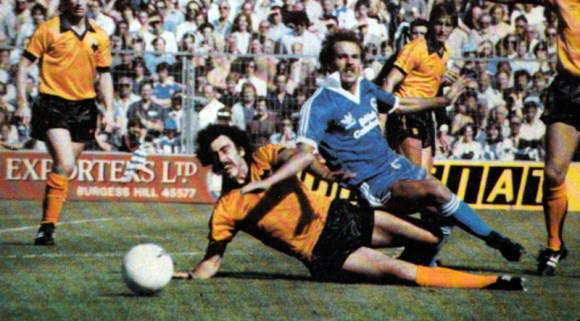
McHale (above), though he operated well forward, is an industrious player busily looking for possession from the man with the ball, but he is not so aware of the damage those without the ball can do.

Neil McNab falls into the same trap of being less than attentive to those who ghost behind his area of concentration. On the ball, he has the look of threatening competence as he moves forward with control. The final pass is often less incisive than anticipated, and some of his forward probes are too easily read by those who should be troubled by them.

Brighton’s build-up when started by Horton or full-back John Gregory is patient and constructive, but tends to be a fifteen-yard game which is easily closed down by good defenders or by teams that fall off and vacate the midfield space.

With a build-up like this, one waits frustratingly for the breakthrough from the back or the run into space which has been created by the diagonal drift of their build up.

So often play develops from the right to left, dragging opposition players with it and leaving large spaces into which back or midfield players should be running in order to exploit opportunities on the blind side.

Even when they are developing their game around the midfield, and where the opposition is turned minimally, there is still a great need for play to be switched once the options have closed down on one flank or the other.

If there was a major reason, in their second game, why their opponents could sit reasonably comfortably it was this tendency to attack in straight lines.
ipswich1

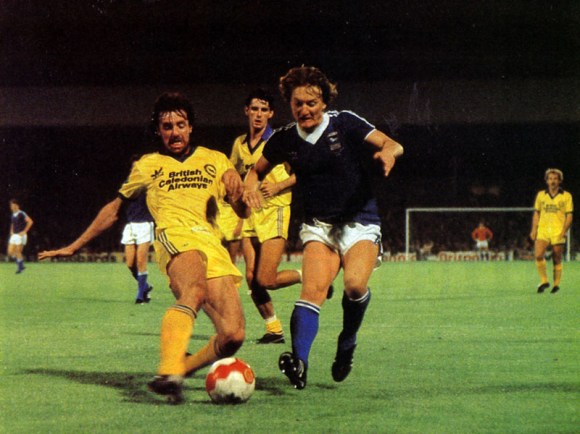
It has been generally accepted by the Seasiders that (above) Lawrenson’s best role is at the centre of the back four.

Certainly with he and Steve Foster at the heart of the defence there is a solidarity that will stand them in good stead whenever they play.

Brighton’s resources probably dictate this policy, lacking the luxury of being able to use players in their perfect role.

I thought Lawrenson playing in front of the two centre-backs last season was more effective because of the strength of his forward runs, and he didn’t have the worry of leaving gaps at the back.
wolves5

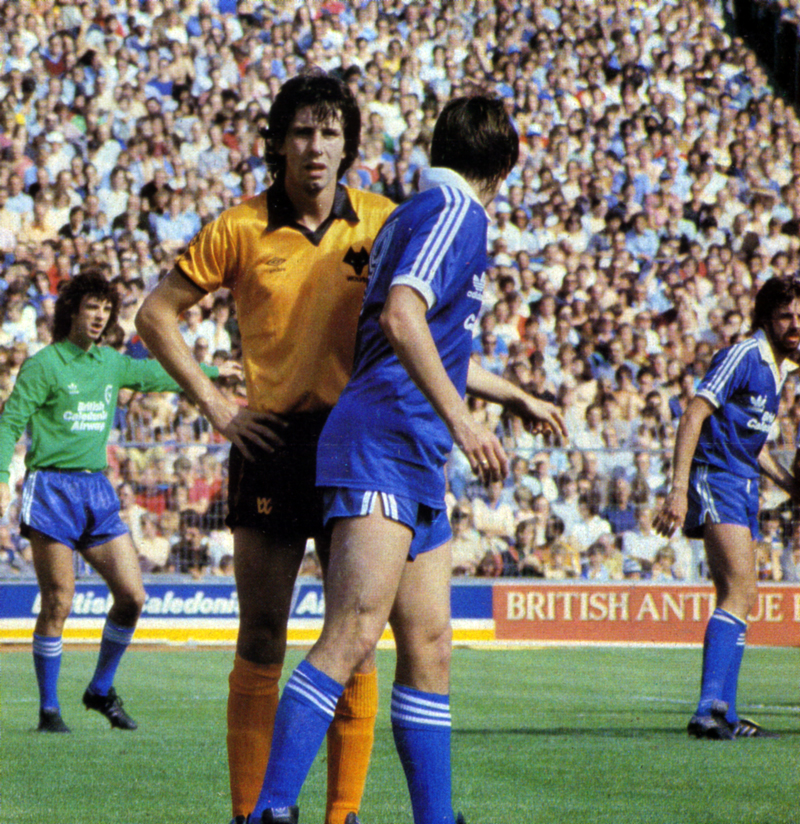
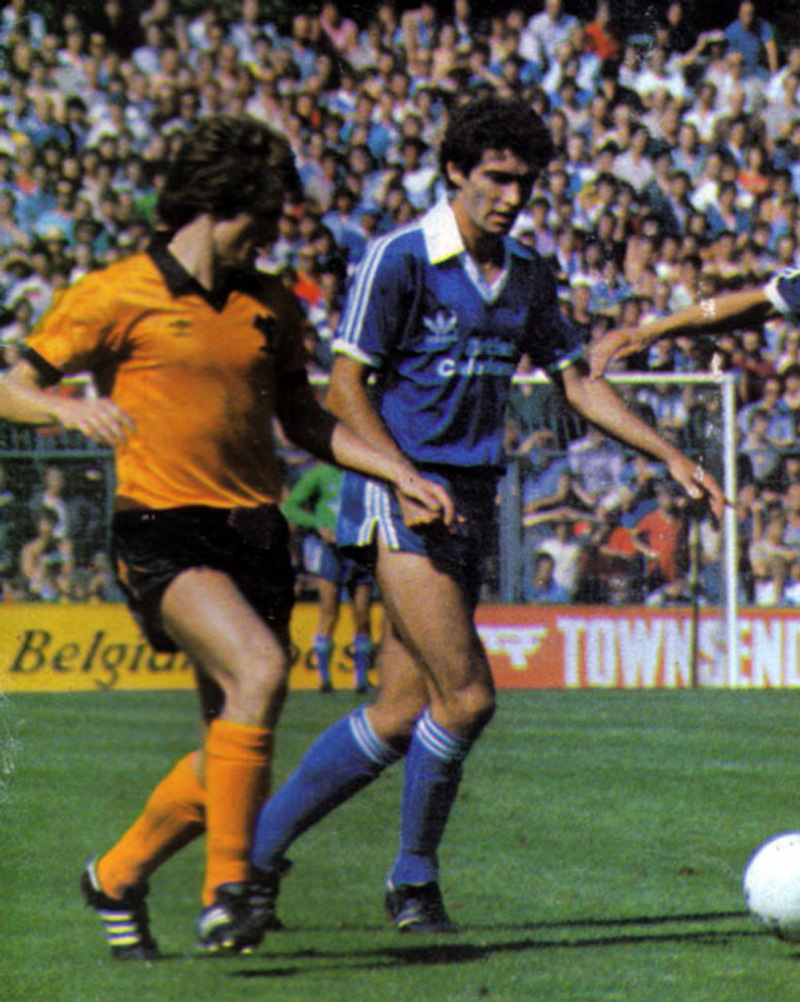
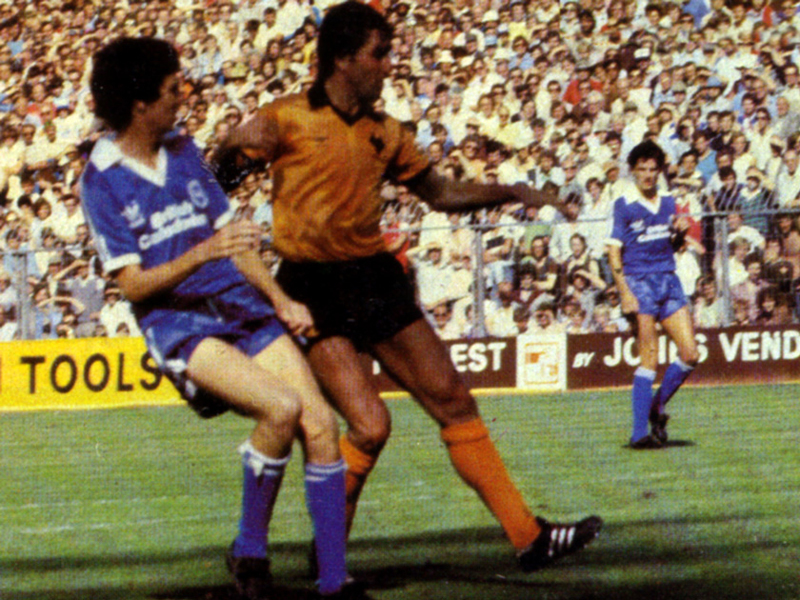
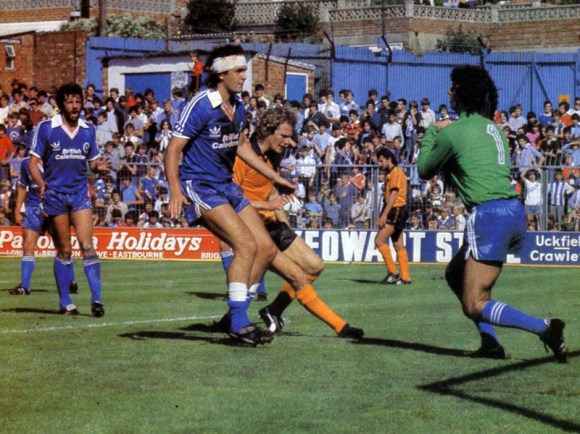
Foster (above) is playing better than ever alongside Lawrenson, with tireless courage and aggression.

There are those who feel him to be one of the best young centre-backs in the country. Against Ipswich, it was interesting to see him with the two favourite contenders for the spots currently held so securely by Thompson and Watson.

Under far greater pressure, Foster made several early errors – especially when it came to picking up high balls on the edge of the box. But once he settled down, he looked the equal to anybody aspiring to international status.
wolves4

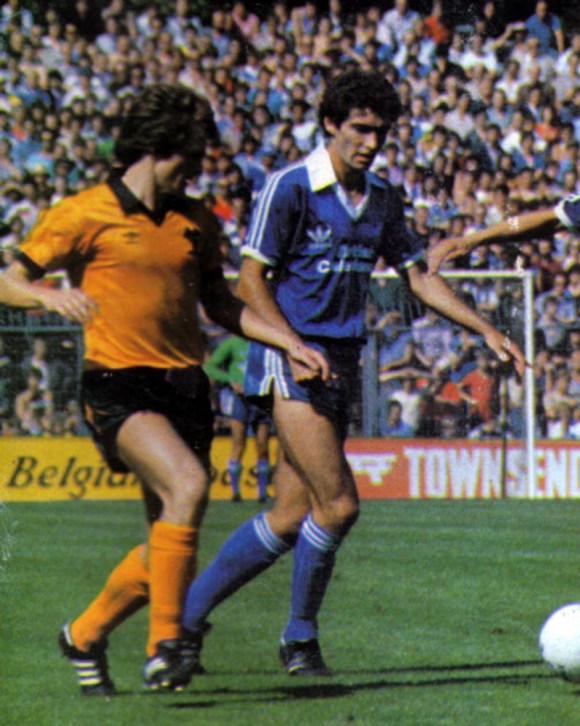
At full back, Gregory (above) turn in his usually immaculate performance both defensively and creatively when he plays the ball forward, but his energy in getting forward into good space seems seriously curtailed. Whether through disinclination or orders, only the player and his manager can know.
wolves1

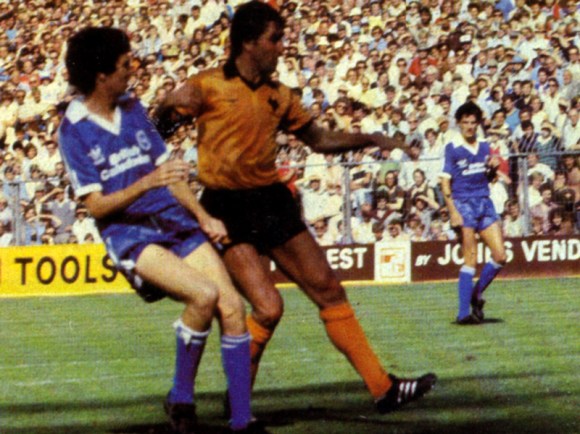
On the other flank, young Gary Williams (above) gives the impression that, unless he tightens up on his jockeying to players who run at him withthe ball, he could be in for a skinning before the season gets much older.

The rest of his game seems to be developing well and the way he linked up with the centre-back in the middle when his partner had been pulled out wide suggests he is learning his craft quickly.
wolves2

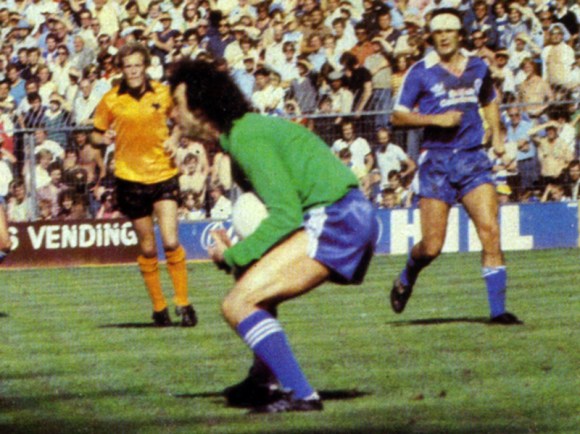
Behind this promising back four Graham Moseley (above) looks quick and agile, enjoying the confidence of those in front of him.

There are times when he could be more positive in his communication but I suspect his diffidence may be prompted by the perpetual dialogue conducted by Foster just in front of him.

The 1980/81 season turned out to be another one of struggle as Brighton’s reshaped side blew hot and cold in the First Division. After the opening day victory over Wolves, it took another six games to record another League victory. Peter Ward left for Nottingham Forest in the middle of a ten match winless spell from late September that saw Brighton vacate the League Cup and marooned at the bottom of Division One by mid-November. Then, a surprise 1-0 win over League leaders Ipswich Town kick-started a brief run of good form. After another slump in the New Year, when Brighton won just twice in fifteen matches, the Seagulls saved themselves with a miraculous spell of four wins in four matches at the end of the season.

This late form showed what Mullery’s most accomplished looking side was capable of. However, it was not without its flaws, as journalist Dave Spurdens capably showed. Although Michael Robinson came good with 22 goals, this did not fully paper over the cracks. When Mike Bailey took over in the summer of 1981, another re-jig of the squad was in the pipeline.

Tagged , , , , , , , , , ,

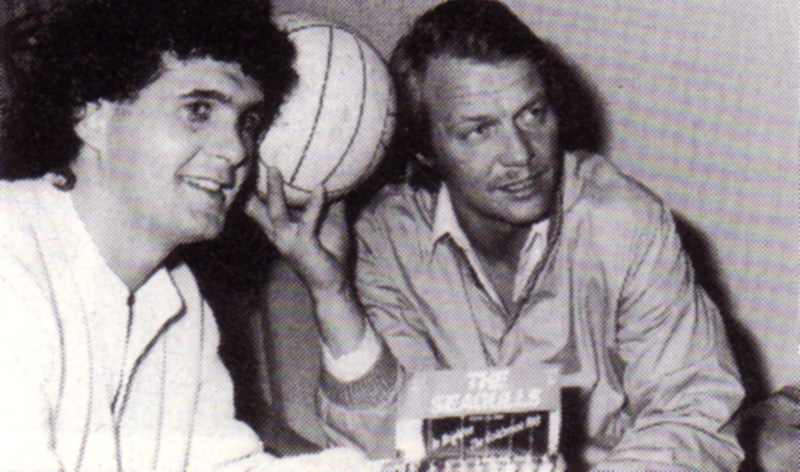
Double A-Side single: ‘In Brighton’ / ‘The Goldstone Rap’ (1982)

First Division footballers they may have been, but Brighton’s team of ’82 also made an audacious bid for pop fame and hip-hop credibility.

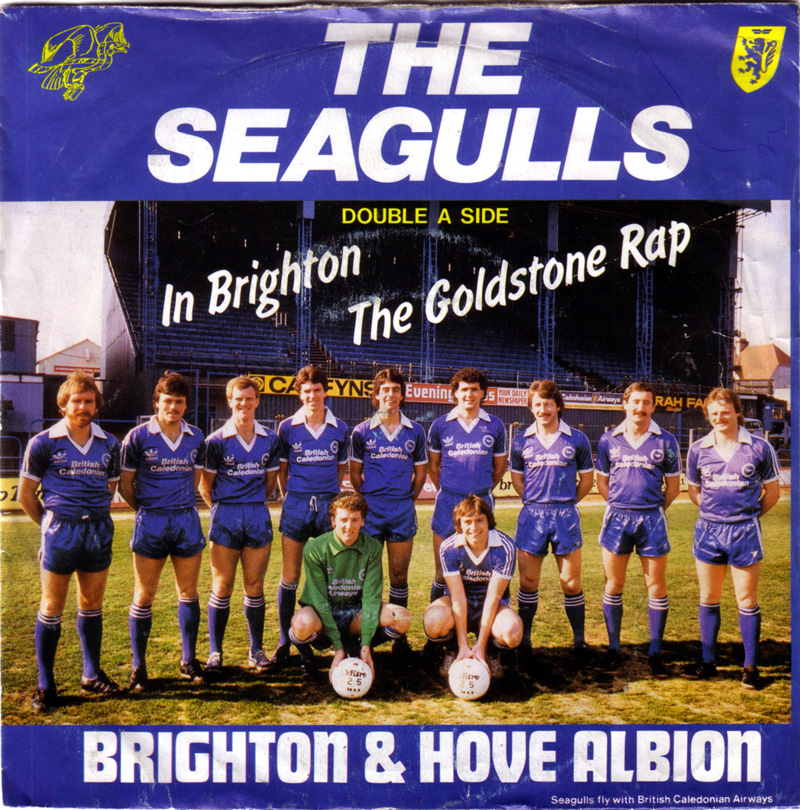
From left to right, here are the rather earnest-looking Gordon Smith, Steve Gatting, Perry Digweed, Andy Ritchie, Jimmy Case, Gary Williams, Gary Stevens, Gerry Ryan, Michael Robinson and Steve Foster seeking to set the world alight with their dulcet tones and Farah slacks, not to mention their previously unrevealed rapping skills:

goldstonerapstudio

In the Brighton v Tottenham match programme from March 1982, it was announced:

Last Wednesday our first team squad had a unique day out when they travelled to recording studios in South London to cut their first record. The record is entitled ‘In Brighton’ and should be available on general sale in early April.

Howard Krugar, who lives in Hove and specialises in organising concerts for some of the world’s biggest stars, is the man behind the idea and he is hopeful of the disc making the charts. In fact it is highly likely that the Albion squad will appear on ‘Top of the Pops’.

Also involved in the record is BBC football commentator Peter Brackley who livens things up with commentary on a memorable Albion goal… which one? Well, for that you’ll have to buy the record.

Thanks to the lads at We Are Brighton, you can hear ‘In Brighton’ here:

Based on the Drifters’ song ‘On Broadway,’ the song received a positive response from John Henty who gave it a spin at Radio Brighton on Sunday 4th April. With dubious lyrics such as ‘Big Fozzie keeps it tight for Brighton’ and the boast of ‘Playin’ at the Goldstone Ground, where good football’s always found’ (sadly, no football of any kind down there now), not to mention even dodgier singing, the song probably did not have much of a fanbase outside of Brighton supporters.

Nevertheless, it was also played by Peter Powell on Radio One. However, as notes that month in the Brighton v Manchester United programme lamented:
Last week Peter Powell played the disc on his Radio One show but allowed his own support of Wolves to colour his comments on the merits of the recording.

The song was also erroneously aired on BBC’s ‘Match of the 80s’ series in the 1990s in its coverage of Brighton’s FA Cup run of 1983, with Danny Baker hesitating about even calling it a ‘song’! And, just in case you are wondering, the Andy Ritchie goal that Brackley acts out a commentary on is almost certainly this swerving free-kick belter from the Brighton v West Bromwich Albion game in February 1982:

The other track on this Double A-side was ‘The Goldstone Rap’, which this very blog you are reading takes its name from. Looking at it now, it’s amazing to think that Brighton & Hove Albion were at the forefront of the UK hip-hop scene in 1982, especially as this was almost certainly the first ever football song to feature rapping.

Unlikely to win any prizes at the MOBO awards, the rap memorably includes such lyrical gems as:
‘When you make that cross you’re gonna cross it fine / Give the ball to the player on the dead ball line.’

Never mind the MOBOs, though. Were you at Busby’s Night Club on Kingswest, Kings Road, in Brighton on the evening of Tuesday 6th April 1982? If you were, you would have been present to the grand launch of the single, as Brighton & Hove Albion’s first team squad belted out their musical masterpieces on stage! Sadly, I have no video footage of this priceless moment.

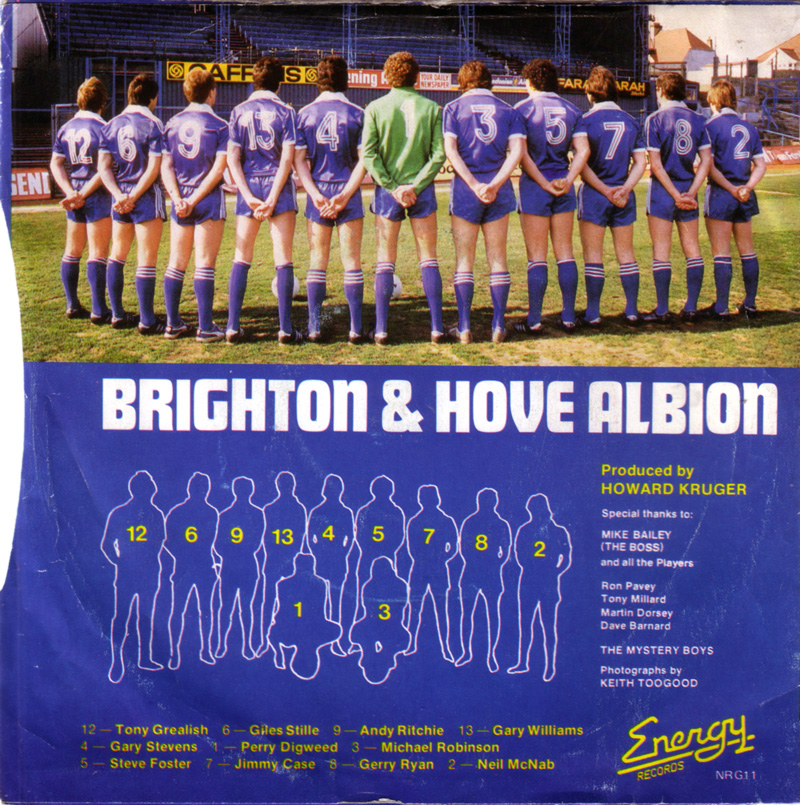
When released to the general public, the colour sleeve of the 7″ looked splendid, with the players proudly posing in front of the temporary Lego Stand in all its glory:

inbrighton-front

inbrighton-back

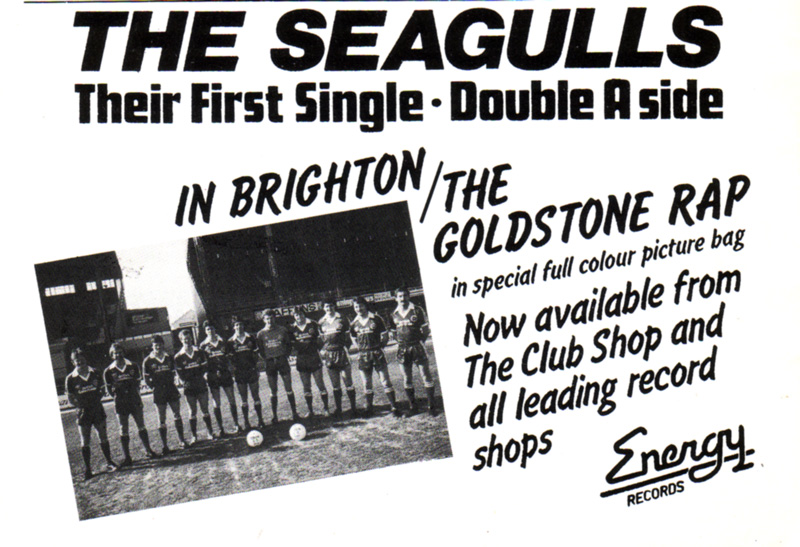
The price was a bargain £1.20. Buyers of the single from the club shop were also given a chance to enter a great competition to win two tickets to Dallas, Texas, with British Caledonian Airways.

inbrightonad

So, was the Brighton release a launchpad to instant chart fame and fortune? Unfortunately, the single sank without trace but it gave Steve Foster (whose vocals also featured on the England 1982 World Cup song ‘This Time’), an opportunity to meet up with proper singer David Soul and wing a copy to the ‘Starsky and Hutch’ star:

steve-foster-david-soul

Years later, I was wondering about ‘The Goldstone Rap’ and imagining what it would have sounded like if it adopted the electro sound of 1982’s other great hip-hop release, ‘The Message’ by Grandmaster Flash & The Furious Five. Thanks to the power of the internet, and due to a discussion on North Stand Chat, I got to find out.
Major props to Ian, the DJ who created this ‘Goldstone Message’:

A much enhanced version, I hope you’ll agree. In terms of pushing at the limits of what was possible for music and Brighton & Hove Albion footballers, it was certainly close to the edge.

Some MP3 files for your listening pleasure:
(right-click to ‘Save Target As…’ or ‘Download Linked File’)
In Brighton
The Goldstone Rap
The Goldstone Message

Other Wrap posts about Brighton & Hove Albion songs:
Carol Manns – ‘Seagulls’ (1979) – a video!

Tagged , , , , , , , , ,

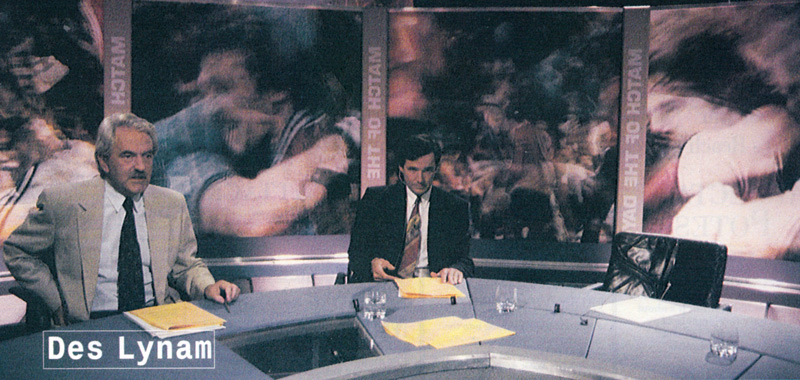
Des Lynam’s dream team

As a reader, having outgrown Shoot! and with Match dumbing down to becoming little more than a poster magazine, I became a big fan of 90 Minutes magazine in the 1990s. Irreverent and intelligently written, it’s a weekly magazine that I wish was still going. Here’s a fascinating read from its pages on 28th January 1995. Interview by Kevin Palmer:

deslynam2

Des Lynam may spend his Saturdays discussing the ins and outs of the Premiership with his Match of the Day colleagues, but what he’d really like to be doing is breathing in the sea air and cheering on his beloved Brighton at the Goldstone Ground. 90 Minutes dons a jacket and tie and asks our Des to spend an imaginary £8million on his Seagulls Dream Team.

Why Brighton?
My family originally come from Ireland, but when we moved over here and into the Brighton area I started going to watch and developed a real interest. I started to go to the Goldstone Ground more and more as time went on, but I did play on Saturdays for school teams which meant I missed some games. Since I’ve been working on TV I’ve become associated with Brighton and have even been offered a place on the board, although I wasn’t mad enough to take it.

First game?
I clearly remember the first game I ever attended at Brighton and it wasn’t especially for the football. It was around 1952 and they still used those big, heavy leather footballs. I went along to the game with a neighbour and his daughter and unfortunately a ball smashed the child in the face and knocked her out cold. We were dragged away from the game while they got treatment. I have always said it was the first time I had ever experienced a woman’s headache getting in the way of a lot of fun! We did manage to see some of the game in the end, but it was an interesting afternoon that was somewhat spoilt by the pre-match ‘entertainment.’

stevefoster6This season?
I don’t get to see the team as often as I like because I have to work every Saturday with Match of the Day, but I follow their fortunes very closely. I also live in the London area now which makes it a little more difficult to go. But a team like Brighton are always going to find it very hard in a modern football environment. Liam Brady is doing a good job, but they’ve had a bad run of late which has pulled them down somewhat. I still feel Brady has a lot to prove as manager, but Brighton is a great place for him to make his mark. There has been talk of him moving in as the new Arsenal manager if George Graham was to leave, but I don’t think Arsenal would want to make such an ambitious appointment with an unproven manager. The main aim for Brighton this season has got to be survival in the Second Division and then we can look to build from there.

An £8 million injection would surely have been enough to stop the club from selling the Goldstone Ground. But if it had to go on players who would Des have chosen?

battyDavid Batty
Current club: Blackburn Rovers
Fee: £2.95 million

He’s a great competitor and would give us the extra edge we need in the midfield, although we do have Jimmy Case who’s still a good performer even if he is past his 40th birthday. Batty would win the ball for you and let the others play the football, though he has improved his passing game immensely in recent years.

harfordMick Harford
Current club: Wimbledon
Fee: £50,000

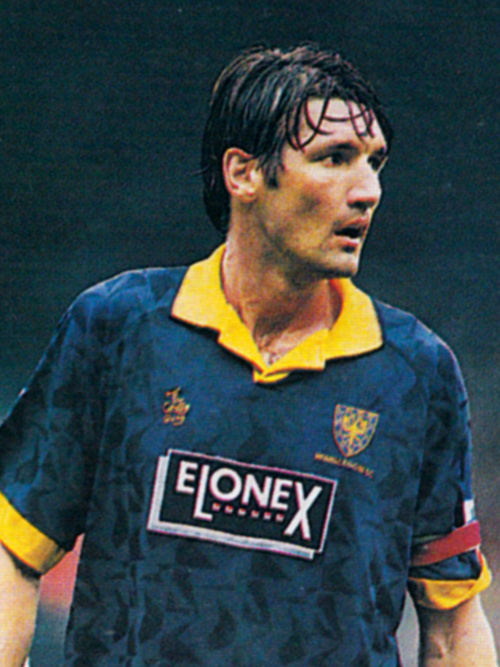
This will be a surprise choice for most, but he is perhaps the sort of player we could hope to sign with the financial situation at brighton. Harford would put the fear of God up the defenders in our division and would cause a lot of problems. He’s proved he still has the ability with his recent burst of goals for Wimbledon in the Premiership.

collymoreStan Collymore:
Current club: Nottingham Forest
Fee: £5million

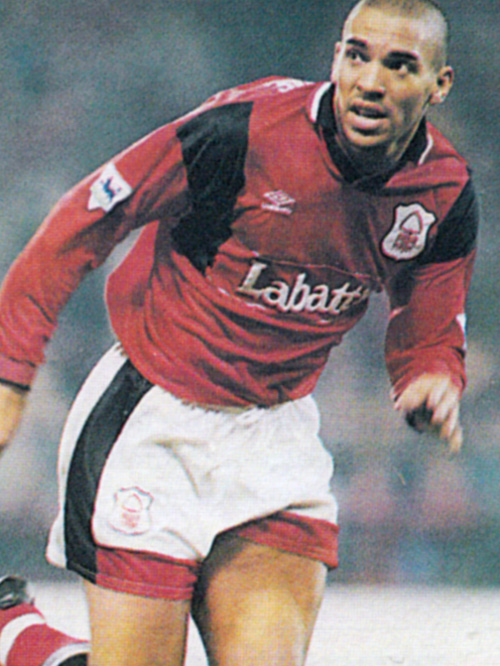
One of the most sought-after players in the Premiership and it’s not surprising. Everything he does makes him look like a class striker. I wouldn’t say he’s the best in the country, though. Alan Shearer’s the best striker around, but with just £8million to spend, I wouldn’t have enough to make a bid for him.

Tagged , ,

A greyhound called ‘Seagulls’

greyhound

From the Brighton v Norwich programme in October 1979:

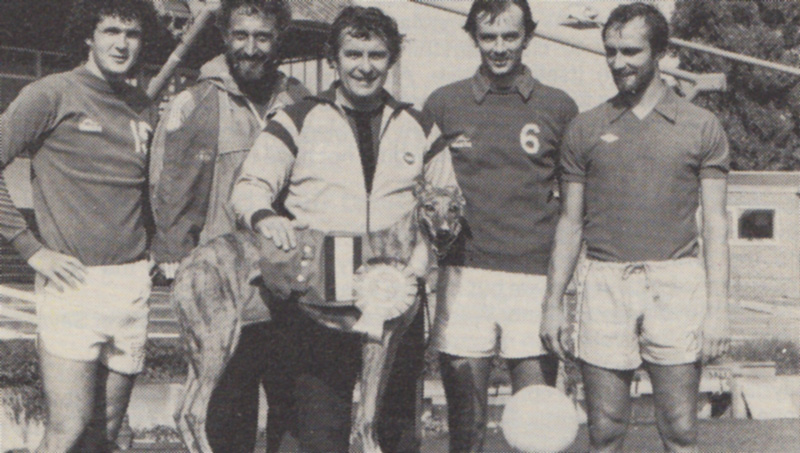
The greyhound recently adopted by the Albion and renamed ‘Seagulls’ has, since taking the Albion’s colours, been pretty successful. Despite being just about the youngest dog in the Grand Prix field she won her heat, came second in her quarter-final and then third in the semi-final to reach last Saturday’s final at Walthamstow.

Tagged , , , , ,

Brighton v Nigeria, 1981

Amazingly, on 24th August 1981, Brighton played a friendly against the Nigerian national side.

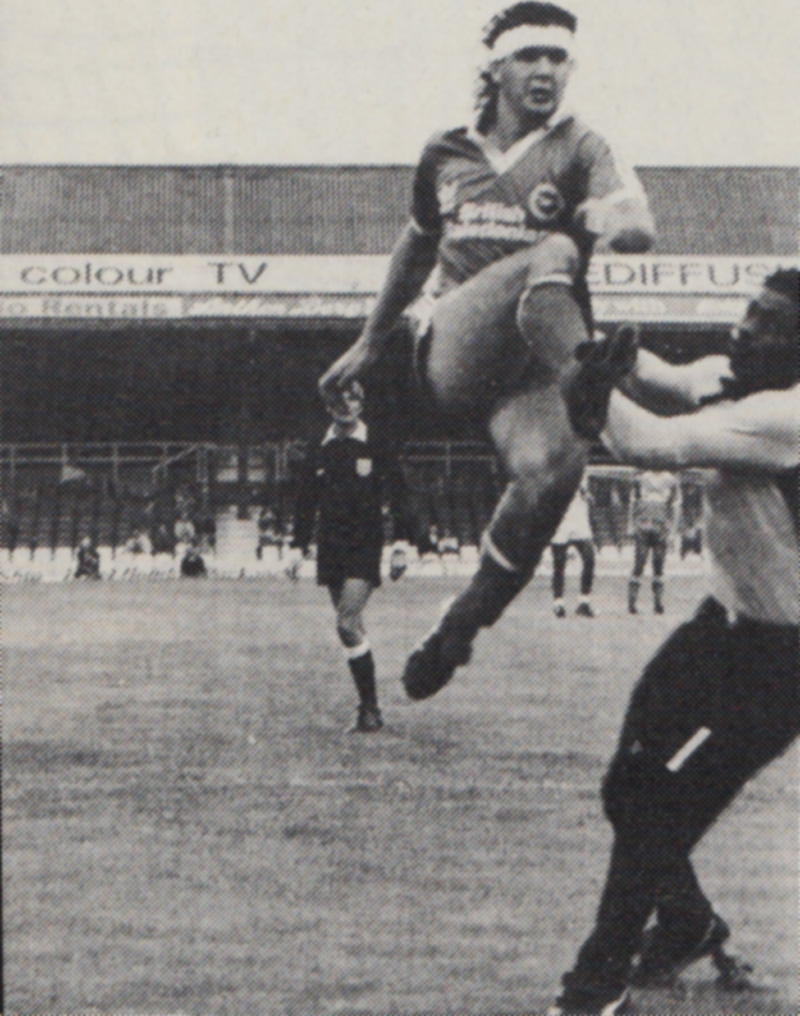
Here’s Steve Foster’s high challenge that created the opening for Tony Grealish to get Albion’s first goal. So high, the cameraman almost missed it.

nigeria1v2

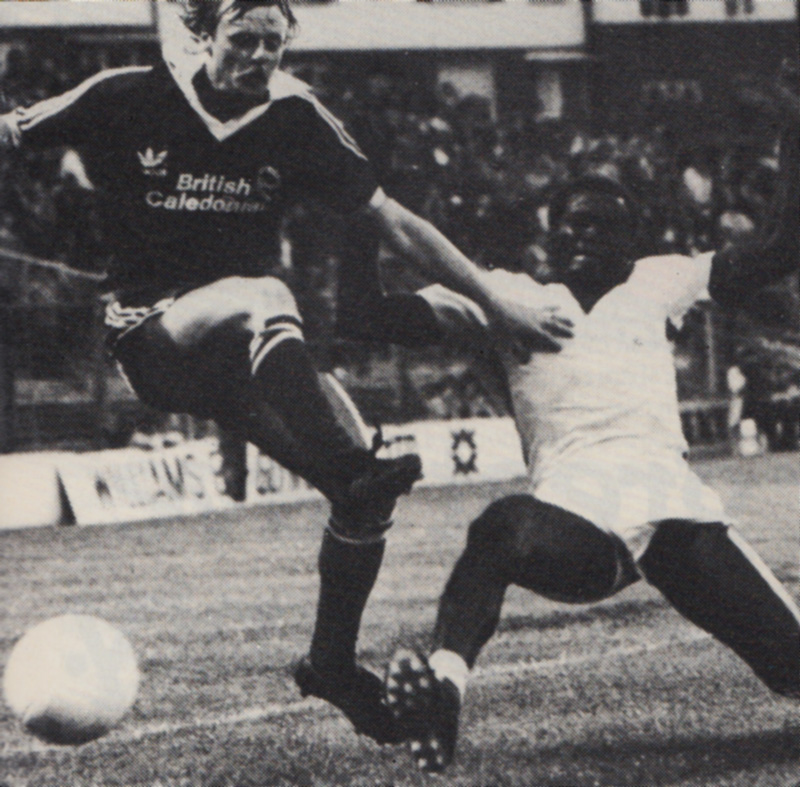
According the club’s match programme, Neil McNab was ‘always in the thick of the action against the Nigerians.’
nigeria2

In a match sponsored by British Caledonian Airways, Brighton & Hove Albion triumphed 5-1. Grealish, Foster, Ritchie, McNab (pen) and Smith got on the scoresheet. We beat a whole country at football, in other words!

In Gordon Smith’s entertaining autobiography, ‘And Smith Did Score,’ he writes vividly about the match:

We were playing a friendly against the Nigerian national side at Brighton and it turned into a real roughhouse. I was playing up front and we were winning 3-0 when their six-feet-four centre-half came up to me and said, ‘You are shit.’

‘What do you mean?’ I asked.

‘I said you are shit. You are a bad team. Liverpool are a good team but you are shit.’

‘Well, if we’re beating you 3-0 and we’re shit, what does that make you?’

And the giant centre-half answered menacingly, ‘I am going to get you. I’ll kill you.’

After some really bad tackles were going in and Tony Grealish got such a bad tackle you could see the bone and the ligaments in his leg through the gash. The whole Nigerian team were acting like maniacs and, at the final whistle after we had won 5-1, I said to the big centre half, ‘So who’s shit now?’

‘But we’re amateurs,’ he said.

‘Yes, we can tell,’ I replied.

That’s when he went off his head and came chasing after me. There was a huge scuffle in the tunnel and he had to be held back while I headed for the dressing room.

Abou ten days later, I walked into the club and was told to go to the treatment room to get an injection from the club doctor. When I asked what it was for, I was told I was going to play a return match against Nigeria, in their capital city, Lagos. I immediately said I wasn’t going. ‘It’s one of the worst places in the world,’ I said. ‘The land that time forgot.’

Mike Bailey said that, if I didn’t go, he would fine me two weeks’ wages.

‘Do you want to take it out of my wages or do you want a cheque now?’ I asked him.

I got back to the dressing room and the boys were wondering what was going on. I told them about Nigeria and why I wasn’t going. One by one, the rest of the team agreed they wouldn’t go either. A team meeting was held and we told the management we weren’t prepared to go to Lagos to play the Nigerians. The following day, the doctor was back in, giving the reserves their injections to go to Nigeria. Mike Bailey didn’t even go and no one was fined. The incredible thing was that, although the reserve boys didn’t enjoy the trip, they played in front of 90,000 people in Lagos – the biggest crowd most of us would have experienced at that stage in our careers. The reserves were used to playing in front of 200-300 fans.

gordonsmith

Tagged , ,

Steve Foster: third choice as captain

stevefoster1

From Match Weekly:

Brighton defender Steve Foster wasn’t the club’s original choice as skipper… he was third in line!

Before the season started Brian Horton, who led ‘Seagulls’ to the First Division in 1979, was expected to carry on the captaincy.

But his surprise move to Second Division promotion favourites Luton created a chance for Eire international Mark Lawrenson and he took charge for a couple of pre-season friendlies.

Mark didn’t keep the job for long because he too fond his way from the Goldstone Ground when Liverpool manager Bob Paisley parted with £900,000 to take him to Anfield.

So new manager Mike Bailey found himself looking for another leader and he had no hesitation in choosing 23 year-old Steve.

‘Mike’s decision to make me skipper came right out of the blue – I’d never even thought about leading the team before,” said Steve. “But it’s a great honour and I’m really enjoying the job. I suppose I play in the ideal position for a captain. Being a defender means you can see more of the game and can tell where things are going right or wrong. I see my role as putting over what the manager wants on the field. It’s my job to make sure each player does what he has been told to do. I’m a bit of a moaner on the field. Part of my game is talking and if things go wrong I’m not scared of bullying my team-mates.

‘The lads have been tremendous. They’ve just knuckled down and done what I’ve told them. I think we can do really well this season. We’ve made a good start and I’m sure we can build on it.’

Foster did so well in 1981/82 that he found himself picked for the England World Cup squad in Spain that summer.

stevefoster3

stevefoster2

Tagged

Opening of the Seagull Tavern

seagull tavern

Taken from the Brighton v Crystal Palace programme of December 1979:

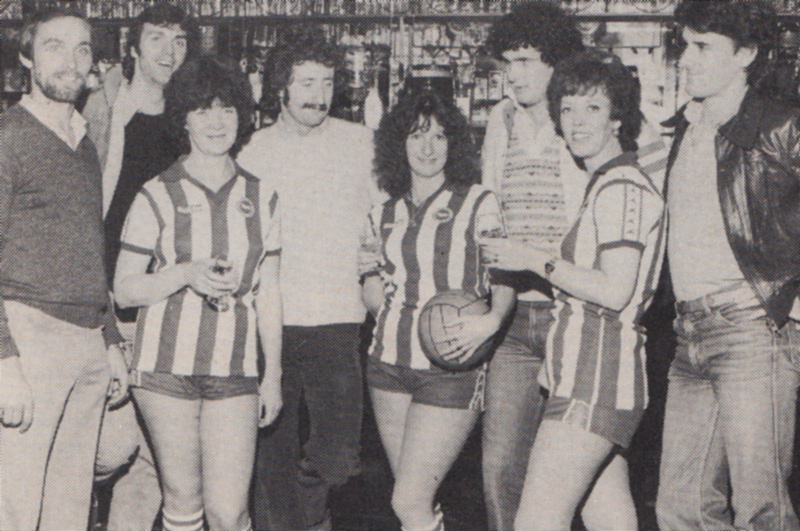
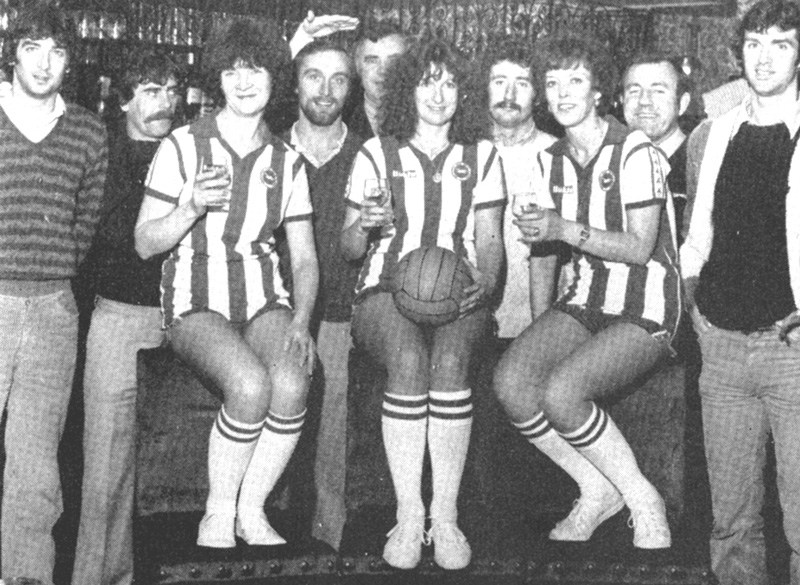
Two weeks ago the nearest hostelry to the Goldstone took on a new name. The former Sackville pub on the corner of Old Shoreham Road and Sackville Road was renamed the ‘Seagull Tavern’ and there for the opening were a number of Albion players to wish landlord John Sainsbury well. Our photo shows the lads together with some ‘Seagulls’ lovelies.

Anyone who owned a replica of that Bukta shirt can vouch for its nipple-scratching effects of the sandpaper-like material. I hope the, ahem, ‘lovelies’ weren’t too discomforted. Gerry Ryan appears to be somewhat distracted by the young lady with Peter Sayer’s perm!

And a few drinks later, things get a bit more cosy…

seagulls tavern 2

(from Brighton v Southampton, Peter O’Sullivan testimonial programme, April 1980)

Tagged , , , ,

Cheerleaders!

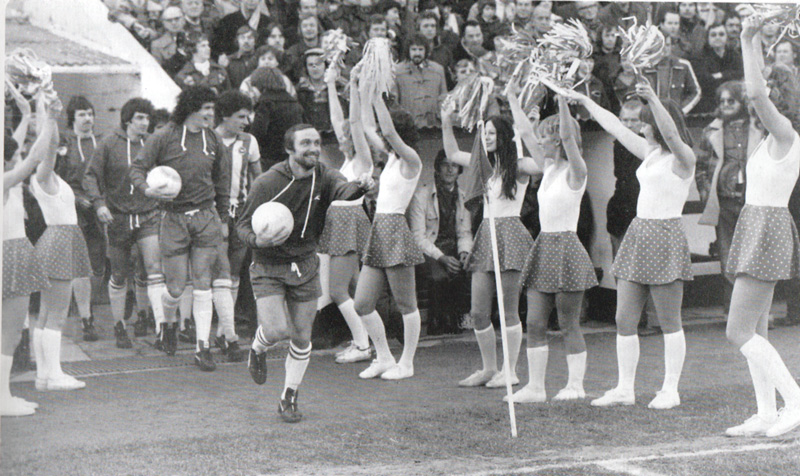
And if you thought Gully’s Girls were Albion’s first cheerleaders, this might cause you to do a double-take.

cheerleaders

The Albion team come out of the tunnel in their last match of the 1970s, at home to Manchester City, to an enthusiastic welcome from this troupe.

Brian Horton looks as pleased as punch. It seemed to do the trick. Albion triumphed 4-1.

Tagged , , , , ,

Backpass Magazine: Steve Foster interview

backpass1

Backpass Magazine is a fantastic read for anyone who loves football culture of yesteryear. Priced £3,95, the magazine has been going since the summer of 2008. The current issue, issue 27, with cover star Liverpool’s Roger Hunt, features the Steve Foster photo above in the glorious Highbury sunshine in April 1983. It also includes a two page interview with Fozzie. He says:

I started there under Alan Mullery. He was followed by Mike Bailey, a lovely man and manager who was sacked for not smiling enough! Jimmy Melia took over and that’s when everything started to take off, especially with the FA Cup run.

There is a mistake in the interview as Foster appears to suggest that Albion finished 13th under Mullery in 1982 before becoming defensive under Bailey. That high finish was, of course, under Bailey. However, this does not take away from the fact the interview is an enjoyable read with Foster characteristically forthright in his views about managers and players.

Anyway, I won’t spill the beans as this magazine is in some newsagents despite problems with the barcode restricting supply.

Brighton have been very well served by the magazine over its 27 issues:

    Issue 1 has a short article on Bristol Rovers’ Bannister and Warboys, the nemesis of Brighton in 1973 in the 8-2 defeat
    Issue 2 has a short article on how Brighton got the Seagulls nickname, and a summary of the 1982/83 season with a review of the FA Cup Final. Also mentions the club ‘unveiled plans for a new £7 milion stadium to be opened in 1985. They are still waiting!’
    Issue 4 has memories of Norman Gall and a feature on the Leatherhead Lip giantkillings
    Issue 5 has an interview with Jim Walker
    Issue 7 has an interview with Mel Hopkins although there is no Albion references other than a photo of Hopkins
    Issue 10 has reviews of the Peter Ward and Martin Chivers biographies, an interview with Peter Ward, and Mike Tiddy obituary
    Issue 13 has an interview with Jimmy Melia, a feature on the famous ‘penalties’ match with Crystal Palace in 1988/89, and a Bobby Smith obituary
    Issue 14 has an Alan Davies retrospective with comment by Gary Stevens. Also, a Mel Hopkins obituary
    Issue 15 has interviews with Ian Goodwin and Gerry Ryan
    Issue 16 has an interview with ex-Albion coach Ray Crawford
    Issue 17 has a flashback to the epic cup tie between Brighton and Walsall in 1969/70
    Issue 18 has a Ken Beamish interview and Goldstone retrospective
    Issue 19 has a Bernie Gallagher obituary
    Issue 24 has a retrospective of Southern TV’s football coverage and the Preston days of Alex Dawson – only a very brief Albion mention in each plus a photo of Dawson in a Brighton shirt
    Issue 25 has a feature on Brighton & Hove Albion kits and an Ernie Machin obituary
    Issue 26 has an interview with Brian Horton
    Issue 27 has an interview with Steve Foster
    Issue 28 has a short article on Spencer Vignes’ ‘A Few Good Men’ book
    Issue 29 has a synopsis of the John Shepherd book, an article on the 2-8 defeat to Bristol Rovers, and obituaries of Tony Grealish and Freddie Jones

Some back issues are still available. Get them from their website before they go! Digital back issues will be available soon.

Tagged ,