Category Archives: Media Coverage

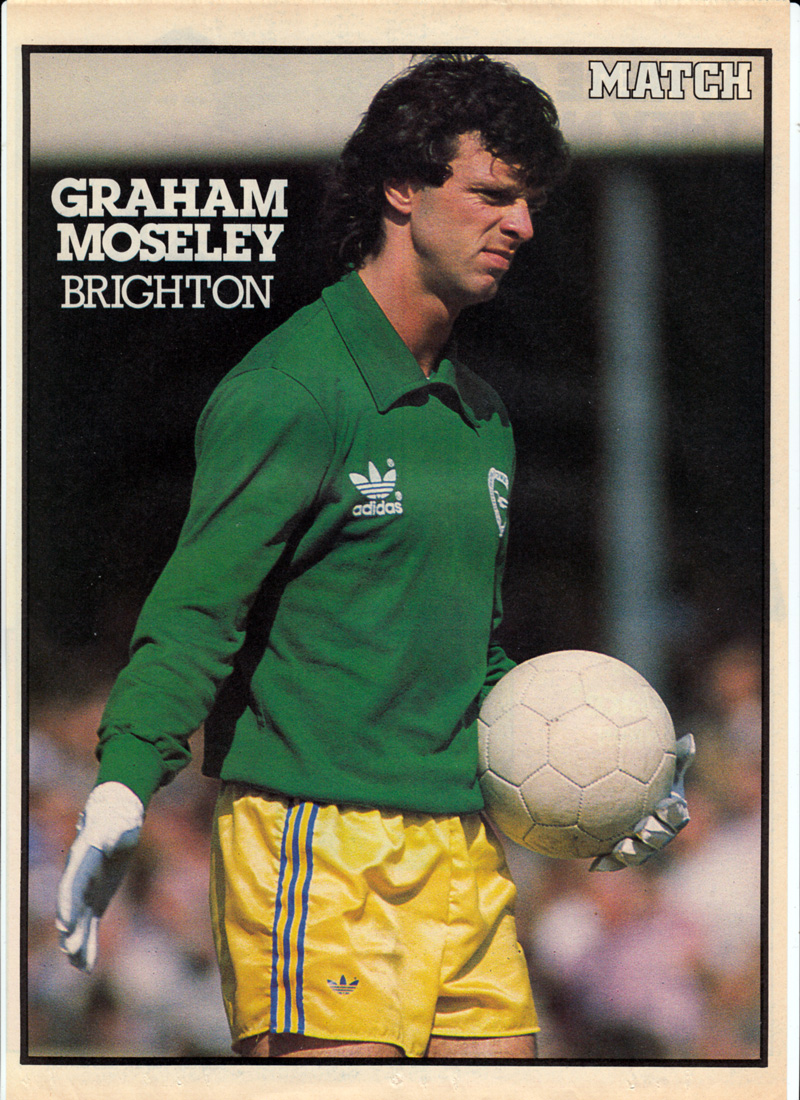
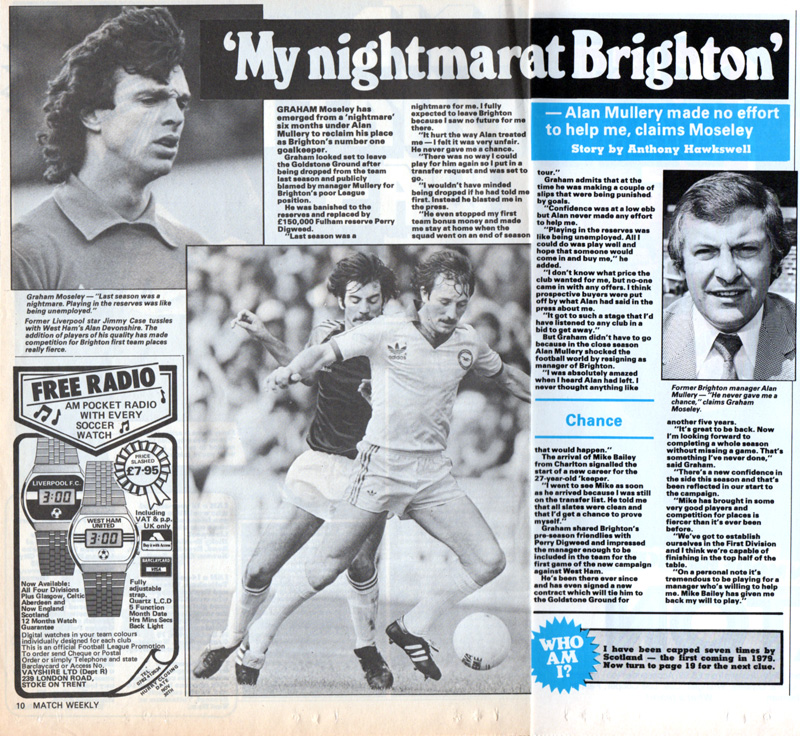
Graham Moseley: My Brighton nightmare

moseley2

From Match Weekly in 1981/82:

Graham Moseley has emerged from a ‘nightmare’ six months under Alan Mullery to reclaim his place as Brighton’s number one goalkeeper.

Graham looked set to leave the Goldstone Ground after being dropped from the team last season and publicly blamed by manager Mullery for Brighton’s poor League position. He was banished to the reserves and replaced by £150,000 Fulham reserve Perry Digweed.

“Last season was a nightmare for me. I fully expected to leave Brighton because I saw no future for me there. It hurt the way Alan treated me – I felt it was very unfair. He never gave me a chance. There was no way I could play for him again so I put in a transfer request and was set to go. I wouldn’t have minded being dropped if he had told me first. Instead he blasted me in the press. He even stopped my first team bonus money and made me stay at home when the squad went on an end of season tour. Confidence was at a very low ebb but Alan never made any effort to comfort me. Playing in the reserves was like being unemployed. All I could do was play well and hope that someone would buy me.

When Alan Mullery resigned as Brighton boss in the summer of 1981, Mike Bailey’s arrival gave Moseley a second chance:

“I went to see Mike as soon as he arrived because I was still on the transfer list. He told me that all slates were clean and that I’d get a chance to prove myself. There’s a new confidence in the side this season and that’s been reflected in our start to the campaign. Mike has brought in some very good players and competition for places is fiercer than it’s ever been before. We’ve got to establish ourselves in the First Division and I think we’re capable of finishing in the top half of the table. On a personal note, it’s tremendous to be playing for a manager who’s willing to help me. Mike Bailey has given back my will to play.”

By the end of the season, Moseley had re-established himself at the club, playing 30 League games with Brighton in 13th spot in Division One, their highest ever finish.

grahammoseley-match

Tagged , ,

Willie Irvine: How Promotion Was Won in ’72

willieirvine

In ‘Together Again,’ the autobiography of former Burnley, Preston, Brighton and Halifax hotshot Willie Irvine, he recounts the story of how Albion’s scintillating all-out attacking play achieved promotion from Division Three in 1971/72. Alongside the equally prolific Kit Napier, his sixteen League goals made him the club’s joint top scorer. Irvine’s strikes against Torquay, Halifax, Walsall (FA Cup) and Bristol Rovers were all in the dying minutes, earning him the nickname ‘Late Goal Willie.’ He also scored this incredible goal against Aston Villa:

More on that later!

Unusually, but effectively, the classy Northern Ireland international reminisces about the famous season through the context of a booklet from those times:

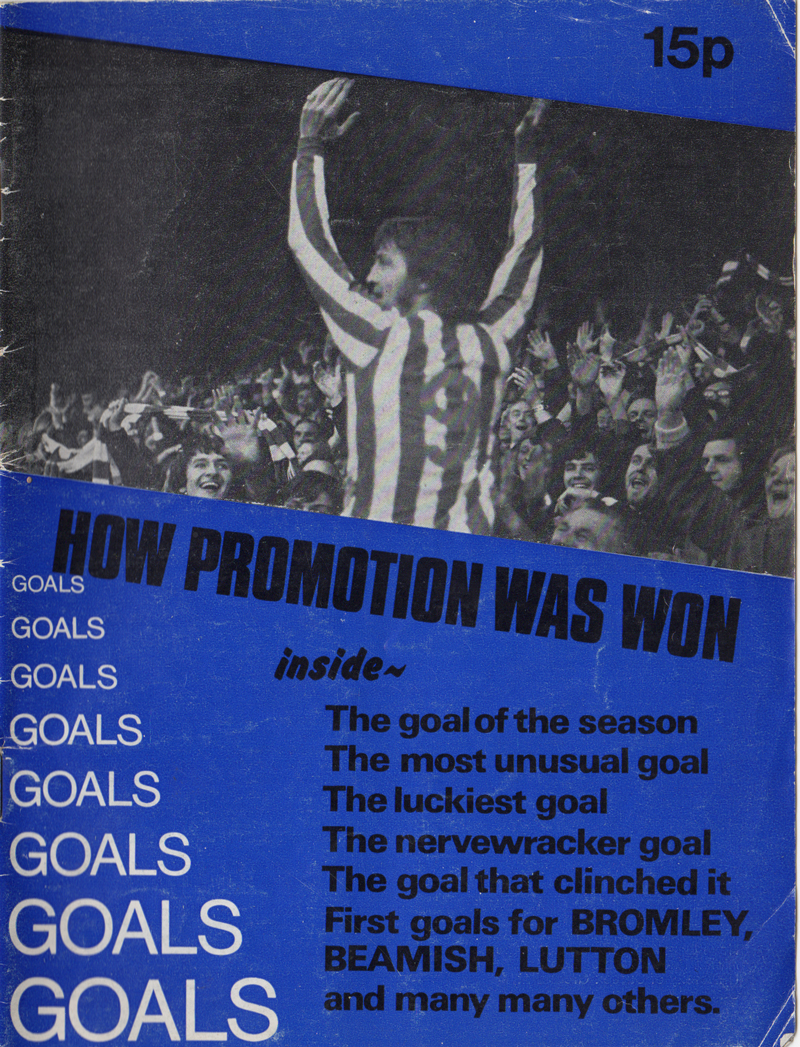
Among my few bits and pieces of memorabilia is a torn, battered, moth-eaten copy of a little programme-sized souvenir booklet produced by Chris Bale, who was sports editor of the Brighton and Hove Gazette. It’s a story in pictures of that memorable season, one of the happiest and most rewarding I spent.
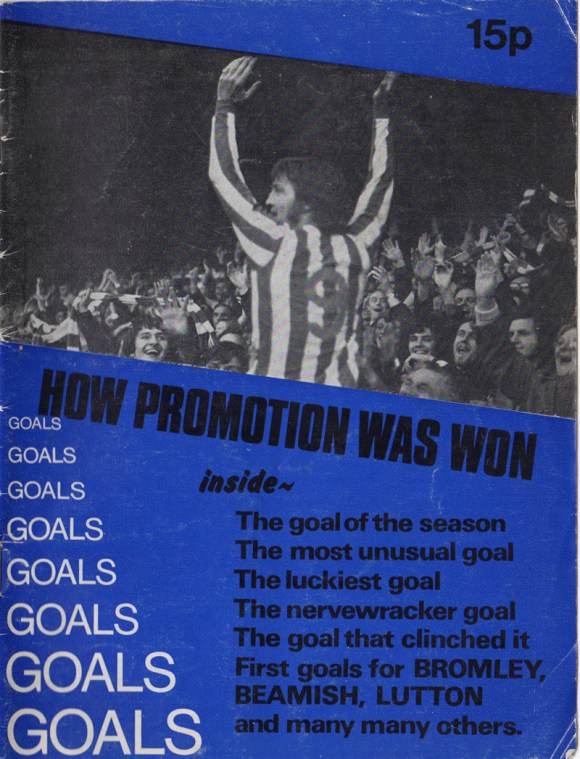
72-1

I look at it now and all the best memories come back as if the 30 years and that have passed by since that year have melted away. It says on the blurb it was the most exciting season since Albion had won promotion from the Third Division 14 years earlier.

I flick through the pages and am reminded of the chairman Tom Whiting, Pat Saward’s right-hand man Mike Yaxley, Ray Crawford the coach, and a bloke called Joe Wilson who had been at the club in one capacity or other since Noah’s Ark first hit the waves.

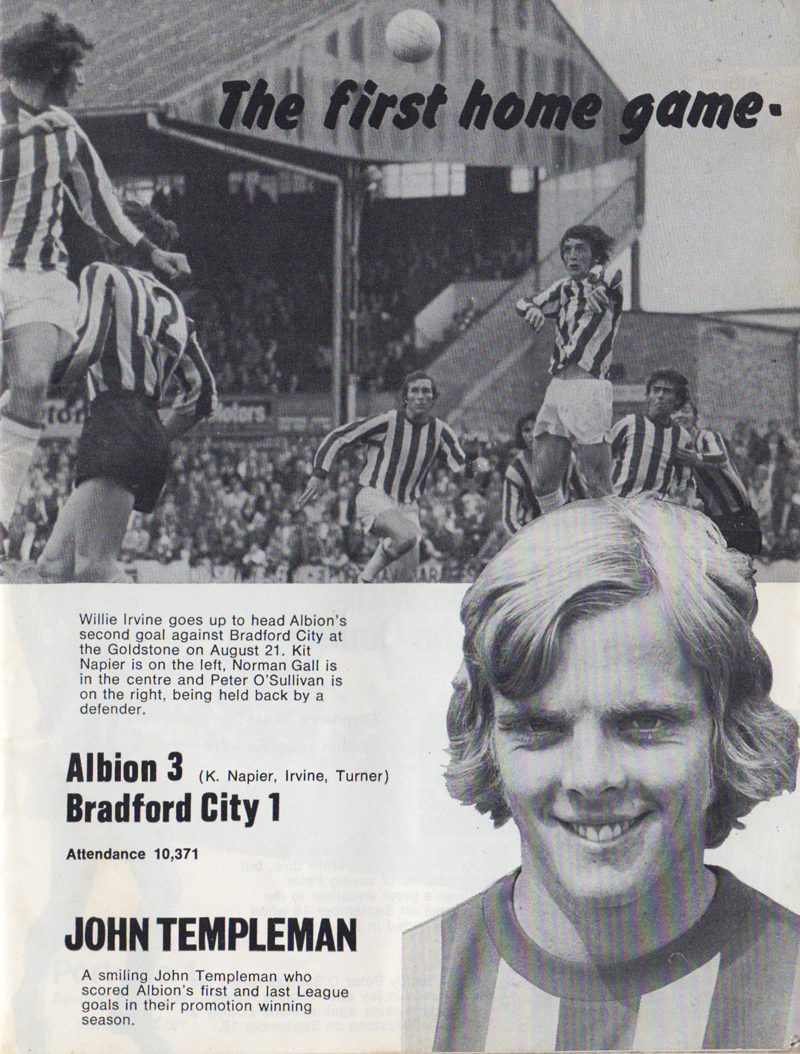
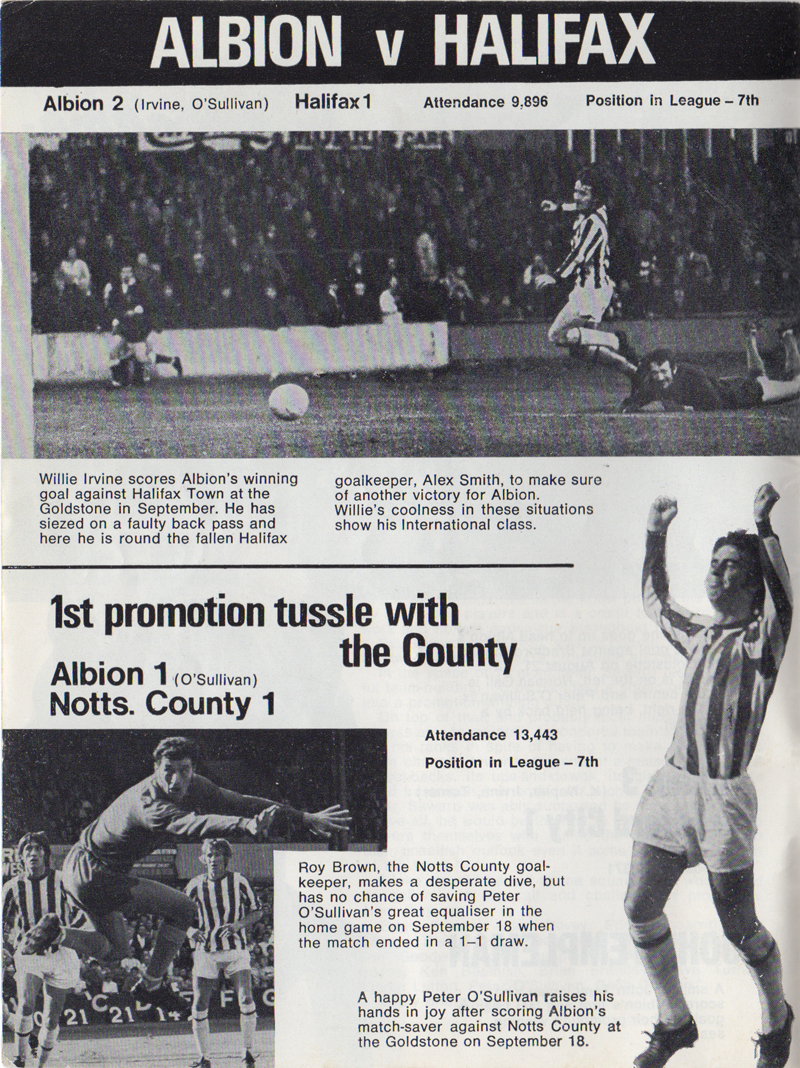
The pages of the booklet aren’t even numbered but there I am on the first page that hits you, scoring against Bradford City, soaring like an eagle, eyes on the ball, shirt flapping, hair flying. Bang, back of the net, bloody magic.
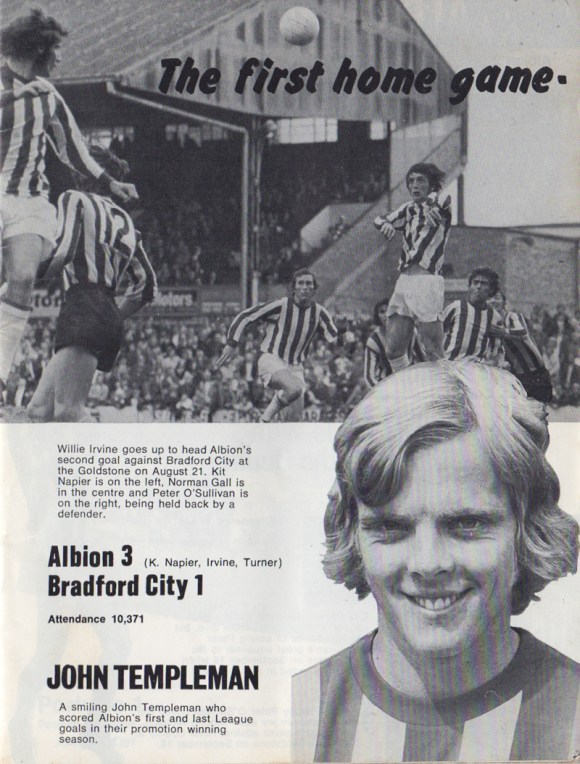
72-2

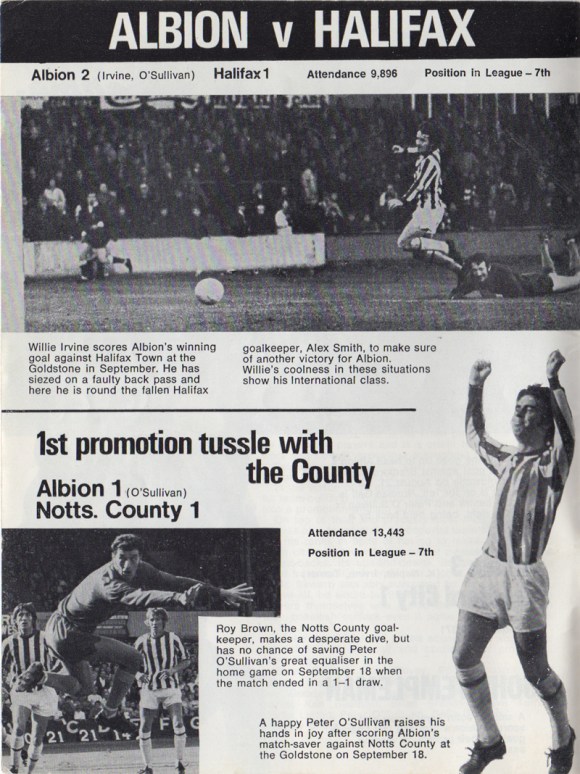
Next page, scoring the winning goal on our home ground, seizing on a faulty back pass and going round their keeper to make sure it goes in. “Willie’s coolness in these situations shows his international class”. Chris Bales’ words, not mine.
72-3

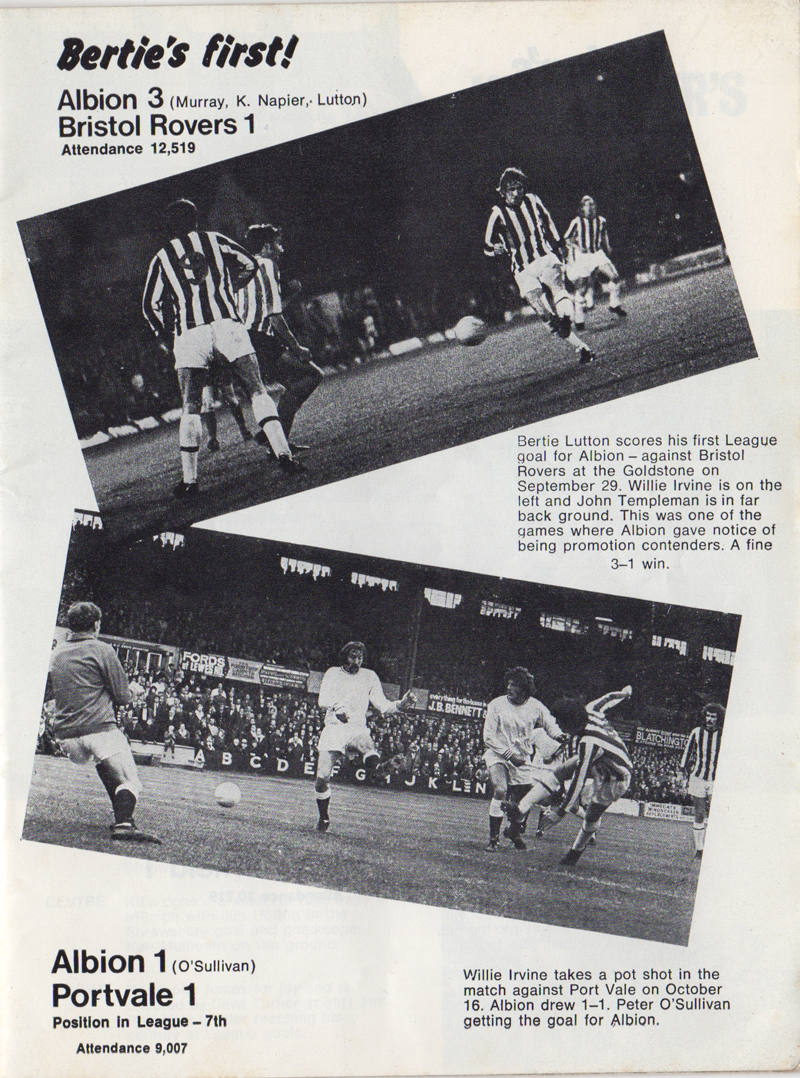
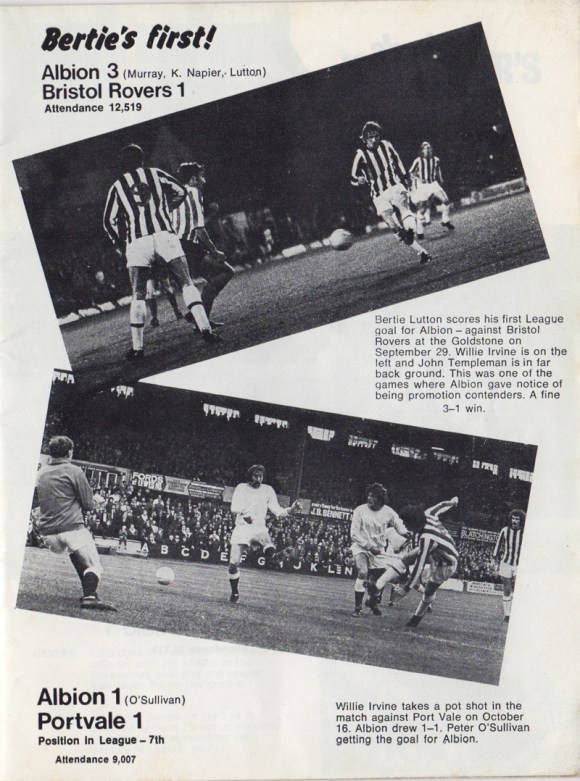
Next page: two pictures of me, one back to the camera, slim, muscular, striped shirt, number 9 big and bold on the back, Bertie Lutton slamming the ball home. Under that one is me talking a pot shot, great picture, almost horizontal above the ground; damn, missed.
72-4

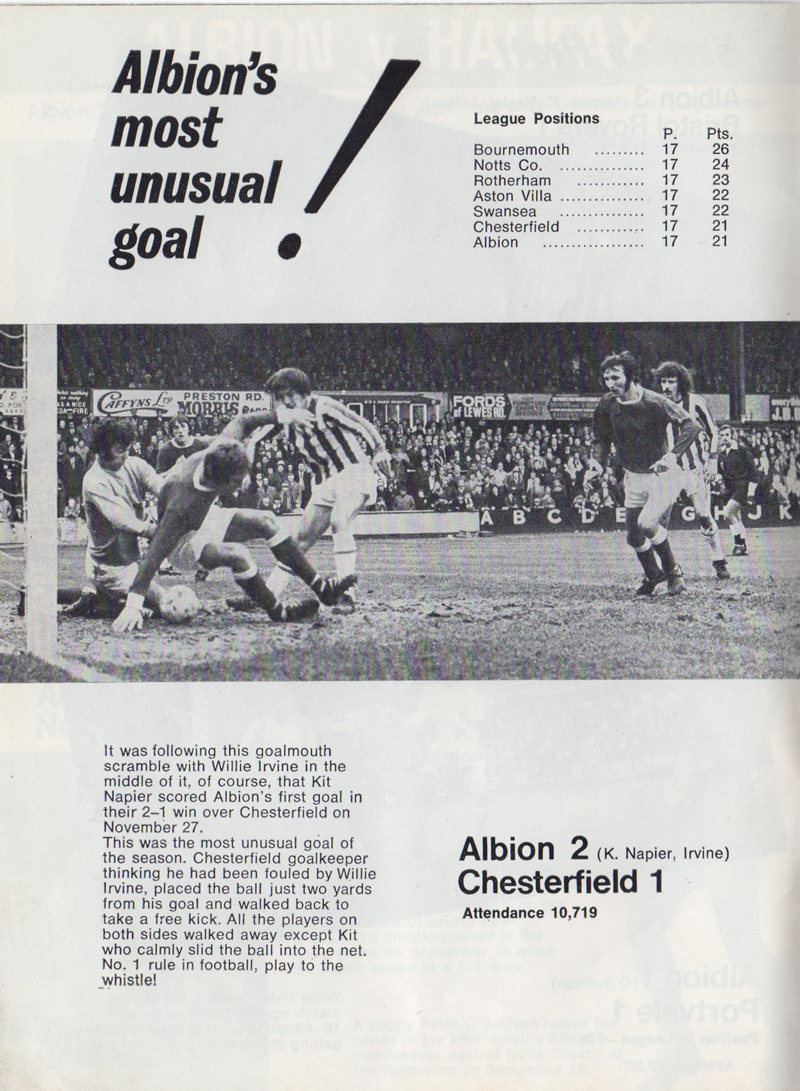
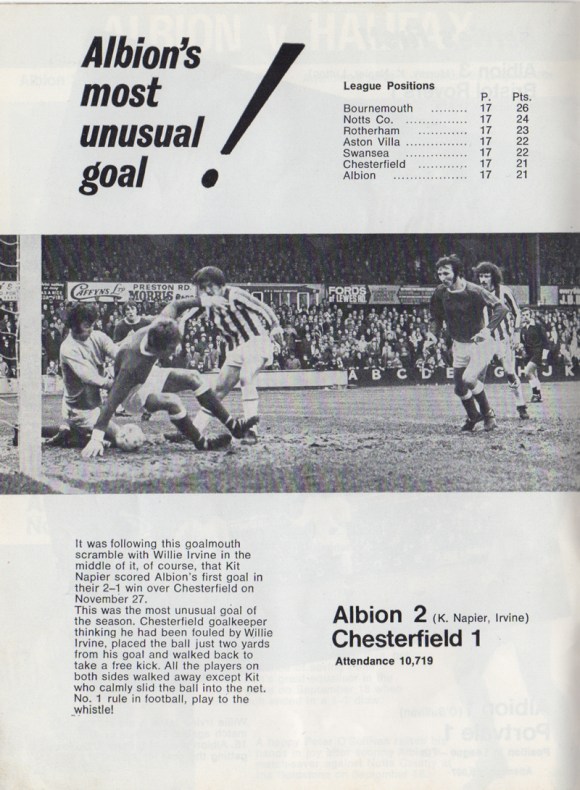
Next page, after 7 games, seventh in the table, five points behind Bournemouth at the top, Albion’s most unusual goal comes next and I’m responsible for it; a goalmouth scramble, me in the middle of it, the Chesterfield goalkeeper thinks I have fouled him and stops playing and puts the ball down for a free kick. He walks back a couple of yards to take the free kick and everyone bar just one player walks back to take up new positions. But that’s just one problem. The referee hasn’t blown for any foul so Kit Napier, cool as you like, puts the ball into the back of the net. Mayhem, stunned Chesterfield players. Stunned Brighton players for that matter; Albion 2 Chesterfield 1. Who gets the other? Me.
72-5

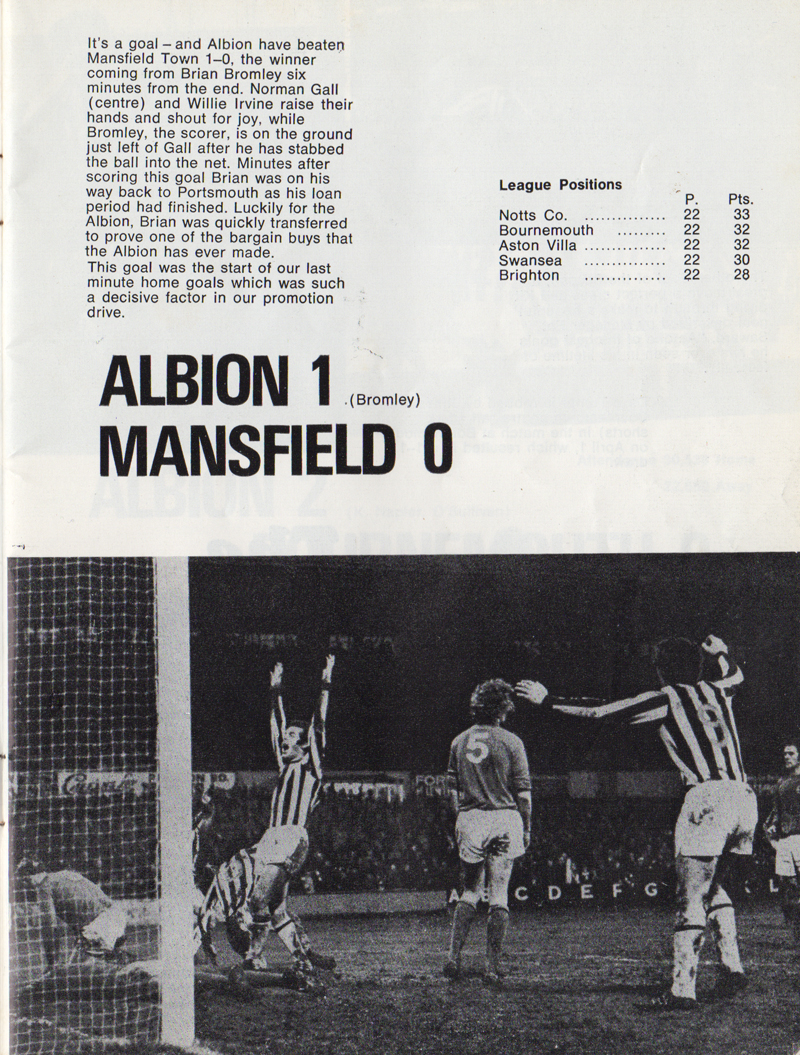
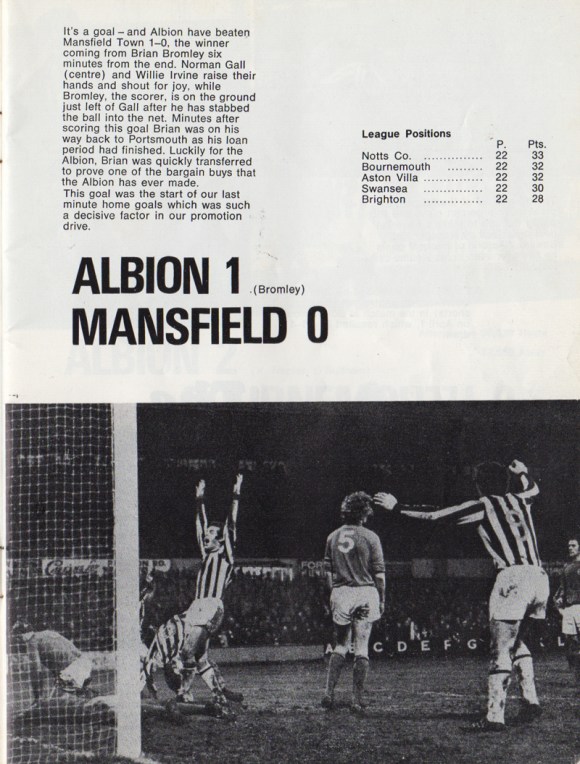
Nearly half-way through the booklet: 22 games played, Brighton fifth, five points behind Notts County, Brian Bromley scores; me, arms raised in joy, and a dejected Mansfield number 5.
72-6

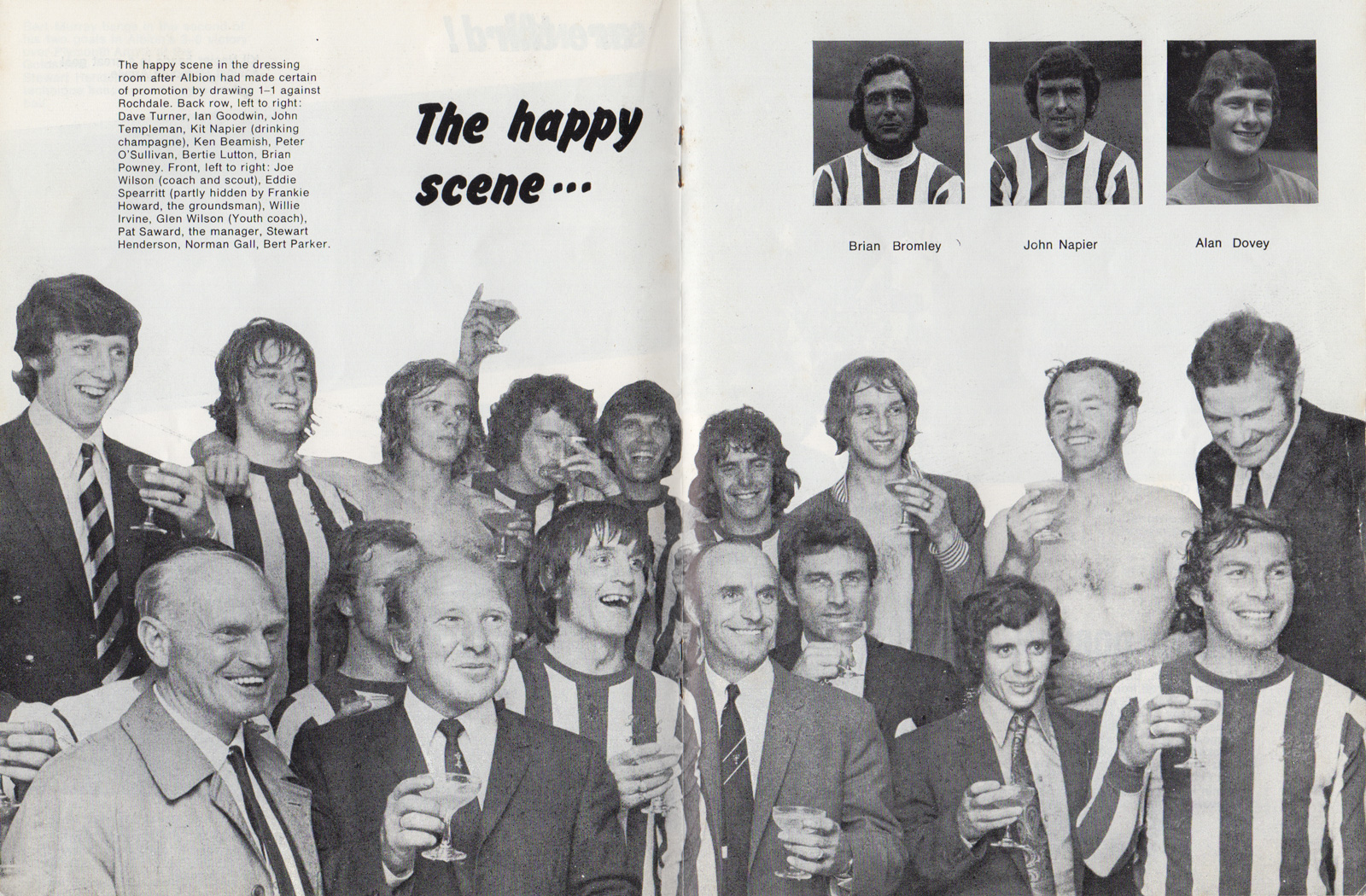
The middle pages of the souvenir have us all smiling and holding champagne glasses. I’ve wangled myself a position in the centre of the picture, hair all over my face. Pat Saward, just to my left, looking cool and calm as if this kind of thing happens every day, but as a former male model this could be his photograph face. Good-looking fella.
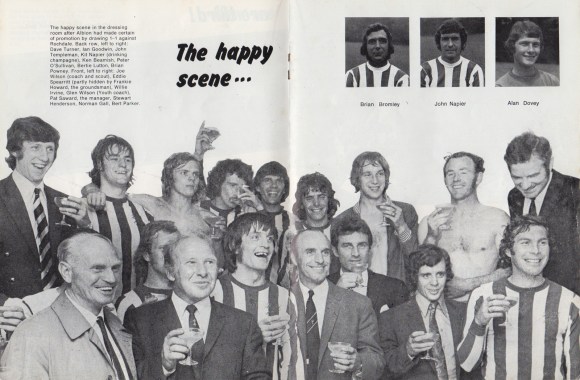
72-7

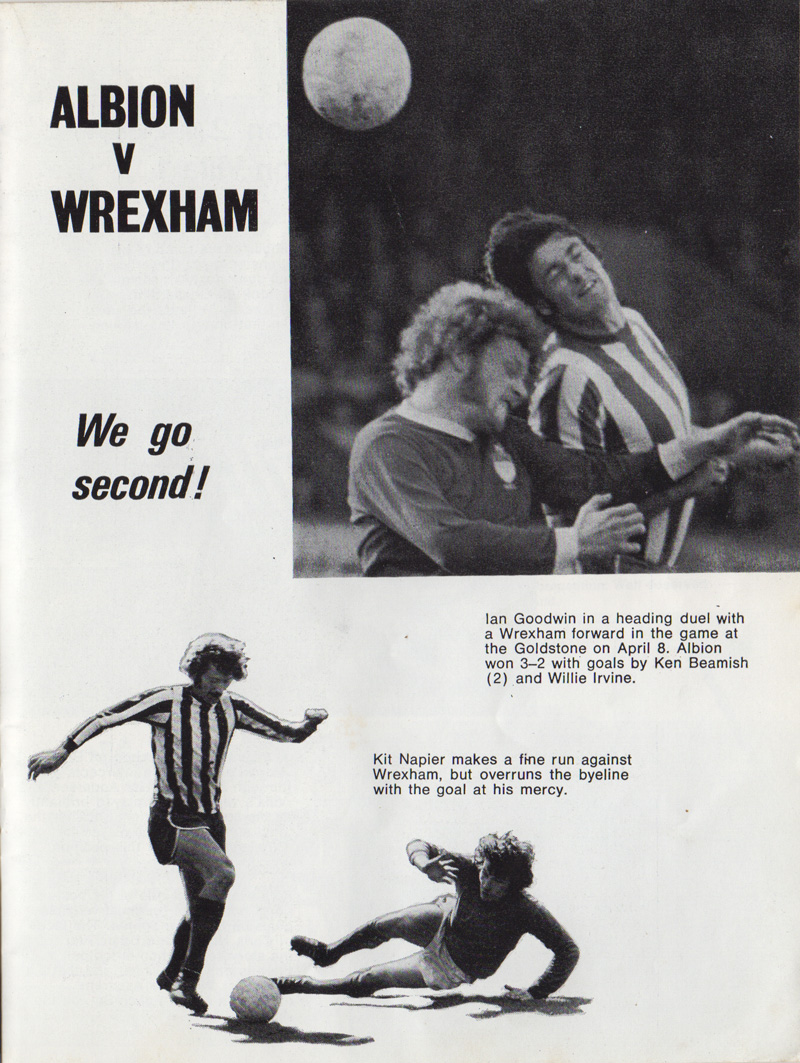
Page whatever it is – it’s a bugger they’re not numbered – and we go second: Albion 3 Wrexham 2, one from me.
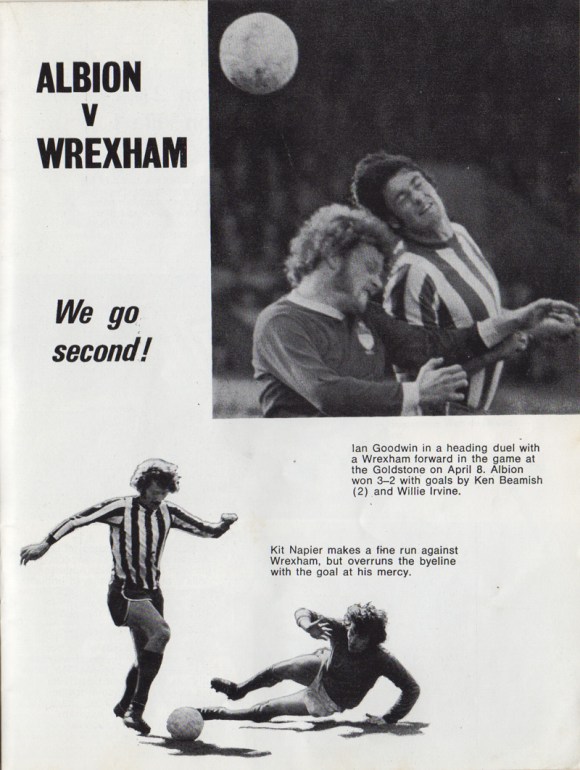
72-8

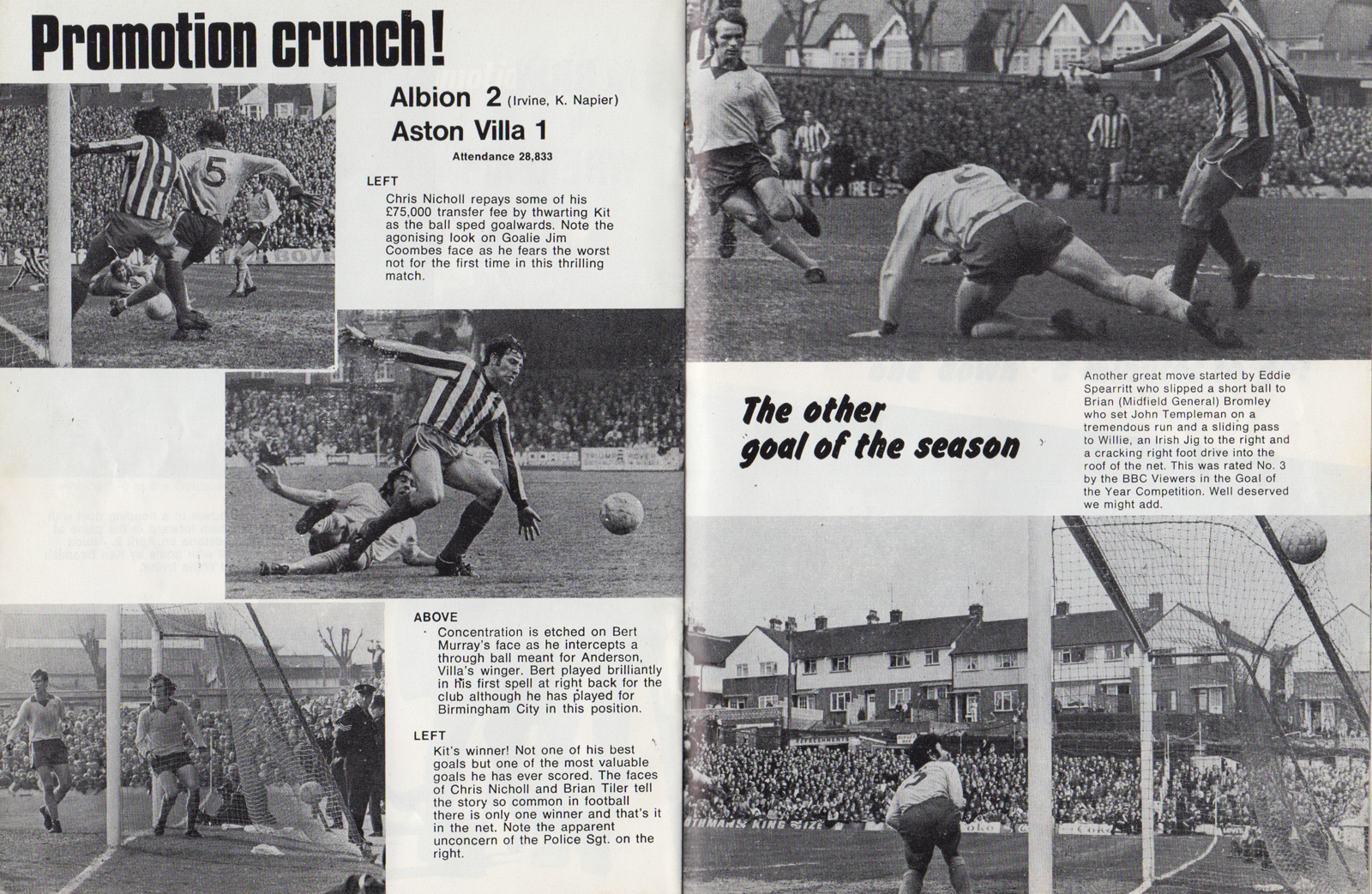
And then the big one, the promotion crunch game, at home to Villa. It was a win that really made us think and believe we could do it: win promotion and get our names into Brighton history books. There were a few drinks that night. The BBC cameras were there for that game and there, next to the Villa page, there’s a picture of me scoring and the goal was voted by BBC viewers into Goal of the Season runners-up.
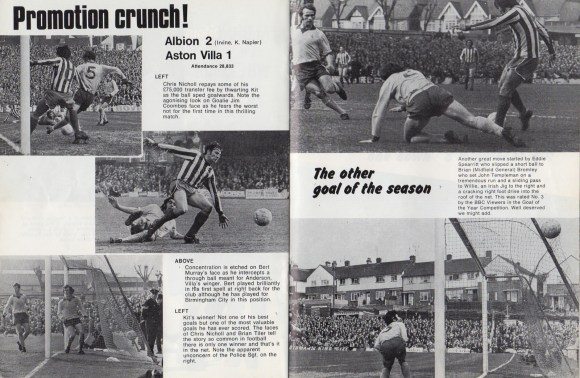
72-9

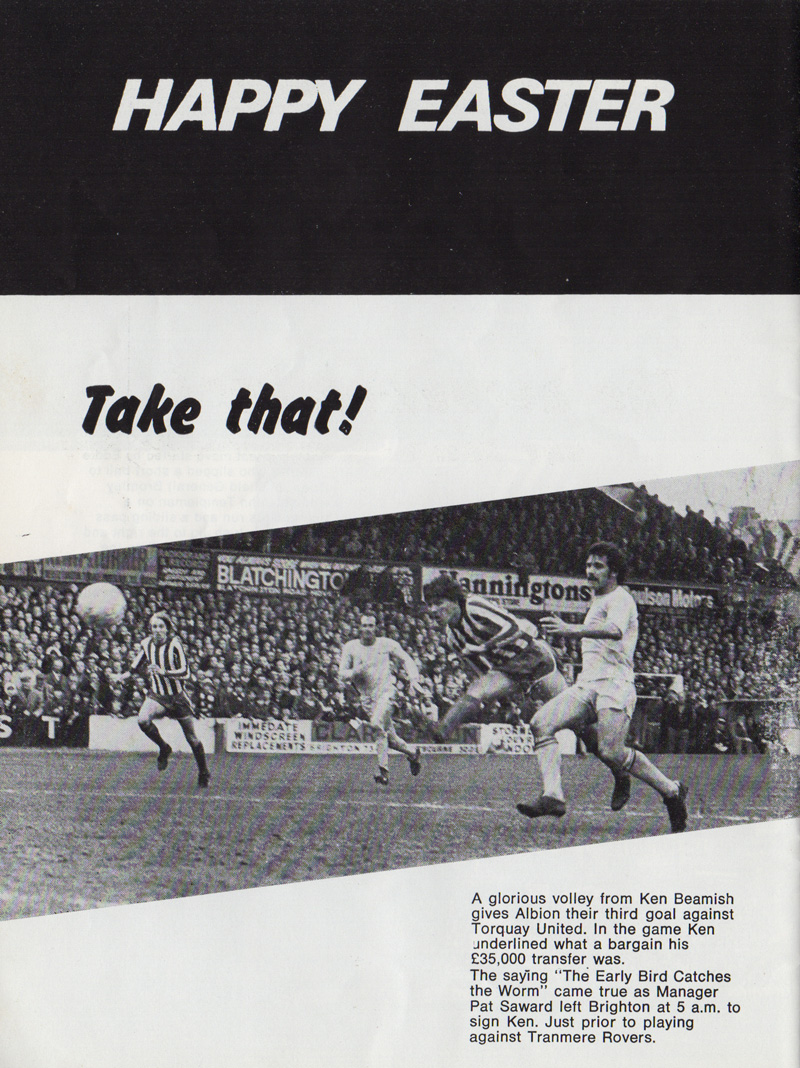
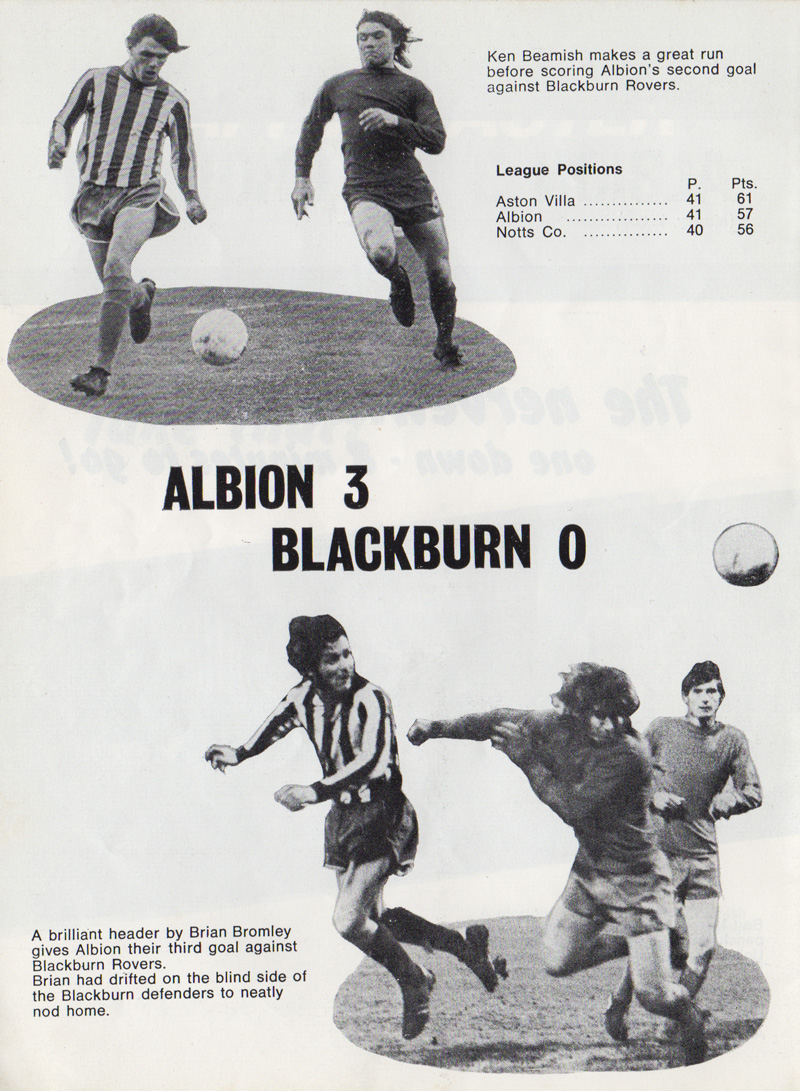
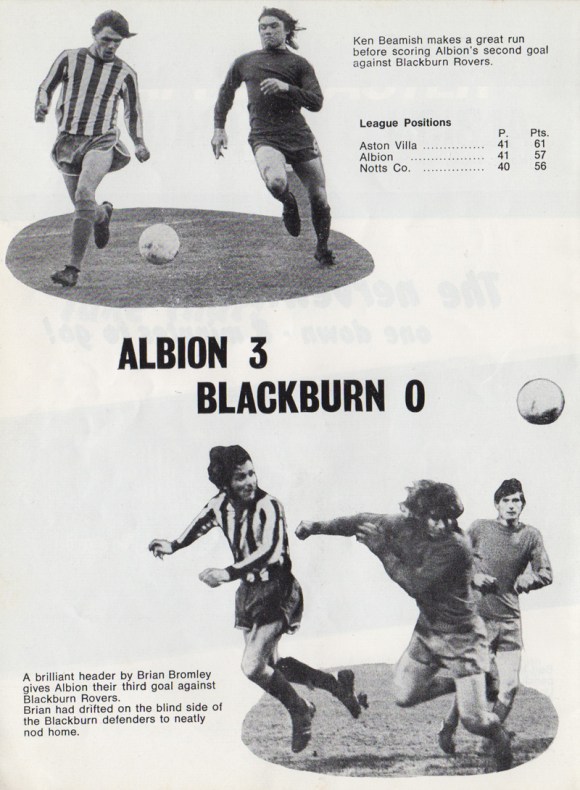
Next page, Ken Beamish is pictured with a flying header. He was a £35,000 bargain and demonstrated that the saying “the early bird catches the worm” is absolutely true. Pat Saward left Brighton at 5am one morning to sign him. I’ve half an idea he signed him from Tranmere, who we played the next day.
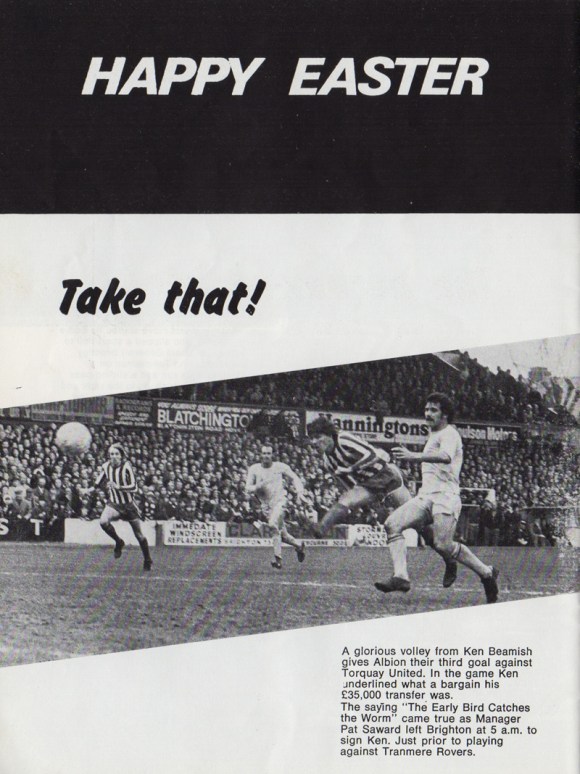
72-10

Albion 3 Blackburn 0 and I scored. I always seemed to score against Blackburn so when I see their old centre half Derek Fazakerley, I always say, “You won’t recognise me now, will you?” He always asks why. “Because all you ever saw was my back and you could never keep up,” I reply.
72-11

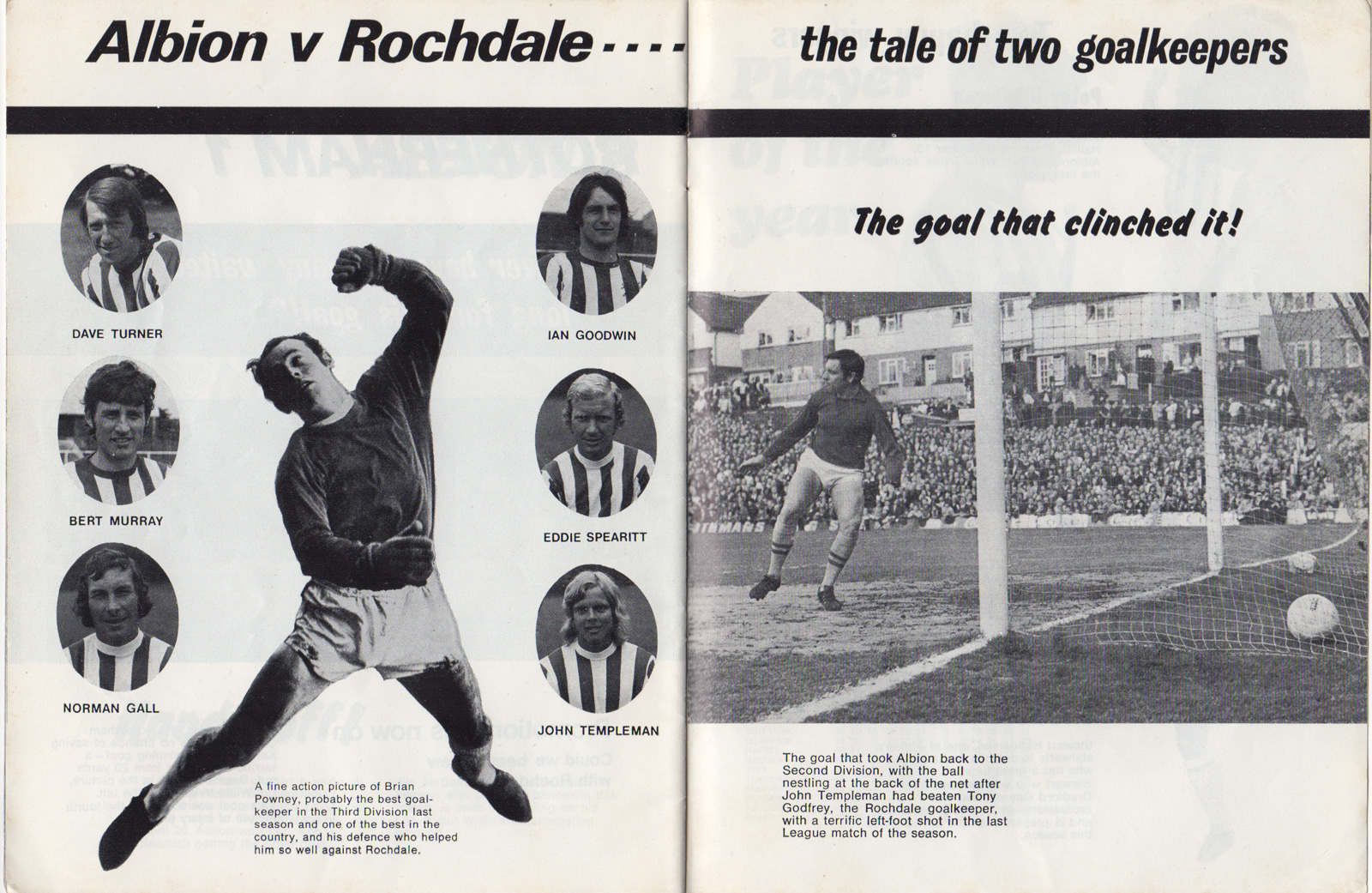
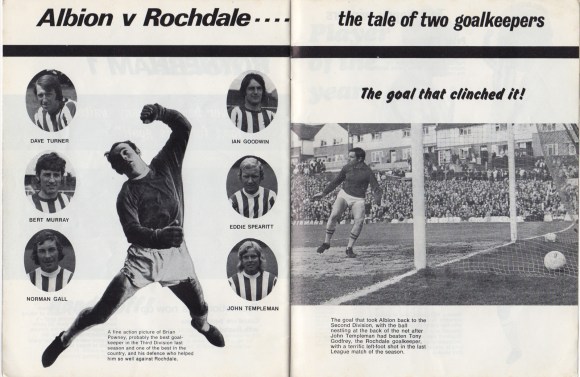
Now here’s the back end of the booklet. Did we by some quirk play Rochdale twice in the final two games?
72-14

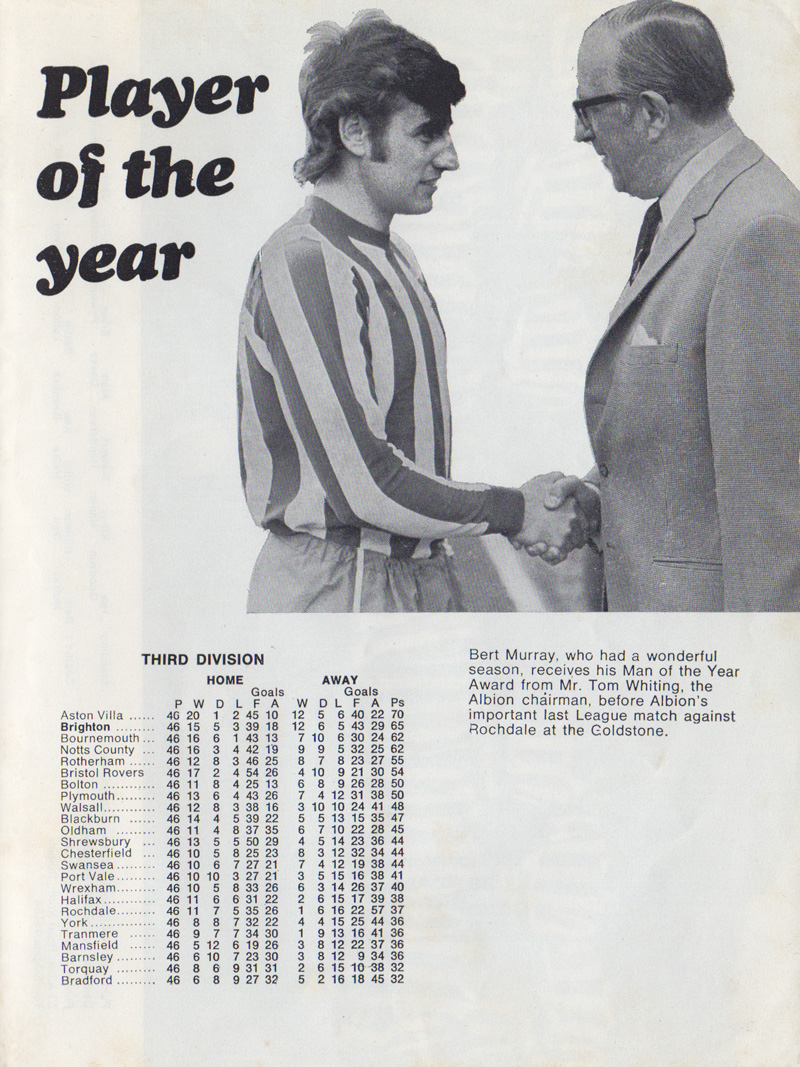
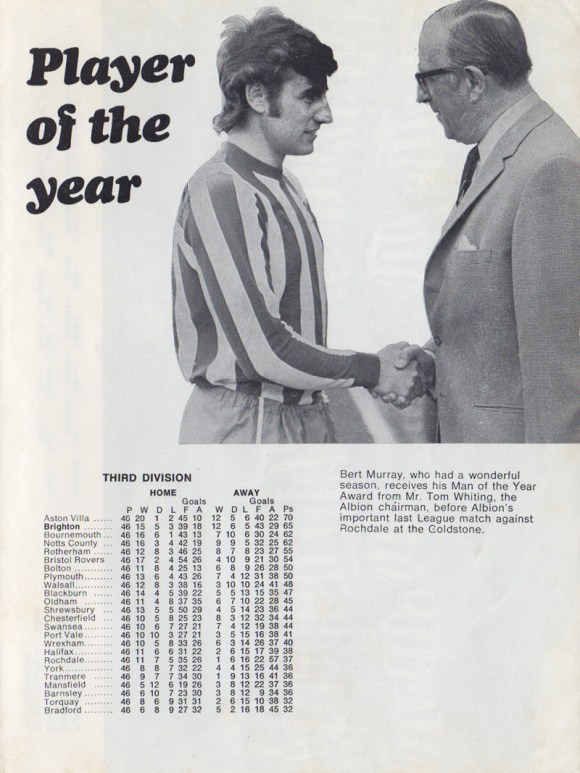
The final table reads: Aston Villa top with 70 points and then us in second place with 65 points, just three ahead of Bournemouth. Absolute jubilation.
72-12

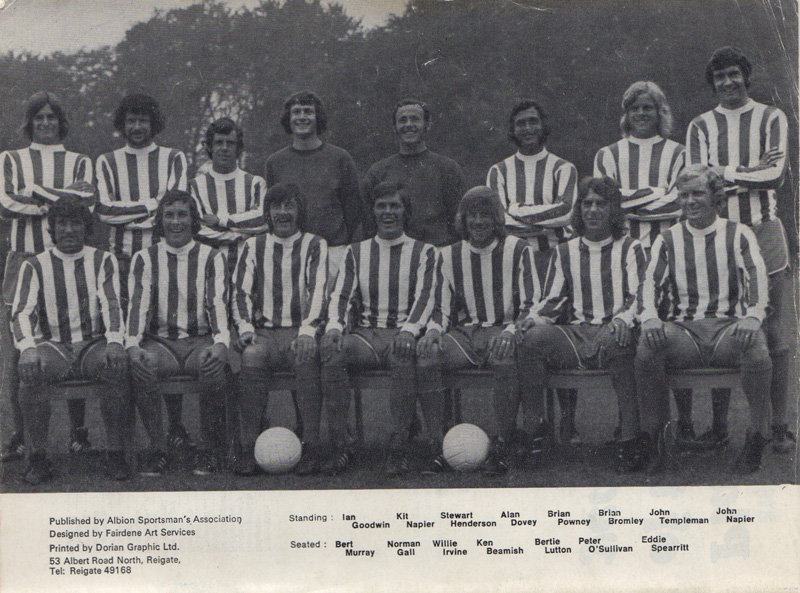
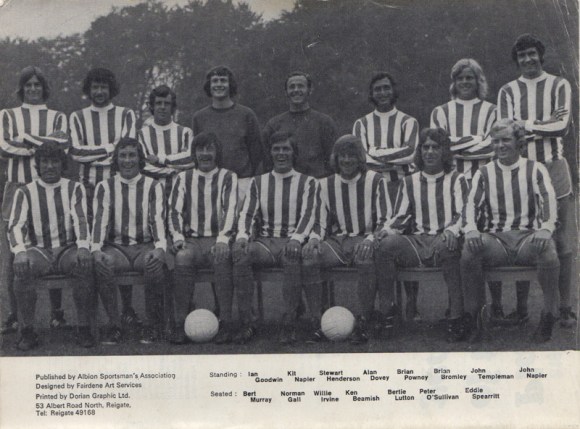
It’s a priceless memento – in spite of my ridiculous Mexican bandit moustache, plus the obligatory ’70s hairstyle. Eat your heart out, Omar Sharif. We all had those big hairstyles then. I just wish I had some left today and didn’t look quite so old.”
72-13

Such was Willie Irvine’s tremendous form in 1971/72 for the Albion that he fought his way back into the Northern Ireland team in the summer of 1972. Here, he gets an assist for Terry Neill’s winner against England at Wembley in the Home Internationals:

Tagged , ,

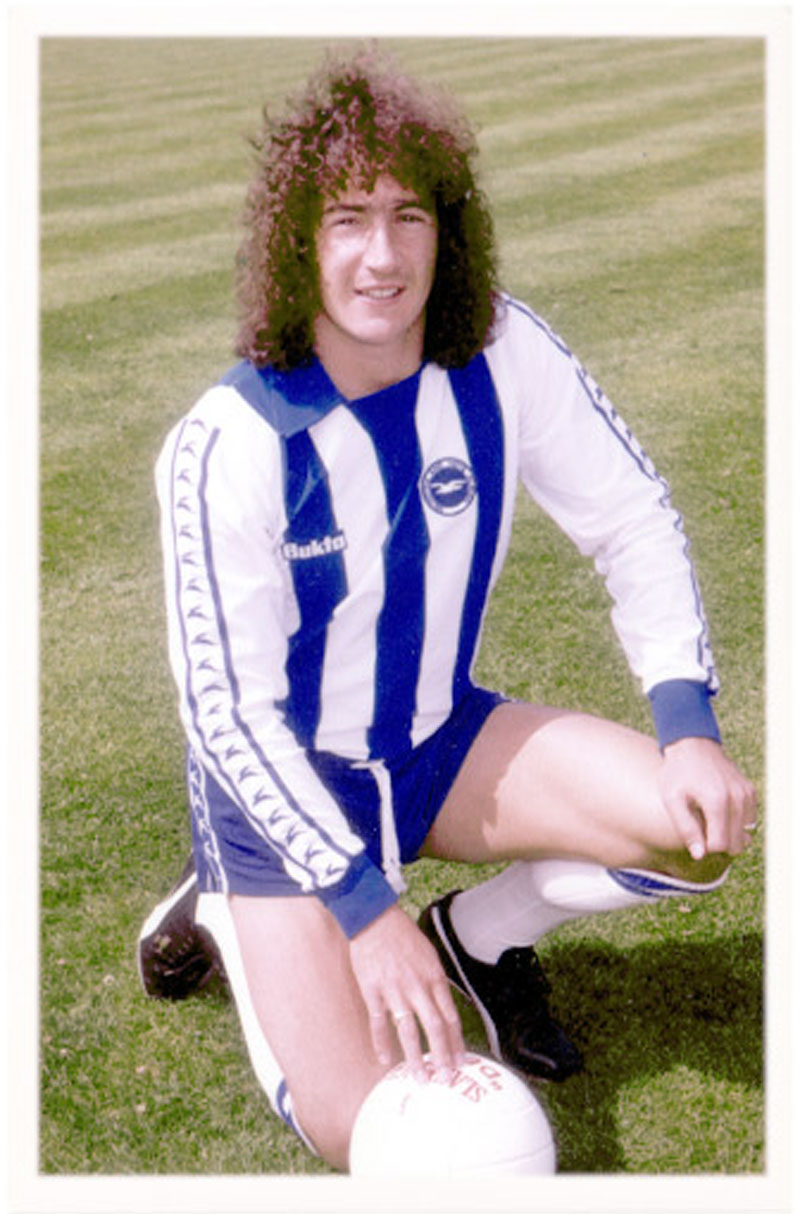
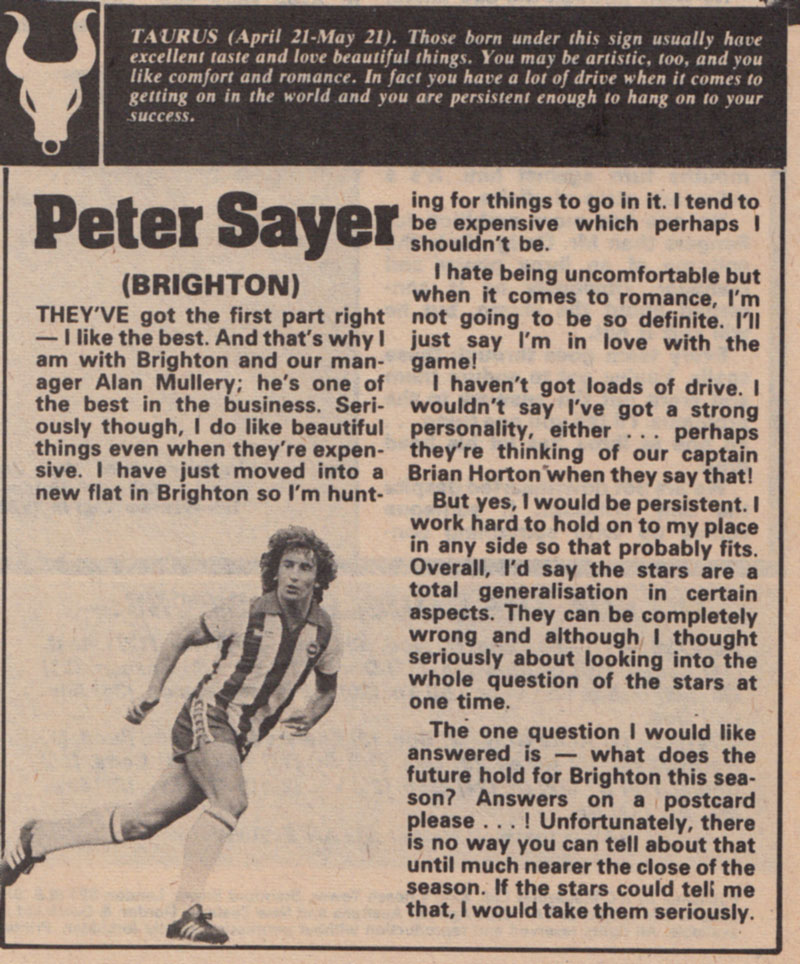
Star Sign: Peter Sayer (happy 58th birthday today)

sayer800

From Shoot! Magazine’s star signs feature:

Taurus (April 21 – May 21) Those born under this sign usually have excellent taste and love beautiful things. You may be artistic, too, and you like comfort and romance. In fact you have a lot of drive when it comes to getting on in the world and you are persistent enough to hang on to your success.

And this is what Peter says about this:

petersayer

Tagged

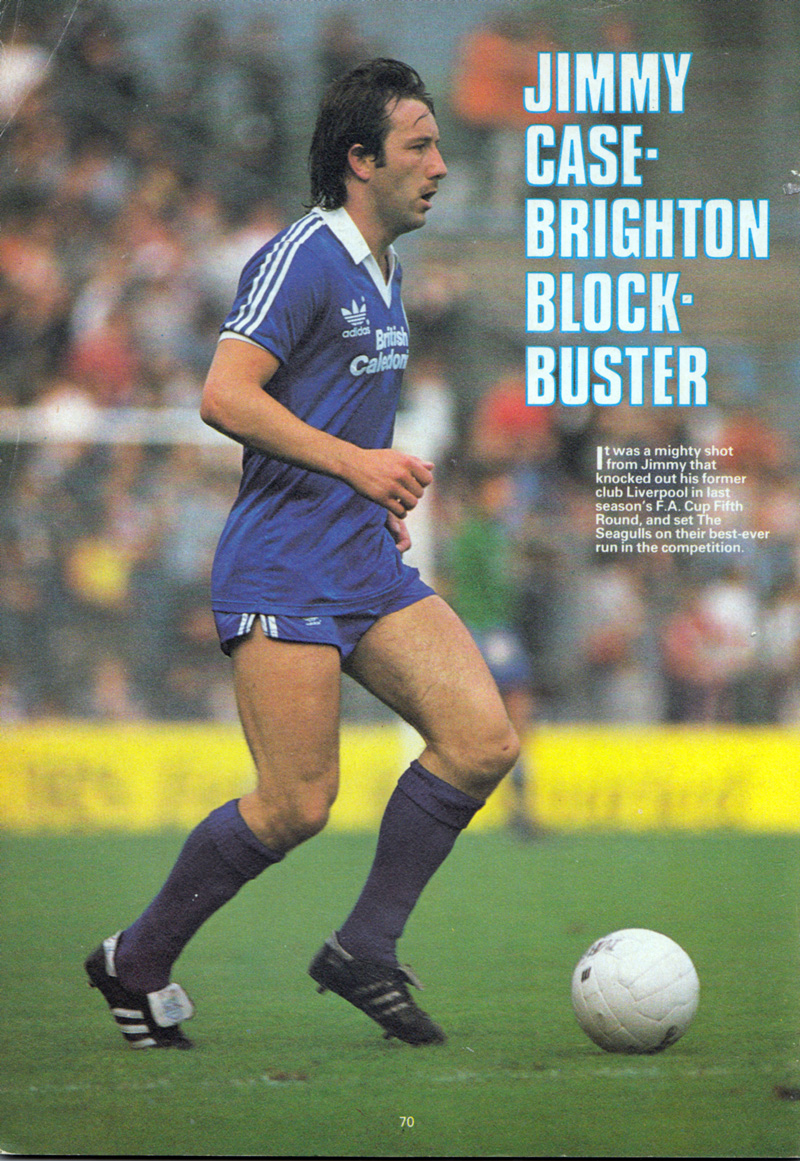
Hard Case, the Jimmy Case autobiography. Seeks pledge.

From Shoot! Annual 1984:

jimmycase

I’ve received an email from Adam Mills, from Unbound about Hard Case, the as yet unpublished autobiography of Jimmy Case.

Case, of course, has legendary status at the Albion, with his goalscoring exploits in the FA Cup run of 1983 particularly fondly remembered.

The tough-tackling, sharpshooting midfielder played 184 games for Brighton over two spells in 1981-85 and 1993-96, as well as managing the club, so hopefully there is significant coverage of those times, to go with his cup-filled days at Anfield.

Adam says the book is “written with the same no-nonsense, crunching honesty that Jimmy applied to the beautiful game, this book tells the story of Jimmy’s life on the pitch, in the changing room and propping up quite a few bars across Europe during one of the most trophy-laden careers of any English footballer.”

“Jimmy is brutally honest in his assessment of some of the players he played with and faced on the pitch, but it’s the candid humour and stories about both them and himself that make this autobiography such a hilarious and nostalgic read.”

Unbound describes itself as a “crowd-funding publisher, meaning that books only get made when readers pledge their support. The book is written, designed, edited and printed and everyone who’s supported the book has their name in the back. It’s then sent to everyone who pledged and it goes into the bookshops and on Amazon.”

I’ve stuck £20 on. I would be delighted for it to see light of day. If you do too, feel free to make a pledge too.

So far, the book has reached 21% of the funds it requires. If you wish to pledge towards the publication of the book, please visit http://unbound.co.uk/books/hard-case

Tagged

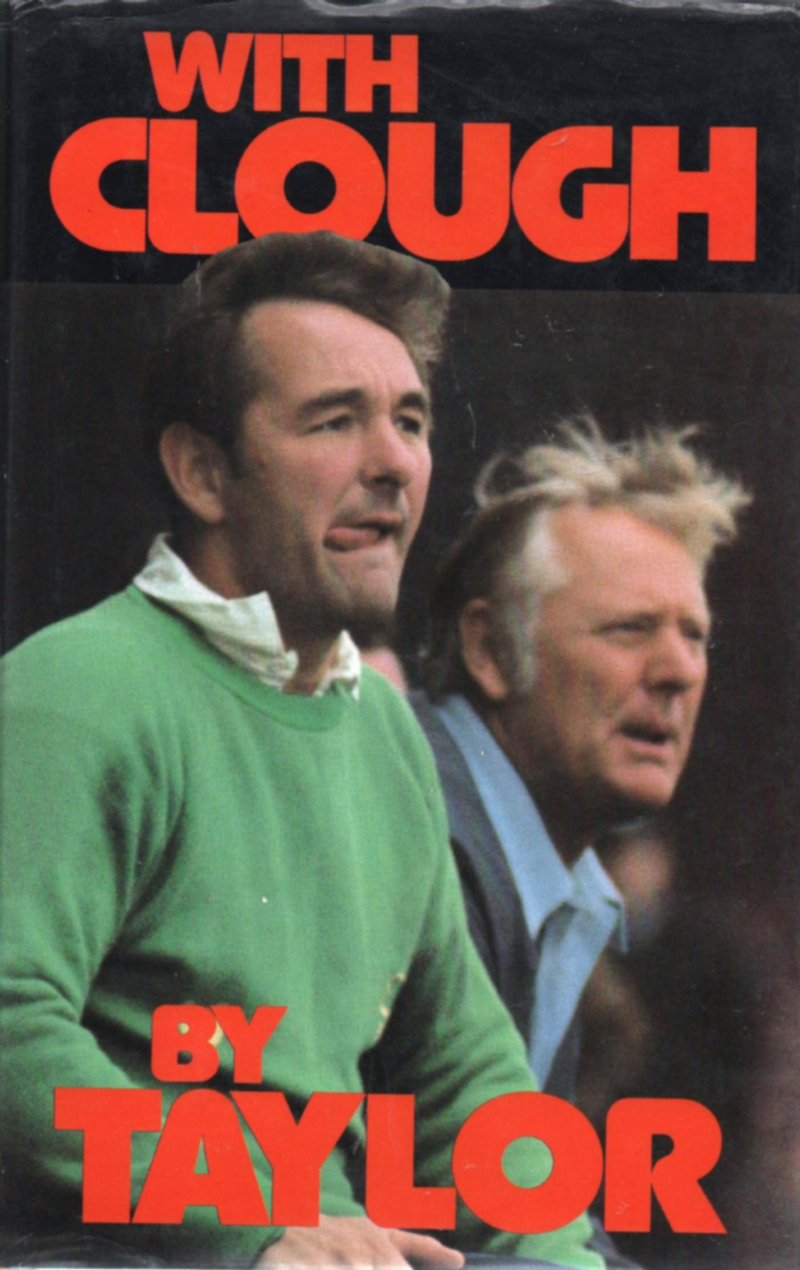
With Clough By Taylor: The Peter Ward Story

withcloughbytaylor

Fascinating extract from this book by Peter Taylor first published in 1980:

I wish Peter Ward had signed for us earlier. I saw Ward slotting straight into Woodcock’s position, with Trevor Francis striking from midfield; everything about the deal looked right, yet everything went wrong.

I had signed Ward for Brighton from Burton Albion – a deal that came about through appointing Ken Gutteridge, Burton’s manager, as a coach at Brighton. He told me, ‘I’ve two or three players at Burton who are good enough for the Third Division. They are Ward, Corrigan and Pollard. Clubs have looked but turned them down. Now will you have a look?’ I sent my assistant manager Brian Daykin, who watched them in an away match and gave the thumbs down. Gutteridge, though, persisted and said, ‘You must rate me to have fetched me all the way from Burton to Brighton so at least give me the satisfaction of seeing these three for yourself.’

There was no answer to that, so I went to Burton and watched them in the second leg of the FA Trophy semi-final against Buxton, whose centre-half was Peter Swan, the old England player. Swan gave Ward a hard time and Burton lost, but I still thought, ‘Yes, he’ll do.’ Burton played at Maidstone four days later and I took Brian Daykin with me. He’d seen Ward once and voted no; I’d seen him once and voted yes, so it seemed a good idea to watch him together. The pitch was bad; Burton, who had turned up with a scratch side, were bad; and Ward was bad – yet he still showed a few class touches, enough to make him worth a £4,000 gamble.

peterward-england

Ward has scored a hat-trick for England Under-21s and had a place in the full England squad but I don’t think he’ll realise his full potential because of inconsistency. Yet I like him. He is very good with his back to goal because he can turn and lick defenders and finish. That’s a rare quality – sticking it in the net.

I thought he would be good value for Forest at £300,000, the price I agreed with Brighton chairman Mike Bamber on the night before leaving for a European Cup tie in Romania. The signing was arranged for the day after our return but, shortly after landing, I heard a story that Derby were hoping to exchange Gerry Daly, their Irish midfield player, for Ward. Efforts to contact Alan Mullery, Brighton’s manager, were unsuccessful, which made me suspicious. Then Brian, for the first time in our partnership, doubted my judgement and asked, ‘Are you right about Ward?’

I felt floored and insulted. ‘Right?’ I shouted. ”I’ve got every detail about him except his fingerprints. I’ve bought him once; I’ve played him. He’s tried and tested. I know him as well as I know you’ – and with that, I left the ground. Brian, on seeing my conviction and eagerness to complete the deal, then got in touch himself with Mullery and Bamber but found them no longer anxious to sell, because Ward was returning to form. He played at Forest in November and gave a dazzling display in Brighton’s 1-0 win. This was our first home defeat in the League for fifty-one consecutive matches, stretching back to April 1977. Mullery said afterwards, ‘You couldn’t have him for £600,000.’

ward-forest-odessa

Tagged , , , ,

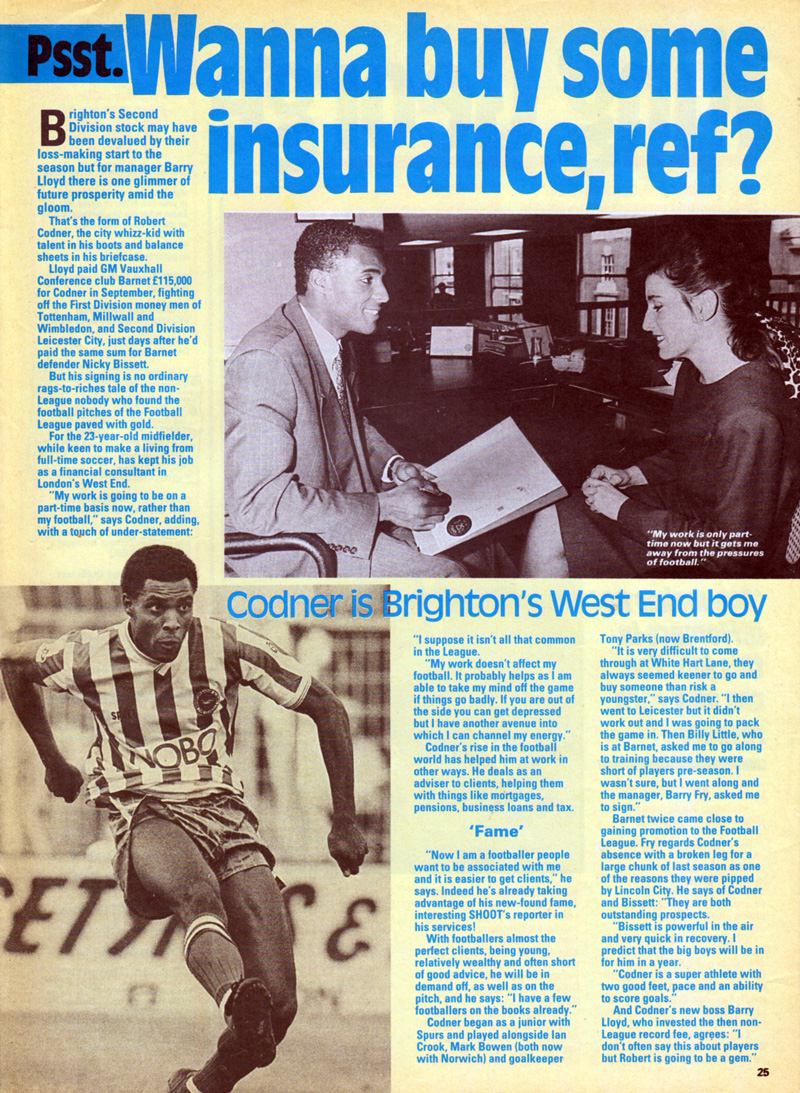
Robert Codner: Talent in his boots and balance sheets in his briefcase

codner

An interesting article in Shoot! Magazine about moonlighting midfielder Robert Codner. This piece is from the early part of the 1988/89 season:

Brighton’s Second Division stock may have been devalued by their loss-making start to the season but for manager Barry Lloyd there is one glimmer of future prosperity amid the gloom. That’s the form of Robert Codner, the city whizz-kid with talent in his boots and balance sheets in his briefcase. Lloyd paid GM Vauxhall Conference club Barnet £115,000 for Codner in September, fighting off the First Division money men of Tottenham, Millwall and Wimbledon, and Second Division Leicester City, just days after he paid the same sum for Barnet defender Nicky Bissett.

But his signing is no ordinary rags-to-riches tale of the non-League nobody who found the football pitches of the Football League paved with gold. For the 23-year-old midfielder, while keen to make a living from full-time soccer, has kept his job as a financial consultant in London’s West End. “My work is going to be part-time now, rather than my football,” says Codner, adding with a touch of understatement: “I suppose it isn’t all that common in the League.”

“My work doesn’t affect my football. It probably helps as I am able to take my mind off the game if things go badly. If you are out of the side you can get depressed but I have another avenue into which I can channel my energy. Now I am a footballer people want to be associated with me and it is easier to get clients,” he says. Indeed he’s already taking advantage of his new-found fame, interesting SHOOT’s reporter in his services!

Unsurprisingly, having hung up his boots, Robert Codner is now a football agent. I wonder if he fulfilled his stated ambition when he was at the Goldstone Ground: his goal to be become a millionaire.

Tagged

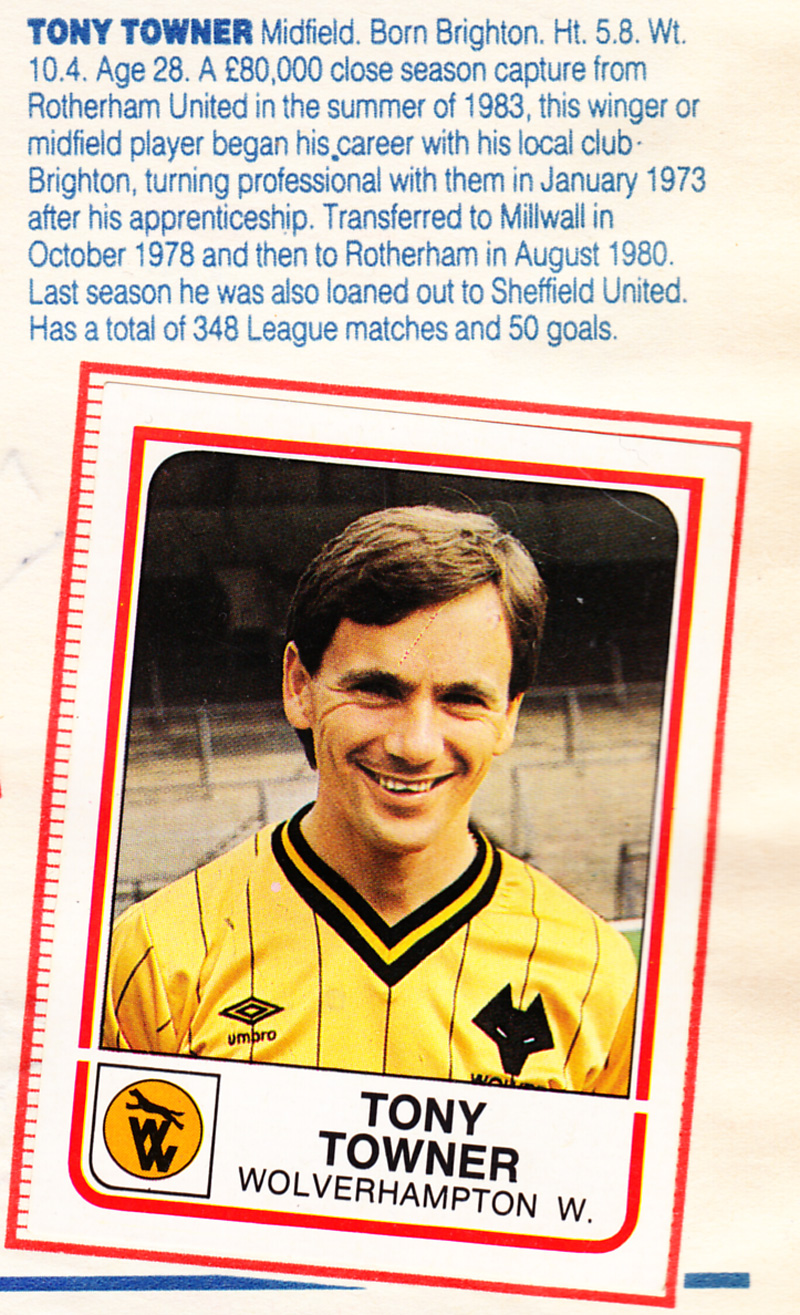
Wing wonder Tony Towner

towner

Extract from the Millwall v Brighton programme from 2005/6:

“It was a dream come true when I joined Brighton, and I remember my debut against Luton as it were yesterday. They were on a great run at the time, unbeaten in 12 games I think, whilst we hadn’t won in as many, but we beat them 2-0 that day although we still got relegated. We regularly played in front of 15- or 20,000 at the Goldstone Ground and there were certainly some eventful times, most notably when Brian Clough took over as manager. In one game that was shown on TV we were beaten 8-2 at home by Bristol Rovers, with Bannister and Warboys having a field day. Mr Clough wasn’t best pleased with that afternoon. I played with some decent players there, people such as Peter Ward, Brian Horton and Ian Mellor. Alan Mullery was the manager when I left. he called me in one day and told me George Petchey wanted to sign me for Millwall, and that was that. I wasn’t in the side regularly at that stage so I thought it would be a good move. As it turned out, Brighton were promoted to the old First Division at the end of the season whilst Millwall were relegated to the Third.

I later had a spell in the First Divsion with Wolves, although we only won four games in the whole season. I actually didn’t do two badly personally and there were one or two highlights, including winning at Anfield and scoring with a header past Chris Woods when we beat Norwich 3-1.

towner2

I was very sad a few years back when the Goldstone Ground was sold and Brighton ended up playing at Gillingham. At least they’re playing back in Brighton now, and I have been along to see them once or twice.”

Tagged

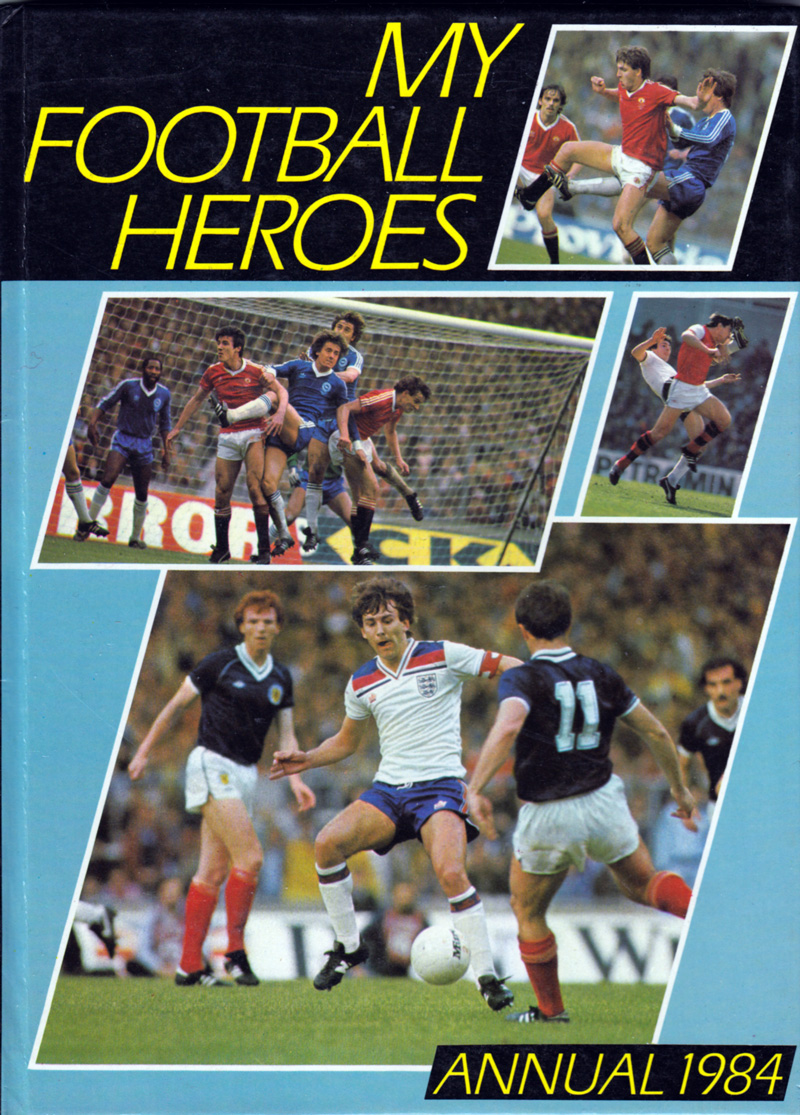
My Football Heroes Annual 1984

myfootballheroes1

This relatively unknown publication was billed as an annual, but I’m pretty sure that there was never a sequel.

‘My Football Heroes’ was published by Opal Quill Limited in 1983, and includes articles about a selection of First Division teams and players of the time such as Simon Stainrod (QPR), Gordon Cowans (Aston Villa) and Ian Rush (Liverpool). As well as profiling the career of future Albion winger Mark Chamberlain (Stoke), some Brighton interest comes in the form of a piece on ex-boss Peter Taylor that asked:

‘Who was the real boss… Brian Clough or Peter Taylor? Thats been the biggest riddle in football as the rest of the game’s pundits watched first Derby then Nottingham Forest reach the heights under this very idiosyncratic managerial partnership.’

Peter Taylor had recently saved Derby from relegation into the Third Division as well as putting Clough’s Nottingham Forest out of the FA Cup. So it must have seemed a pertinent question at the time. Even so, that article disappointingly overlooks Clough and Taylor’s spells down on the South Coast. And, just like the other pieces in this annual, it also suffers from the drawback that ‘My Football Heroes’ didn’t have direct access to the players and managers, unlike the interviews that appeared in ‘Shoot!’ Annual.

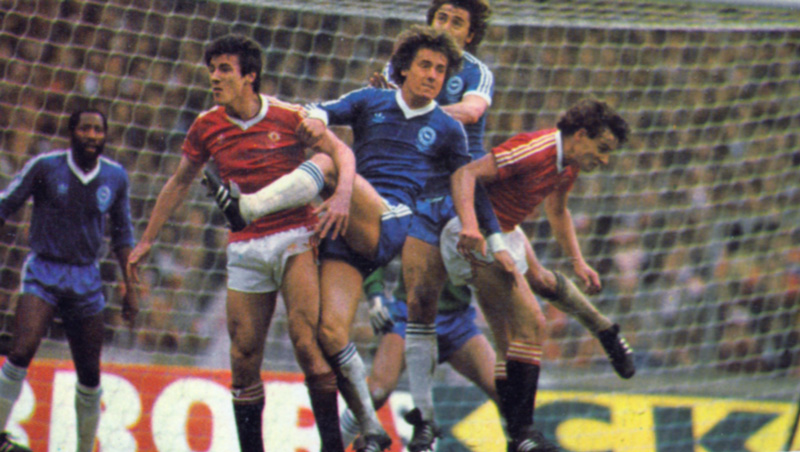
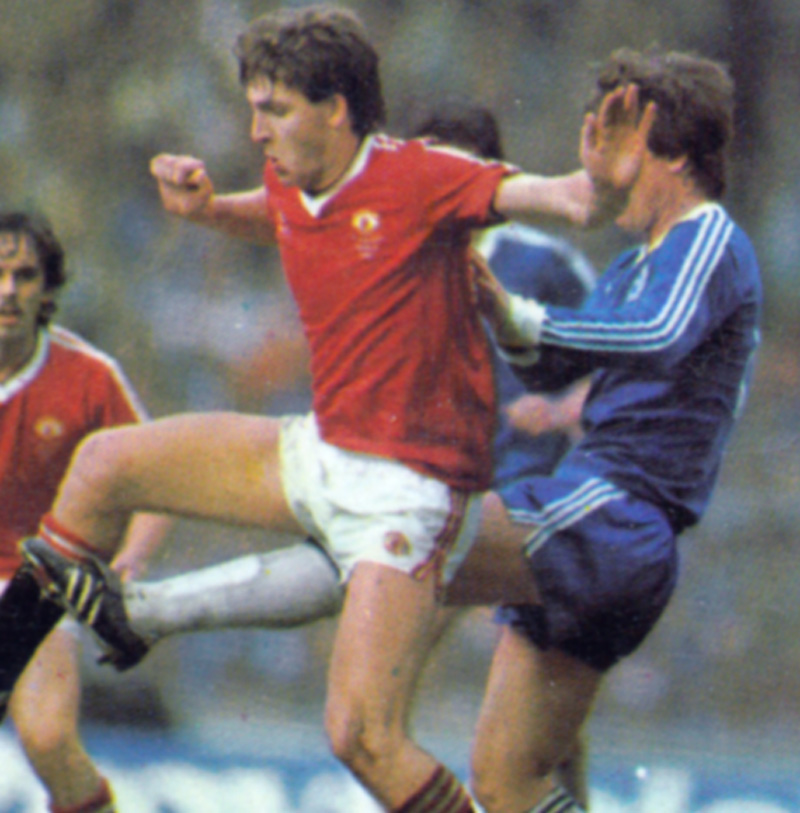
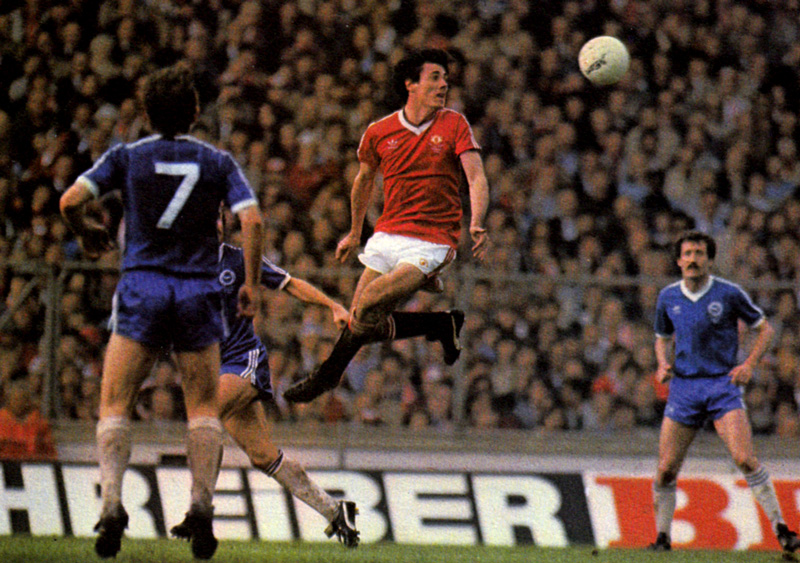
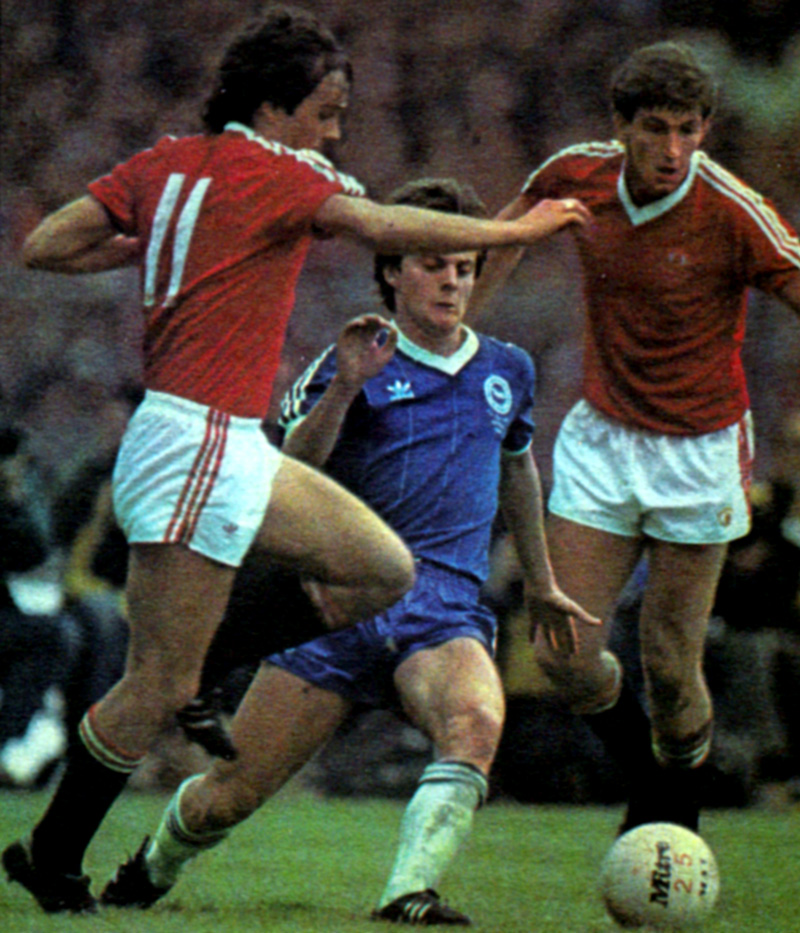
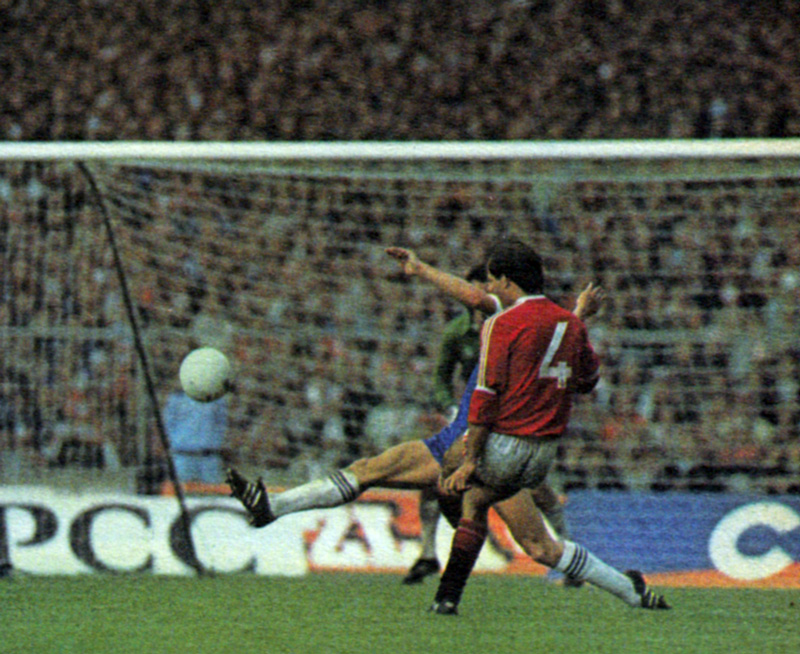
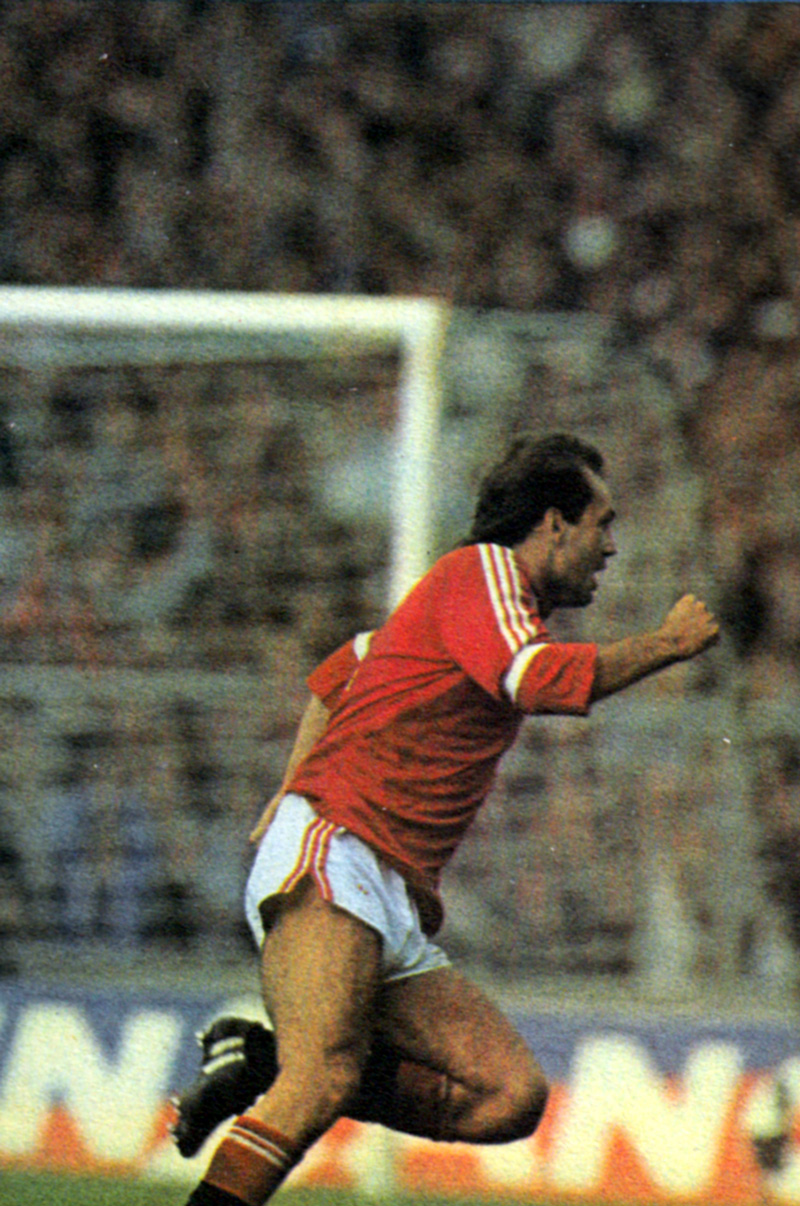
Nevertheless, this rather obscure publication does rather eulogise the Manchester United team and players of the time, with pieces on Alan Davies, Bryan Robson, Norman Whiteside and Ray Wilkins. Through this, we get to enjoy some colour action shots from the 1983 FA Cup Final, ones that I have not seen any where else.

Steve Gatting and Michael Robinson combine to clear the danger:

myfootballheroes1a

Norman Whiteside made himself very unpopular with Brighton fans during the final when he deliberately handled the ball twice in goalscoring positions (would have been cautioned twice to be sent-off nowadays) as well as his X-rated tackle on Chris Ramsey that led to Manchester United’s equaliser. Do I still sound bitter after all these years? Yes, you’re right. Cheating Norman Whiteside is all elbows here against Steve Gatting:

myfootballheroes1b

Next up is Frank Stapleton showing his aerial prowess before joining Brighton some eleven years later:

myfootballheroes2a

The amazing shrinking midfielder Gary Howlett is the filling in a United sandwich of the ill-fated Alan Davies, who committed suicide in February 1992, and Norman Whiteside:

myfootballheroes3a

And finally, Ray Wilkins scores one of Wembley’s finest goals before wheeling away.

myfootballheroes4a

myfootballheroes4b

Tagged , ,

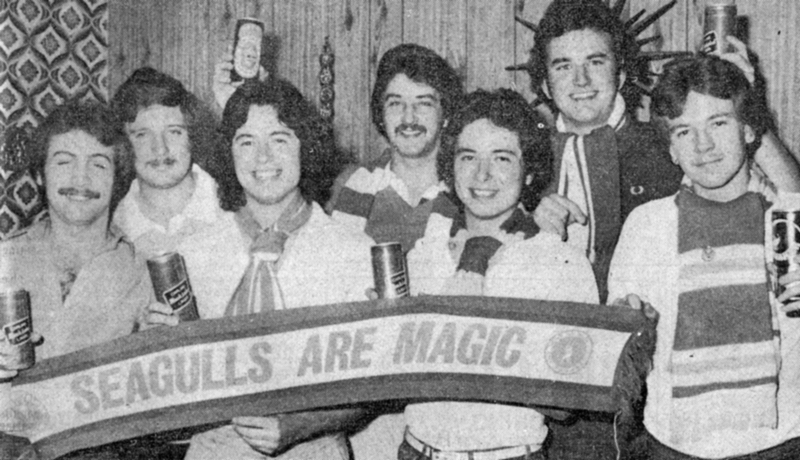
The lads who gave Seagulls their name

seagullschant

(left to right): Peter Warland, Derek Chapman, John Bayley, Jeff Walls, Kevin Bayley, who is twin brother of John, Lee Phillips and Stevie Smith.

A brilliant story from the Argus ‘Division One Here We come’ supplement in 1979:

Albion are called the Seagulls because of Crystal Palace. The group who dubbed them the Seagulls begrudgingly give their arch-rivals a little credit. But we have traced the lads who thought up the name and, as the revelry over promotion continued, they explained how it all began.

The Seagulls were christened with liberal swiggings of beer on Christmas eve of 1975. Christmas festivities were in full swing in the Bosun pub in West Street, Brighton. A group of Albion fans were analysing their vocal failings after a visit to Crystal Palace and decided how to put things right. Said Jeff Wells of Bowring Way, Brighton: “At Selhurst Park the Palace supporters started chanting ‘Eagles’ and the volume was so loud that we could not sing anything louder than them.”

The cry Dolphins never roll easily off the frenzied lips of even the most ardent fan – even when your team was getting the better of Crystal Palace. The Albion have always tried to develop the seaside theme and in pre-war days were known as Shrimps. Many would suggest the nickname was rather appropriate: they were rather small fry and inclined to be gobbled up by the Football League’s big fish. Added to that, Gillingham were also known as the Shrimps, which complicated things. The re-named Dolphins was intended to develop the local link as the Brighton town crest has them, but it never had popular appeal.

Jeff Walls had the marine connection in mind at this Christmas booze up, when he queried: “What do you call those birds down the seafront?” His mate Lee Phillips chanted “Seagulls” and then the nickname was out. It soon spread around the pub, a favourite meeting place for fans. By February the terraces were picking it up and by the end of the season it caught on good and proper. The police had given a helping hand, as well. A crackdown on behaviour in the North Stand led to migration to other parts.

The chant of Seagulls had the Albion soaring to new heights… and it left Rob Pavey, now commercial manager with a Dolphin-sized headache. The fervour from the terraces had to be kept up with. Already one sports shop in Brighton was selling Seagull scarves. Said Ron: “We had a whole lot of stock with Dolphins on it and really all I could do was ditch it. Alan Mullery gave scarves and things like that to children’s homes and we concentrated on the Seagulls.”

Said Derek Chapman, one of the group who gave them the name: “We didn’t really mean to give Albion a nickname. All we were trying to do was have a go at Palace and find a chant that could drown their fans.”

Now, as they toast the Seagulls, with lager, and Newcastle Brown of course, they can admire the Seagull emblem which they helped put on Brian Horton’s jersey. Said Jeff’s mum: “I said at the time that maybe the new name would bring them good luck. Now look at them in Division One.”

Nowadays, Derek Chapman is a director at the club. Also, as mentioned before on this blog, despite what the article says, the club were never known as the Shrimps.

Tagged

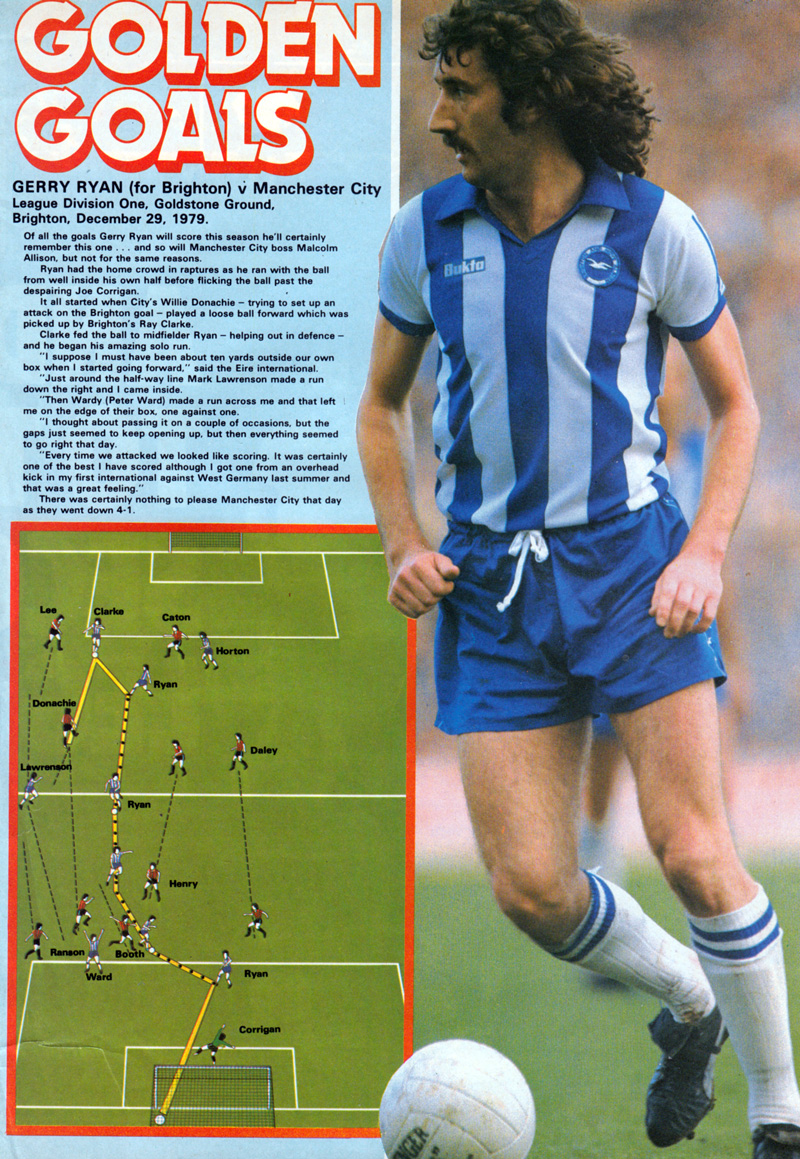
Gerry Ryan’s Golden Goal

Beginning his dribble half-way in his own half, this wonderful solo goal by Gerry Ryan against Manchester City in December 1979 was given the Match Weekly magazine diagrammatical treatment.

The game was a 4-1 triumph and Ryan’s solo effort was Brighton last ever goal of the 1970s.

“I thought about passing it on a couple of occasions, but the gaps seemed to keep opening up.”

gerryryan-match

You can see the goal here…

Tagged