Category Archives: Around The Goldstone

Fanzine vs Programme: Gull’s Eye fires an opening shot

programme-v-fanzine

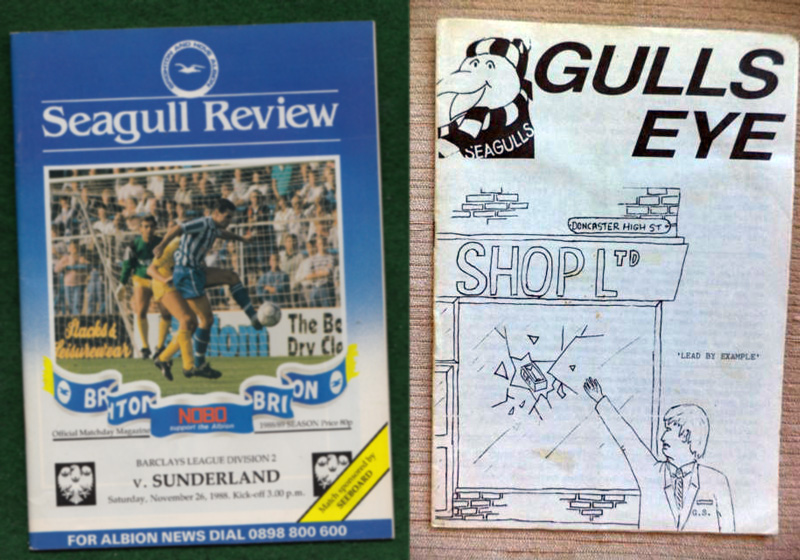
By the second half of the 1980s, the Brighton & Hove Albion matchday programme had become incredibly dull. Save for its colour cover, the rest of the publication was looking increasingly stale. Black and white action shots previously seen in the Evening Argus, lots of unimaginative PR stories (some business chap holds cheque in front of camera alongside a club rep), Tony Pullein’s summary of news in the division and a page where the manager (Barry Lloyd) excuses last week’s unlucky defeat while urging fans to get behind the boys today. You know the score.

The formula had barely changed since the start of the decade, but at least then it was fresh, it had the sparkle of Tony Norman’s photo-journalism and the lustre of First Division football as its subject matter. Now, the bland, lifeless writing and page layout perfectly reflected a club where the likes of Dudley Sizen, Greg Stanley and Bryan Bedson were running the show.

Yet an incendiary letter found its way into the letter’s page in November 1988. Here, for your perusal:

Uplands
Ashtead
Surrey

Although the official match programme hasn’t yet admitted it, there is now a lively unofficial rival called ‘Gull’s Eye”. Perhaps the Editor hopes it will go away! In fact its existence should be a reminder to those who produce Seagull Review that they are missing out on genuine controversy regarding the performance of the team, its players and manager. The topics dealt with in your letters’ columns are dull and of secondary importance. The fencing, the public address system and hospitality to visitors to the ground are not subjects to stimulate our interest. What is needed is constructive comment on club policy, tactics and performance, with replies from the Chairman, Manager and Chief Coach where appropriate. I do not believe in hounding unfortunate players who are out of favour with a section of the crowd, but we the supporters, many of whom are players, past or present, pay the wages of the Club’s employees and should be treated as intelligent and knowledgeable.

Gull’s Eye is brash and a bit brutal. It lacks intelligent comment on skills and tactics, but it is never dull and tries to come up with the behind the scenes news which we really should be reading in Seagulls Review. I challenge the people with authority at the club to allow genuine debate in the pages of your magazine and to reply to the questions the supporters really want answered. Will you print my letter, and will my challenge to debate the issue publicly or privately be taken up?

John Attree

Steve Rooke, the programme editor at the time, replied: “That’s exactly why this page was put here, John, and it’s up to fans like yourself to respond.”

By the following season, 1989/90, the colour content of the match programme dramatically increased, and its design was spruced up, perhaps in a bid to see off the challenge of Gull’s Eye. It never did become the irreverent publication full of debate that was desired by some fans, hardly surprising considering the increasing chasm between supporters and the Board as the nineties rolled on.

Tagged , ,

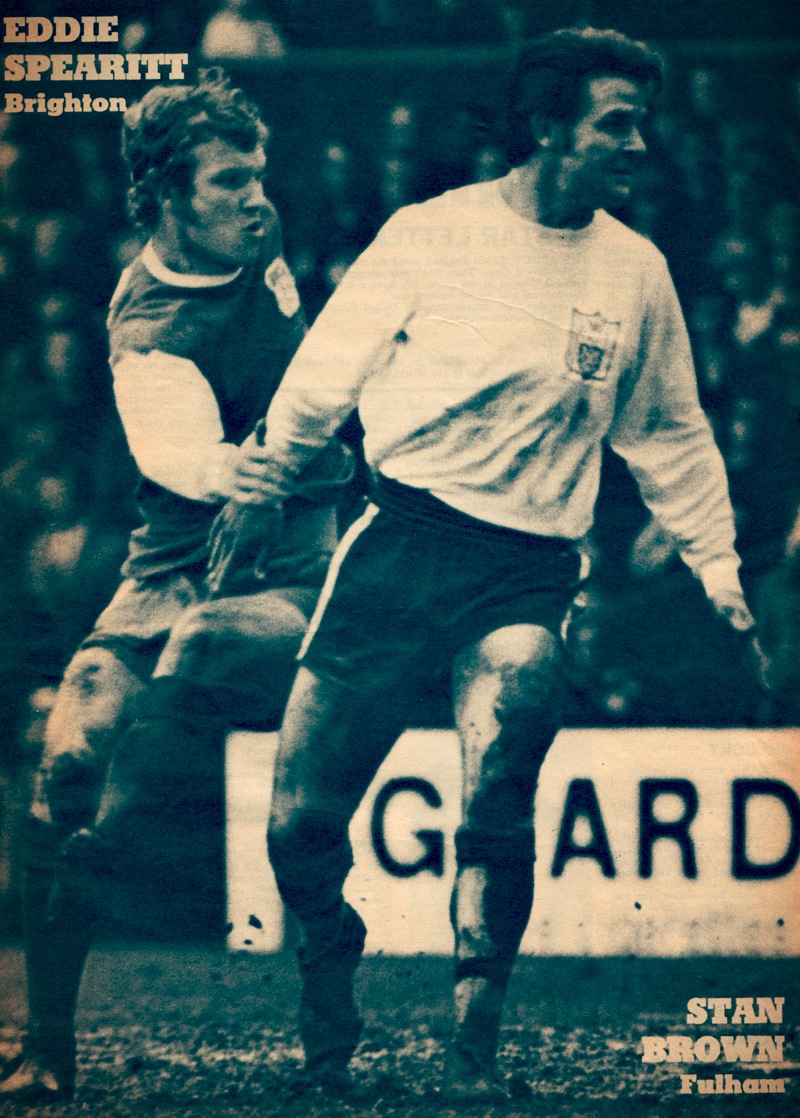
Eddie Spearritt v Stan Brown – before they became team mates

Here’s a nice action shot from Goal Magazine in the summer of 1970, in the edition just after England have been knocked out of the World Cup, judging from the letters page on the other side of the sheet. Never mind all that, because Eddie Spearritt has Fulham’s Stan Brown for company in this match during Albion’s 4-1 defeat at Craven Cottage in March that year. (And yes, I can see them almost holding hands). Little did they know that they would one day be team mates.

spearritt-brown1

Spearritt was a versatile, cultured wing-back who could score goals and had a great eye for a pass. He had six months with Arsenal before becoming an Ipswich apprentice in February 1965. Mainly as a winger, he scored thirteen goals in 72 League appearances for the Suffolk club before he joined Albion in January 1969. At the Goldstone, boss Freddie Goodwin used Spearritt on the left-side of midfield. He also had another important job in the side, as he discussed in December 1972:

“I used to be the club’s penalty taker. But after I missed an important one at Mansfield in 1970 I lost the job. Penalty taking is all about confidence. After I missed that one which cost us a point the players lost confidence in me and the job went to John Napier and was then taken over by Bert Murray.”

All of this was probably old news for Stan Brown. This equally adaptable utility player made 397 League and cup appearances for the Craven Cottage side in a fifteen year spell. Despite his diminutive size, Brown was commanding in the air as well as showing fine ability with his passing and tackling.

As a youngster Brown had played for East Sussex schoolboys and captained Sussex Schools. When he joined Albion on loan in October 1972, with the side struggling in Division Two, he said in the Brighton v Sheffield Wednesday programme:

“It was as if I had been playing for Albion all my life. You see, I live at Lewes, the training ground is only four miles from my house and I have known Bert Murray and Barry Bridges for a long time. As for the rest of the lads I felt I knew them too from reading about them in the Evening Argus every night. So when it actually came to turn out for Albion at Huddersfield I knew all the players by their first names.”

Slotting in effortlessly in midfield, he enjoyed helping the Albion to a 2-0 win at the Terriers, but did not experience another victory in his other eight games with his loan side before returning to Craven Cottage. Brown’s last five games saw Brighton lose all five without scoring a single goal.

The goal-shy spell ended in the very next match, when Eddie Spearritt returned to penalty-taking duties. He said:

“Bert Murray would have taken the penalty at Carlisle. He has already scored two penalties this season. But he had gone into goal after Brian Powney had been carried off with a broken nose. And it was decided that it was too risky to fetch Bert out of goal to take the penalty. Nobody else seemed to want to take it so I just picked the ball up and put it on the spot. We were 5-0 down by then. But I thought just from a morale point of view that it was extremely important that I scored. You can understand my relief when I saw the ball hit the back of the net.”

Tagged ,

Tony Millard, Rest In Peace

Tony Millard, sports commentator, ex-Brighton & Hove Albion matchday programme editor and the brains and voice behind the Seagull Line, has died, aged 74, yesterday morning.

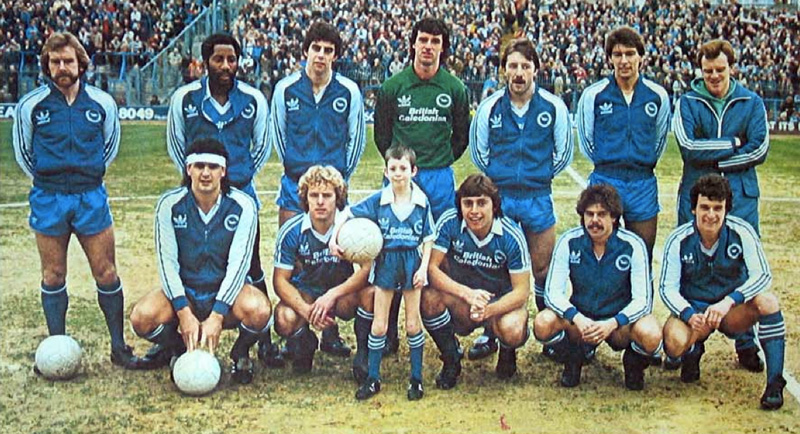
He played a key role in bringing the shirt sponsorship deal with British Caledonian Airways to the club while his eye for a good promotional venture also led the Brighton team to record and release two music singles in the early 1980s, as well as fly to the 1983 FA Cup Final via helicopter.

While disliked by some who depict him as ‘rude,’ ‘obnoxious’ and ‘arrogant’, not to mention less than flattering comments about some of his supposed dalliances, Millard is mostly remembered fondly by Brighton fans for his tremendous work at the club as well as commentating on key moments in the club’s history.

Being a superb organiser and doer, the man was a driving force of so much that was great behind the scenes. Taken from the Brighton v Everton programme in April 1983:

tony millard

Walking into programme editor Tony Millard’s office at the Goldstone can be like stepping into a tornado!

If there is a sports personality in the town who lives a fuller life than Tony, I’ve yet to meet him. It’s not unusual for him to be talking to two people on different telephone lines, whilst looking through programme photographs and Albion promotional material on his desk.

If variety is the spice of life, Tony should be nicknamed ‘Heinz’. He’s always got at least 57 things on the go at the same time! As a sports journalist he has covered everything from speedway and golf, to cricket and basketball. His radio broadcasting has taken him as afar as Los Angeles.

But home is where the heart is and no aspect of Tony’s career is more important to him than his work for Brighton & Hove Albion Football Club. Together, with his friend of many years standing, Ron Pavey, Tony has spearheaded the club’s money-spinning promotions team. He also spends a lot of time fixing personal appearances and interviews for Albion stars.

His journalistic experience means he is never shot of ideas for the match day programmes. Many of the club’s supporters have commented on the improved standard in recent years. Tony also does a great deal as match day announcer. Some of his jokes may be in the Tony Blackburn class, but his professional style eases supporters through the afternoon with pop music, match details and sports news from around the country.

Tony’s match days don’t stop there. He broadcasts reports for local radio stations and he is a regular contributor to ITV’s ‘World of Sport’ big match coverage too. His Saturdays race past in a whirl of activity, but Tony wouldn’t have it any other way.

‘I came to the Albion full-time five years ago,’ says Tony. ‘My first jobs were to reshape the ground advertising contracts and also find sponsors for matches here at the Goldstone. Next I got to work on redesigning the programme and that tied in well with the match day announcing I’d already been doing for some time.

‘It’s a busy life, but I like it. You never quite know what the day ahead holds in store and that’s exciting.’

Tony is a useful cricketer and seems to cram more matches into his summer than Australian sponsors pump into their one-day tournaments. He also plays golf and he enjoyed a fair amount of success as a footballer, playing for Haywards Heath receives, after leaving school.

His flair for organisation shone through as early as 1961, when he became involved with the local football Sunday Leagues. His friendship with Ron Pavey dates back to that time. Now, Tony lives and breathes sport. His energy and enthusiasm combine to make him a popular member of the Goldstone staff.

‘I make my living from being involved with sport,’ says Tony, finally. ‘I really couldn’t ask for more.’

A great example of his intense commentary style can be found here in this famous heartstopping match with Hereford in 1997:

Finally, some classic Millard anecdotes gleaned from the pages of North Stand Chat. Enjoy!

El Presidente – The Albion Supporters Club XI played against the Southern Sound XI in 1985. Millard was playing for Southern Sound, I pushed the ball past him, ran onto it, and his response was to rip my shorts off.
gjh1971 – My favourite Millard moment was during the early eighties at the Goldstone, Andy Ritchie missed an open goal, and Tone had inadvertently left the microphone on, and Millard blurted out ‘pull your bloody finger out, Ritchie’ across the PA.
Harty – My top Millard Moment was at the York City game in 1996, with a near riot taking place and the goals already ripped down ‘our Tone’ comes out with an Albion PA golden moment.
“While we’ve got this break in the play, can I remind you it’s Steve Foster’s testimonial this Tuesday, when the Albion take on Sheffield Wednesday, 7.45 kick off? Hope to see you all back here.”
The Large One – After-match interview with Danny Cullip
Millard: Interesting goal you scored there, Danny…
Cullip: Yeah, well. A bit flukey, but to be honest, it doesn’t matter how they go in – as you should know, Tony.

There’s also another one where he is commentating for radio and accidentally uses one of his catchphrases from his other big project: “You’re listening to Seagull Line on Brighton 8049, that’s the number for Albion information, everyday, 24 hours a day.” Oops. Thanks for the memories, Tony.

Tagged

Steve Foster joins exclusive 10-year club

stevefoster9

No wonder he’s smiling. He’s signed for a club that would later ensure he’d never run out of money for headbands. This is from Football Weekly News, 9-16 July 1980:

Brighton defender Steve Foster has joined an exclusive 10-year club at the Goldstone Ground.

Last week the 22-year-old former Portsmouth centre-back signed the long-term contract which will keep him on the south coast for a decade.

“We want all our best players to spend their whole careers with this club,” said manager Alan Mullery, who purchased the player from Pompey for £150,000 last summer.

“Steve, added the boss, “is an outstanding prospect and could go to the very top of the tree.”

Republic of Ireland star Mark Lawrenson is already serving a similar 10-year stint with Brighton while Young England striker Peter Ward has signed on for eight years.

In addition, Michael Robinson signed a 10 year deal about twelve months later.

But so much for these eye-wateringly long contracts! Ward was gone within three months, Lawrenson after a year while Foster played three more seasons for the Seagulls. Even so, Foster did return, to great acclaim to the Goldstone in the 1990s, once again becoming one of the key players in the team. By then, of course, much shorter contracts were the order of the day for a financially impoverished Albion.

Tagged , , ,

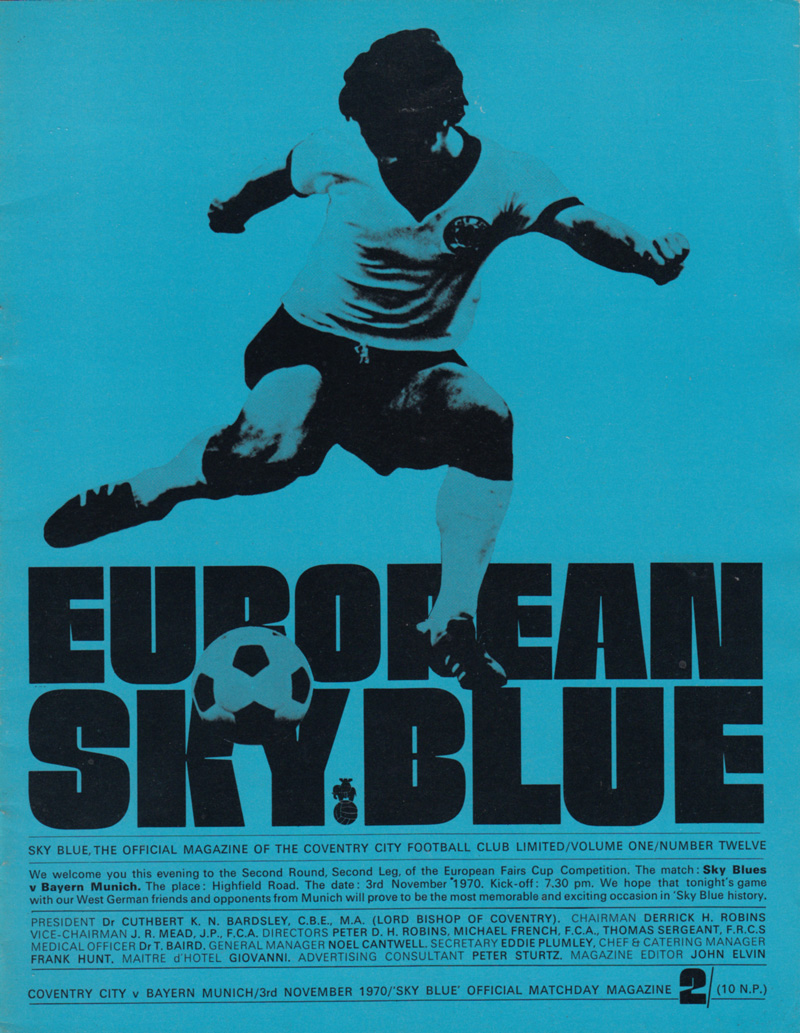
European Sky Blues – the future Albion stars that beat Bayern Munich

The proof-readers must have been on holiday, because the matchday programme for Brighton’s recent pre-season friendly with Norwich City carried this juicy blunder:

Norwich are the only English side to have beaten Bayern Munich in European competition.

Well, apart from Arsenal, Aston Villa, Chelsea, Everton, Manchester United and Tottenham, of course. Three of those were in the final of the European Cup (or Champions League), so it was a sizeable gaffe that deserves to be squelched. And, in an act that might inspire some Jimmy Hill chin-stroking style incredulity, Coventry City have also defeated Bayern Munich. Yes, that’s right. And it was in the decade when Bayern were crowned champions of Europe three times. What is more, the Sky Blues did it with a quite a few players who went on to ply their trade with Brighton & Hove Albion several years later.
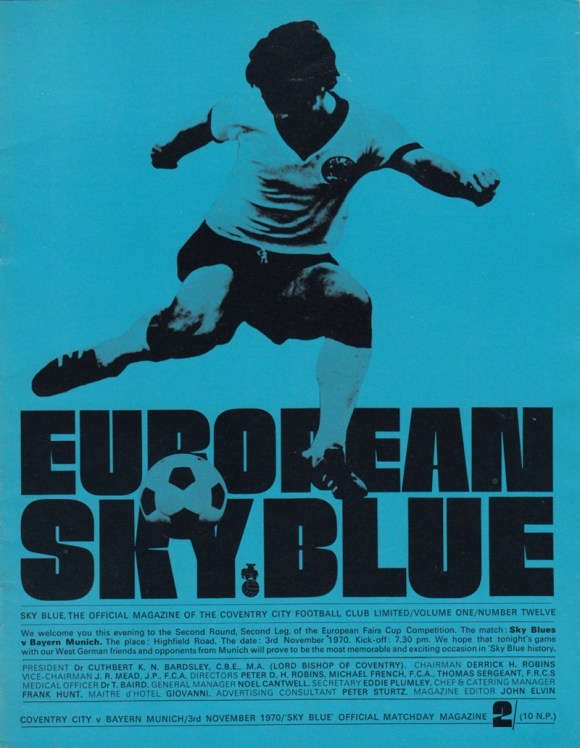
europeanskyblue

Autumn 1970. Ex-Eire international midfielder Pat Saward had recently left the coaching staff at Coventry City, where he had nurtured the youngsters of Highfield Road to the FA Youth Cup Final for the second time in three seasons. However, now a much bigger challenge loomed, as the prospect of relegation threatened to engulf his first campaign as Brighton manager. Having finished fifth in the previous campaign under Freddie Goodwin, Albion had started 1970/71 with a measly two wins in ten matches. So Saward went back to old club to replenish his side in the face of an injury crisis. He emerged with the reserves’ tough centre-half Ian Goodwin on loan. As John Vinicombe wrote of Saward in the Evening Argus:

He well remembered Goodwin, a 6ft central defender, who at 20 was still learning his trade. Goodwin, all 13st of him, had lost his first team place after four appearances when City splashed £100,000 on Wednesday’s Wilf Smith.

The transfer struck a chord with Saward, who during his career at City had tried to sign Goodwin’s younger brother. Ian only turned up at Highfield Road as a driver for the 15-year-old kid. Saward recalled: “We happened to be short of a player and asked Ian to show us what he could do and he turned in such a good performance that he had a month’s trial and stayed.”

Two years later Goodwin answered Saward’s SOS and breezed into the office, declaring: “Have no fear, Goodwin is here.” That self introduction was typical of Goodwin, who became a breath of fresh air to Albion’s dressing room.

“You can relax,” he beamed. “From now on it’s going to be wins all the way.” Now Saward was no mean motivator himself, but with Goodwin having joined the ranks, initially on a short-term arrangement, spirits began to soar.

Goodwin’s boast proved empty as Albion continued to fall, from 17th place in early November to as low as 23rd in late March 1971 before rallying to finish a respectable 14th position.

As for Coventry, the Sky Blues had much, much bigger fish to fry. The Midlanders had finished sixth in the First Division in 1969/70, which opened the way to the first and only European campaign in their history, in the Inter-Cities Fairs Cup. Once they progressed past the first round, having beaten Trakia Plovdiv 4-1 in Bulgaria before a 2-0 win at Highfield Road, Coventry then drew mighty Bayern Munich.

The Sky Blues line-up at the Olympic Stadium in Munich was:
McManus, Coop, Cattlin, Machin, Blockley, Strong, Hunt, Carr, Martin, O’Rourke, Clements.
cov-chriscattlin2So that’s three players there that went on to join Brighton. Left-back on the night was the ever-dependable Chris Cattlin. He had a distinguished career at Highfield Road after signing from Huddersfield for a record fee for a full-back, £80,000, in March 1968. On the Sent From Coventry blog he said recently: “I was a long, lanky lump and I wouldn’t dive in. I’d trap the attackers in the corner then wallop them. I had a great relationship with the fans at Coventry. They knew what they were going to get from me.” He was transferred to Brighton for no fee in summer 1976 as Peter Taylor’s last signing for the Albion, and his stiffening of the defence (when ousting Ken Tiler from right-back mid-way through the season) made such a huge contribution to Brighton clinching promotion to Division One in 1978/79.
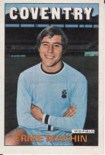
cov-machinMidfielder Ernie Machin also played in Germany on that evening. This energetic and skilful player eventually came to the Goldstone Ground via Plymouth in summer 1974. Although he was appointed captain, he never settled on the south coast, and still lived in Coventry and trained in the Midlands. Released at his own request in 1976, he eventually returned to Coventry briefly as youth team coach.
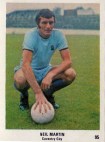
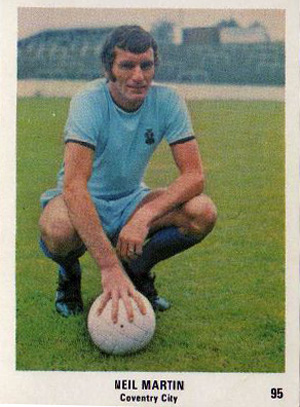
cov_neilmartinCoventry’s lanky striker Neil Martin also didn’t last very long as an Albion player. Signed by Taylor in summer 1975 as a freebie from Nottingham Forest, he left for arch rivals Crystal Palace in March 1976 after losing his place.

In the first leg, Coventry went down 6-1 to Bayern.

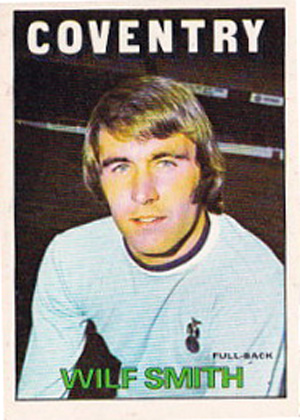
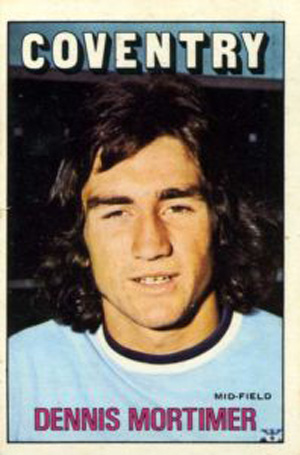
For the return leg, Neil Martin kept his place and scored the winner in a famous 2-1 victory. Cattlin and Machin dropped out, and Wilf Smith and Dennis Mortimer were promoted to the side:
Glazier, Coop, Smith, Mortimer, Blockley, Hill, Hunt (Joicey sub), Carr, Martin, O’Rourke, Clements.
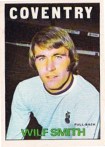
cov-Wilf-SmithWilf Smith had been born as Wilfred Schmidt in Neumünster, Germany before his parents decided to Anglicise his name. He had joined Coventry from Sheffield Wednesday for £100,000, a record fee for a full-back, in summer 1970. It was this move that led to unsettled Goodwin joining Pat Saward’s Albion. The classy Smith also came to Albion on loan from Coventry in October 1974, but Albion could not afford the fee to make the deal permanent.
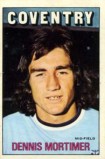
cov-mortimerFinally in this exodus-of-sorts to the Goldstone, Dennis Mortimer. At the time of the Bayern clashes, he was just eighteen years old, eventually playing 193 Division One games for the Sky Blues before a successful move to Aston Villa. He joined Albion much later in 1985, signed by Chris Cattlin, now Brighton manager, on a free transfer. By that time, Mortimer was reaching the end of his career and yet his powerful performances with Brighton made him a firm favourite at the Goldstone Ground. The influential midfielder had already notched up another victory over Bayern Munich, in the 1982 European Cup Final as Villa skipper.

Tagged , , , , , ,

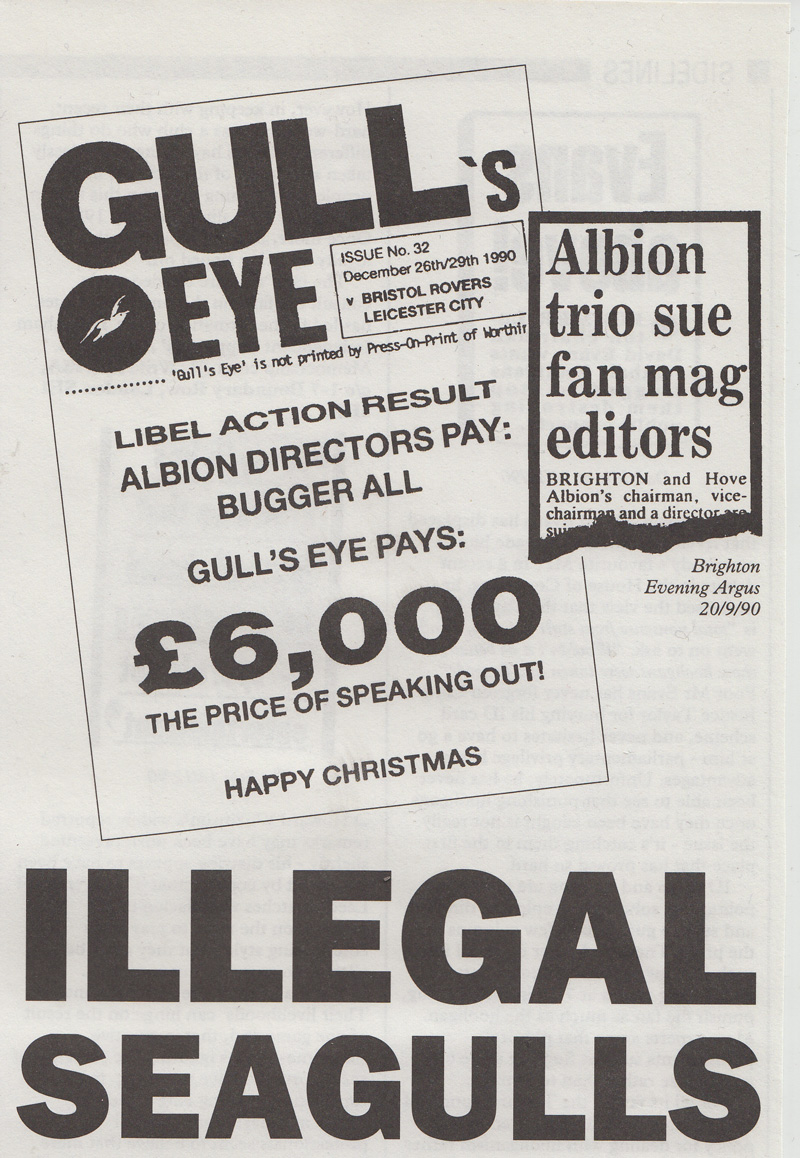
The Albion directors sue Gull’s Eye fanzine

illegalseagulls1

I think this is from When Saturday Comes. Atilla The Stockbroker had been kind enough to give me permission to reprint this article by him:

I suppose it was going to happen to some fanzine or other eventually, but it still feels very strange. As Gull’s Eye editor Peter Kennard and myself met up with FSA lawyer Peter Jackson on the steps of the High Courts of Justice in London, I could hardly believe it could come to this, even more so as we sat in the stiffly formal atmosphere of Court 14 as a public apology was made on behalf of the fanzine while Brighton and Hove director John Campbell looked on. The ponderous sledgehammer of the British libel laws descended with all its force on, well, a nut: sixteen sides of erratically typed A5 sold by a bunch of enthusiasts outside the Goldstone on alternate Saturdays.

The judge certainly felt the occasion worthy of humorous comment: “We don’t need the jury, do we?” he smiled as the court rose after the proceedings, total duration around two minutes. The court reporter was grinning too. Rather less funny, though, was the cost for £6,000 in legal costs…

That was the final act in a long-running saga, an apology in open court being just one of the conditions imposed on Gull’s Eye as of an out-of-court settlement, leaving the fanzine’s co-editors, Ian Hart and Peter Kennard, to pay the legal costs of the Brighton directors.

The libel consisted of a series of allegations about the directors’ activities, couched in humorous language but taken oh, so seriously by the board; better leave it there, I am advised, although I was not aware that my phrase “there is a stench of decomposing flounder in the air” could possibly be viewed as libellous. It is certainly true that, these days, an ancient and dilapidated flatfish would make a far more appropriate symbol for our beloved Brighton and Hove Albion than the soaring seagull of popular legend.

There can be no doubt that the club has enormous potential. In the 1970s, as the Seagulls hovered near the top of the Third Division with Peter Ward and Ian Mellor leading the line, crowds of over 30,000 poured regularly into the Goldstone. Just two years ago, when the club bounced back from relegation to the Third Division at the first attempt, 20,000 people saw the final game of the season against Bristol Rovers. All it takes is a sniff of success for the crowds to start pouring in – and this is hardly surprising since Brighton is the only League club in Sussex, one of the largest (and wealthiest) counties in England.

However, such sniffs have been few and far between since Gordon Smith’s famous 1983 Cup Final miss, and now gates are averaging well below five figures, with debts of over £3m. As usual, the powers that be refuse to discuss the clubs financial position with supporters, and appear unable or unwilling to attract new faces onto the board. Huge debts continue to be cited as the reason for Brighton going absolutely, and spectacularly, nowhere.

All very frustrating – and that’s where Gull’s Eye comes in. They have consistently campaigned for a change in regime and for a dialogue with supporters (personally I’d like to see the club taken over by Brighton Council a la Halifax, but anything is better than the present situation). Gull’s Eye is caustic, passionate and occasionally way over the top, but its editors have spoken out in a way which has certainly struck a chord with the fans (average sales are currently around 2,000 per issue). It is without doubt a thorn in the side of the board, and this ridiculous libel action is a clear attempt to intimidate it out of existence.

The action of a bunch of wealthy businessmen who seek to squeeze £6,000 out of a couple of young fans, one of whom is currently unemployed, leaves a very big nasty taste in the mouth indeed; and I am sure directors of other clubs are following the case with interest.

So please support the Gull’s Eye Fighting Fund. And if you’re a band, comedian, Lithuanian nose flute virtuoso or other top entertainer willing to perform at a benefit concert, please get in touch also. We need all the support we can get; and remember, an injury to one is an injury to all. Fanzine readers of the world, unite!

Happily, the matter was resolved speedily. As Lenny Rider said on North Stand Chat a couple of days ago:

Our readers rallied round: bucket collections, benefit gigs, the odd dinner and a charity auction including donations from Robert Maxwell and Stuart Hall, proving there’s a little bit of good in everybody. Paid it all off inside 18 months, but a lesson in life learnt: it’s not about whether you are right or wrong. It’s about who’s got the most money. Nearly a quarter of a century later, if TSLR got sued, if I believed what they were writing was true, I would back them every way possible.

Tagged

New arrivals hold the key in 1980/81

newsigning1980v2

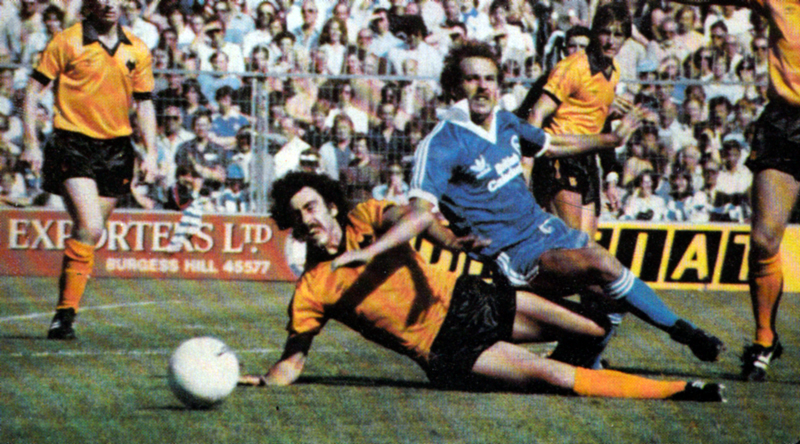
The 1980/81 Albion squad was probably the strongest in the club’s history. At least on paper. With their first season of top flight football behind them, Brighton looked to build on their experience, and were bolstered by Michael Robinson and Gordon Smith, two £400,000 captures. The Robinson-Ward striking partnership appeared to promise an avalanche of goals while Mark Lawrenson and Steve Foster seemed likely to keep things solid at the back.

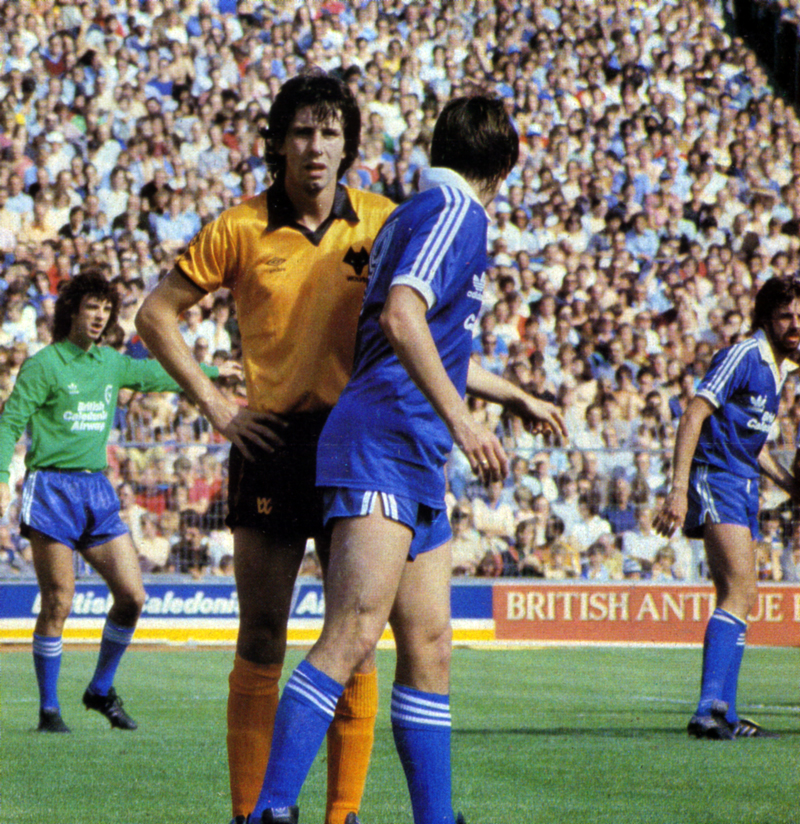
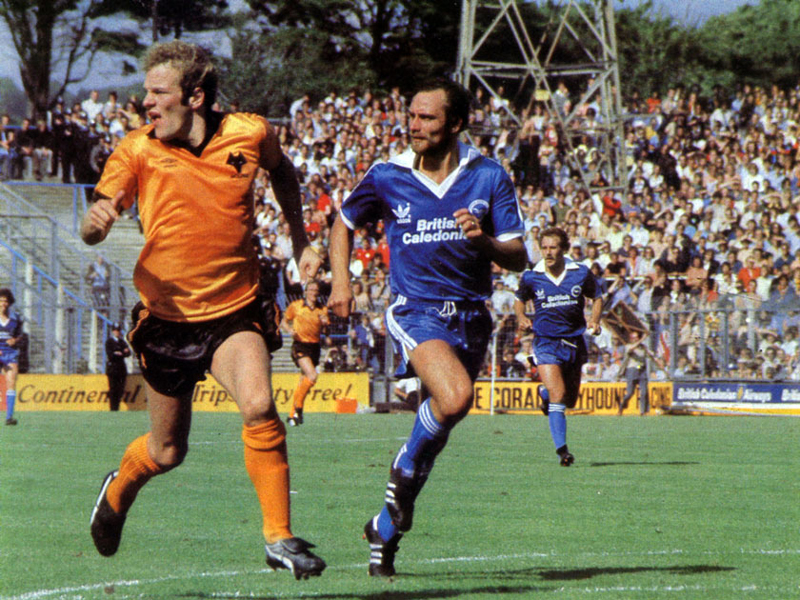
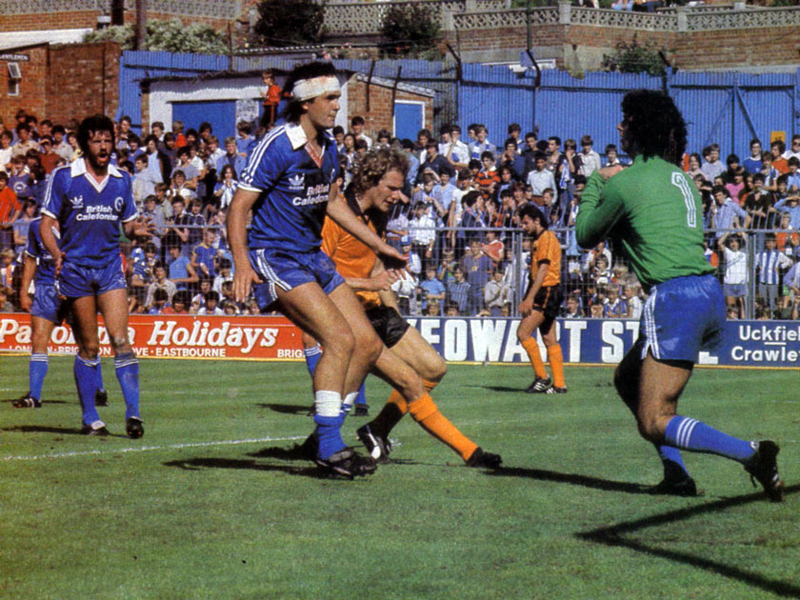
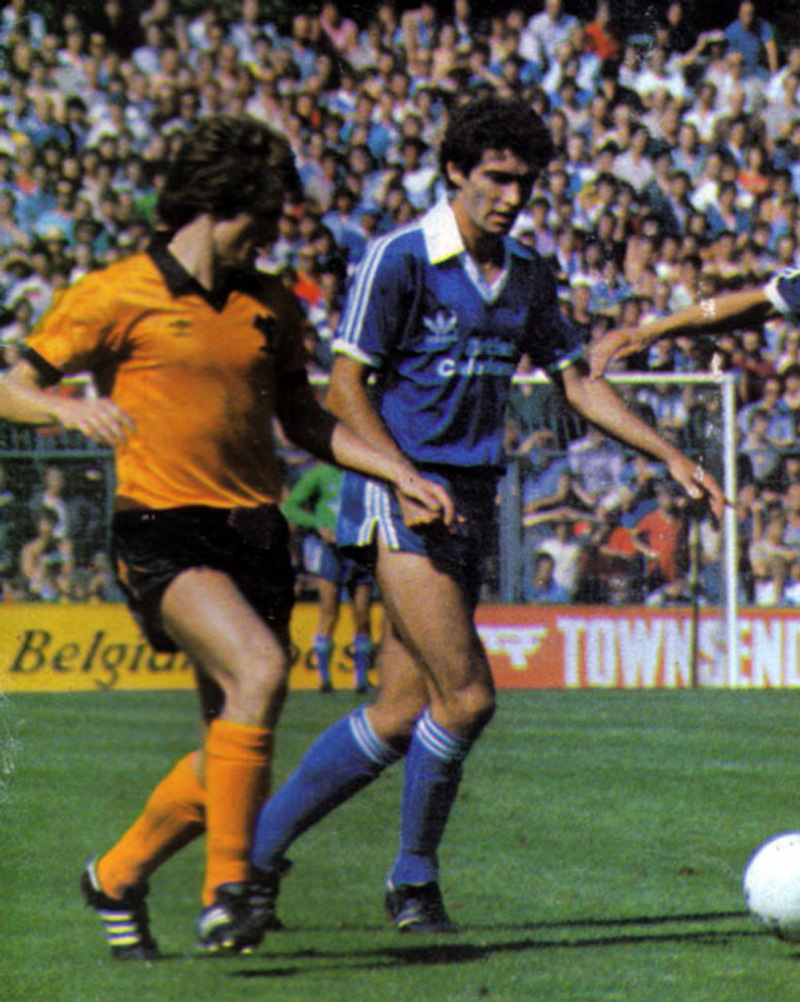
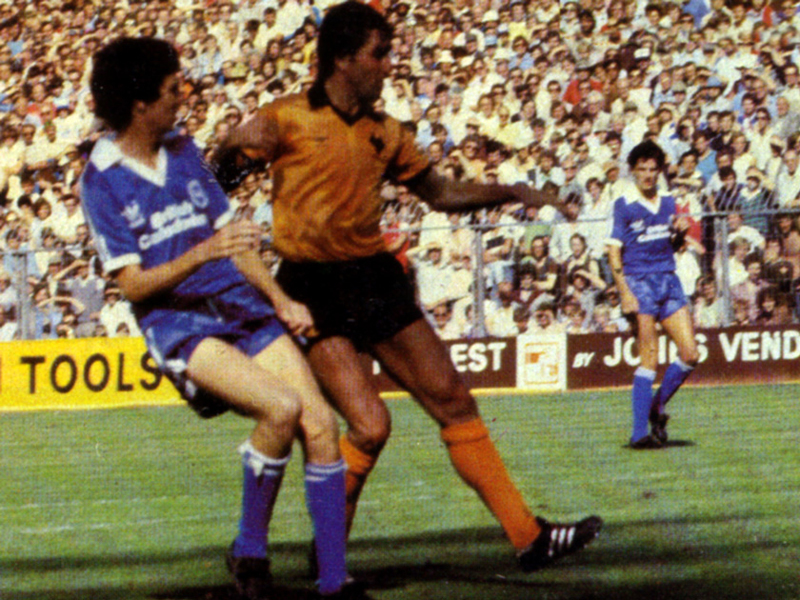
It certainly didn’t pan out that way, which is perhaps testament to the outstanding contributions that Ray Clarke and Peter Suddaby made to the Brighton side. They both had a profound effect on Albion’s season when they joined mid-way in 1979/80. Their departures certainly coincided with a downturn in Albion fortunes, despite the opening day success, a comfortable 2-0 victory over Wolverhampton Wanderers in the sunshine at the Goldstone in August 1980.

An outstanding article by Dave Spurdens dissects the functioning of the Brighton team at the time:

Last season the First Division induced in Brighton the sort of timorous insecurity common to squatters awaiting removal from their borrowed abode.

No mean appraiser of life’s realities in the big league, Alan Mullery saw clearly that reinforcements would have to be moved up if Brighton was to grow from a rather crotchety tenant to an established mortgagee.

The departures of Ray Clarke, Peter Suddaby and Andy Rollings to pastures new heralded the expected re-jig and after a series of wrangles Mullery forked out a million pounds and came up with Gordon Smith, signed from Rangers, Ray McHale, the generator behind Swindon’s surge, Moshe Gariani, spotted in Israel during a club trip and finally, after much ado, Michael Robinson (below, middle), the Manchester City reject, unloaded by Malcolm Allison in a cut price deal.

wolves3

Robinson went to the Goldstone Ground hopefully to prove that Allison had been right to buy him in the first place, but hopefully remiss in sending him packing after one short season.

Apart from those four it’s the same Brighton and at the end of the day success will depend on these players being better than those they have replaced, coupled with the experience of more prolonged First Division status.

Mullery’s prognostications that Brighton will cause a few surprises started off with a bang when Wolves, the team many tip to challenge the leaders, were reminded that the supposed no-hopers from the south would certainly not help them in their aspirations and were duly beaten by them 2-0.

The blend looked good. Smith, everybody in Brighton averred, was another Trevor Brooking. McHale’s industry was commendable and Robinson, if nothing else, confirmed that he was unlikely in the next few years to halve his value again. Robinson, whom nobody apart from Malcolm Allison thought a near million-pound player, now has to prove that he is a near half-million player.

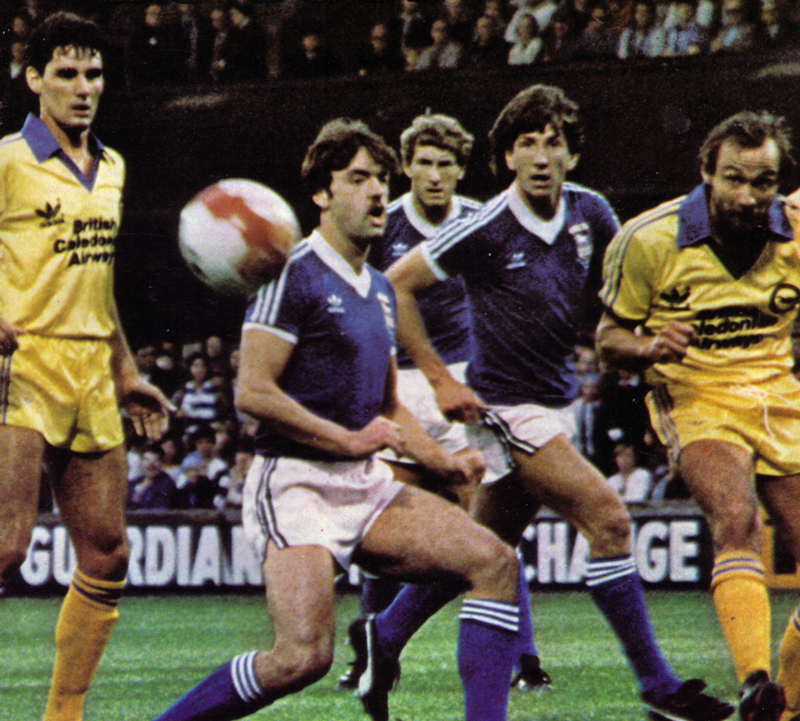
The next game was not so auspicious but nevertheless, despite defeat, demonstrated Brighton’s senior status against another of this year’s tips for the great ‘Nick the title off Liverpool’ campaign, Ipswich.

Taken all round in victory and defeat, this new-look Brighton is a tight outfit with a very solid back four, a midfield that is directed by skipper Brian Horton and a front line that once gets to know itself could produce problems for even the best.

wolves7

Horton (above), a ubiquitous character, has an influence in the three lines slotting into the back whenever Mark Lawrenson takes off for advanced territory, running the midfield and going on occasional forays behind his front three whenever the opportunity presents itself.

In four seasons at Brighton, since he arrived from Port Vale, he has matured into an integrating force with a strong sense of how to exploit time and space. His influence gives Brighton a varied tempo and a less predictable pattern of advance.

ipswich

Horton (above) plays a complete midfield role and his defensive work is tenacious and very professional.

Unlike his two midfield colleagues, who allow players to steal goalside oblivious of the pressure it puts on the back four players, Horton is an expert tracker and uses his experience to transfer marking responsibilities when he feels he is being pulled too far away from crucial zones.

raymchale

McHale (above), though he operated well forward, is an industrious player busily looking for possession from the man with the ball, but he is not so aware of the damage those without the ball can do.

Neil McNab falls into the same trap of being less than attentive to those who ghost behind his area of concentration. On the ball, he has the look of threatening competence as he moves forward with control. The final pass is often less incisive than anticipated, and some of his forward probes are too easily read by those who should be troubled by them.

Brighton’s build-up when started by Horton or full-back John Gregory is patient and constructive, but tends to be a fifteen-yard game which is easily closed down by good defenders or by teams that fall off and vacate the midfield space.

With a build-up like this, one waits frustratingly for the breakthrough from the back or the run into space which has been created by the diagonal drift of their build up.

So often play develops from the right to left, dragging opposition players with it and leaving large spaces into which back or midfield players should be running in order to exploit opportunities on the blind side.

Even when they are developing their game around the midfield, and where the opposition is turned minimally, there is still a great need for play to be switched once the options have closed down on one flank or the other.

If there was a major reason, in their second game, why their opponents could sit reasonably comfortably it was this tendency to attack in straight lines.

ipswich1

It has been generally accepted by the Seasiders that (above) Lawrenson’s best role is at the centre of the back four.

Certainly with he and Steve Foster at the heart of the defence there is a solidarity that will stand them in good stead whenever they play.

Brighton’s resources probably dictate this policy, lacking the luxury of being able to use players in their perfect role.

I thought Lawrenson playing in front of the two centre-backs last season was more effective because of the strength of his forward runs, and he didn’t have the worry of leaving gaps at the back.

wolves5

Foster (above) is playing better than ever alongside Lawrenson, with tireless courage and aggression.

There are those who feel him to be one of the best young centre-backs in the country. Against Ipswich, it was interesting to see him with the two favourite contenders for the spots currently held so securely by Thompson and Watson.

Under far greater pressure, Foster made several early errors – especially when it came to picking up high balls on the edge of the box. But once he settled down, he looked the equal to anybody aspiring to international status.

wolves4

At full back, Gregory (above) turn in his usually immaculate performance both defensively and creatively when he plays the ball forward, but his energy in getting forward into good space seems seriously curtailed. Whether through disinclination or orders, only the player and his manager can know.

wolves1

On the other flank, young Gary Williams (above) gives the impression that, unless he tightens up on his jockeying to players who run at him withthe ball, he could be in for a skinning before the season gets much older.

The rest of his game seems to be developing well and the way he linked up with the centre-back in the middle when his partner had been pulled out wide suggests he is learning his craft quickly.

wolves2

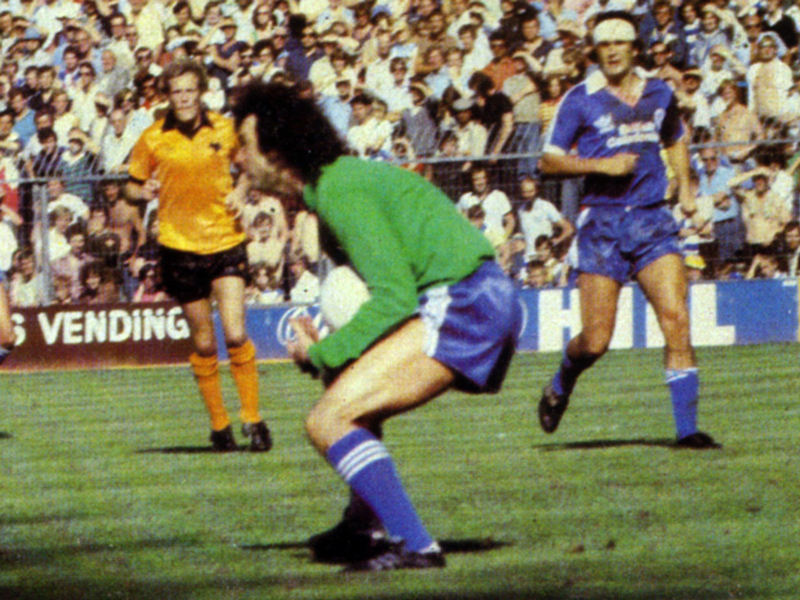
Behind this promising back four Graham Moseley (above) looks quick and agile, enjoying the confidence of those in front of him.

There are times when he could be more positive in his communication but I suspect his diffidence may be prompted by the perpetual dialogue conducted by Foster just in front of him.

The 1980/81 season turned out to be another one of struggle as Brighton’s reshaped side blew hot and cold in the First Division. After the opening day victory over Wolves, it took another six games to record another League victory. Peter Ward left for Nottingham Forest in the middle of a ten match winless spell from late September that saw Brighton vacate the League Cup and marooned at the bottom of Division One by mid-November. Then, a surprise 1-0 win over League leaders Ipswich Town kick-started a brief run of good form. After another slump in the New Year, when Brighton won just twice in fifteen matches, the Seagulls saved themselves with a miraculous spell of four wins in four matches at the end of the season.

This late form showed what Mullery’s most accomplished looking side was capable of. However, it was not without its flaws, as journalist Dave Spurdens capably showed. Although Michael Robinson came good with 22 goals, this did not fully paper over the cracks. When Mike Bailey took over in the summer of 1981, another re-jig of the squad was in the pipeline.

Tagged , , , , , , , , , ,

From Alan Young’s autobiography: Jimmy Case goes AWOL

During 1983/84, Brighton & Hove Albion had three Youngs in their squad: Eric Young, Willie Young and Alan Young, none of whom were related! In a seldom seen aligning of the stars in March 1984, all three made the starting line-up in the fixtures against Manchester City, Derby County and Leeds United. It proved a winning combination as Albion drew 1-1 against promotion-chasing City before thrashing both Derby and Leeds 3-0.

Scoring a powerful volley from a Gary Howlett cross in the second half against Derby was Alan Young, a burly striker who was exceptional in the air, yet also had fine technique on the ground. The Scot had been signed by Jimmy Melia in a £150,000 deal for Brighton from Sheffield United in August 1983 as a replacement for Michael Robinson. He announced his arrival at the south coast club in September 1983 with a spectacular overhead kick in his debut against Chelsea.

alan_young

Although he had only one season at the Goldstone Ground, and was in and out of the side with injuries, he was regularly on the scoresheet when playing for Brighton. Thanks to Simon Kimber, who has allowed me to share an extract from Alan Young’s autobiography ‘Youngy’:

I didn’t realise until I looked recently that my goal return at Brighton was pretty decent; I got 12 goals in 26 matches and I really enjoyed my time at Brighton.

The supporters were still recovering from losing the FA Cup Final to Manchester United in 1983 (this was the game when Gordon Smith should have won the Cup for Brighton with a late chance when he was one on one with Gary Bailey) and the whole euphoria of the day and the occasion. I’m not saying that Brighton isn’t a proper football club but in Brighton the football was viewed as part of the entertainment industry. The football they tried to play reflected that and if the fans weren’t being entertained then they got at the players and the manager.

At Brighton we played with a lot of freedom. There were no restrictions. We were allowed to make our own decisions on the pitch. We had the players with the right experience to do that and I’m thinking of international players like Corrigan, Ryan, Grealish and experienced lads like Jimmy Case and Steve Foster. The football was very enjoyable there and never more so than when Jimmy Case and I were playing together; I loved playing with Jimmy. He was very quiet and has a hearing aid because he doesn’t hear too well.

I remember we finished training one day and headed off to Woody’s as usual and then on to the gentlemen’s club for a game of pool. Then everyone starting to drift away and by ten o’clock in the evening there are only about six of us left. (Bear in mind that we didn’t have mobile phones back then so you couldn’t phone up to let anyone know you were going to be late.)

jimmycase9

So I got home and Karen asked me where I had been so I told her and then she asked me if Jimmy had been with us because Lana (Jimmy’s wife) had been on the phone asking if we knew where he was. I told her not to worry because he left same time as me and would probably be home any time soon. The next day Jimmy is nowhere to be seen and nobody knows where he is. So there is a little bit of panic around. Nobody has a clue where he has gone until the following morning at training when Jimmy saunters in, whistling and acting as if nothing is wrong. So I asked him: “Jim, where the f*ck have you been?” and he looks at me and says “What do you mean?.”

I said “Jim, nobody knows where you have been, we’ve been panicking”.

Then he smiles and goes. “Ha! The Avenue” and I’m like “The Avenue? What Avenue?” and he says “The f*cking Avenue de Champs Elysee!.” Then he tells us how, after we all went our separate ways that night he fancied going to Paris! So he went up to Gatwick and jumped on a plane to Paris. He showed us the stamp in his passport to prove it – he had gone to Paris for a day just because he could and he fancied it.

On the pitch he was different class though. I once saw him on the receiving end of a dreadful challenge when a guy (I forget who) tried to get the ball off him and put his studs down the back of his calf and Achilles. That really bloody hurts and Jim just let the ball roll away and turned on this guy and, through gritted teeth, said “Don’t you ever, ever f*cking do that to me again!” and then he turned and went after the ball and got it back before it went out. I watched this going on and the guy was sh*tting himself. That is the only time I have really seen one professional footballer genuinely scared of another. Because Jimmy could be a hard bastard and really knew how to look after himself.

He used to do about two hundred sit ups every days after training. He would wear one of those polystyrene bags that you get from the dry cleaners when he did them. He got me in to it as well!

If you are interested in reading more, you can buy ‘Youngy,’ the Alan Young autobiography here on the accompanying site.

You can also order a rather wonderful Alan Young t-shirt from Cult Zeros.

1984-85v3

Back row: Mark Jones, Steve Penney, Steve Jacobs, Alan Young, Graham Pearce, Kieran O’Regan, Gary Howlett;

Middle row: Sammy Nelson (coach), Hans Kraay, Eric Young, Joe Corrigan, Perry Digweed, Frank Worthington, Terry Connor, George Petchey (youth development officer);

Front row: Neil Smillie, Chris Hutchings, Jimmy Case, Chris Cattlin (manager), Steve Gatting, Gerry Ryan, Danny Wilson.

Tagged ,

Avoiding Jimmy Savile, here’s Jason’s big day with his Albion heroes

In the 1970s and 1980s, the Evening Argus newspaper was living in the dark ages compared with the lesser known West Sussex Gazette, which sometimes offered glorious technicolor coverage of Brighton & Hove Albion. I have a wonderful edition that shows the 1979 promotion parade in colour, but I’ll save that for another time.

Rolling on four years, Brighton were still in the First Division, but struggling to maintain its place in such lofty heights. Nevertheless, they were still hero-worshipped by Seagulls fans lucky enough to be growing up in the town at the time. On Thursday 27 January 1983, the West Sussex Gazette reported on a young mascot’s big day, one where he was made highly welcome by towering Albion skipper Steve Foster:

mascot

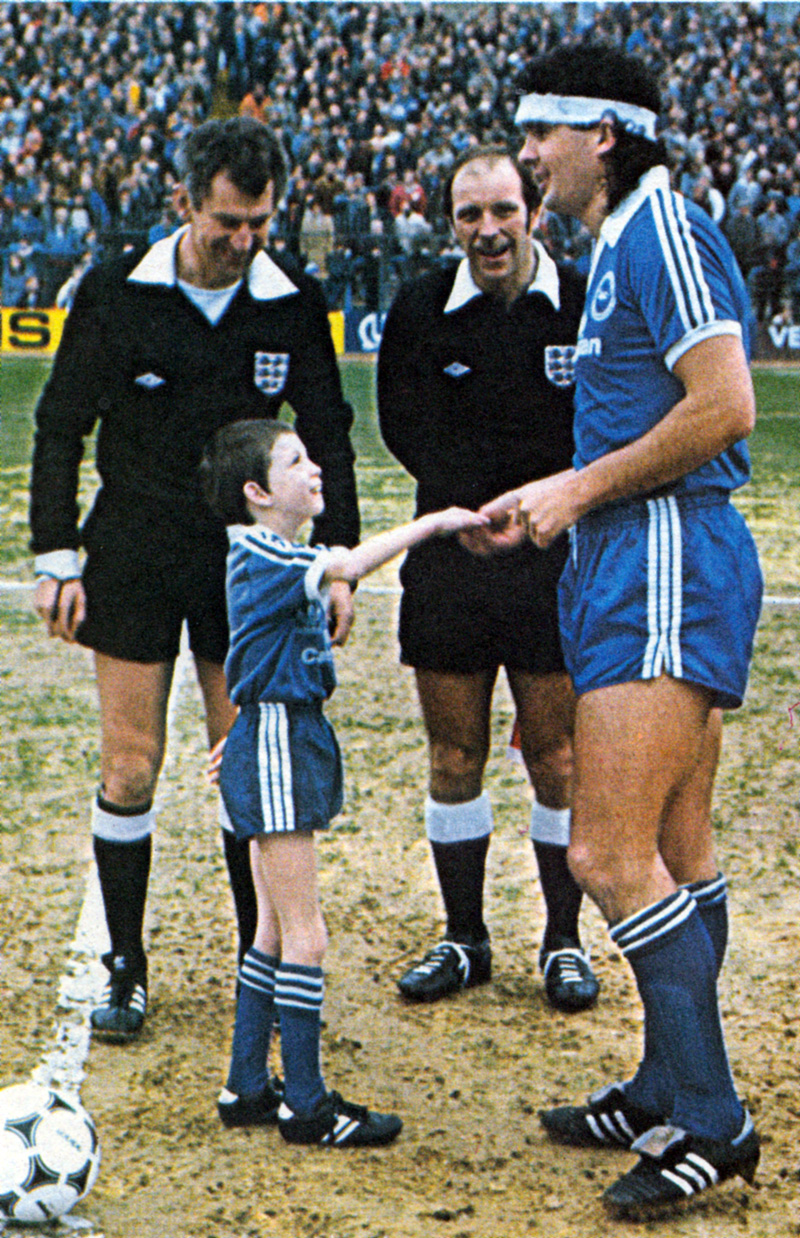
A dream came true for ten-year-old Jason Byrne on Saturday. He changed into football kit and led out the Brighton & Hove Albion team before their match against Luton.

Jason, who lives in Coombes Road, Steyning, regularly watches all the team’s home matches and has longed to meet his hero, player Peter Ward.

His grandfather, Mr Ernest Lidbetter, of Storrington, tried to arrange a meeting with the team by writing to Jimmy Savile. But when that failed he wrote direct to Brighton and Hove Albion themselves.

Yes, you read that right. Just as well!

So, Jason became mascot for the day to the team he avidly supports – and it was a double celebration for his family. His debut before the crowd was on his mother’s birthday.

“It could not have been a better birthday present. When I watched him lead the team out I was overwhelmed and it brought tears to my eyes, says Mrs Sandra Byrne after the match.

Jason’s father, Mr Michael Byrne, was also there to watch his son have a kick around with the Brighton team before the match. He had bought tickets for all of Jason’s grandparents so they could watch.

Jason is a very keen footballer and players for the under-11 team for Steyning Strikers. He is a pupil at Steyning Junior School.

He had his autograph taken with his team, and Peter Ward, and with the referee and now has a referee’s whistle from the match to remind him of his big day.

He kissed the coin for good luck before it was spun to start the game – but the two goals it brought Brighton was not enough: they lost 2-4.

1983_v8

Tagged ,

Mark Fleet – from soccer scrapheap to Skipton success

In Lawrie McMenemy’s ‘Book of Soccer’ from 1981, it gave an insight into the world of the football apprentice back then:

Life as an apprentice footballer is a hard slog – have no doubt about that. The basic hours are nine to five from Monday to Friday, with a game on Saturday morning. The social life is very limited. You still want to be an apprentice? Well read on, because if you love football, then – at the risk of repeating myself – it’s a wonderful life. Whatever you earn, you are being paid for doing what you enjoy. You have free lodgings and meals. You ‘play games’ for most of the time. And, if you’re with a big club, you mix with, and learn from, the stars.

The chapter went on to state that in the Football League, clubs were permitted a maximum of fifteen apprentices at any one time. At 16, the wages of an apprentice at the time were about £16 a week, rising to £20 at 17, the maximum the Football League would permit in those days. At 18, an apprentice would find out whether he will be retained or not. According to the book, these young hopefuls had a full programme of training in the morning and afternoon, with chores fitted in before or after training. Famously, the biggest chore was cleaning boots, which apprentices nowadays no longer do. However, as the old-school voice of McMenemy argued:

The chores that apprentices do are all connected with the cultivation of pride in the club. They are not provided just for the sake of finding them something to do. All are necessary jobs and someone has to do them. An apprentice is not a groundstaff boy, as youngsters used to be, although there are jobs connected with maintenance that he might occasionally help with.

At the Goldstone Ground, Mark Fleet was one of several Brighton & Hove Albion apprentice footballers in the early 1980s. Here he was proudly wearing the club colours:

markfleet2

Hailing from Southport, he came to the club as an apprentice in September 1980, featuring regularly for the Albion in the youth side that won both the Hampshire Youth League and Youth Cup in 1980/81, before playing for Albion reserves in the Midweek Football League. A left-back by trade, he had a strong robust physique for one so young. He was picked for the Irish youth trials in Dublin in November 1980. At the age of 16, he eventually became an Eire Youth International when he played in the number 3 shirt in a 2-2 draw against Wales in Swansea in February 1981 as part of the European Youth Championship. Despite international recognition, he suffered with his knees, and it soon blighted his progress.

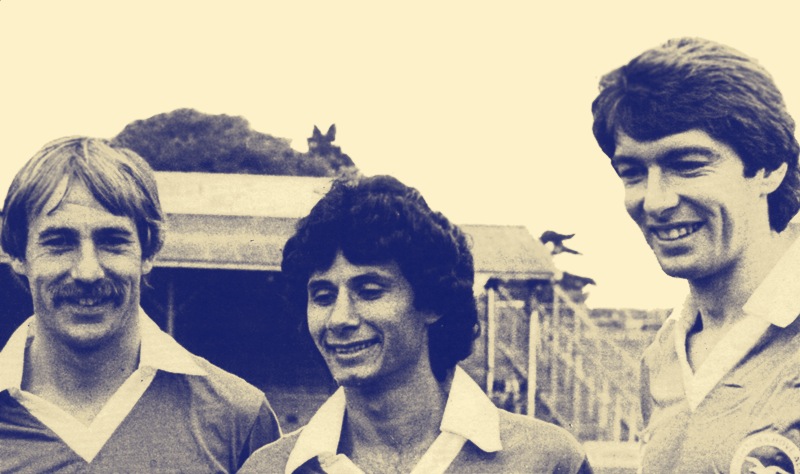
Goalkeeper Simon Steele (below left), who was to play for Brighton against Real Madrid in a pre-season friendly in 1983, joined a little later than Fleet, around 1982 and he and Fleet were originally quite close friends and they both received support with their progress from Jimmy Melia, then working as chief scout and as part of the coaching staff.

simon_steeledannydeansmatthewwiltshire

Out of an intake of about nine second-year apprentices in 1982, Mike Bailey signed Fleet and Danny Deans (central photo above) on a year’s professional contract and Matt Wiltshire (right) on a two year pro deal. Although a matchday programme from March 1983 mentioned that Fleet had been “improving steadily among the defenders”, he had to have a knee operation that summer and then suffered a recurrence of knee trouble following a very crude tackle on him in a reserve game with Arsenal in the September that followed. It was his last ever game for the club. Fleet and Deans didn’t gain a further contract, and Wiltshire left too after his two year deal expired.

The matchday programme vs Portsmouth in December 1984 announced Fleet’s retirement along with Giles Stille’s. Regarding Fleet:

During the summer he had another operation, but unfortunately the specialists have decided he can no longer play full-time football. We hope each of these lads find a successful career outside the game.

Nowadays, Mark Fleet has certainly made a name for himself outside the game. Unlike midfielder Giles Stille who now works as a coach and manager in Swedish football, it’s in the world of financial services where Fleet has proved himself. He is currently Distribution Director at Skipton Building Society, having previously held been managing director at AWD Moneyextra and Skipton Financial Services.

Having done a Google search, I found that there are quite a few interviews and quotes of his on various financial news sites. As you can imagine, it’s mostly almost unrecognisable from the lingo you usually hear from professional footballers.

I did try to contact Mark Fleet at Skipton by calling his office to see if I could grab an interview and ask about his memories of his playing days as well as charting the dramatic change and upturn in his career. Sadly, I didn’t get a reply!

Tagged , , , , ,