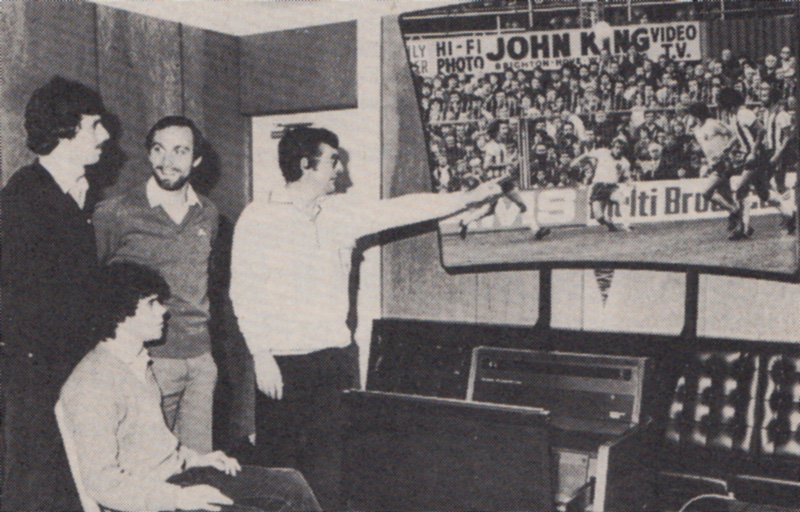
In a scene befitting a ’70s sci-fi movie, Alan Mullery goes over footage of a recent match with some of his star players. As the Brighton v Nottingham Forest programme from 1979/80 reports:
Every home game at the Goldstone is recorded on video by John King Films and Manager Alan Mullery spends a considerable time looking through the replays for tactical purposes.
John King are now marketing a brand new form of television. It is the biggest screen on the market operating on a sophisticated projection system. Our picture shows Alan with players Mark Lawrenson, Peter Ward and Brian Horton viewing the action of a recent match and envying the chance of such a set at him.
If the picture quality was really as good as that, JKF were really ahead of their time. And whatever happened to all the video footage from Albion’s first in the top flight? If only it still survived…
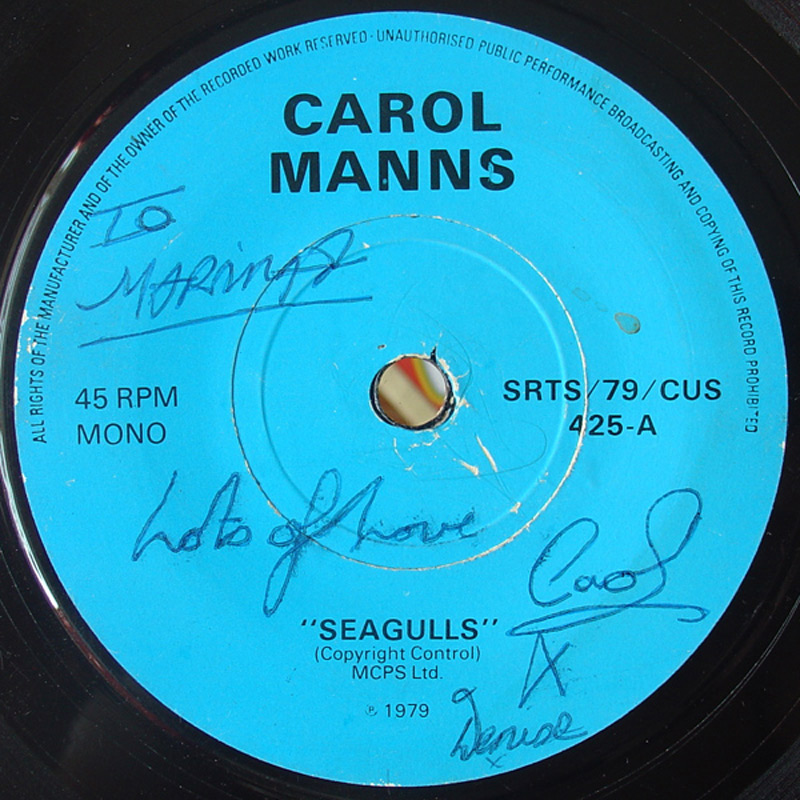
Thanks to North Stand Chat user Fork Me, last week I got hold of a digital copy of this rarely heard song about Brighton & Hove Albion from the late 1970s.
I decided to make a video to it and you can see it here
As well as watching the video, you can have a sing-a-long. Lyrics are here:
I live near a football ground, Albion is her name.
I tell you it’s almost hell when they play a game.
Saturdays are all the same, football fans about
And when you pass them in the street
This is what they shout:
Chorus:
Seagulls, Seagulls.
They’ll play on and on.
Seagulls, Seagulls.
Forever playing strong.
La la la la la la la
La la la la la la la
La la la la la la la
We are the Brigh’on North Stand!
Other teams’ supporters may as well go home
While in the North Stand, our boys sing: “You’ll never walk alone”
And you could be in Timbuktu and still know when they score.
Cos it’s enough to deafen you
When you hear that roar:
Chorus
And now they’ve finally made it, we’re in Division 1
Brighton and Hove Albion have only just begun.
So when somebody asks you, “What team do you support?” (Seagulls!)
Stand up proud and sing out loud
And shout this in retort!
Chorus
Lovely how she drops the ‘t’ from Brighton in her pronunciation in the chorus, for that authentic local dialect.
There has already been a thread on NSC about the song here. Feedback about this video can be viewed here Feel free to add your own!
Comments so far have included:
“Brilliant, thanks for sharing. Great to see the old footage and the Goldstone. Horrible to see the fences that we used to stand behind. It’s so good that those days have gone. Catchy little tune.” – Thisistips
“Fantastic! Brought lots of happy memories of a great time in the club’s history. All the players look so young! Nice to have a reminder of what a great finisher Peter Ward was and to see the skill of Sayer out wide again. It’s amazing now to think we were made to watch from behind those fences. I well remember how they obscured the view” – ChilternGull
“That thing in the middle of Churchill Square was a eaterie I believe. And sorry the song is pants” – Beach Hut
Does anyone know any more about this singer? Google draws a blank in the matter. Can’t even find a photo!
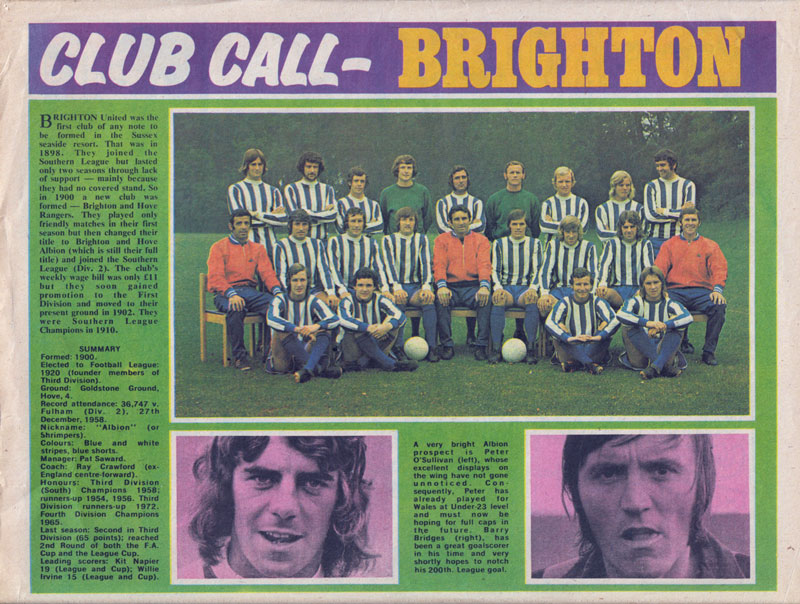
Back row: Ian Goodwin, Kit Napier, Stewart Henderson, Alan Dovey, Brian Bromley, Brian Powney, Eddie Spearritt, John Templeman, John Napier;
Middle row: Mike Yaxley (trainer / physio), Bert Murray, Norman Gall, Willie Irvine, Pat Saward (manager), Ken Beamish, Bertie Lutton, Peter O’Sullivan, Ray Crawford (coach);
Front row: Steve Piper, Tommy Armstrong, Alan Boorn, Steve Breach.
For more about these players during this disastrous campaign, please visit my other Albion site Seagulls TV.
The summary in Roy of the Rovers magazine includes these ‘facts’:
Formed: 1900.
Nickname: “Albion” (or Shrimpers).
I’ve seen the club erroneously nicknamed the Shrimps. But this is the first time I’ve seen us down as the Shrimpers which is equally wrong. I suppose it’s preferable, though. Wouldn’t have liked to have been the Shrimps and having to play Southend (the ‘Shrimpers’)!
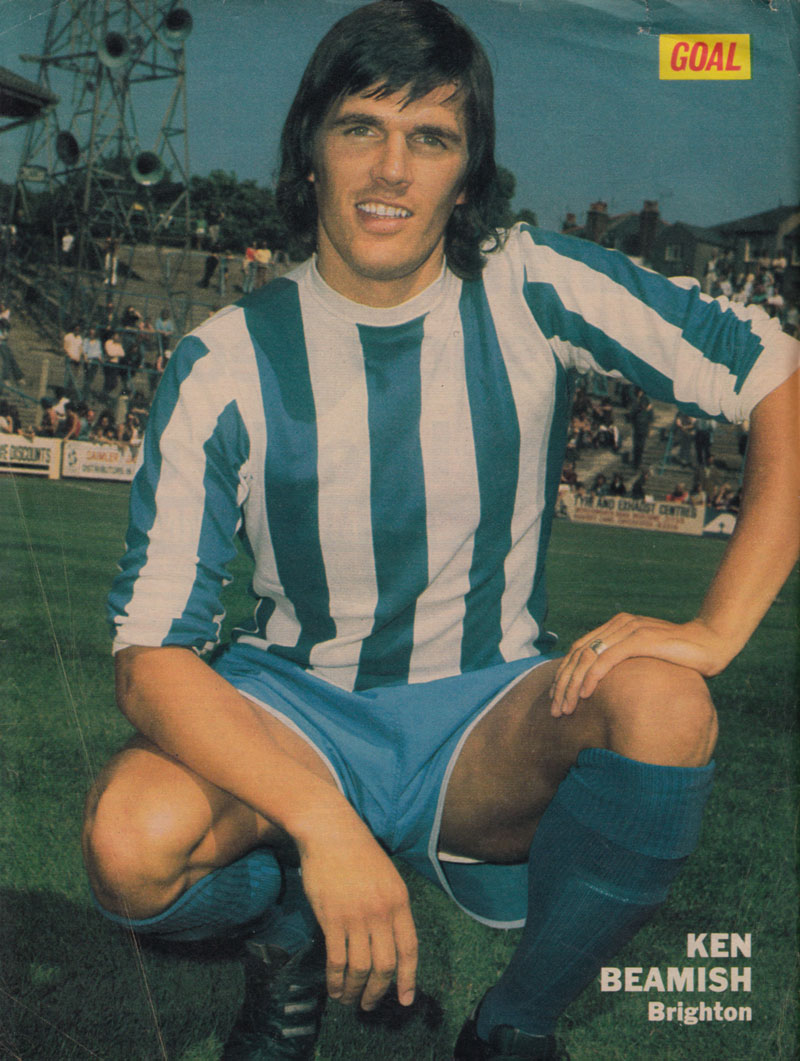
Here’s Ken Beamish, bought in March 1972, posing in PE shorts before the ill-starred 1972/73 season.
The all-action striker was Albion’s top scorer, with ten goals, as the team slid back into the Third Division.
Fast forward eight seasons to 1980/81 and Beamish was back at Tranmere, the club from which Pat Saward had signed him. Rovers were a Fourth Division side by then but they had the matter of a two-legged 2nd Round League Cup tie with Brighton & Hove Albion, now a top flight club.
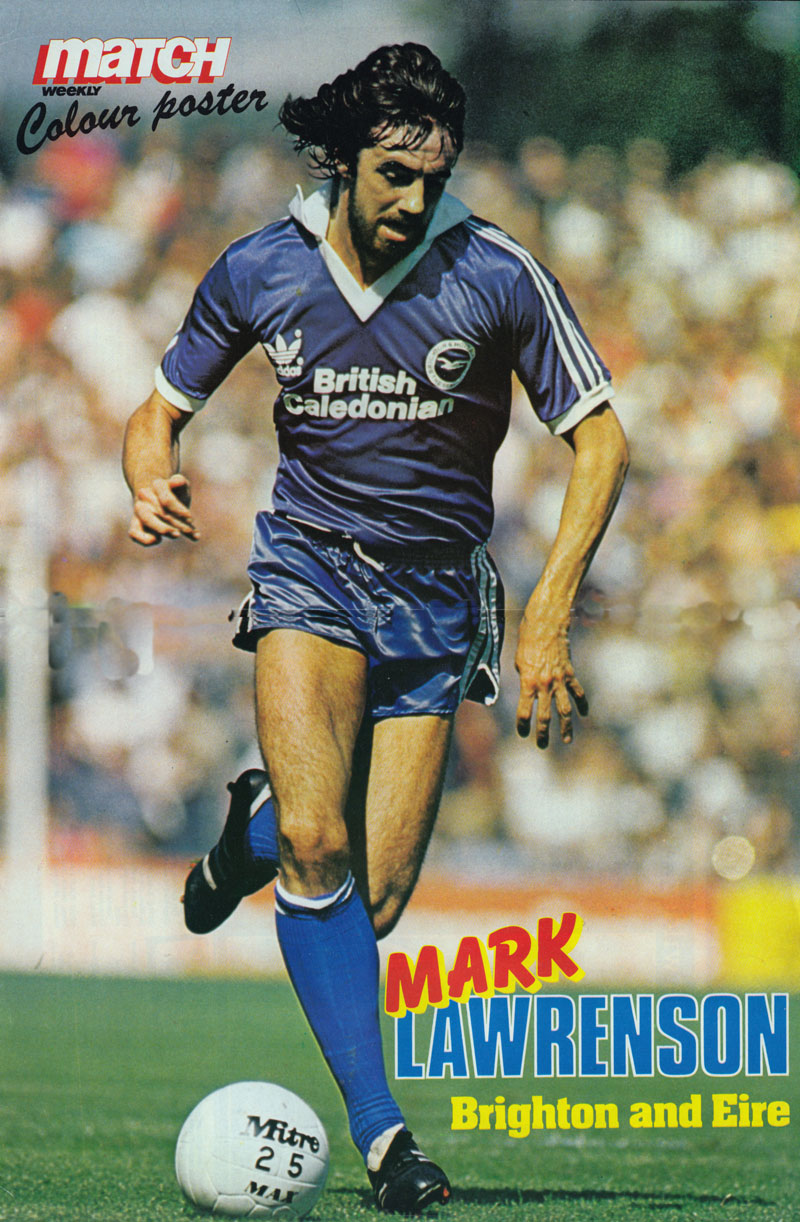
In Mark Lawrenson’s ‘The Autobiography,’ he takes up the story on page 152:
“You learn, sometimes the hard way, the steps you need to take to protect yourself physically and psychologically. Opponents will always be testing you to see if you can be conned into losing your temper and, with it, your self-control. Ken Beamish certainly caught me out playing for Tranmere. We won the first leg comfortably, but I fell for the five card trick in the return. I can honestly say he tried to tackle me just below the hip and for the next five minutes I just went crazy. Ken, an old pro who had played for a lot of clubs including Brighton, obviously set out to try and unsettle me. If that tackle did not do any lasting damage it certainly wrecked my concentration and I was eventually sent off for a remark to a linesman. I was still fuming as I headed for the tunnel and looking across at Beamish who gave me a sly wink. Sure, the laugh was on me, but it was a lesson I have never forgotten.”
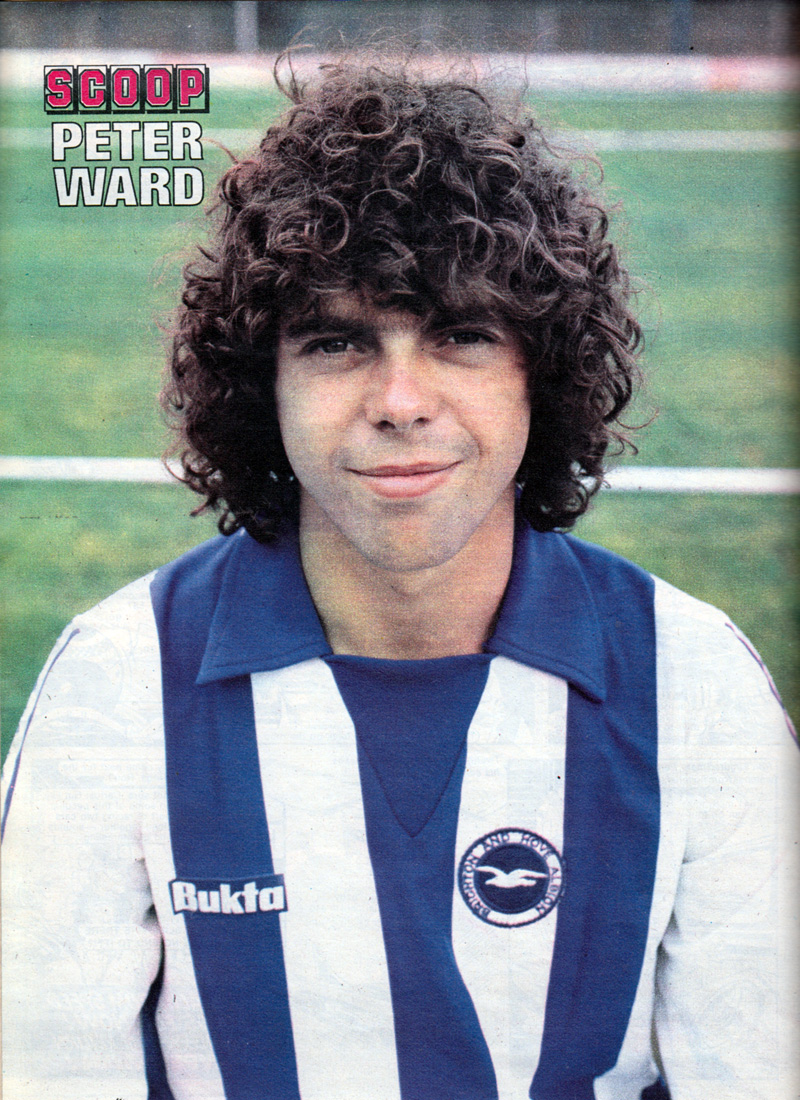
In this perm, Wardy hit ten goals to help fire Albion into the top flight and then another sixteen to help keep Brighton amongst the elite. In Scoop Magazine, from 12 July 1980, it says:
Although he’s a hero down Brighton way, life hasn’t always been easy at the Goldstone Ground for star striker Peter Ward.
He was on the transfer list last summer and again in the autumn.
But when Brian Clough failed to whisk the talented star away to Nottingham Forest, it triggered off a South Coast revival!
Peter sat down and had a long chat with his manager, Alan Mullery, and sorted out a lot of problems. He felt much happier after that and it showed in his big match performances.
“I had a very good Christmas,” Peter smiled. “First there was my first hat-trick in Division One against Wolves. Then I scored again on Boxing Day, when we beat our old rivals, Crystal Palace. Those results obviously helped everyone at the club and we went on to hold our First Division place last season quite comfortably.”
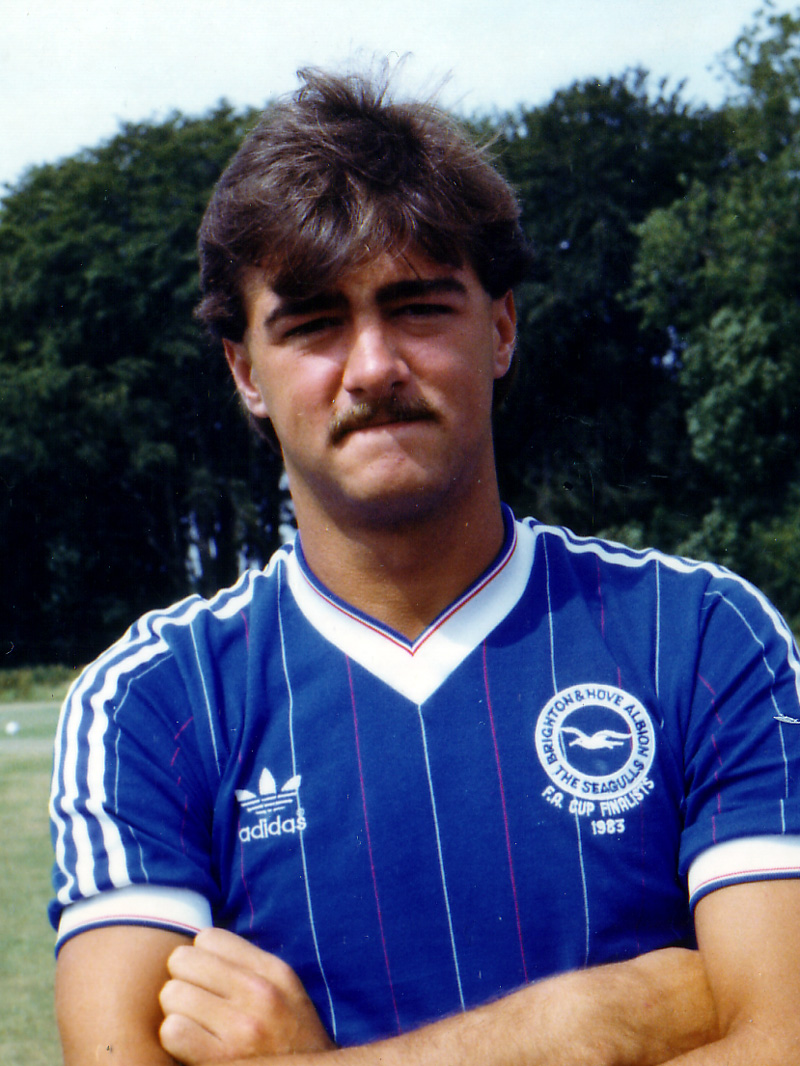
Sadly, in the summer of 1980, Ward ill-fatedly grew a moustache to add to the perm. Not sure why – perhaps the additional weight – but he was never the same again. He scored just one League goal in eleven games at the start of the 1980/81 season before signing for Brian Clough, where again he was far from prolific. Ward did rejoin the Albion on loan in 1982/83 and his two League goals in 16 League matches barely hinted at what kind of player he was in the late 1970s. Goldstone regulars spoke of how his movement was not what it was.
Some players are weighed down by their big transfer fee. Ward may well fit into the rare category of star players weighed down by their ‘taches.
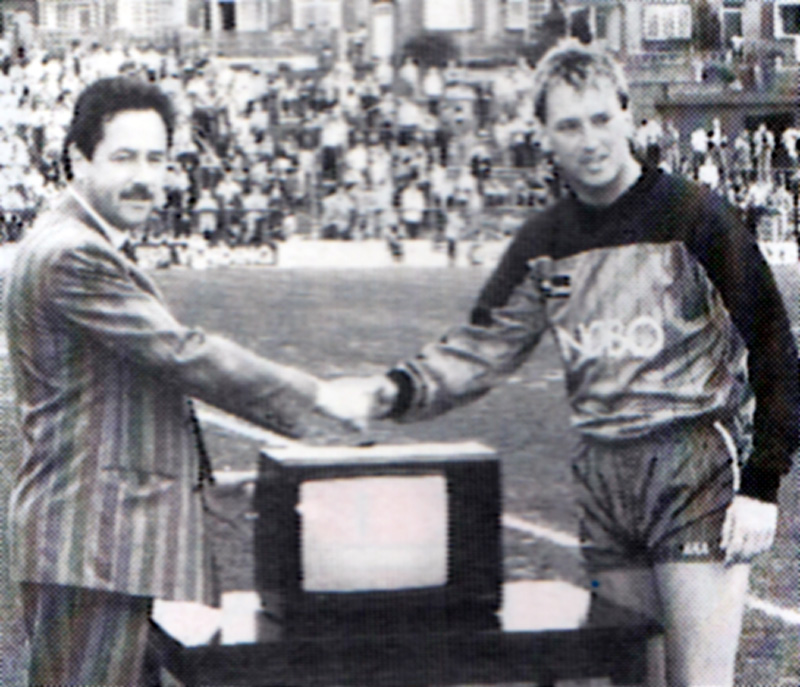
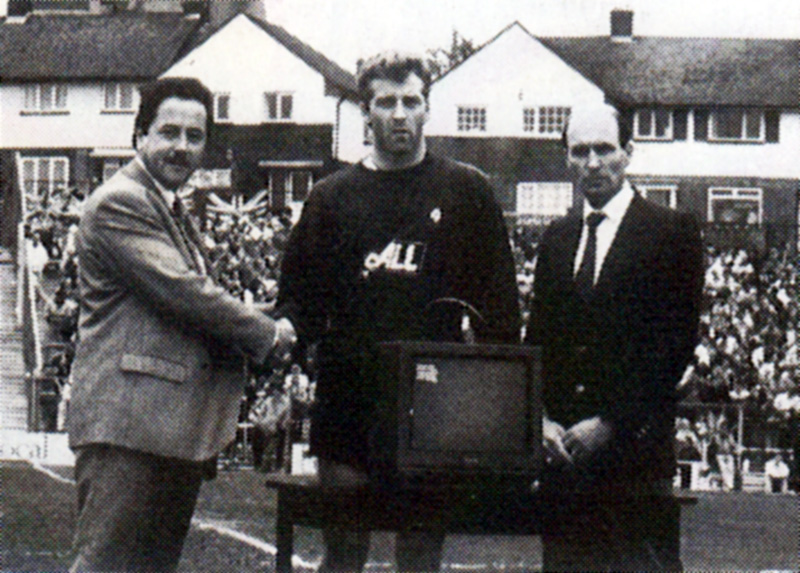
Unsurprisingly, Garry Nelson was the runaway winner in 1988, scoring himself a crappy little ‘portable’ colour TV to watch Neighbours and Wogan.
The following season and then, in 1991, goalkeepers John Keeley and a less-than-excited Perry Digweed scooped the prestigious prize from the Granada bods, Ian Wedge (pictured twice) and Roy Ovenden.
Granada TV Rental took over from Rediffusion after another keeper, Graham Moseley, won the award in 1985, and their sponsorship was still going strong into the mid-1990s, despite the collapse of the TV rental market.
From the Brighton v Manchester City FA Cup programme of January 1983:
When striker Chris Rodon joined the Goldstone staff nine days ago, he was the subject of some good natured banter concerning the job he ‘chucked’ to join us here at the club.
While playing part-time football in the Welsh Premier League, Chris worked in the Driving Vehicle Licensing Centre in Swansea, and in view of the happenings at that establishment, it was thought to be a good place for a striker.
For anyone who has had dealings with this office it will surprise Goldstone regulars that Chris himself is a pretty fast mover… the speed with which his signing went through was indeed a great deal faster than any processing of the documents at the DVLC.
Incidentally, Chris has moved into ‘digs’ in Portslade, to allow him to settle and to find his feet in the local community, as he enjoys full-time training for the very first time.
Sadly, things did not end well for Chris. He made his debut as substitute in Albion’s last fifteen minutes of top-flight football, at Norwich in May 1983. Included in the club’s tour of USA, Belgium and Holland, the Welshman became homesick and returned to Glamorgan to play six games on loan with Cardiff. In September, his contract with the Albion was suspended, and he announced he would never play football again. Later played for Haverfordwest.
These three full-time apprentices are Martin Lambert, a 17 year old centre-forward from Southempton, David Ellis, a 16 year old midfielder from Newcastle-under-Lyme and Gerry McTeague, 17, a centre-half from Edinburgh.
‘We all want to make it in the game,’ says Martin, the player on the right. ‘There’s nowhere we’d rather be.’
Following this photo published in the Brighton v Watford programme, 1982/83, Lambert was the only one of the three who signed professional forms with the Albion, having a baptism of fire against Leeds in August 1983.
He was released at the end of the 1984/85 season with three appearances to his name before rejoining the Goldstone playing staff under Barry Lloyd in July 1989.



 The Goldstone Wrap