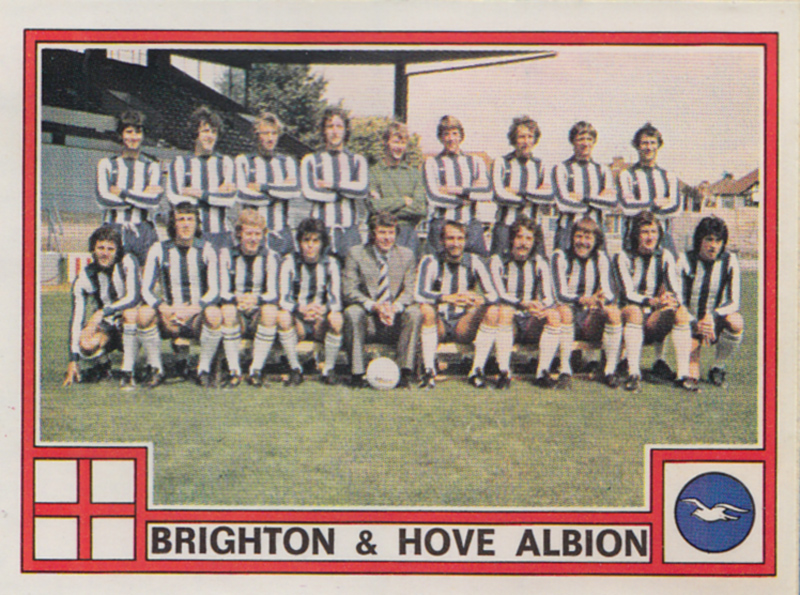
You may remember that Football 78 was Panini’s first sticker album covering all the First Division clubs. Strangely, in the coverage of Division Two, Brighton’s team sticker featured the Third Division squad for 1976/77:
In a piece for Shoot! magazine, Alan Mullery gave some insight into how he re-shaped the Albion in his first season at the Goldstone:
I wasn’t in charge at Brighton when they just missed going up last season. But I could still tell everyone was mighty disappointed from the long faces when I took over.
With eight games left – and I was watching Brighton closely last year without, of course, dreaming I’d be their manager within months – Brighton were second and looked certainties to go up. But then they suddenly lost their form at the vital time and won just one of their last eight games. That decided it and they finished fourth, missing promotion by just three points.
The main thing I wanted to know when I took over was how a side could be so good at home and so terrible away. Three of the teams relegated from Division Three last season had better away records so something was wrong somewhere. Brighton’s home record was the best in the Division so we obviously needed some character instilled into the side.
I suppose I changed six positions.
Peter Ward had only played six games last season but he was a regular right from the start this season.
Ian Mellor only played nine League games while Tony Towner was moved farther forward: Steve Piper moved to midfield from the back and I brought in Graham Cross and Chris Cattlin, two highly experienced professionals, to give us some know-how at the back [both were Taylor signings].
I think it has worked well. We are now averaging about a point a game away which is very acceptable. I’m still looking to make the side a better one – just because we’ve been in the top three all season doesn’t mean we’re world-beaters.
We’re not sitting back and saying everything is fine. And there’s no doubt the best time to bring in new players is when you’re at the top of the table, not struggling at the bottom. I want to improve us all-around as a side but I think we’re well on the way to overcoming some of the problems which cost the club promotion last year.
Players like Cattlin, Cross and Brian Horton have the character and fighting instinct to keep working when things are going against them away from home. That’s what I wanted to get into the side and we have benefited from that. Whether we go up is up to us – no one else. One thing is sure – I feel we have more character and a better set up in those crucial away matches this season. And it’s invariably your away results that decide whether you taste success or disappointment.
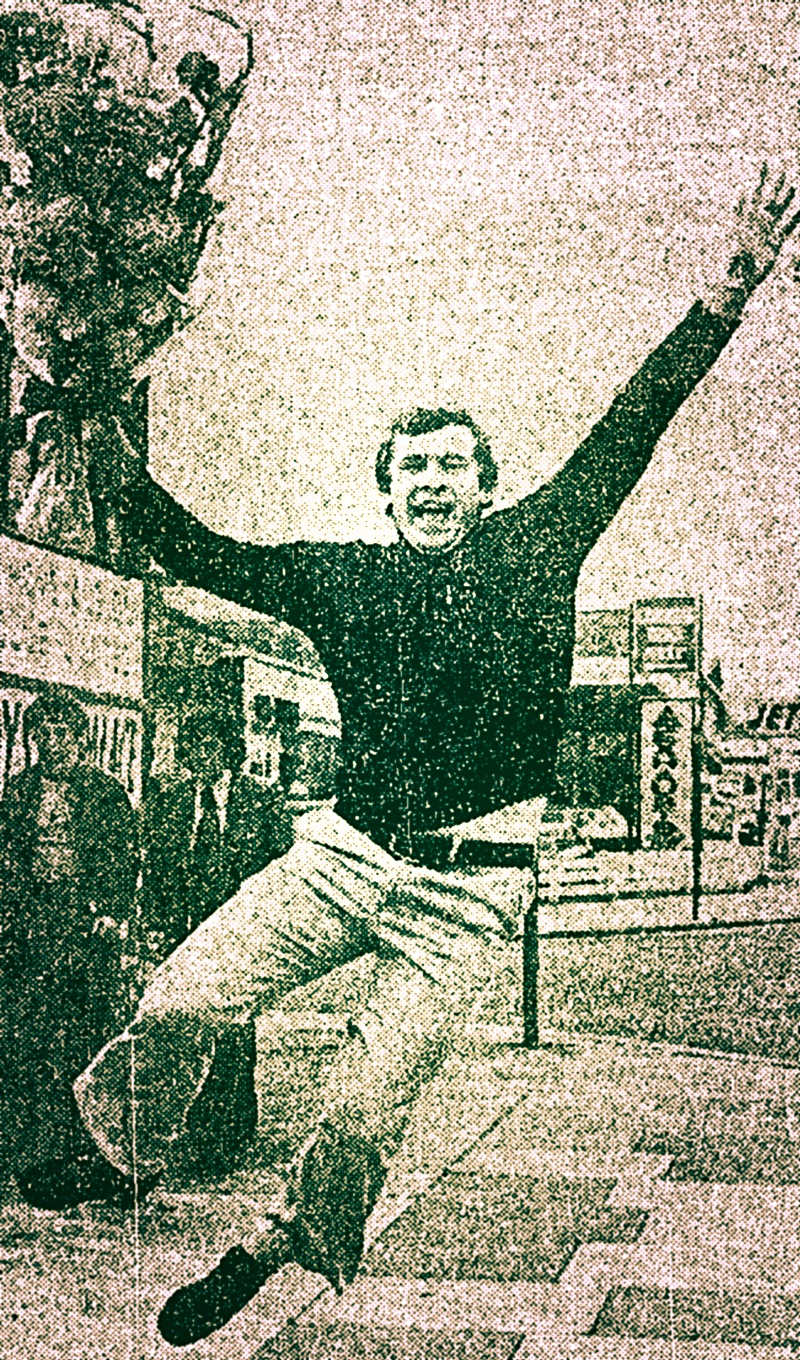
Brighton had picked up a meagre 14 points away from home in 1975/76 (W4 D6 L13), but turned things around slightly the following campaign with 20 points (W6 D8 L9). It was still not much to shout about. However, allied to the Albion’s astonishing home record where they attained 41 points (W19 D3 L1), and it was enough to seal promotion. No wonder Mullery (below) was so happy:
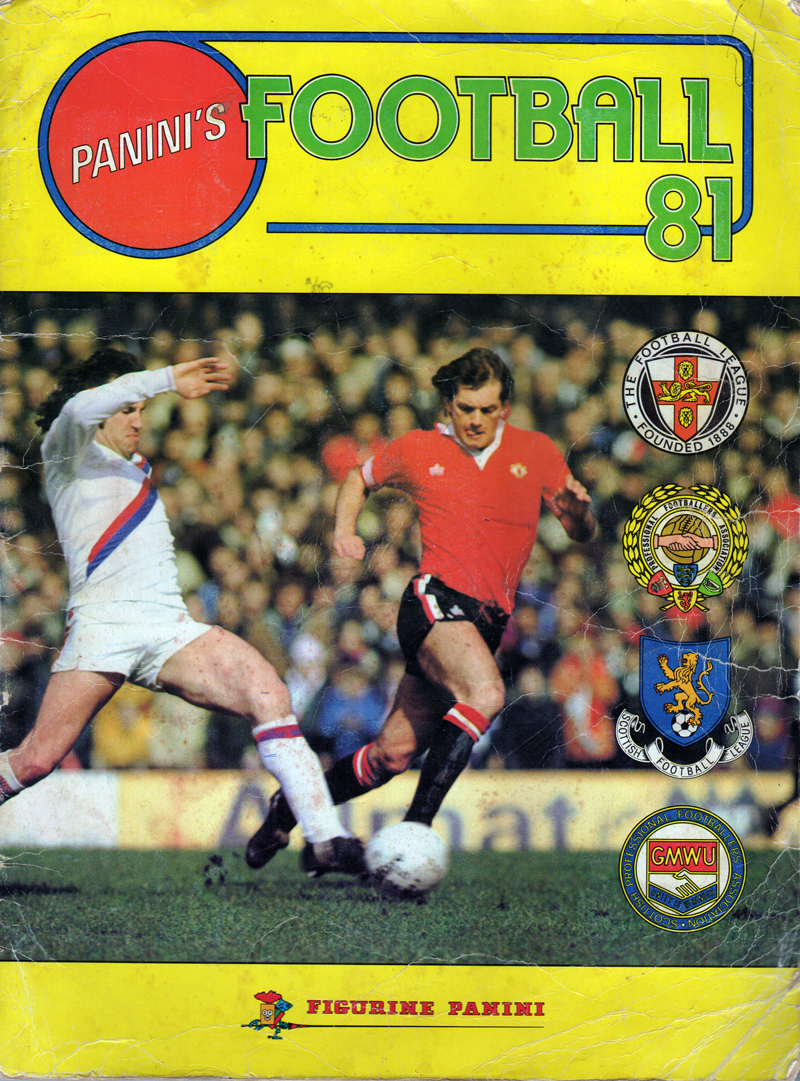
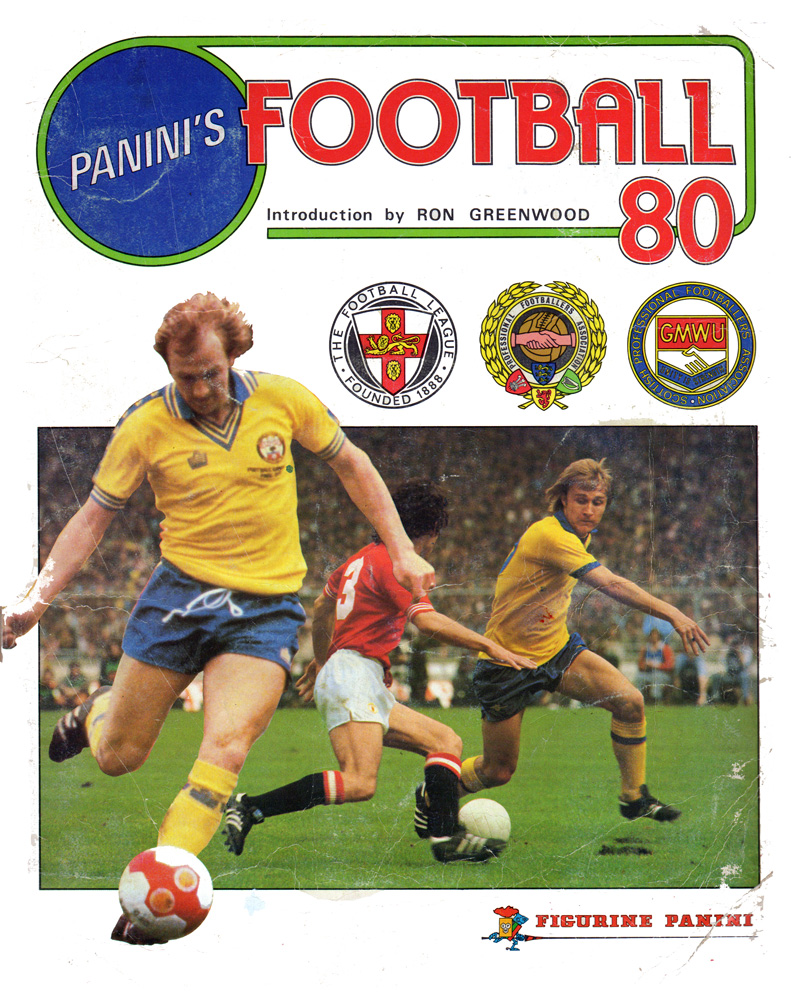
Brighton fans may have initially balked at getting a sticker album with Crystal Palace’s Gerry Francis on the cover, but I’m sure they got over it!
Besides, Palace’s season was a disaster. They even had four different managers during the course of the 1980/81 season, none that could arrest their slump. Even Ray Wilkins’ side, Manchester United, sacked theirs, ex-Albion player Dave Sexton, at the end of their own disappointing campaign.
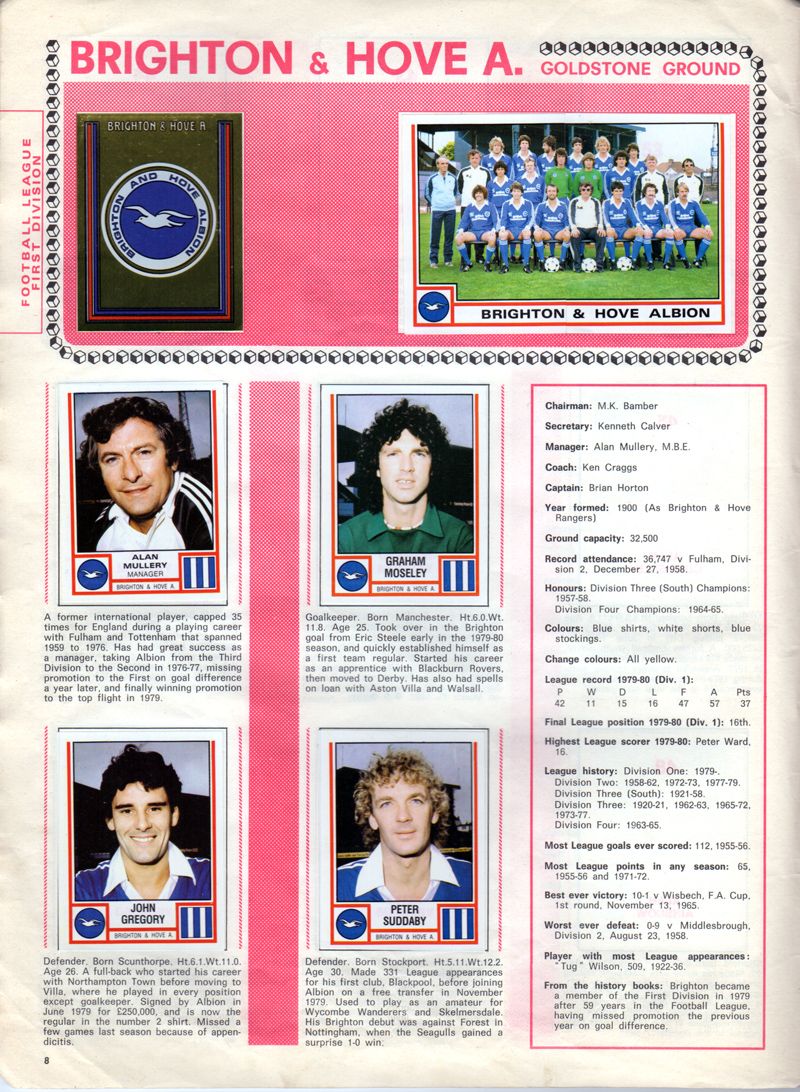
And Brighton? It was a watershed season for us too. Potentially Albion’s strongest squad had flattered to deceive. Peter Suddaby had played a major role in 1979/80 but injury meant he never did play in the new all-blue Adidas kit. Mullery resigned at the end of the 1980/81 season, and the reliable John Gregory was another departure, to QPR. While he stayed, Graham Moseley was deeply unsettled, rocked by a loss of form, the signing of Perry Digweed as well, as Mullery’s stinging criticism of the erstwhile number one keeper at the Goldstone:
Interesting to see Mark Lawrenson listed here as a midfielder. He had performed that role admirably in the second half of 1979/80. Would Albion fortunes have been different had he stayed there in 1980/81? He, alongside Ward and Horton, also departed the Goldstone not long after the publication of this album. We are also treated to a rare shot of Peter Sayer in our new fangled Adidas kit. Sayer was an unused sub on the opening day match against Wolves before leaving for Preston North End.
Notable absences here are Perry Digweed, Gary Stevens and Andy Ritchie, all of whom made a significant number of appearances during the course of the season.
This album is notable for the first appearance of team groups being made up of two stickers rather than one. Looking through the album, there are some alignment issues with some team groups, but happily, the Brighton one looks fine.
Second Division clubs were also given the half and half treatment, and it’s possible to clearly see Ray Clarke at his new club, Newcastle United. Even Third Division clubs were covered by Panini at the time, albeit with a single sticker team photo. 15mm tall in Charlton’s team sticker was Mike Bailey. Little did Albion fans know it in 1980/81, he would be man to bring forth a new era to the Goldstone, and a whole lot of new player stickers to collect!
In a ‘friendly’ match in August 1973, Albion beat Crystal Palace 2-1, with goals from Ken Beamish and John Templeman. Regrettably, there was crowd trouble at the Goldstone. Even so, cooling the potential for antagonism, the two clubs didn’t get to play each other in the League that season and, in any case, the respective managers Brian Clough (once Pat Saward got the boot) and Malcolm Allison were good friends.
By the time the 1974/75 season kicked off, though, Crystal Palace were slumming it in Division Three with Brighton. In an encounter on the opening day, there was an intensity to the game that hadn’t been seen before in a clash between the two clubs. Again, there was crowd trouble. Argus reports in 1975/76 certainly talked of a rivalry between the two sides. Reporting on Palace’s 1-0 home defeat to Brighton from Sept 1975, John Vinicombe explained that:
‘The exchanges were conducted in a cup-tie atmosphere, and the cut-and-thrust carried through with the zest of deadly rivals.’
However, it was the infamous FA Cup 1st Round second replay at Stamford Bridge on 6th December 1976 that turned the flickers of ill-feeling into a fire. Here is how it was reported in the Daily Express:
Brighton crashed out of the FA Cup last night… and manager Alan Mullery made it an undignified exit.
Mullery had to be restrained by police after striding on to the Stamford Bridge pitch for a face-to-face confrontation with referee Ron Challis, who had disallowed two second-half Brighton goals.
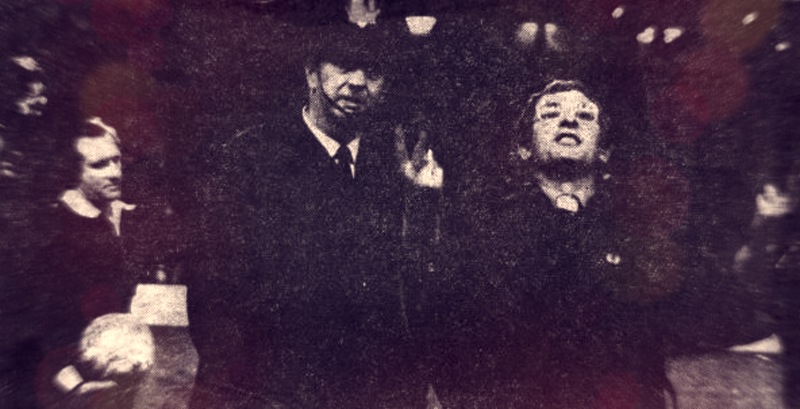
And as Palace fans jeered from their seats near the tunnel, Mullery waved two extravagant double-handed V-signs at them.
According to Palace Echo, ‘He flung down about a fiver’s worth of notes change into a puddle and screamed “You’re not worth that, Palace” whilst flicking the viccies.’
The Express continues:
Mullery was unrepentant afterwards. He explained: “I asked him [Challis] why he had disallowed the penalty which Brian Horton had scored for us.
“He said to me, ‘I can’t talk to you on the pitch.’ I said that I was only asking him a question. I wanted to know how he could turn an advantage he had awarded to us for the foul on Chris Cattlin and then make it a disadvantage because a Palace player had stepped into the penalty area.
“The referee waved me away. He said: ‘I’ve told you you can’t talk to me on the pitch. Get off.”
Challis, who needed a police escort to get him safely past a group of angry Brighton supporters, did not caution Mullery for his protest. And he refused to comment on the incident. But it seems certain Mullery will now face disciplinary action.
He raged: “How can you get beaten like that? There was only one team in it. We were in a different class and if it was a fight it would have been stopped in the second round.
The controversy began in the 73rd minute when Ian Mellor’s header from a corner went past Palace goalkeeper Paul Hammond – but Brighton’s celebrations came to an abrupt halt when referee Challis awarded Palace a free-kick for handball against Peter Ward.
Mullery said: “The ref was the only one out of 14,000 people who saw Ward handle. I’ve got better eyes than him – and I wear glasses.”
But the real drama unfolded 13 minutes from the end when Mr Challis pointed to the penalty spot after Cattlin had been fouled by Barry Silkman.
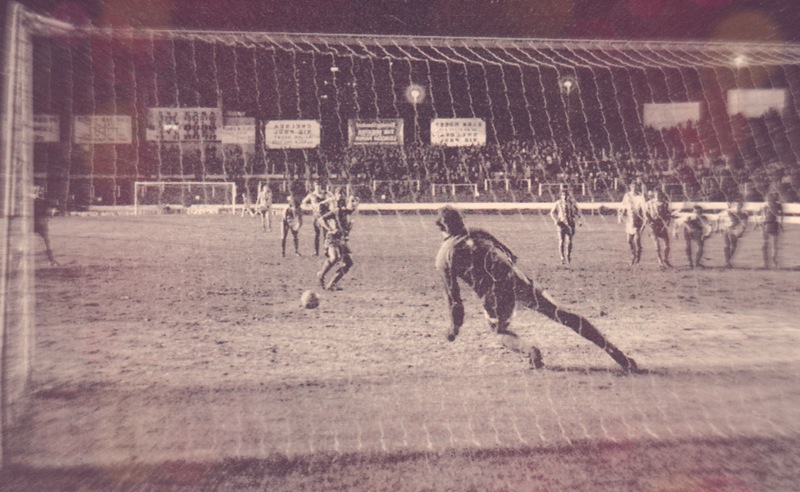
Brighton captain Brian Horton pushed the penalty out of Hammond’s reach and into the left hand corner of the net. But the referee ordered him to retake it after he had spotted players encroaching illegally inside the area.
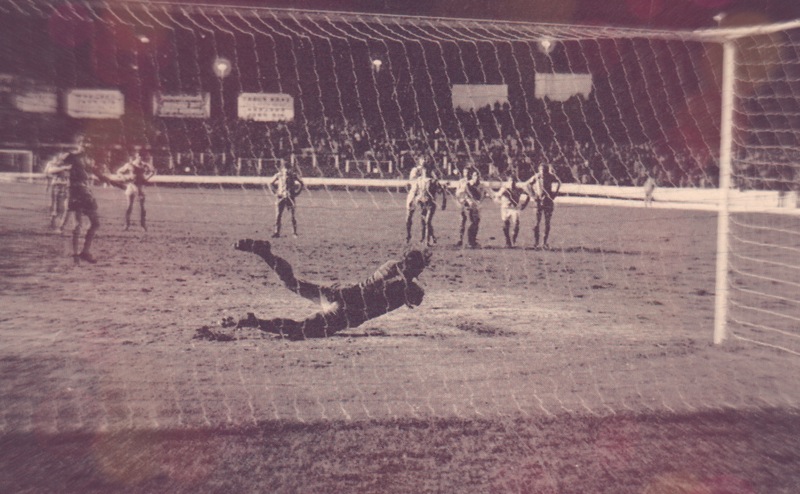
The penalty that started the row… the ball’s in the net but the ref says ‘no goal’
The retaken penalty… this time Hammond blocks Brian Horton’s spot-kick
Horton elected to try for the opposite corner. Hammond guessed that he would and dived to his left to palm the ball to safety.
Brighton’s experienced defender Graham Cross complained: “The referee made Brian take it again because Palace’s Ian Evans had pushed me inside the box as he took the first penalty. It was a disgraceful decision.”
Hammond explained the secret of his successful guess when he said, “I almost reached the first penlty, and I thought he would try to hit the second one the other way. I ‘sussed’ him out, although the second shot was not the best penalty the lad’s taken.”
The one goal which did stand came from Palace’s diminutive midfield player Phil Holder in the 19th minute.
Holder, given a free transfer by Palace in the summer, showed great composure as he drove David Swindlehurst’s centre into the net to wipe out the memory of Palace’s FA Cup semi-final defeat against Southampton on this ground eight months ago.
Palace now have prospects of another healthy Cup run, beginning with a second round tie at home to Enfield on Saturday.
For his troubles, Alan Mullery was ordered by the Football Association to answer charges of bringing the game into disrepute:
He was fined £75 in 1977.
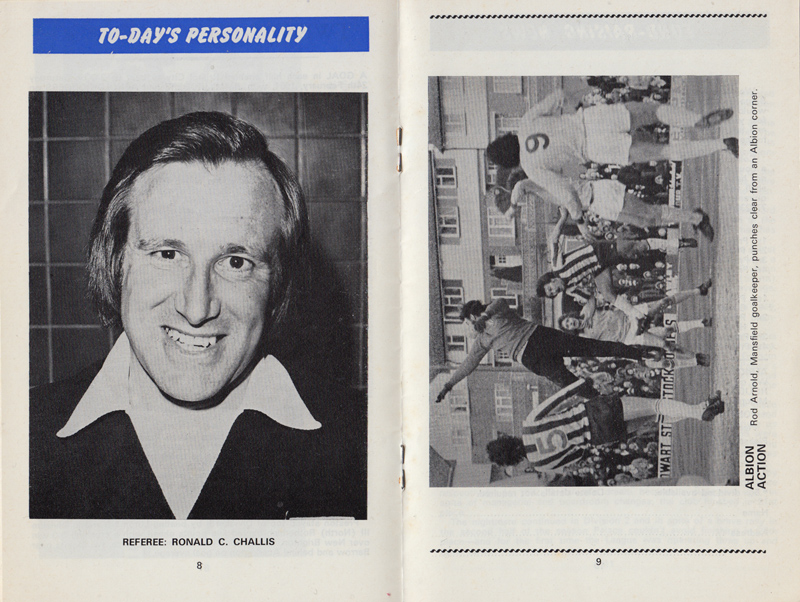
Referee Ron Challis was dubbed ‘Challis of the Palace’ by Brighton fans, becoming something of a hate figure. Was it really just a season before when Brighton’s matchday programme devoted a whole page to his photo?! Suffice to say, his image was now dartboard material:
Centre-spread of the Brighton v Palace programme from February 1976.
As for Brighton, who were without a win in seven matches following the FA Cup exit, the team responded with eight wins in the next twelve matches to regain momentum, as well as leadership in the Third Division.
I hope you’ve had a chance to hear Alan Mullery, club ambassador, speak so eloquently at the North West Sussex Seagulls (NWSS) meeting last Thursday:
He is, for many supporters including me, by far the greatest manager Brighton have ever had. Certainly the most successful. When he speaks, it is full of passion and candour. For someone known for his fiery temper, he seems to have significantly mellowed. Watching the video is a lovely experience, probably a bit like having Alan Mullery for tea in your living room, so intimate and warm was the atmosphere. Even so, as well as fascinating, I also found it slightly maddening, as some of his account of his career was clearly not factually accurate.
Is it too pedantic to point out that the Fulham v Brighton game from 1972/73 that he mentions ended 5-1 rather than 3-1 to the London club? OK, everyone gets a score wrong every now and then. Crazily, though, he talks about getting angry with team mate Jimmy Dunne for leaving Fred Binney unmarked. Suffice to say, Fred Binney was not a Brighton player at the time. As for the Albion player he meant, both Mullery’s autobiographies name the centre-forward as Ken Beamish. At least that’s clear.
(As for another Ken, it was Ken Gutteridge that was the member of Peter Taylor’s back room staff, which Mullery mentioned later on when his mind went blank).
Other clangers include Mullers saying Peter Ward was signed from Borrowash United. As we probably all know, it was actually Burton Albion. Politeness and respect probably stopped anyone calling this out! Mullery also suggested that Fred Binney was sold a week later from the now famous pre-season training session. In fact, Binney played a few matches at the start of the 1976/77 season and eventually departed a year later, to Plymouth after a summer with St Louis (Exeter was the team that Binney joined Albion from). Furthermore, in the thrashing that followed Maybank and Sayer being seen in a nightclub, Leicester also did not beat Brighton 5-1, but 4-1 in September 1978.
Should we cut Mullery some slack on the events of 30 or 40 years ago? Certainly, yes. Personally, I know I don’t remember the details of everything that long ago. It’s probably the case that when you’re a participant in an event, like players and managers are, living in the moment, your recording of events in your brain works differently from that of supporters, who may be more likely to look up records of past seasons and players of their favourite club, and have accurate facts and figures reinforced that way. A participant is much more likely to record the flavour of their emotions around an experience, though. Indeed, the effortless way Mullery is able to evoke the glory years, so you can almost feel it and see it, is part of what makes events in which he speaks so enthralling.
Nevertheless, I thought Mullery’s account of Ray Clarke, that he ‘never lived up to his reputation’ at Brighton, seemed rather harsh. As well as scoring himself, Clarke’s intelligent play provided such good service for Peter Ward’s only successful season in the top flight, 1979/80. A comparison of Albion’s fortunes in that debut campaign in Division One before and after the ex-Ajax striker was bought demonstrates how significant a contribution he made. To put the record straight, Clarke was sold to Newcastle for £175,000, the same figure he had cost the club from Bruges.
Mullery also got quite angry about his second spell at the club, repeatedly speaking about how he was reduced to picking a reserve goalkeeper, John Phillips, as the substitute for his final match against Grimsby in January 1987 before being sacked. This did not actually happen, as Kieran O’Regan was the sub. Phillips had left Brighton in June 1981. The player Mullery was referring to was probably John Keeley, but he was in goal during the Grimsby match.
In the current Backpass Magazine, a letter talks of Steve Daley:
“I believe Steve Daley is a successful and humorous after-dinner speaker. I suspect, like most speakers, he has embellished a few anecdotes over the years and has eventually believed them to be true.”
Perhaps the same is true of Mullery.
At the risk of being seen as overly picky, I do hope it’s OK to give notice of these errors, just in case some people are learning about the club’s history and may take it all as gospel.
That said, it doesn’t detract from the fact Mullery is a wonderful, passionate speaker who does a great job in capturing people’s imaginations and, occasionally, bringing a tear to the eye. I found it such a moving moment when he remarked:
The best five years I had in football was not for me, it was for people like yourselves, when I was manager at Brighton and Hove Albion. They were the best five years I ever had, and I played in World Cups, played in cup finals, I played all those games and everything else. But that was the best time I ever had.
Factual errors or not, the Albion is so very lucky to be able to call upon Alan Mullery as its club ambassador. Just like 30 or so years ago, he is a doing a wonderful job in the service of the club and its supporters.
Here is Peter O’Sullivan in a rare Bukta-branded shirt from the end of the 1976/77 season. This blog featured this shirt in a previous post a few months ago.
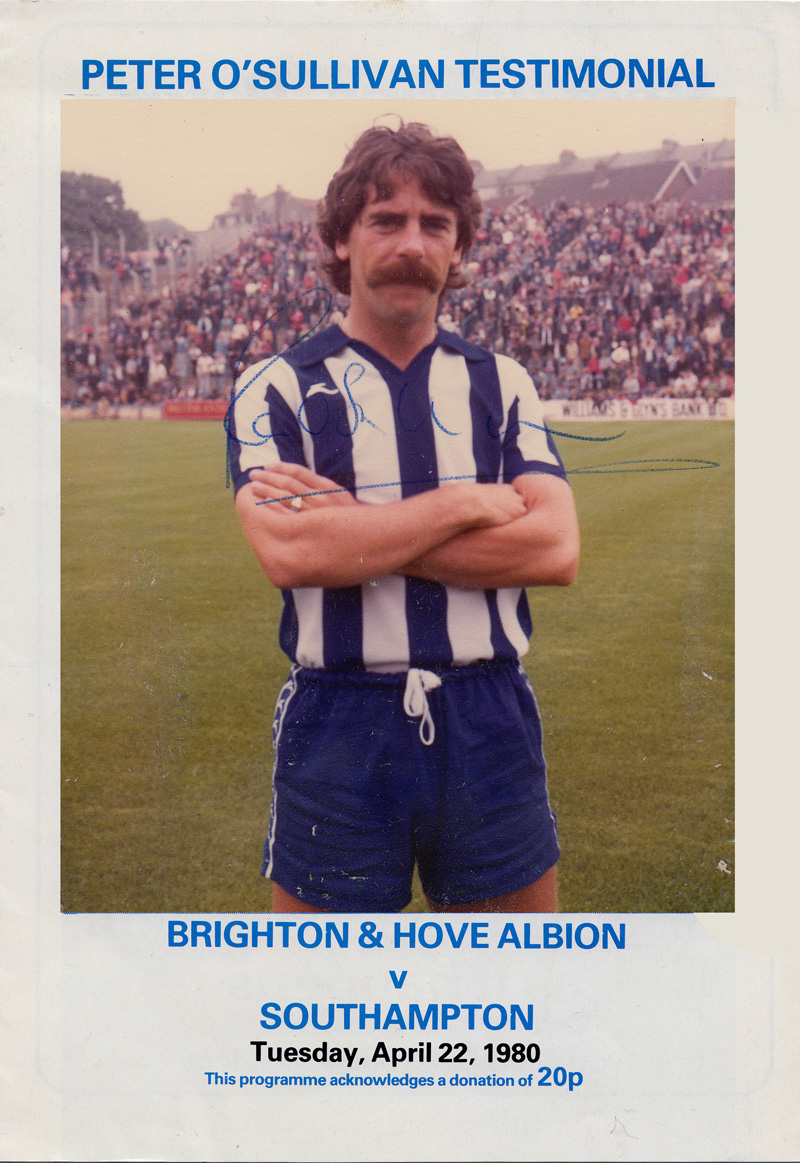
Sporting a Rivelino-moustache, he truly looked the part on the cover of his testimonial programme at the end of the 1979/80 season:
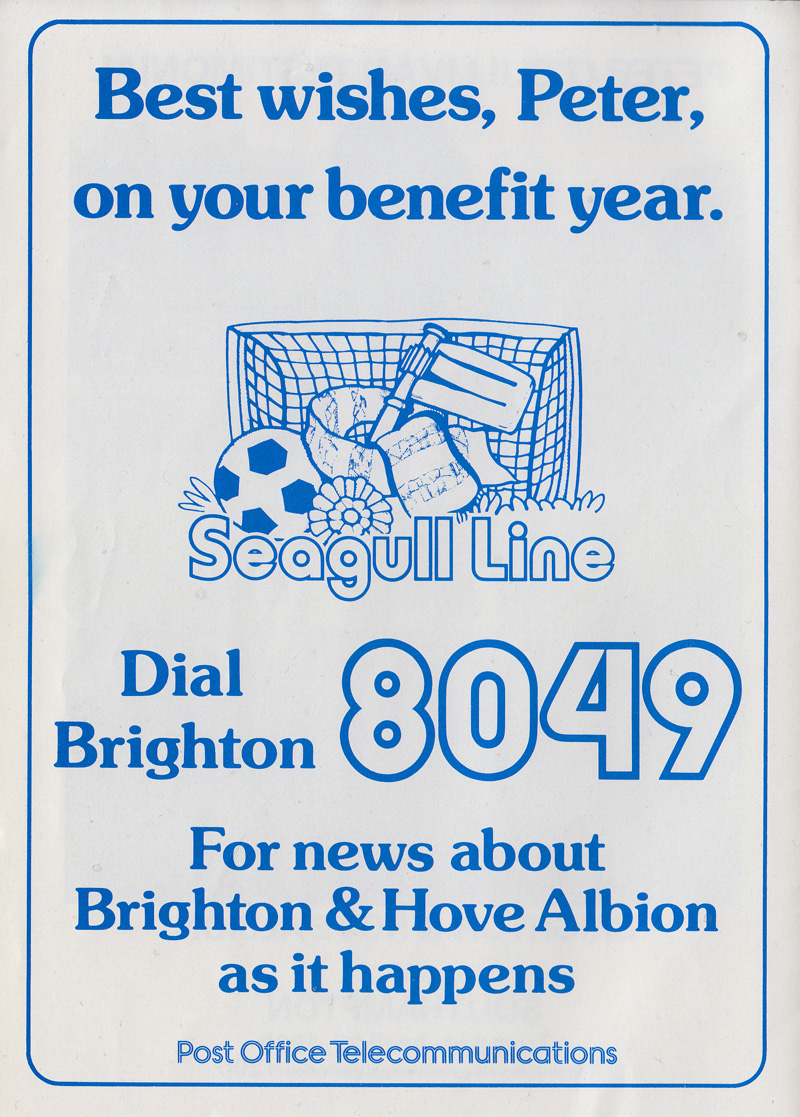
Inside, an advert for the Seagull Line wished him well:
The editorial was by Tony Millard who paid tribute to Sully:
These days very few footballers spend ten years at one club and when Peter O’Sullivan recently completed 400 League games in Albion colours it was certainly quite an achievement.
When, on April 20, 1970 the youngster with the ‘Beatle’ style haircut came to the Goldstone from Manchester United not many would have thought that 10 years hence he would still be turning out and still wearing the number ’11’ shirt.
In fact, when Peter made that 400th appearance he had never been chosen as substitute but since then he has worn ’12’, for the first time, at Derby 10 days ago.
When he first came to the Goldstone the little Welshman with the Lancashire accent was an orthodox winger. As the game has changed and patterns of play have altered he has become a midfield player and he has been chosen once for Wales as a full cap, that against Scotland in May 1976 while he has also twice come on as a substitute in a full international, against Scotland in 1973 and against Malta just under a year ago.
Peter has played for the Albion in Three Divisions of the Football League. When he came to the club the side was in the Third Division and Peter was in the promoted side in 1972. Unfortunately, after just one season it was down again to Division Three and there they remained until the current ‘Alan Mullery era’.
Promotion from Three to Two in May 1977 was followed by disappointment a year later when the team just failed to gain promotion to One on goal difference. Ironically it was the failure of tonight’s opponents Southampton to beat Tottenham Hotspur at the Dell that meant that ‘Sully” and his colleagues were destined to have another season in the Second Division.
However Peter’s ambitions, and those of many more were finally fulfilled just under twelve months ago on that marvellous day at Newcastle. Ambitions that seemed to have been ended with his release from Manchester United were, nearly 10 years on, finally to be realised.
On October 9 last year Peter ran out at Old Trafford in front of 52,000 fans and he knew that he’d finally made it. Although, at that time, Albion were struggling in the League; Peter has now played quite a part, hopefully in ensuring the Club’s future.
As the programme continued:
During the year a number of benefit functions have been organised for Peter and the Committee of ‘Friends of Sussex Football’, the benefit organisers, have worked hard to make it a successful year.
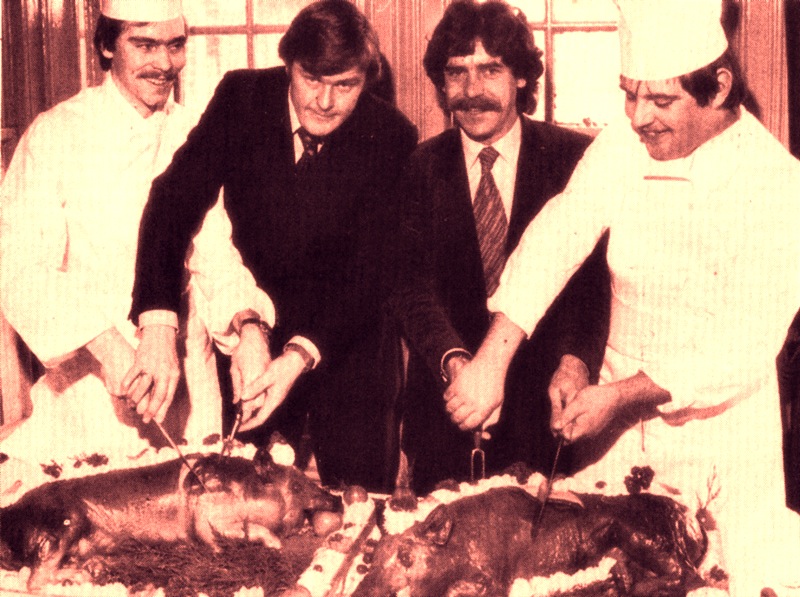
One of the functions held recently was a businessman’s lunch at the ‘Sussex Pad’ in Lancing where landlord, Wally Pack and friends provided a marvellous spread. Our picture shows Sully helping Wally and his staff with the carving.
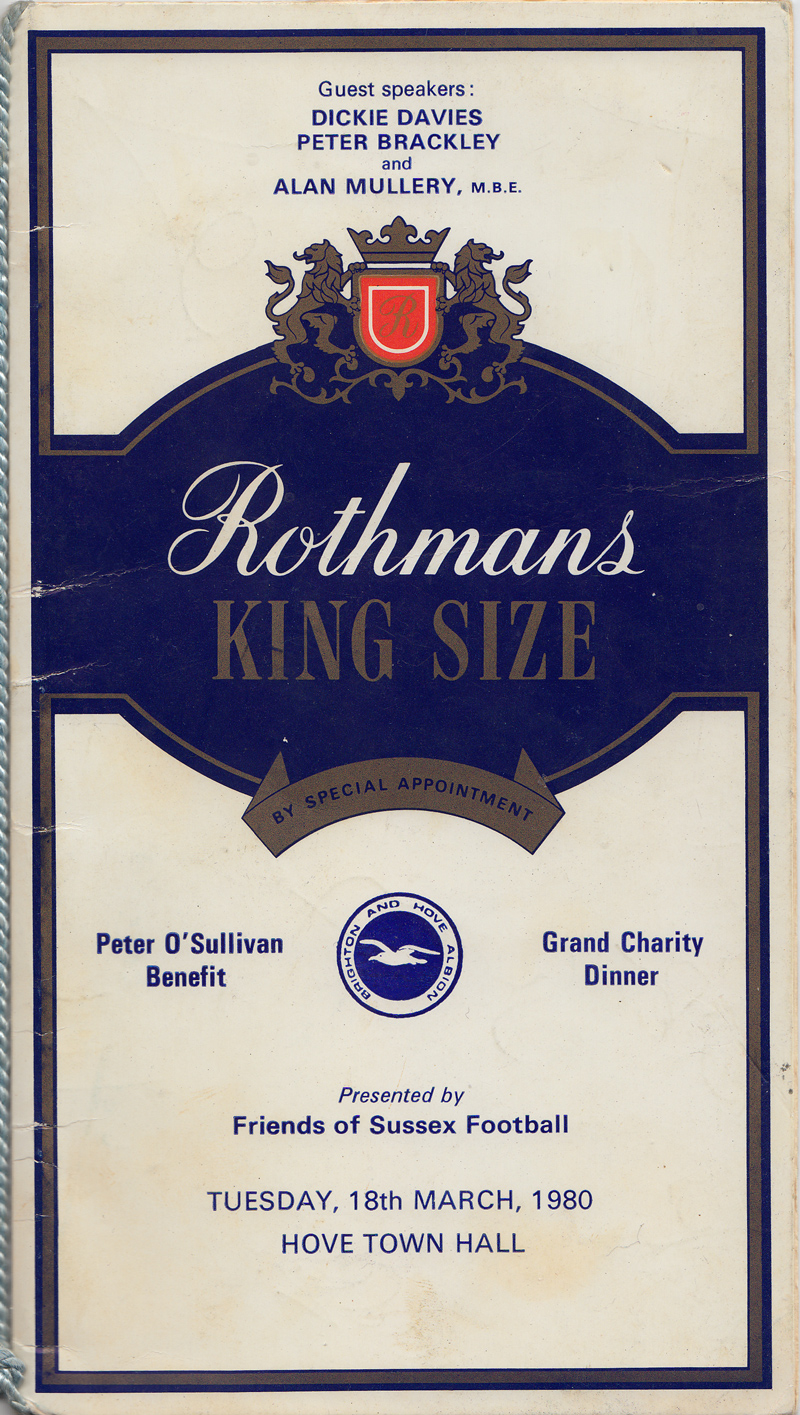
At the Grand Charity dinner in March 1980, with guest speakers Dickie Davies, Peter Brackley and Alan Mullery, the dinner guests enjoyed the delights of asparagus mousse with smoked turkey as a starter.
This was followed by grilled trout with almonds, and then roast contra fillet of beef, sauce madeira, garden peas with bacon and parmentine potatoes.
Desert was pineapple cheesecake with fruit salad, and then petit fours and coffee.
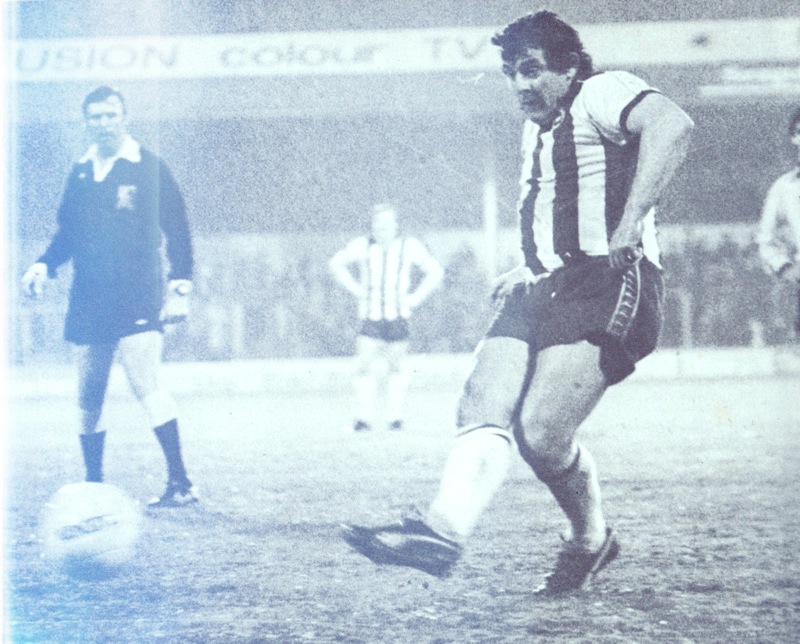
As for the benefit match itself, a month later, Lawrie McMenemy’s Southampton won 3-1. Albion fans had the curious experience of seeing manager Alan Mullery score the Seagulls’ consolation from the penalty spot:
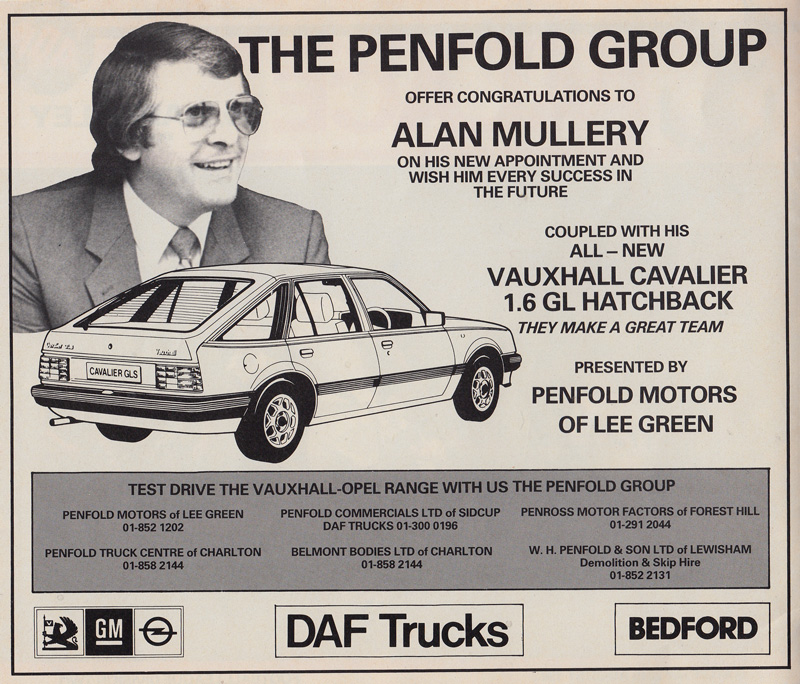
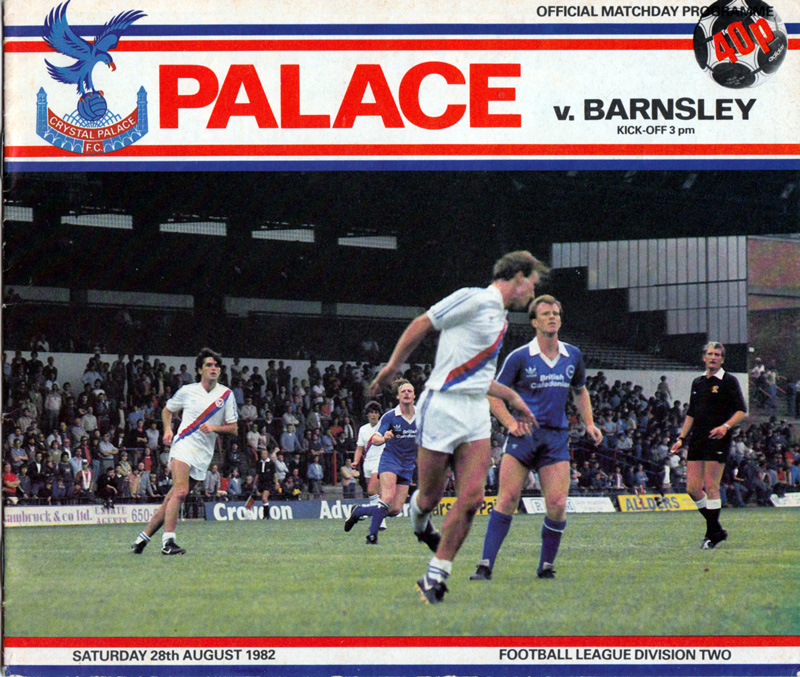
In the summer of 1981, Alan Mullery resigned as manager of Brighton. He was appointed boss of Charlton and led the cash-strapped club to a brief flirtation with promotion from the Second Division before it fizzled out with the Addicks finishing 13th. In July 1982, in a highly controversial move, Ron Noades appointed Mullery as the new manager at the even more cash-strapped Crystal Palace, following the sacking of Steve Kember.
Unsurprisingly, Mullery attracted enormous hostility from Eagles supporters, due to his association with arch rivals Brighton, not to mention his rather impolite gestures at their fans following the FA Cup match at Stamford Bridge in 1976.
Palace’s new gaffer struck a more diplomatic tone once appointed, however:
I sympathise with the fans who not so long ago saw their team perched proudly at the top of the League and have since followed the club’s decline in fortune. We approach the season with new faces and new optimism. Palace have had more than their share of bad publicity over the last two years. That is inevitable when a club reaches the top. People are all too ready to knock you down.
Mullery even put one over Brighton, and his replacement at the club Mike Bailey, with Crystal Palace prevailing 1-0 in the friendly at Selhurst Park on 7th August 1982:
Andy Ritchie in action against Palace in a pre-season friendly.
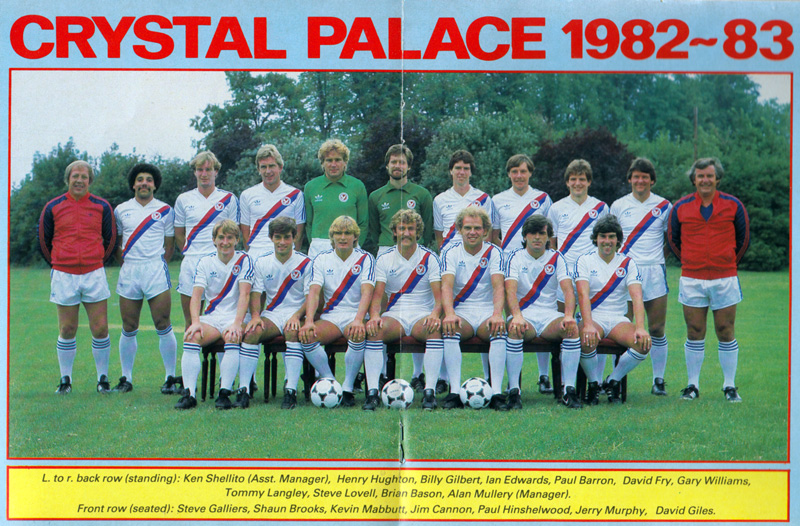
The new boss also made an excellent start to the 1982/83 campaign, with Crystal Palace drawing with Barnsley and Rotherham before beating Shrewsbury and Blackburn, taking the Eagles unexpectedly to sixth in Division Two. In the Barnsley match programme on the opening day, here was the centre-spread:
As you can see, seventh from the left in the back row is Gary Williams, previously a favourite at the Goldstone. Mullery said:
Gary Williams is an experienced pro who, while at Brighton, travelled with me from the Third [sic] to the First Division. I have every confidence that his value will lie in his experience as well as his ability.
Also, in relation to the player who would later end Gerry Ryan’s career with a horrific tackle in April 1985, Mullery said this:
Henry Hughton was Steve Kember’s last signing for the club and he is a player who is never satisfied with giving less than his best effort.
At the end of the 1982/83 season, Brighton were relegated from Division One and financially-stricken Crystal Palace did well to hold on to their Second Division status, meaning that in 1983/84, the rivalry between the clubs would be renewed once more.
However, Brighton proved Palace’s masters in both league matches, winning 2-0 at Selhurst Park on Boxing Day 1983 before the Seagulls’ 3-1 victory at the Goldstone Ground in April 1984. As a match report at the time said:
Mullery Misery
By Michael Eaton
Brighton 3 Palace 1
Palace boss Alan Mullery suffered agonies on his return to the club he twice led to promotion.
Rival manager Chris Cattlin had plenty to be pleased about – especially the performance of leading scorer Terry Connor, who was dropped last week.
Connor responded with three goals in two reserve games and crowned an eventful week with his 16th goal of the season.
Alan Young put Brighton ahead after nine minutes and Brighton were only threatened when Peter Nicholas scored early in the second half.
But Eric Young’s 89th minute goal, when Palace’s defence was pulled apart at a corner, settled the match.
Brighton: Corrigan 7, O’Regan 6, Hutchings 7, CASE 8, Young (E) 7, Garring 7, Wilson 7, Penney 7, Sub: Ryan 6.
Future Palace defender Eric Young sealed Brighton’s win
Despite the defeat, Palace survived at the end of the season, finishing in 18th while Brighton stood in 9th spot. Given the crisis at Selhurst Park, Mullery probably deserves a lot more credit for the job he did there than he has been given. When he was sacked at the end of 1983/84, the players rallied behind him. In a newspaper piece by Tony Stenson, defender Billy Gilbert angrily said:
“I’m not happy with the way the club is being run. Alan wasn’t a yes man and shouldn’t get the sack for that. He deserved a fair chance after all the injuries we’ve had this season.”
Keeper George Wood added: “I’m sick. He’s a good manager who, I feel, has been let down.”
And only last week star winger Vince Hilaire said: “If Alan goes – so do I.”
The 42-year-old Mullery, who took Palace to Brighton for a testimonial last night, said: “I’ve been in football long enough not to be surprised by anything, but it did come out of the blue.
Two years later Alan Mullery would return to the club where his management career began – Brighton. By that point he may have believed he had seen almost everything in football management, especially as far as ailing clubs go. Perhaps he thought he was beyond surprise. He was in for another shock.
In early February 1979, Mike Bamber divulged plans to sign Peruvian World Cup stars Juan Carlos Oblitas and Percy Rojas. As John Vinicombe reported in the Evening Argus at the time:
In a sensational bid to improve their chances of reaching the First Division, Albion are bringing Oblitas to Brighton and he will play in a friendly match the club are trying to arrange at the Goldstone on Monday.
Accompanying Oblitas is striker Percy Rojas, who also played when Peru reached the World Cup quarter-finals last year in Argentina, and the president of the Sporting Crystal Club, Lima.
Albion have paid the Peruvians’ air fares and they are expected to arrive tomorrow.
Oblitas, “the many who catches pigeons” , was voted the best winger in the World Cup. I understand the fee would be around the £200,000 mark and Albion have plans to split the cost by arranging a deal that would take the Peruvian to San Diego Sockers in the summer.
This is the club Brighton are to play in June at the end of their Californian five-match tour.
If Oblitas joins Albion he will need a work permit, but chairman Mike Bamber foresees no difficulties. The San Diego side of the deal will be discussed when Bamber and manager Alan Mullery go to California early next week.
Reports linking the Peruvians with Nottingham Forest drew this comment with Bamber: “I have no idea if Oblitas is going to see Brian Clough. All I know is that we have been promised first choice.”
The skills of Oblitas were just one of the many exciting facets on TV from Argentina in the summer. He was particularly devastating when Peru beat Scotland 3-1.
Unfortunately, the Peruvian pair did not arrive on the Friday as expected as a misunderstanding caused them to believe they were expected to play in a friendly against Nottingham Forest on the forthcoming Monday. As Alan Mullery said:
“They haven’t trained for a couple of weeks and weren’t keen to play against Forest. But we were never going to play Forest on Monday.”
Eddie Buckley, the agent responsible for Ardiles and Villa at Spurs, flew to South America to try to clear up the confusion, as well as investigate reports that tax formalities were causing a hold-up. The delay caused the proposed practice game with Brentford to be called off.
However, Percy Rojas (above, left) and Juan Carlos Oblitas did eventually arrive in Brighton for a spot of training, both finding the weather and training conditions just a little difficult. Alan Mullery said:
“Neither of them looked very fit. But they haven’t played for nine weeks so we can make excuses for them.”
It was reported that both players would be at Craven Cottage on 24th February to watch their prospective new club play Fulham. The news coincided with the decision by the Football League to extend the 8th March transfer deadline by three weeks, which gave Brighton much needed breathing space in trying to gain work permits.
Incredibly, the two World Cup stars eventually played for Brighton in… wait for it!… Hove Greyhound Stadium. In a piece in the Daily Express:
Off the beaten track – Brighton give trials to the Peruvian pair
Brighton staged a match behind closed doors at the local greyhound stadium yesterday to test Peruvian World Cup players Juan Carlos Oblitas and Percy Rojas.
An hour before kick-off club officials were still denying that any game was to be played.
But it was known that Brighton manager Alan Mullery had arranged for Alex Stock to bring Bournemouth for a work-out. Brighton played 28-year-old winger Oblitas, who was the more impressive, and striker Rojas throughout. Rojas and Peter Ward scored in a 2-2 draw, cancelling out two goals from Ted MacDougall.
The Peruvians have a £400,000 price range and Brighton may make a decision today to start negotiations.
An overly hasty report in the paper then stated:
Peruvian World Cup winger Juan Carlos Oblitas signed for Brighton last night in a two-way £190,00 deal with Tampa Bay Rowdies. But the 28-year-old who helped show Scotland the door in Argentina will first play in the United States before joining Brighton in the autumn ready for the new season. The other Peruvian, Percy Rojas, is unlikely to join Brighton though he still hopes to find an English club in time for next season.
Tampa Bay? What happened to San Diego Sockers?
However, the reality was that no deal had been done. Gordon Jago, manager of the Rowdies, had Oblitas on trial but withdrew interest once the North American League season started. There were already gathering snags for Brighton, such as establishing the true age of Oblitas, the lack of availability of either player for the current season, not to mention all the issues regarding obtaining work permits and the language barrier. Without a partner club to bid, though, the deal for either player was dead.
Update: Both Juan Carlos Oblitas and Percy Rojas have now been added as honorary Brighton players by Cult Zeros. Click on a player’s name to order a T-shirt or hoodie of your favourite Peruvian superstar.
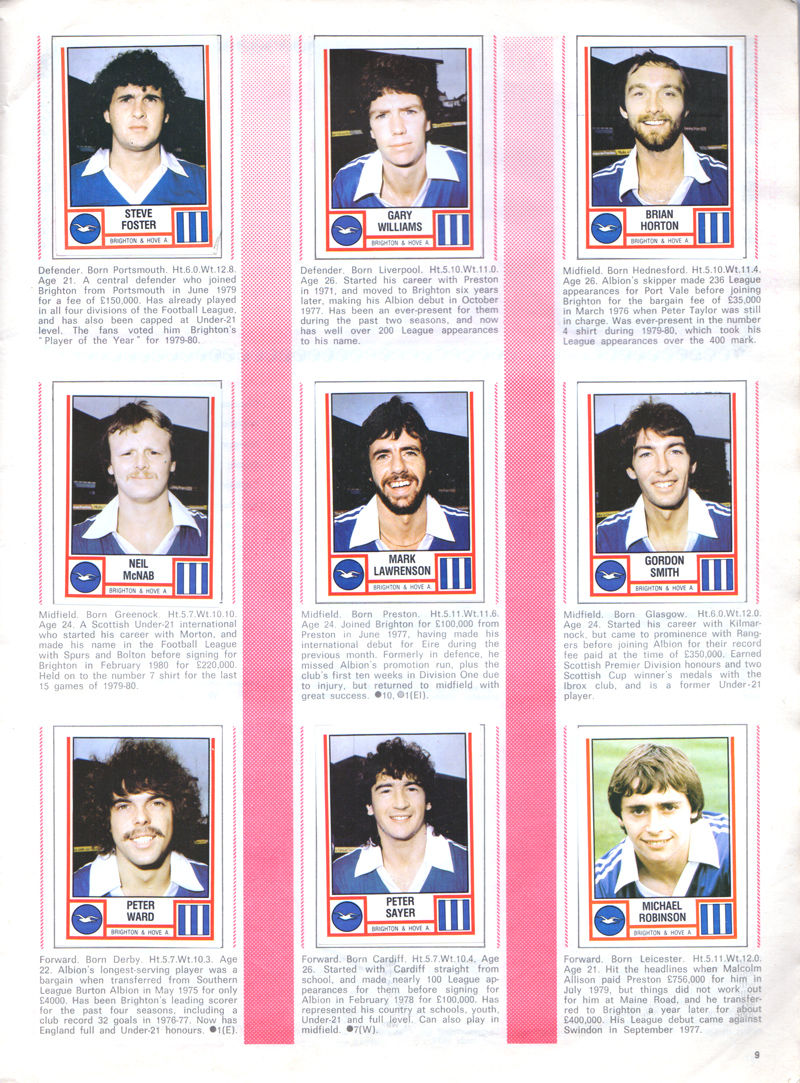
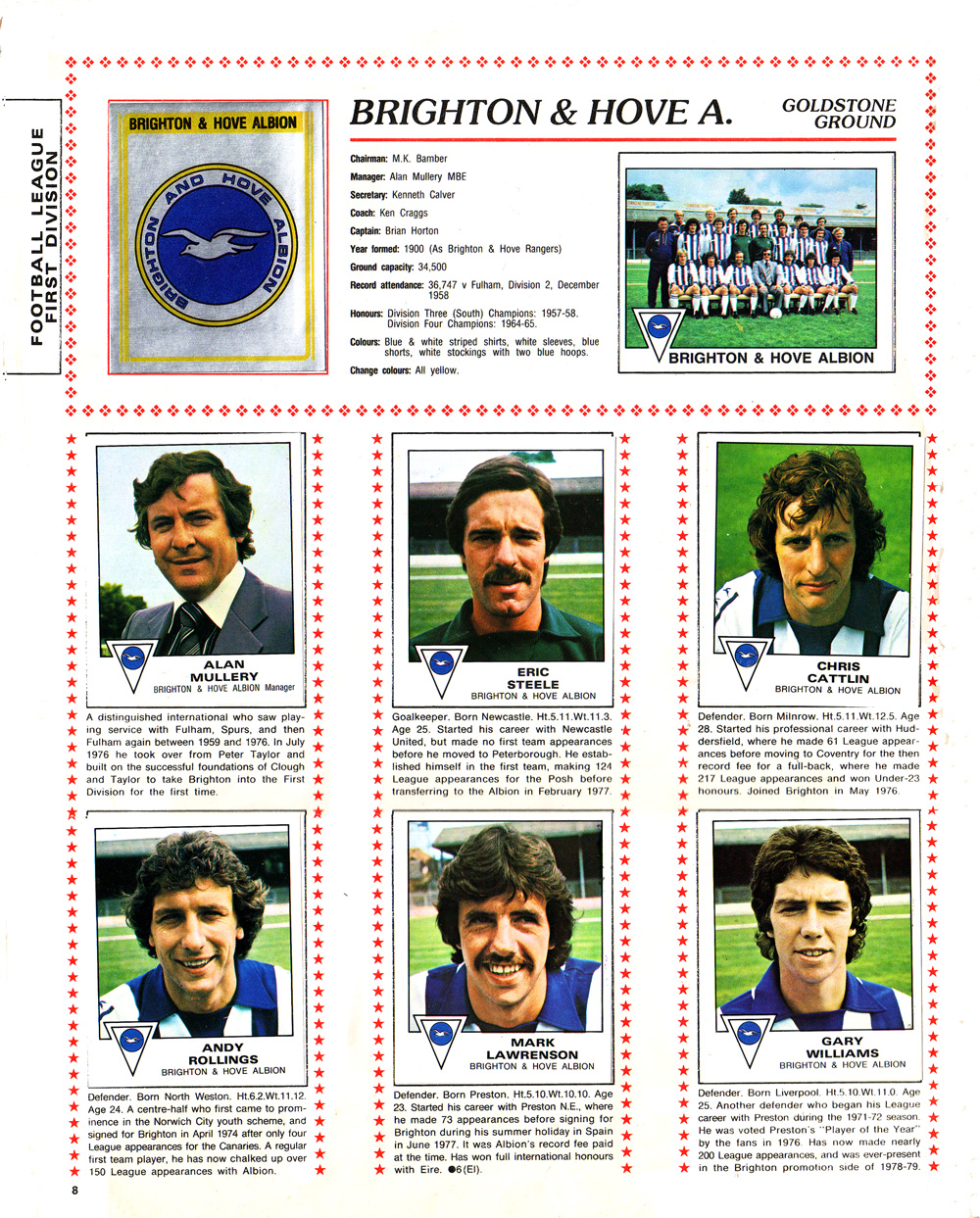
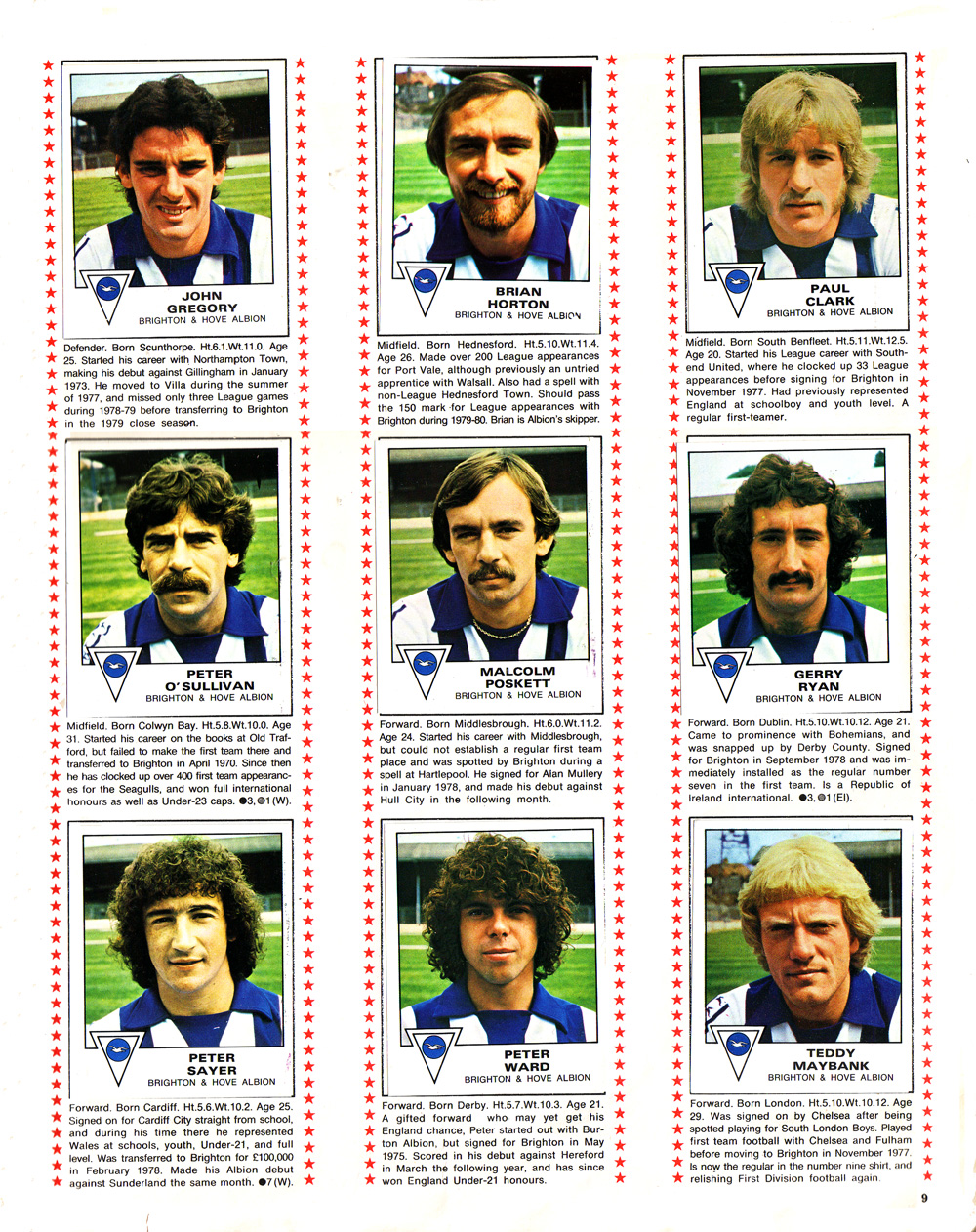
I originally bought this second hand at the Sunday market outside Brighton train station in the early 1990s. I thanked my lucky stars that all the Albion stickers were there. This was years before eBay, so finding someone with a spare Peter Sayer sticker lying around would have been tricky, whereas now it would only take a few seconds…
Looking at the Arsenal pages now, it’s striking that out of the 14 Gunners on display, five would eventually join Brighton (Steve Gatting, Willie Young, Sammy Nelson, Liam Brady and Frank Stapleton). Neil McNab lined up as a Bolton player sticker for the last time, while future Seagull favourite Michael Robinson smiled for his Manchester City photo shoot with a joviality that was not reflected in his unhappy year at Maine Road.
However, it’s the Albion double-spread that really catches the eye!
In these head and shoulder shots, we get to see the bubble perms of Sayer and Ward, but even these are outnumbered by the popularity of moustaches within the Brighton first team, through Lawrenson, Horton, Clark, O’Sullivan, Poskett and Ryan. Curiously, our players here are wearing flared collars with a triangular panel at the bottom, whereas during the season (I’m addressing fellow shirt anoraks, here!) it was open flared collars that were on display, at least for the home kit.
As the season unfolded, keeper Eric Steele gave way to Graham Moseley. Gary Stevens and Steve Foster also played much stronger roles in defence than either Chris Cattlin or Andy Rollings. Sayer, Maybank and Clark would be further casualties as Mullery moved his Panini stickers around his imaginary album to try to find a winning formula. Then, from nowhere (OK, Blackpool in the Third Division) Peter Suddaby took Lawrenson’s spot in defence while the Republic of Ireland international was pushed further forward. He would have taken one of the midfielder stickers, while Neil McNab and Ray Clarke would have been the new arrivals bringing high quality passing and forward play to the Goldstone. Good swopping, Mullers!
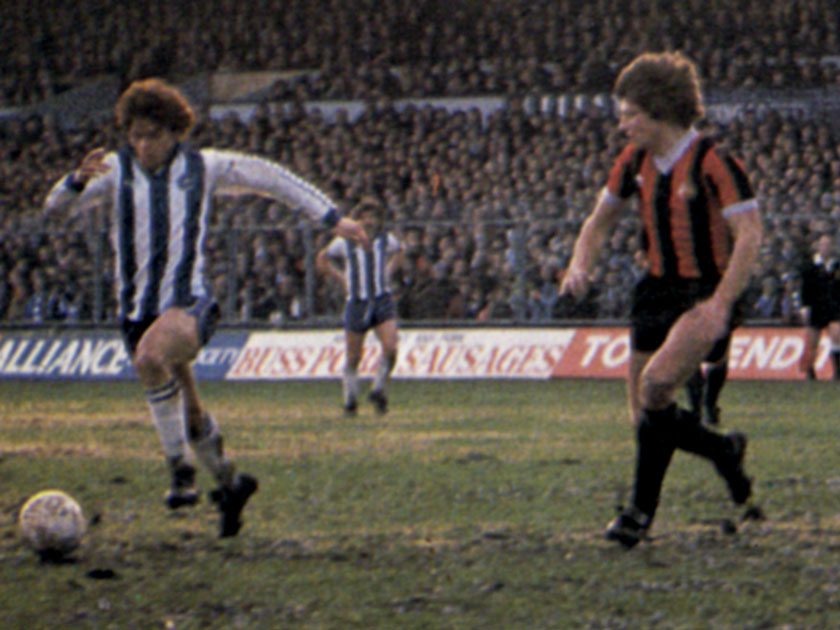
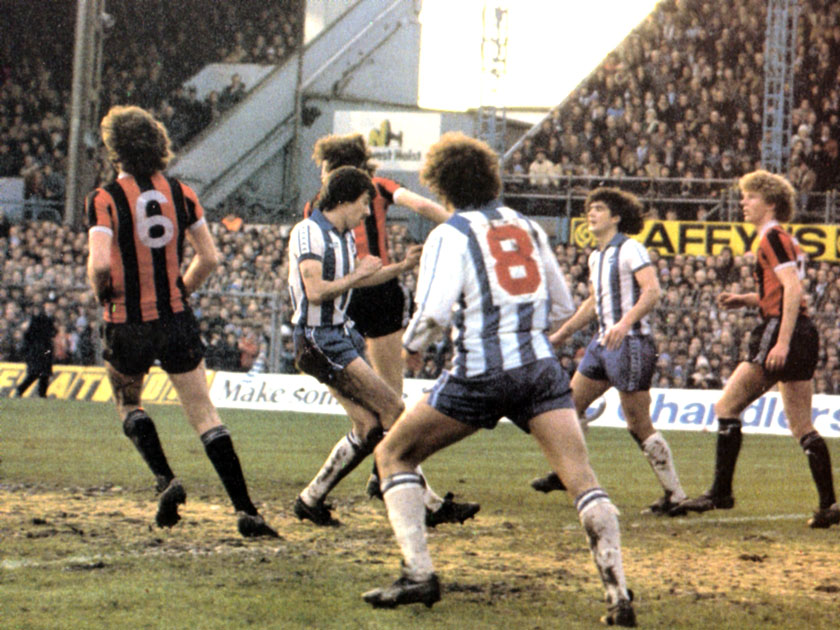
They were heady at the Albion in December 1979. When the decade had started, the side was in the Third Division and now it had rocketed up to the giddy heights of the top flight. When the then current campaign had started, the Seagulls looked like relegation fodder. However, in the Christmas season, a resurgent Brighton played like nothing short of champions. Having trounced Wolves and Crystal Palace, two top-half sides, they proceeded to wipe the floor with Manchester City.
Here is a piece from the Daily Express that perfectly captures the delight in Sussex at the magnificent turnaround at the club:
As the decade draws to a close it is fitting to reflect on the fortunes of Sussex’s only League club whose First Division lifeline has grown progresslvely stronger over Christmas.
When the seventies were new Albion enjoyed a brief flirtation with the Second Division.
Once again they resumed an all too familiar Division Three tag, but as the influence of the incoming chairman, Mike Bamber, began to be felt a fresh picture took shape. The management team of Clough and Taylor halted a headlong plunge towards the Fourth Division and achieved vital breathing space with a crash programme and Taylor, alone, had a near miss in 1975-76.
Success
The Alan Mullery touchstone brought unprecedented success with two promotion seasons out of three and then, inevitably, came the slump.
Anything less on merely a nodding acquaintance with the best company in the country would be expecting too much.
As Mullery said during the darkest moments: “Our mistake is in treating famous clubs on reputations, and not as 11 players.”
Albion are no longer overawed in their present suroundings. It has taken them half the season to acclimatise and pick up very much in the same fashion as last Christmas – maximum points from three games, and ten goals.
Last year the spurt sent them towards promotion; this time they have taken a further important step away from the rock bottom strugglers.
The yawning chasm of relegation has receded, but Mullery knows that the fight must continue, and any relaxation at this stage could be fatal.
Nevertheless, these last three games have seen Albion play more like a team better suited among championship contenders than down among the no-hopers.
In nine days they have demolished Wolves, Crystal Palace and now Manchester City, all clubs in the top half of the table.
Once might have been a fluke, but we have seen enough lately to measure Albion’s growing stature. On current form they are in a grossly false position, and while the prevailing mood is with them, they need fear no side.
In a splendid match, particutarly a memorable first half, Albion outclassed City who may yet feel the chill breath of relegation waft through the plush carpeted corridors of Maine Road.
For Mullery, at Albion’s helm, could well come the accolade of Manager of the Month.
He has motivated his players to work out their own salvation and instilled that priceless asset – self-confidence.
Fluency
Even bearing in mind some of those high scoring Second and Third Division days, I cannot recall seeing Albion play so well as a team-as that opening 45 minutes against City.
Malcolm Allison, declined to grant interviews and preferred to keep his own counsel. Just as well.
There was nothing he could fairly say after his team succumbed to Albion’s fluency. In fact, they could have gone down by a good siX goals such was their lack of method and application.
The impetus of a goal inside half a minute leaves its mark and once Ray Clarke had profited by terribly slack marking to convert Mark Lawrenson’s centre, the crowd and team became as one.
For the first time this season the Goldstone really got behind Albion.
They had been wound-up by the Palace defeat, and suddenly here, was a killing thrust before many had time to settle.
City went to pieces after Clarke’s first goal. Eager to drive forward Sully missed from Brian Horton, and Joe Corrigan saved point blank from Peter Ward.
Then he got down well to the irrepressible Ward on two occasions. Next it was Gerry Ryan opening the way for Ward again, but his finishing let City off the hook.
Thirst
A player with such a thirst Ward now has for goals eouldn’t keep missing, and at 27 minutes he scored his fifth in three straight outings.
The build-ups were coming from all points of the compass, especially a series of penetrating long passes and centres by John Gregory.
Just past the half hour, Clarke whipped in a third when Ryan, Ward and Sully were involved, and the North Stand chorussed: “You’re worse than Palace.”
There haven’t been many occasions when the fans have been able to rub it in, and they made the most of it this time.
They were momentarily silenced by Stuart Lee pulling one back for City, and just before the break, Graham Moseley made a daring save that prevented the lead being whittled to one.
A rare miscue by the normally composed Steve Foster let Gary Power in, and Moseley raced from his line to make a brave stop on the edge of the box.
Fears that Tommy Caton’s tackle on Lawrenson in the dying seconds of the half would prevent his reappearance were assuaged.
Early in the restart, Ward laid on delightful pass for Lawrenson to surge through the cloying mud and hit Corrigan’s bar.
There were still enough City heads still held high to make a game of it, but the result was put beyond doubt by the best goal of the match.
It was scored by Ryan who ran half the length of the pitch after gathering a throw from Moseley.
Had a Liverpool player scored it, I’ve no doubt it would be hailed as the goal of the century or some such exaggeration.
This was a masterly effort from a player who contributed much by strong running and intelligent passing.
He collected nine in 34 outings as a winger last term, but hasn’t had much luck so far.
When one player, in this case, Ward, starts to buzz, it rubs off.
The positions he reached prompted Sully to spray a series of fan-tailed passes from midfield, and Clarke, after nine games with Ward, now has settled to becoming an intuitive partner.
Ward kept turning the defence at will long after Ryan’s goal had passed Corrigan.
He was after another hat-trick, but I reckon he has done enough to prod England manager Ron Greenwood.
The Hortons of football, don’t gain international honours, but he’s as good a pro as you’ll find anywhere, and better than most.
I hope to get full highlights of this game soon. When I do, I’ll share here!
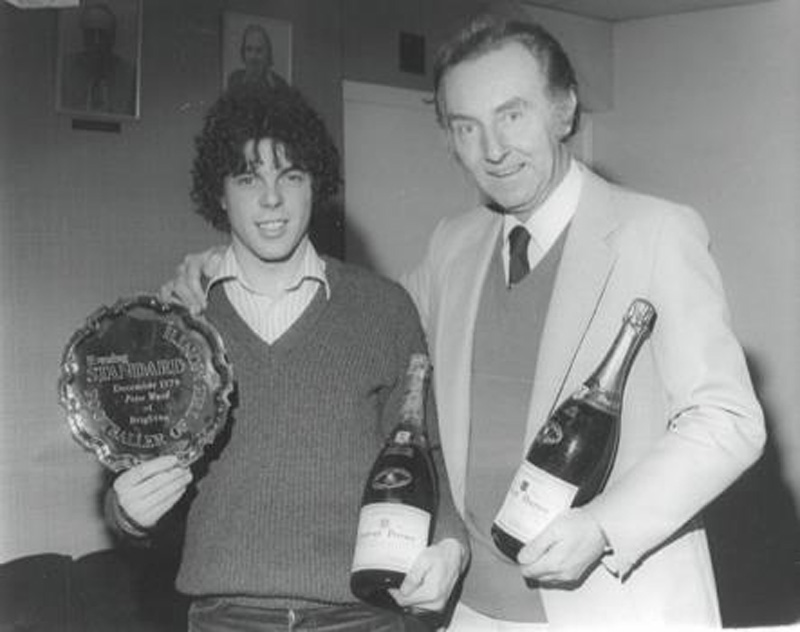
One accolade that came out of the glorious form was that Peter Ward ended up receiving the Evening Standard player award for December 1979. Here he is with chairman Mike Bamber and two bottles of bubbly:
Well done, Wardy!
In the meantime, I’d like to wish you all a Happy New Year. Roll on the 1980s!
Argus journalist John Vinicombe was in a happy mood, describing Brighton’s 5-0 annihilation of Cardiff City in December 1978. Helped by three goals from Teddy Maybank, the handsome result put the Seagulls in third place in Division Two:
Albion’s form in the two Christmas matches – at Charlton and yesterday against Cardiff City at the Goldstone – was nothing less than superb.
From the 3-0 success at The Valley, where Malcolm Poskett scored a second half hat-trick, Albion carried on where they left off when Cardiff arrived at the Goldstone.
And there to greet them was a numbing goal in the first 23 seconds by Gary Williams and Teddy Maybank bagging his first hat-trick for the club.
But for the courage of goalkeeper Ron Healey, City would have been taken for a cricket score.
The 5-0 victory was easily Albion’s most convincing display so far and helped lift them to third spot in the table as all the results went their way.
Before a ball was kicked, Albion knew that close rivals West Ham had crashed to a shock home defeat at the hands of Orient.
Albion needed six goals to eclipse them on goal difference alone, and the situation now is that Brighton have won more games (12) than any other side. On this form they face the New Year with confidence.
If Charlton were just as comprehensively outclassed as Cardiff, it should be borne in mind that Charlton picked up yesterday to take a point at Stoke.
Other results in Albion’s favour were the 1-0 defeat of Newcastle United at Bramall Lane and Sunderland dropping a point at home to Leicester City.
And while West Ham came tumbling down, there was a similar upset at Selhurst Park, where leaders Crystal Palace suffered a 1-0 defeat by Bristol Rovers.
This is a traditional time for crazy results, but there was no hint of Albion slipping up. I cannot recall them playing so consistently welt for the entire 90 minutes as Cardiff reeled under a succession of tremendous blows.
Never mind Cardiff’s bad away record… they had toppled Fulham in their previous match and are desperate to avoid the drop.
Not once did they remotely look like upsetting Albion’s approach, and it was realty a case of how many goals would finish in City’s net.
The three deposited by Maybank will do wonders for his morale. In a twinkling, a much-maligned player has earned many new admirers, although those who watch the side home and away will testify to his voracious work rate.
Significantly, Mark Lawrenson played a part in all three Maybank goals, and if there is a more gifted player in the division, I have yet to see him.
When Maybank headed Albion’s second at 23 minutes it was his first at home for nearly a year! He last hit the Go!dstone net on January 21 against Mansfield and it is almost four months since he scored away from home.
The way has been far from easy for Maybank, but now that the spell is broken I look forward to his luck changing.
Although his damaged ankle ligaments are healed, there was no place for Peter Ward. How could Alan Mullery have changed the side that dazzled at Charlton? Now he has what managers like to call a ‘nice problem’. With nearly half the season remaining there will be plenty of chances for Ward to get back, but the good of the club comes first and personal feelings second.
It must be satisfying for Mullery to have found the touch with his players at such an important time. Aibion were long overdue for a good Christmas. but I don’t think even the most devoted fan thought in terms of two wins and eight goals!
The heavy conditions yesterday suited Albion, and skipper Brian Horton showed himself master of the long ball. Peter Sayer and Peter O’Sullivan ran and worked so hard that there was nothing for Cardiff to create. And Lawrenson, always ready to go on runs at Charlton. was equally hungry yesterday. He inspired that much confidence in Andy Rollings to mind the shop with the ever vigilant Chris Catilin to provide additional cover.
Twelve minutes from the end, Lawrenson limped off with a touch of cramp. It was a wise move to pull him out at that stage, as Cardiff’s defence lay in tatters.
Without any buses, the crowd was kept down to 20,172, but surely there must be a good 28,000 for Saturday’s visit of Newcastle.
They should prove a sterner test than Charlton or Cardiff, but in this mood I doubt if Albion care very much who they play.
Shrewd Mullery had the players in on Christmas morning to be weighed. Not one was a pound over – testimony to their professionalism. I lost count of the bails on Cardiff’s goal. Lawrenson hit the post early on, and midway through the first hall Poskett’s shot was deflected on to the bar. Two other Poskett efforts missed by narrow margins, and twice Maybank went very close and so, for good measure, did Cattlin.
When referee Tony Cox sounded the final whistle it was a merciful release for Cardiff, who were reduced to the stature of a park team.
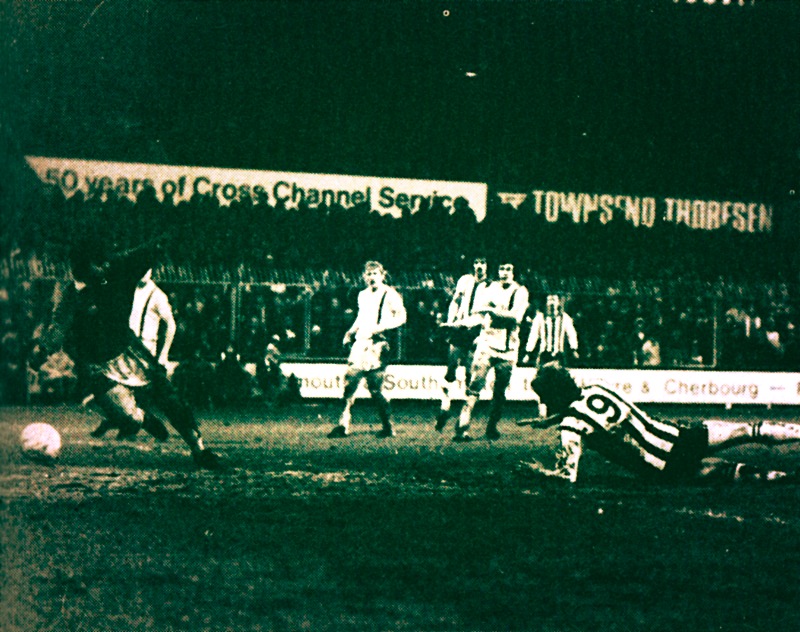
One minute: The stopwatch showed 23 seconds when Williams hit a swerving shot from just inside the box from a pinpointed Poskett centre (1-0). Twenty three minutes: A long ball from Lawrenson found Sayer and he quickly picked up Sully. When the ball came over to the far post, Maybank was in with his head (2-0). Forty three minutes: A finely worked move involving five players ended when Ryan flicked across for Maybank. He pitched headlong when he shoved in the back by Roberts, and Horton nearly took the back of the net out from the spot (3-0). Forty-eight minutes: A run of 20, maybe 25 yards by Lawrenson took him down the right, and the hard, low cross was met by Maybank with a diving header (4-0).
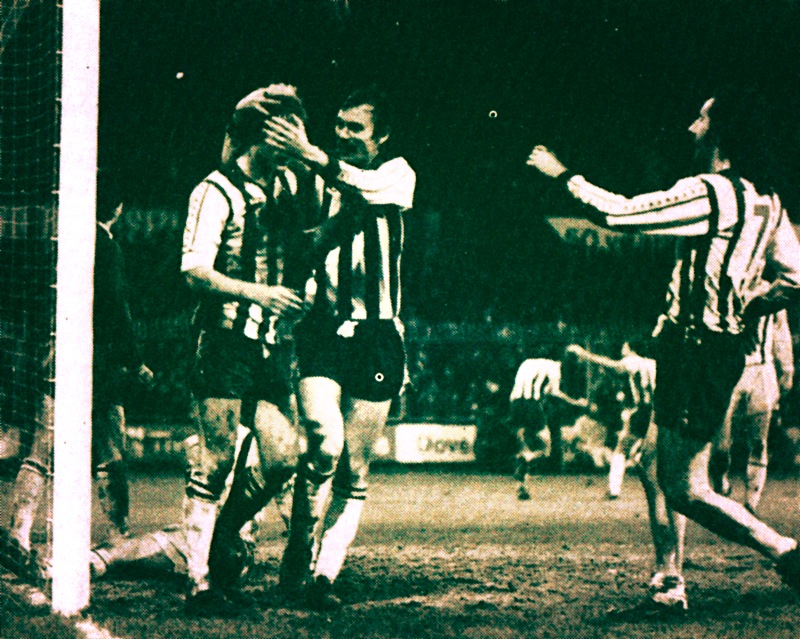
Jubilant Maybank completes his hat-trick
Sixty-two minutes: An almost identical move: Lawrenson raiding yet again, and Maybank getting in to force the ball home (5-0).
From his moment of triumph, Teddy Maybank didn’t quite run into a rich vein of goalscoring form. He popped up with the opener against Leicester City in early February at the Goldstone before embarking on another fruitless spell in front of goal. A sending off against Sheffield United in March threatened to curtail his participation in the final run-in as Mullery moved quickly to sign Martin Chivers as a stop-gap.
However, three goals in the last four matches meant Maybank ended the season with a bang. It was ample reward for a forward who unselfishly did the donkey work to create space for his more fleet-footed colleagues.






 The Goldstone Wrap