Category Archives: Media Coverage

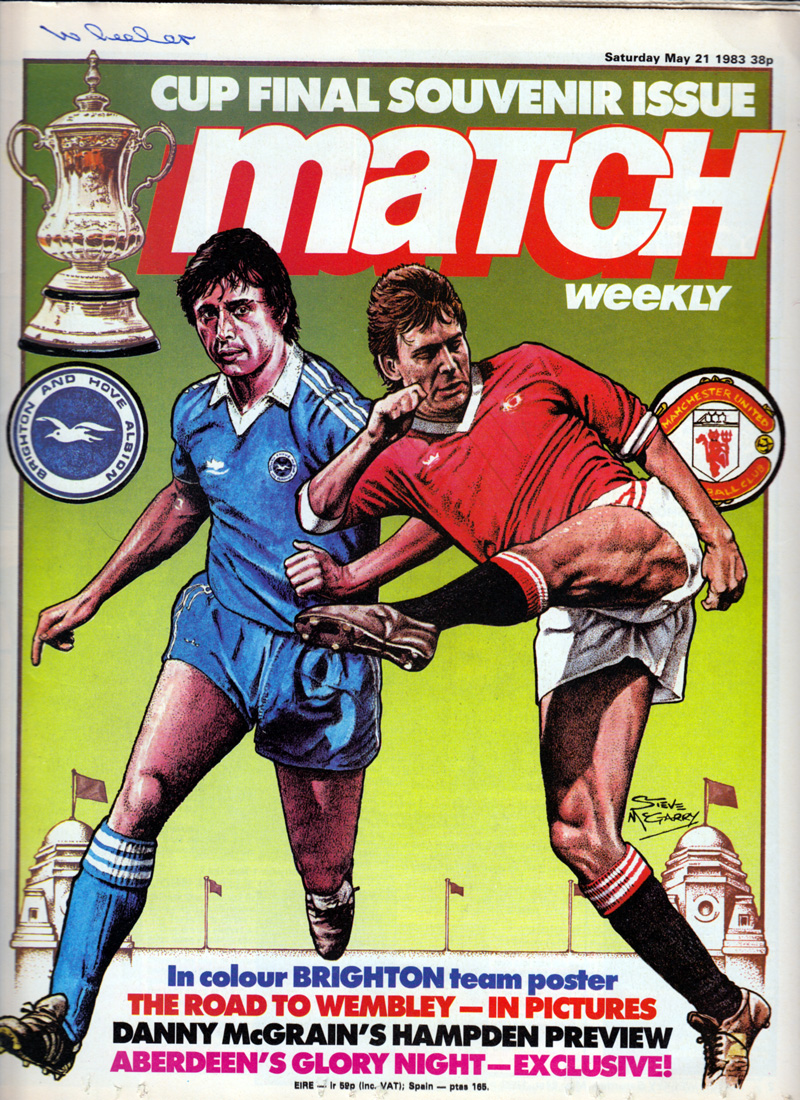
Match Cover: Michael Robinson (21 May 1983)

matchcover3

An artist’s impression of Michael Robinson and Bryan Robson makes the cover of this very special Cup Final Souvenir Issue of Match Weekly. Inside, unsurprisingly, Cup Final talk dominates:

Eight pros predict a Manchester United victory (Craig Johnston, Gary Bannister, John Hollins, Steve Perryman, Chris Woods, Paul Walsh, Geoff Pike, John McAlle and Graham Sharp, Terry Fenwick). Tommy Caton and Chris Waddle go for a Seagulls victory.

Elsewhere, Steve Gatting talks of the pain of missing out on the FA Cup Final when Arsenal reached that stage in 1979 and 1980. He says: ‘It’s a great feeling to finally get the chance to play in an FA Cup Final and I just can’t wait to walk on that famous turf.’

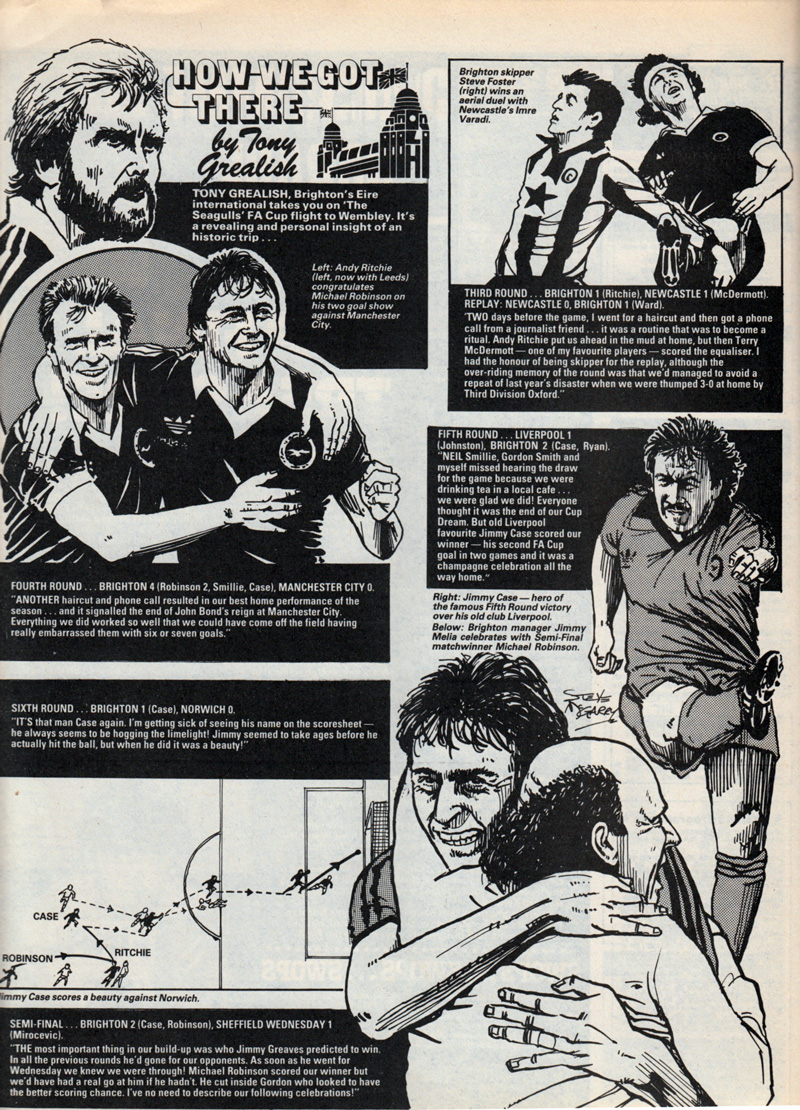
In their lovely V-necked and pinstriped Cup Final kit, there is also a Brighton team photo in the centre-spread, and Graham Moseley is quizzed in Cup Final Focus, along with Arnold Muhren. Finally, an artist’s impression of the teams’ Cup Final run is included. Here’s Brighton’s:

match-howwegothere

Tagged

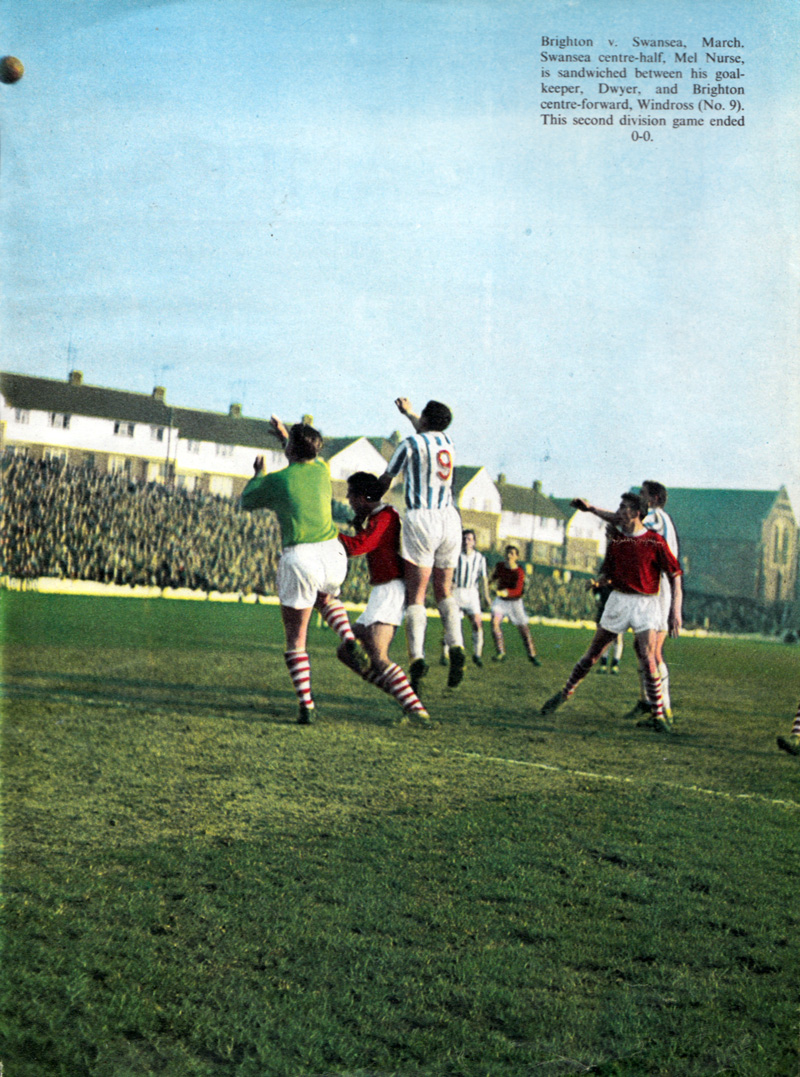
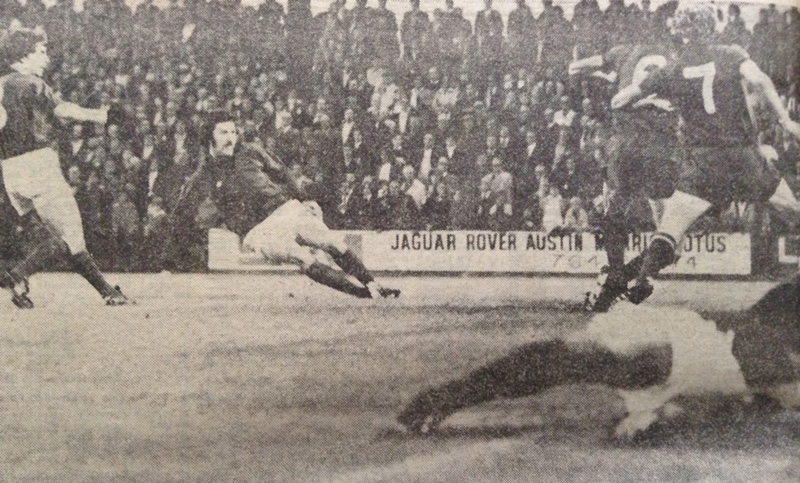
March 1961: Brighton v Swansea goalmouth scramble

This colour image of the Goldstone Ground comes from the annual Football Champions:

swansea

The number 9 is Albion centre-forward Dennis Windross who cost £1,000 from Middlesbrough in November that season. The Yorkshireman had a purple patch of four goals in five games around the turn of the year during the campaign, including a goal against League champions Burnley in the FA Cup. However, the goals completely dried up after this and he lost his place in the side in early April. Brighton finished in 16th position in Division Two.

Out of favour, Windross was swopped for Darlington’s Bobby Baxter in the summer.

Tagged

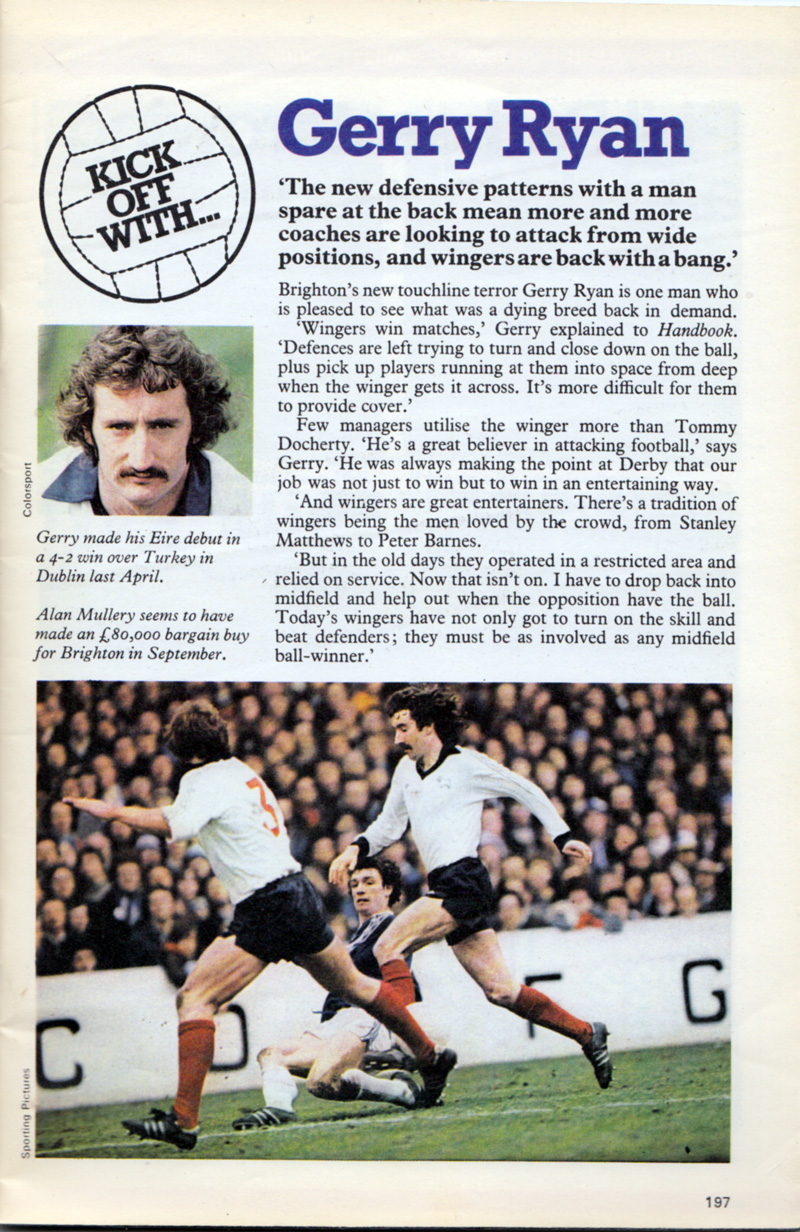
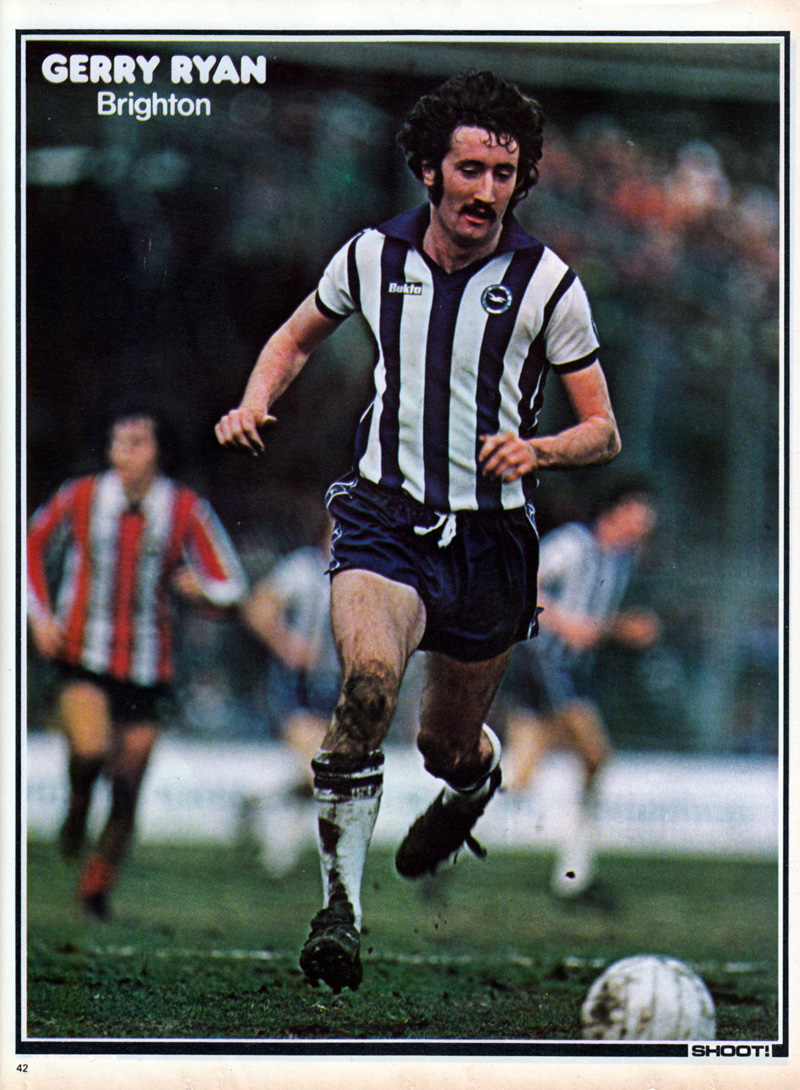
Kick off with Gerry Ryan

gerryryan2

From Marshall Cavendish’s splendid Football Handbook (Part 8):

“The new defensive patterns with a man spare at the back mean more and more coaches are looking to attack from wide positions, and winers are back with a bang.”

Brighton’s new touchline terror Gerry Ryan is one man who is pleased to see what was a dying breed back in demand.

“Wingers win matches,” Gerry explained to Handbook. Defences are left trying to turn and close down on the ball, plus pick up players running at them into space from deep when the winger gets it across. It’s more difficult for them to provide cover.”

Few managers utilise the winger more than Tommy Docherty. “He’s a great believer in attacking football,” says Gerry. “He was always making the point at Derby that our job was not just to win but to win in an entertaining way. And wingers are great entertainers. There’s a tradition of wingers being the men loved by the crowd, from Stanley Matthews to Peter Barnes. But in the old days they operated in a restricted area and relied on service. Now that isn’t on. I have to drop back into midfield and help out when the opposition have the ball. Today’s wingers have not only got to turn on the skill and beat defenders; they must be as involved as any midfield ball-winner.”

gerryryan

Tagged

How it was then: Alan Mullery leaves Brighton in June 1981

At the end of ‘Up, Up And Away,’ John Vinicombe’s account of Brighton’s promotion to the First Division, he paints a rosy picture of the relationship between chairman and manager in 1979:

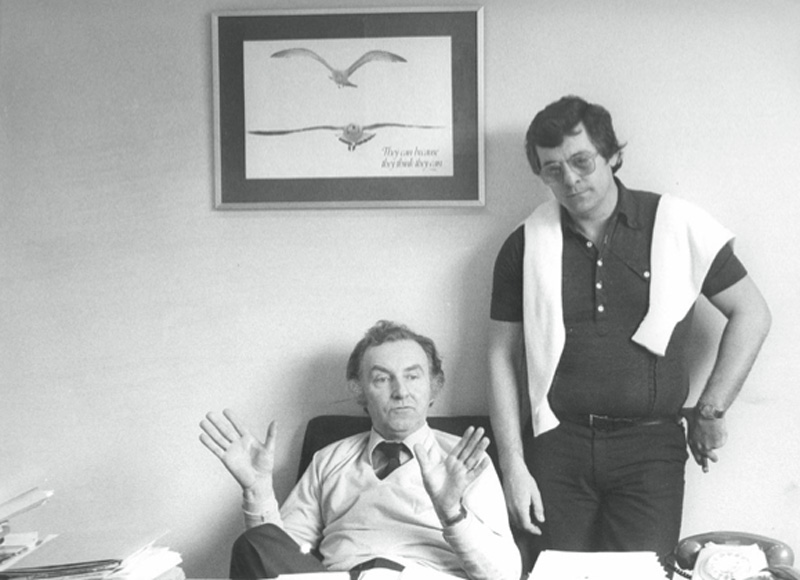
It took the arrival of Mike Bamber to bring about a new era, for, without Bamber, there would have been no Mullery – no promotion. They are twin architects of Albion’s success and the key to their thinking can be seen in Bamber’s motto on the wall of his Goldstone office – “they can, because they think they can”:

bambermullery

(In the photo above, from ‘Through Open Doors’ by Brian Radford, you can just about see the slogan).

However, by 1981, things had turned for the worse. Manager Alan Mullery resigned after disagreeing with Mike Bamber about the chairman’s plans to reduce the size of the coaching staff and how to resolve the Mark Lawrenson transfer saga. Mullery had cut a deal with Manchester United that involved cash plus a part exchange of a player, but Bamber had already set his sights on a money only £900,000 deal with Liverpool. Mullery decided it was time Bamber found a new club manager.

From Alan Mullery – ‘The Autobiography’ (2007):

Angry.

That’s how I felt in the days after I left Brighton. I thought I’d achieved more than any previous manager at the club. I’d started with a decent Third Division team and developed it into a Division One side filed with top-level players – Mark Lawrenson, one of the best defenders of modern times; John Gregory, Steve Foster and Gary Stevens, all of whom went on to play for England; Michael Robinson of Eire; Neil McNab and Gordon Smith, both Scottish internationals.

Plenty of that calibre would never have dreamed of joining Brighton and Hove Albion before I took over. My credibility helped me to sign them. I’m not saying I deserve all the praise for the rapid rise the club enjoyed during my five-year stay, but I sure as hell played my part. Our two seasons in the top flight were tough, there’s no denying that, but any club should expect a similar period of transition.

If I had continued to enjoy the backing I’d received while Harry Bloom was alive, I’m sure we could have consolidated our position as a First Division club. Instead I was out of the cold and Brighton went on to be relegated just two seasons later.

Did I regret walking out after my confrontation with Mike Bamber? Was I too headstrong? The honest answer is yes, I was fiery and prone to rush into emotional decisions. I should have taken my time to think things through before resigning, but it wouldn’t have changed anything in the long term. If I had backed down over the Lawrenson transfer, I believe Bamber would have walked all over me from that moment on. And my pride was too strong to allow that. Our split was inevitable.

As Mullery departed from Brighton & Hove Albion that summer, “the truth was,” he later wrote, “my best days as a manager were already behind me.”

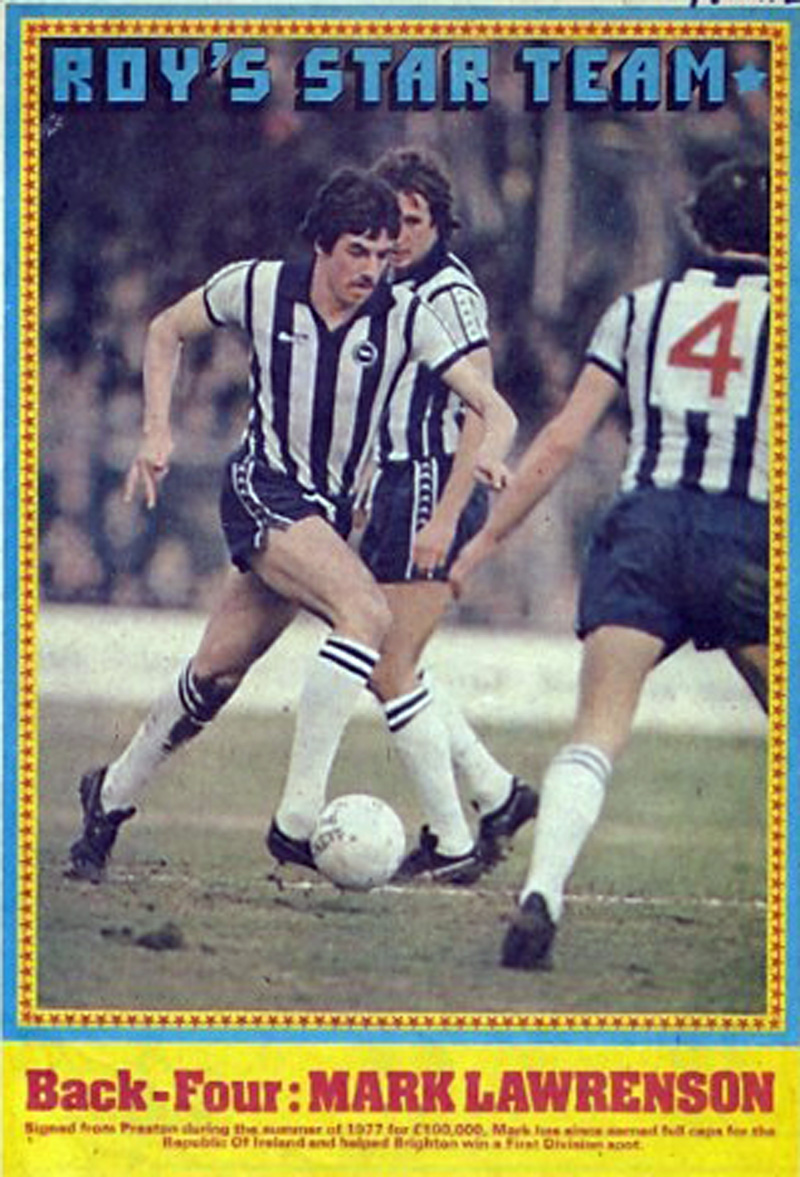
lawrensonv2

Tagged , ,

Jimmy Case spills the beans on his team-mates in 1984/85

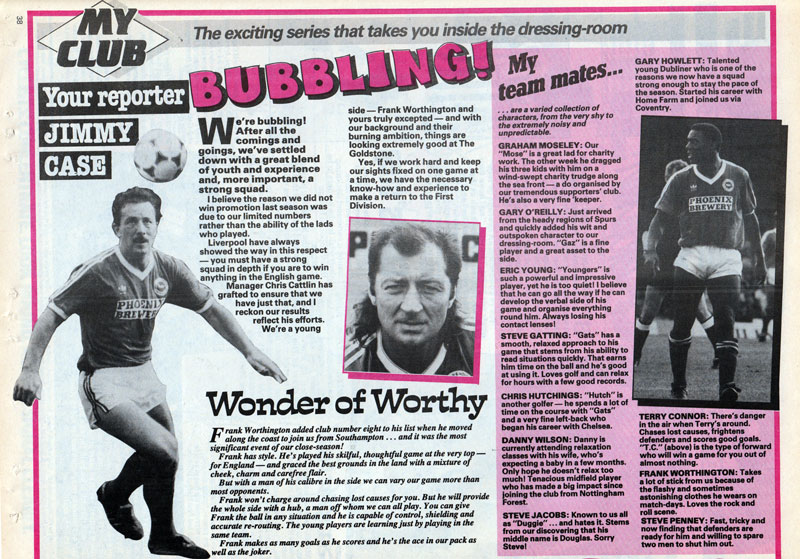
From Shoot! Magazine in 1984/85:

myclub

My team mates are a varied collection of characters, from the very shy to the extremely noisy and unpredictable.

Graham Moseley: Our ‘Mose’ is a great lad for charity work. The other week he dragged his three kids with him on a wind-swept charity trudge along the seafront – a do organised by our tremendous supporters’ club. He’s also a very fine keeper.

Gary O’Reilly: Just arrived from the heady regions of Spurs and quickly added his wit and outspoken character to our dressing room. “Gaz” is a fine player and a great asset to the side.

Eric Young: “Youngers” is such a powerful and impressive player, yet he is too quiet! I believe that he can go all the way if he can develop the verbal side of his game and organise everything round him. Always loses his contact lenses!

Steve Gatting: “Gats” has a smooth, relaxed approach to his game that stems from his ability to read situations quickly. That earns him time on the ball and he’s good at using it. Loves golf and can relax for hours with a few good records.

Chris Hutchings: “Hutch” is another fine golfer – he spends a lot of time on the course with “Gats” and a very fine left-back who began his career with Chelsea.

Danny Wilson: Danny is currently attending relaxation classes with his wife, who’s expecting a baby in a few months. Only hope he doesn’t relax too much! Tenacious midfield player who has made a big impact since joining the club from Nottingham Forest.

Steve Jacobs: Known to us all as “Duggie” … and he hates it. Stems from our discovering that his middle name is Douglas. Sorry Steve!

Gary Howlett: Talented young Dubliner who is one of the reasons we now have a squad strong enough to stay the pace of the season. Started his career with Home Farm and joined us via Coventry.

Terry Connor: There’s danger in the air when Terry’s around. Chases lost causes, frightens defenders and scores good goals. “T.C” is the type of forward who will win a game for you out of almost nothing.

Frank Worthington: Takes a lot of stick from us because of the flashy and sometimes astonishing clothes he wears on match-days. Loves the rock and roll scene.

Steve Penney: Fast, tricky and now finding that defenders are ready for him and willing to spare two men to shut him out.

In the upbeat article Case is adamant that “if we work hard and keep our sights fixed on one game at a time, we have the necessary know-how and experience to make a return to the First Division.”

Well, he was right in one respect. He did make a return to the top-flight, but it was with Southampton, as Chris Cattlin made a massive mistake by selling the Liverpudlian for a mere £30,000 to Brighton’s south coast rivals in March 1985. The Seagulls missed out on promotion by just three points.

Tagged ,

Protest and survive

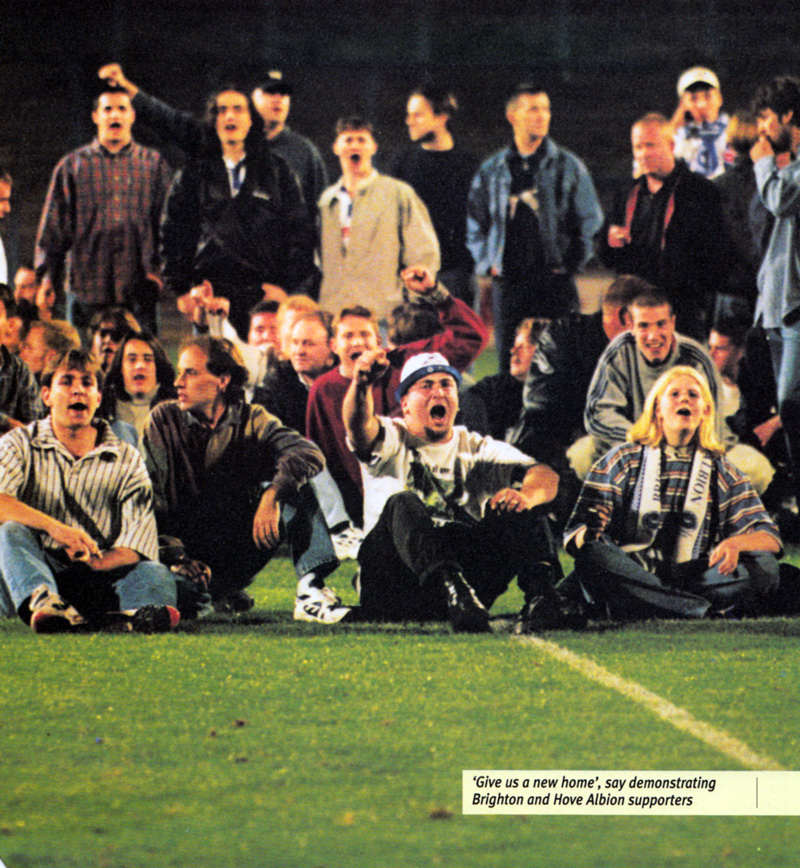
This picture is from Superclubs Soccer Yearbook 1998/99 and shows livid Brighton fans staging a sit down protest on the pitch during the ‘Troubles’ of the mid-1990s:

protest

Do you recognise anyone in this photo?

Tagged , ,

Brian Clough: You Can’t Win ‘Em All

A fitting time to share this gem of a pop record, after Brighton’s painful 0-2 Play-Off Semi-Final home defeat against Crystal Palace yesterday.

This track (file under ‘philosophical football’), where Brian Clough made an astounding guest appearance, was by JJ Barrie, the Canadian singer and songwriter, most famous for his cover of ‘No Charge’ which was number one in the UK in June 1976. How he ended up recording a song with the then Nottingham Forest manager is a mystery to me although I have heard suggestions that Barrie was a fan of the City Ground side.

For your reference, the improbable fantasy commentary is:

“Neeskens is going down the wing. He’s crossed to Beckenbauer and he heads down to Keegan. A one-two with Dalglish. He takes on two defenders. Brady takes over. He lobs to Cruyff. He’s in the 30 yard box with a short pass to Pele. He shoots. It’s in! What a goal – ONE – NOTHING! In the final twenty seconds. It’s just as Peter Taylor predicted!”

A very nice touch to namecheck assistant boss Peter Taylor in there. Apart from the FA Cup, the management double-act pretty much did win ’em all: League Championship, League Cup, Charity Shield, European Cup and European Super Cup. Unlike at Forest and Derby, I think the track is far more relevant to Clough and Taylor’s brief time at Brighton together, where results were often mediocre, or even dire such as Albion losing 4-0 at home in the FA Cup to Walton & Hersham (which Clough wittily said sounded more like a branch of solicitors than a football club!) in November 1973 and then getting trounced 8-2 by Bristol Rovers at the Goldstone Ground three days later.

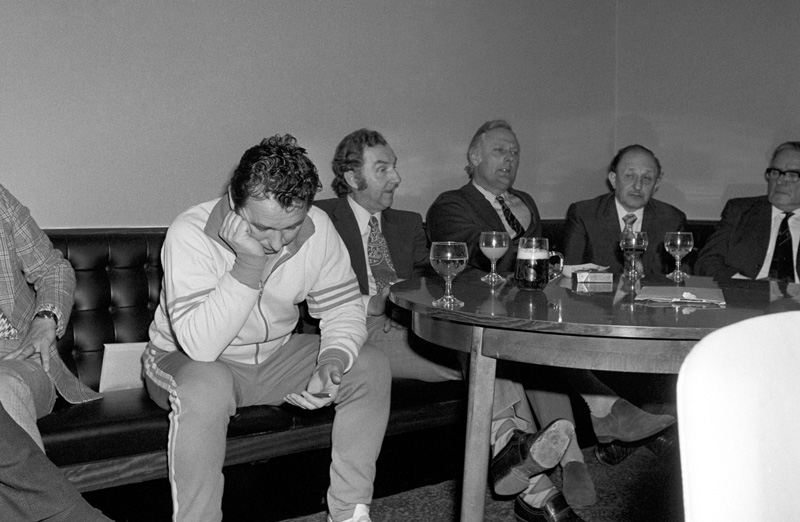
Here the two men are in an unhappy mood, with Brighton chairman Mike Bamber in between. As the song suggests, defeat is no more than ‘a toss of a coin, the luck of the draw’ although when the stakes are high, it doesn’t often feel this way.

clough3

Tagged ,

Longest throw competitions

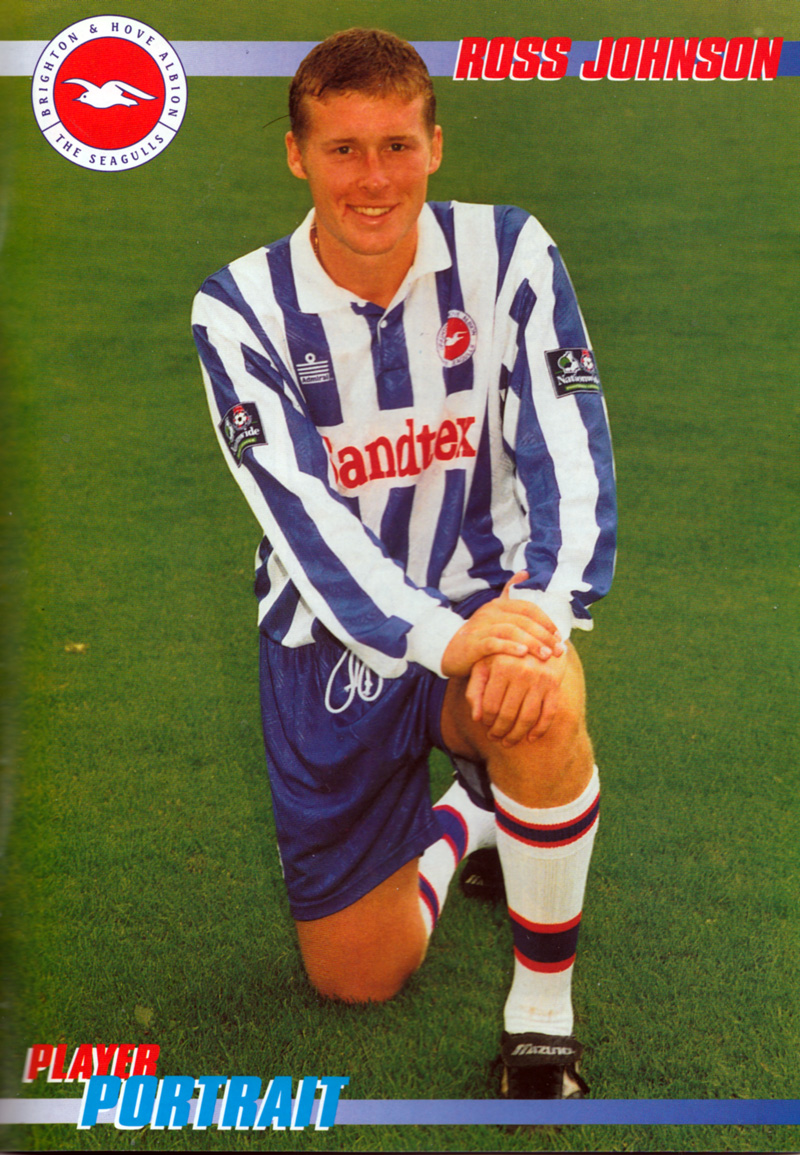
While Brighton slid down the Football League in 1995/96, young central defender Ross Johnson could still be proud of his calm performances, showing good aerial ability and growing in confidence.

rossjohnson1

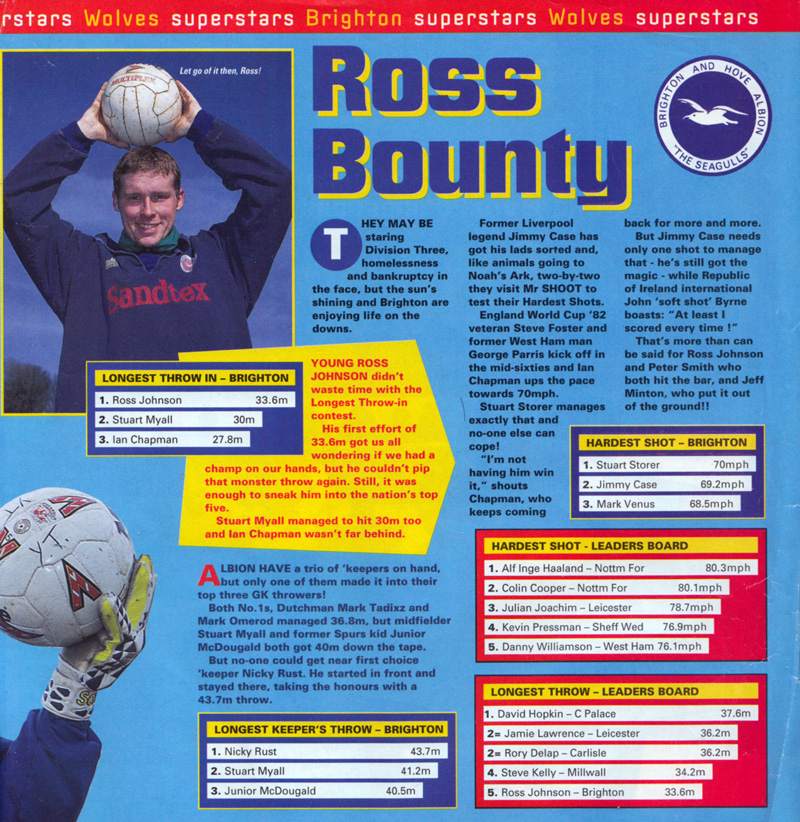
The Brighton-born lad, who turned 20 in February 1996, even got a bit of national media coverage in Shoot! Magazine, with his long throw-in, which served the team well in matches as effectively as a corner:

rossjohnson

A throw of 33.6m propelled Johnson onto the Leaderboard in fifth place. Sadly, I have no record of Eddie Spearritt’s effort for Grandstand in 1970/71, in the BBC’s sport show’s Longest Throw competition, presented by Frank Bough, who also presented on Nationwide in the 1970s and then Breakfast Time in the early 1980s.

spearritt

Sporting some lovely curly blonde hair, Spearritt was an impressive utility player for the Albion in the late 1960s and early 1970s. He could play in defence and midfield, and even deputised in goal when required. He’s also the uncle of Hannah Spearritt, ex-member of S Club 7. Here, his long throw is beaten by Cardiff’s Bobby Woodruff:

Tagged ,

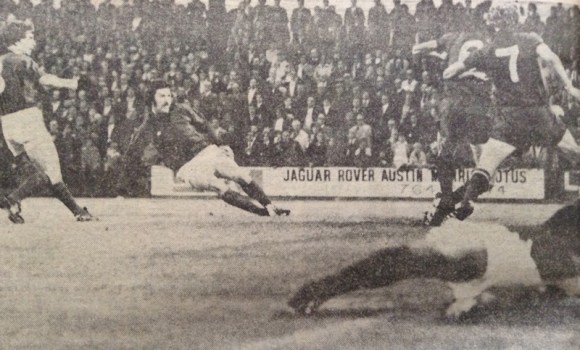
Barry Butlin scores the winner at Selhurst Park

butlin

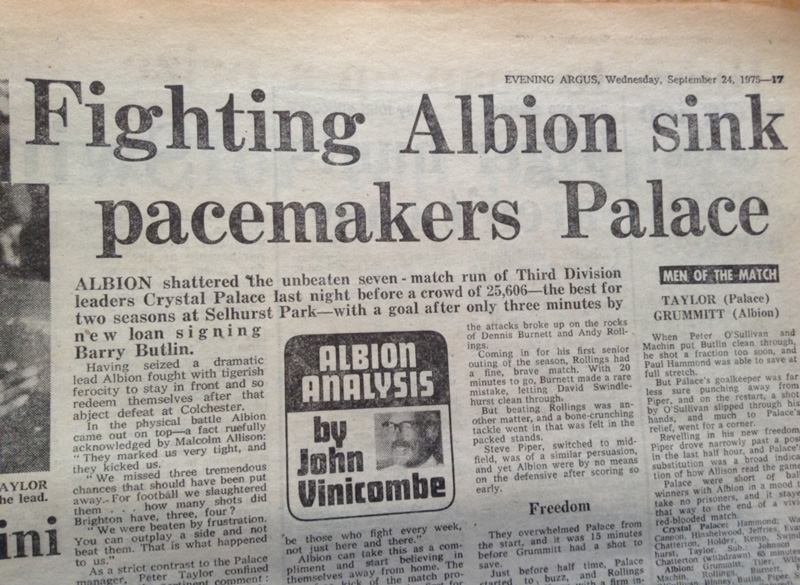
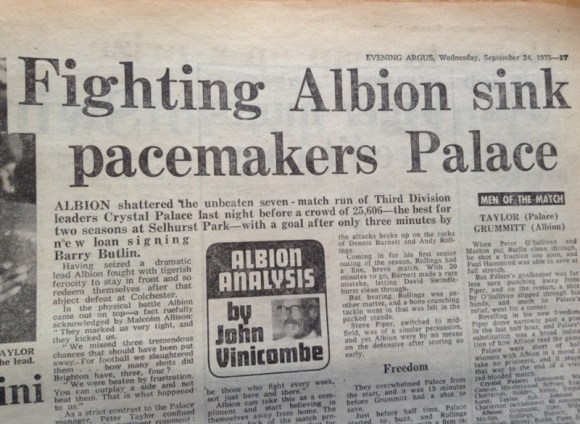
Classic match report by John Vinicombe from the Evening Argus in September 1975:

Fighting Albion sink pacemakers Palace

Albion shattered the unbeaten seven-match run of Third Division leaders Crystal Palace last night before a crowd of 25,606 – the best for two seasons at Selhurst Park – with a goal after only three minutes from new loan signing Barry Butlin.

Having seized a dramatic lead Albion fought to stay in front and redeem themselves after that abject defeat at Colchester.

In the physical battle Albion came out on top – a fact ruefully acknowledged by Malcolm Allison: “They marked us very tight and they kicked us. We missed three tremendous chances that should have been put away. For football we slaughtered them… how many shots did Brighton have, three, four? We were beaten by frustration. You can outplay a side and not beat them. That is what happened to us.”

As a strict contrast to the Palace manager, Peter Taylor confined himself to the pertinent comment: “I was delighted with the result, but I have talked too much this week. The lads did the talking out there tonight.”

Indeed, they did: it was a performance that could well herald the much-promised revival. This was no ordinary League match.

The exchanges were conducted in a cup-tie atmosphere, and the cut-and-thrust carried through with the zest of deadly rivals.

No quarter was asked, or given, but not once did I see a vicious or mean foul awarded by the TWO referees. The first half was run by Denis Turner of Cannock. But he strained an ankle and the second period saw John Hazell from Colchester promoted from senior linesman to the middle.

On 22 occasions Albion were penalised, while Palace had 18 free kicks given against them. This stiffening of resistance by Albion was a direct contrast to their last outing when Allison had them watched. “I was told that Brighton didn’t fight very hard. Well, you saw them tonight… the teams that will go up from this division will be those who fight every week, not just here and there.”

Albion can take this as a compliment and start believing themselves away from home. The first free kick of the match produced the only goal and a first for Albion from Butlin. Machin split Palace with his artful kick and Fell, with room to move, hit a low cross that Binney jumped over. When the ball arrived at the far post, Butlin’s shot was unstoppable.
butlin3

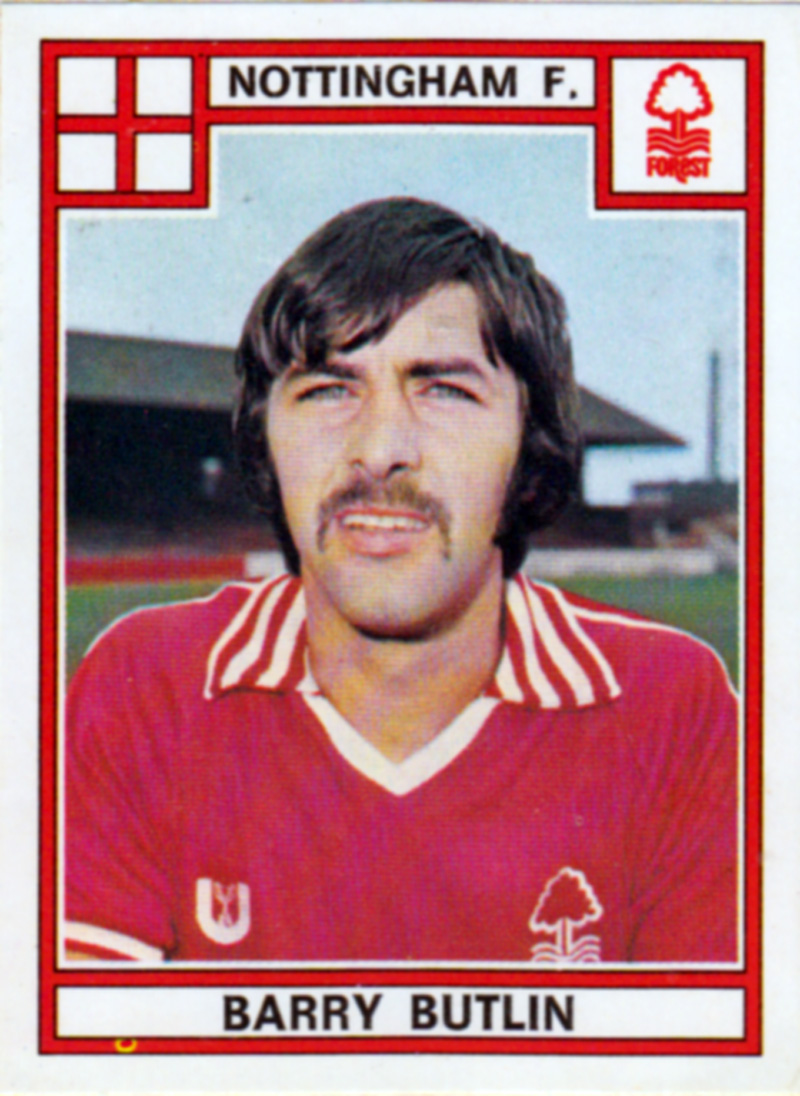
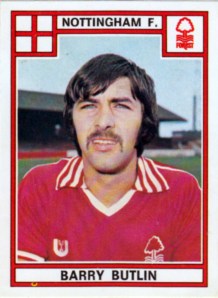
Barry Butlin was a former Derby and Luton striker who had topped the Second Division scoring charts when his seventeen goals helped the Hatters to promotion in 1973/74. (You can see footage of him scoring for Luton in a remarkable game in the snow and fading light against Huddersfield). He had joined Nottingham Forest in a £120,000 deal in October 1974. Making smart use of his ties with Brian Clough, Brighton boss Peter Taylor was able to secure Butlin on loan in September 1975. The goal at Selhurst Park was in the second of the attacker’s five appearances with the Albion. He followed up his Selhurst winner in the next game with another goal as Brighton romped to a 3-0 win against Chesterfield at the Goldstone.

The two successive victories pushed Brighton up to sixth position, a welcome relief after three successive campaigns battling relegation. Nevertheless, inspired by the flamboyant Malcolm Allison and breathtaking wing-play of Peter Taylor (as opposed to the then Brighton boss of the same name), Crystal Palace were still sitting pretty at the top of Division Three, with the loss to the Albion their only League reverse of the season so far. It was still their sole defeat by 6th December when the South London side held a yawning seven point gap between them and second place Brighton. Surely an unbridgeable gap? In the promotion chase that followed, however, Albion completed the League double over Crystal Palace in February 1976, with Sammy Morgan getting both goals at the Goldstone. Helped by wins such as this, Brighton held the runners-up slot as late as 3rd April 1976, before a run of one win in the last five matches ended their dreams. As for Crystal Palace, they seemed distracted by a wonderful run to the FA Cup Semi-Final where they enjoyed famous victories over Leeds, Chelsea and Sunderland. The League form of Malcolm Allison’s side imploded and they finished the campaign weakly with one win in eight matches. By the season’s conclusion, they had nosedived to fifth spot, one place behind the Albion.
butlin2

Tagged ,

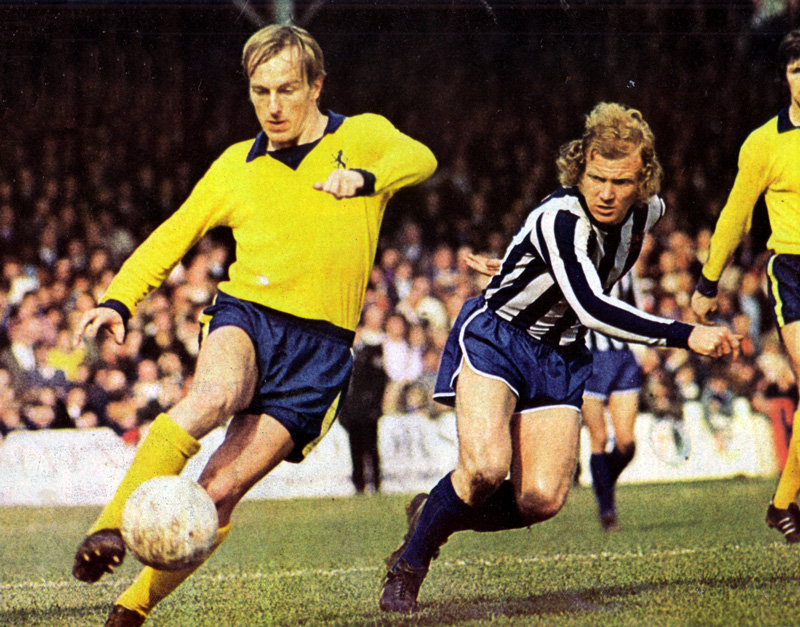
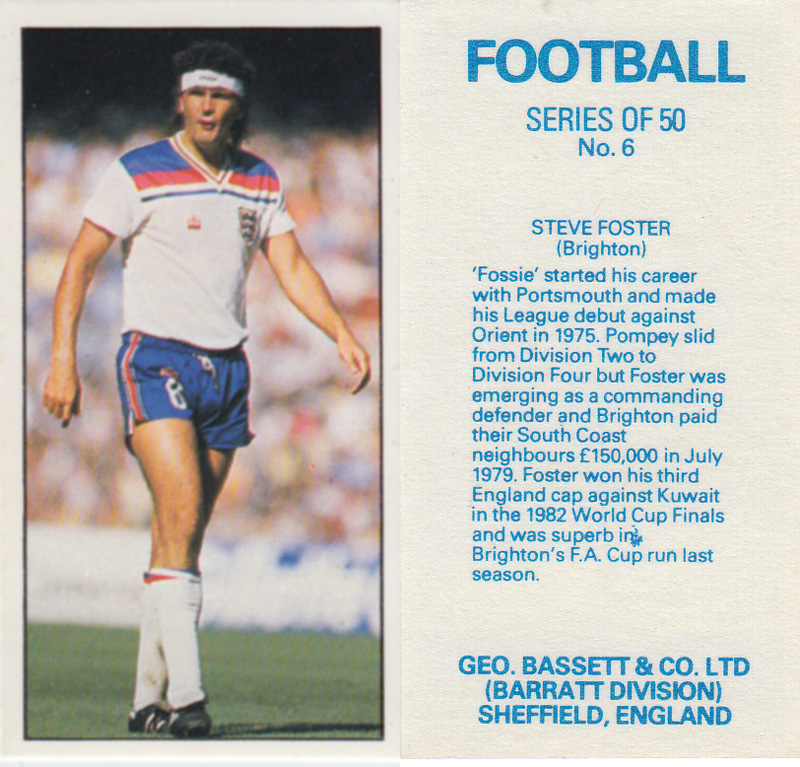
Steve Foster: third choice as captain

stevefoster1

From Match Weekly:

Brighton defender Steve Foster wasn’t the club’s original choice as skipper… he was third in line!

Before the season started Brian Horton, who led ‘Seagulls’ to the First Division in 1979, was expected to carry on the captaincy.

But his surprise move to Second Division promotion favourites Luton created a chance for Eire international Mark Lawrenson and he took charge for a couple of pre-season friendlies.

Mark didn’t keep the job for long because he too fond his way from the Goldstone Ground when Liverpool manager Bob Paisley parted with £900,000 to take him to Anfield.

So new manager Mike Bailey found himself looking for another leader and he had no hesitation in choosing 23 year-old Steve.

‘Mike’s decision to make me skipper came right out of the blue – I’d never even thought about leading the team before,” said Steve. “But it’s a great honour and I’m really enjoying the job. I suppose I play in the ideal position for a captain. Being a defender means you can see more of the game and can tell where things are going right or wrong. I see my role as putting over what the manager wants on the field. It’s my job to make sure each player does what he has been told to do. I’m a bit of a moaner on the field. Part of my game is talking and if things go wrong I’m not scared of bullying my team-mates.

‘The lads have been tremendous. They’ve just knuckled down and done what I’ve told them. I think we can do really well this season. We’ve made a good start and I’m sure we can build on it.’

Foster did so well in 1981/82 that he found himself picked for the England World Cup squad in Spain that summer.

stevefoster3

stevefoster2

Tagged