Category Archives: Media Coverage

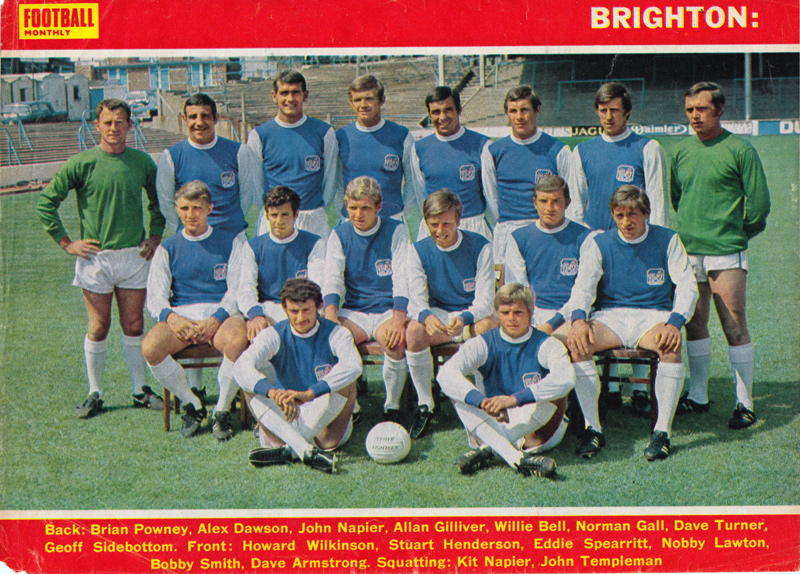
Brighton’s Team Photo 1969/70

1969-70

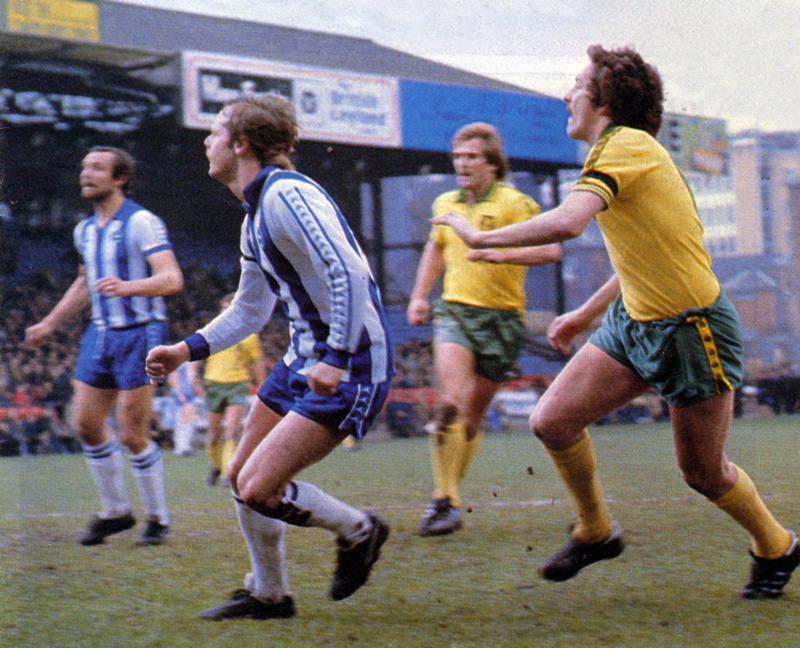
After getting knocked out of the FA Cup by Walsall in a long-running FA Cup 2nd Round tie that went to three replays in December 1969, Freddie Goodwin’s side embarked on a scintillating run of form of fourteen victories in nineteen league matches. Supported by new striker Alan Duffy, who had a sensational debut against Bradford in January, the team (dressed above in kit that made them look like a blue Arsenal) were sitting pretty at the top of Division Three at the start of the Easter schedule. However, four defeat in five games put paid to the promotion dreams. Goodwin left for Birmingham City in the summer.

Tagged ,

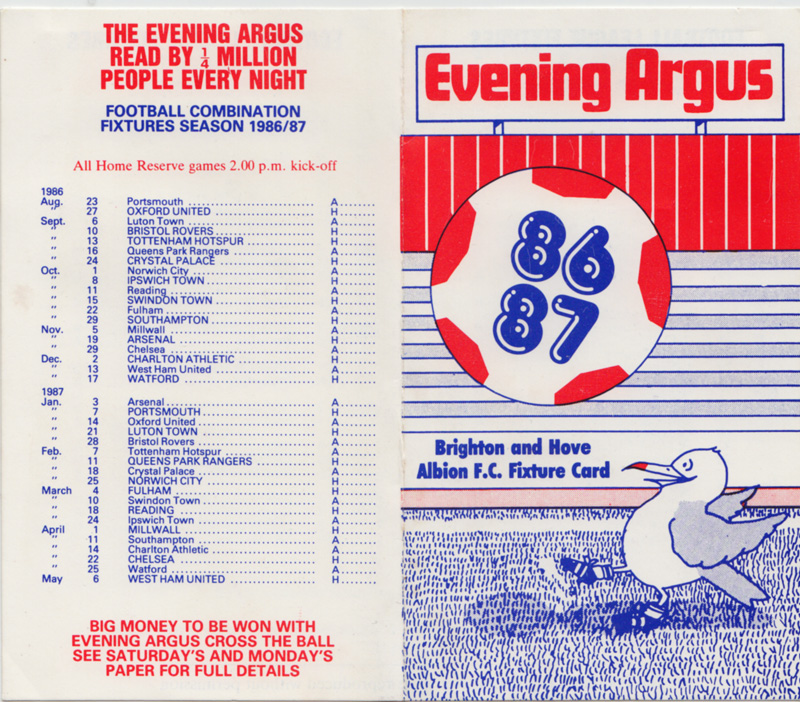
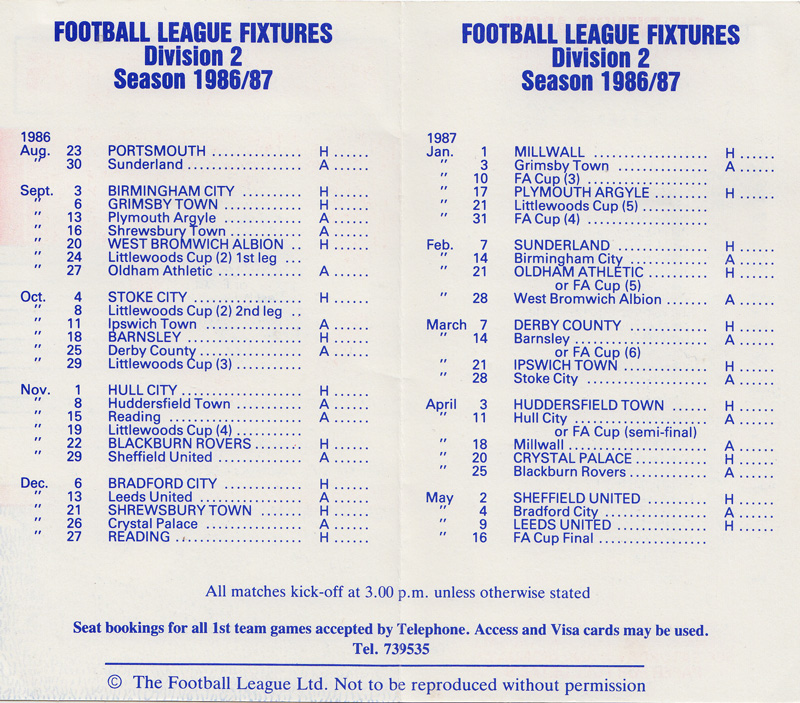
1986/87 Evening Argus Fixture Card

argusfixturecard86-87a

argusfixturecard86-87b

On the day the fixtures for the 2013/14 Football League season are announced (9am), I’d like to share with you an elegantly designed fixture card from the Evening Argus from the mid-1980s. You can also view the one for the 1982/83 season.

Fan anger at the sacking of manager Chris Cattlin was assuaged in summer 1986 by the announcement that Alan Mullery, Brighton boss during the glory years, was back at the helm.

As you can see, the 1986/87 campaign began with an exciting prospect of a south coast derby at home to Portsmouth (yes, it ended 0-0). By the season’s end, Alan Ball had led Pompey back to the First Division (probably the only club where the World Cup winner is considered a managerial success).

Brighton, however, headed in the opposite direction. Mullery was harshly sacked in January 1987 for lacking ‘commitment’ despite doing OK with having virtually no money to spend. Waiting in the wings, Barry Lloyd took his place. Of the fixtures in the second half of this card, only three were won.

Tagged , ,

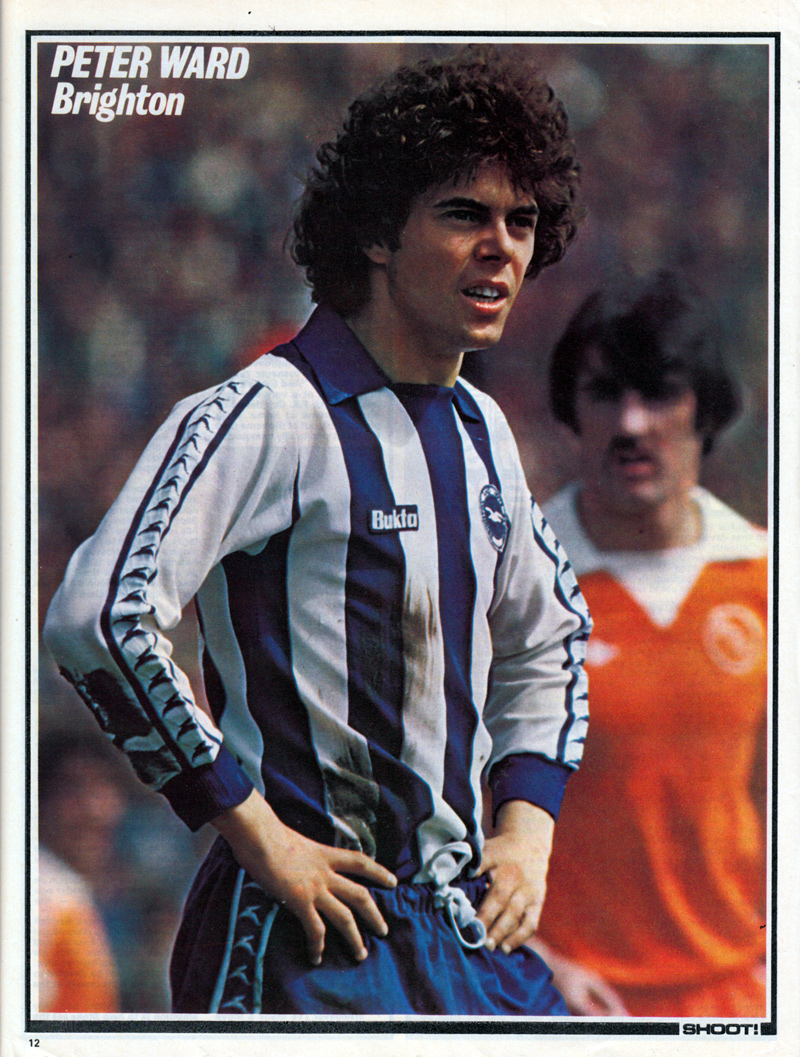
‘I lost my shoes because of Peter Ward’

The pulsating atmosphere of the home match against Blackpool at the end of the 1977/78 season will live long in the memory. High-flying Brighton needed to win at the Goldstone Ground to stand a chance of eclipsing Southampton or Tottenham. Although they won 2-1 it was not enough to give the side promotion to Division One.

peterward5

Teenager Dave Jenkins, in an extract from ‘He Shot, He Scored’ by Matthew Horner, page 78:

During the Blackpool game, a few of my 17-year old mates and I were once again worshipping Wardy in the North Stand.

Yet again, in a desperate tense game, Wardy came to the rescue with a piece of typical fleet-footed magic. As the ball sped into the net, the North Stand erupted with even more thunder than had been usual in those fabulous years under Taylor and then Mullers. The surge from the back of the stand lifted us fully 10 steps down that crumbling terrace.

As I was being carried down towards the pitch in a state of delirium, I remember the feeling of my new and very expensive Ravel of Western Road moccasins being ripped from my feet by thousands of equally out-of-control Brightonians.

Needless to say, I never saw those shoes again: I had to walk back to central Brighton barefoot.

Not really feeling up to much, we decided to have a beer of commiseration in Shades (now the Pavilion Tavern). Unlike today, a bloke taking to the pubs and clubs without any shoes was a bit unusual in 1978.

It turned out to be a hugely successful evening with some of the town’s best-looking girls, and even the bouncers in the Queen Anne pub let me in shoeless in Wranglers (very unusual) – all because of my response to the obvious question ‘What happened to your shoes?’ My answer was, ‘I lost my shoes because of Peter Ward.’

moccasins

Tagged

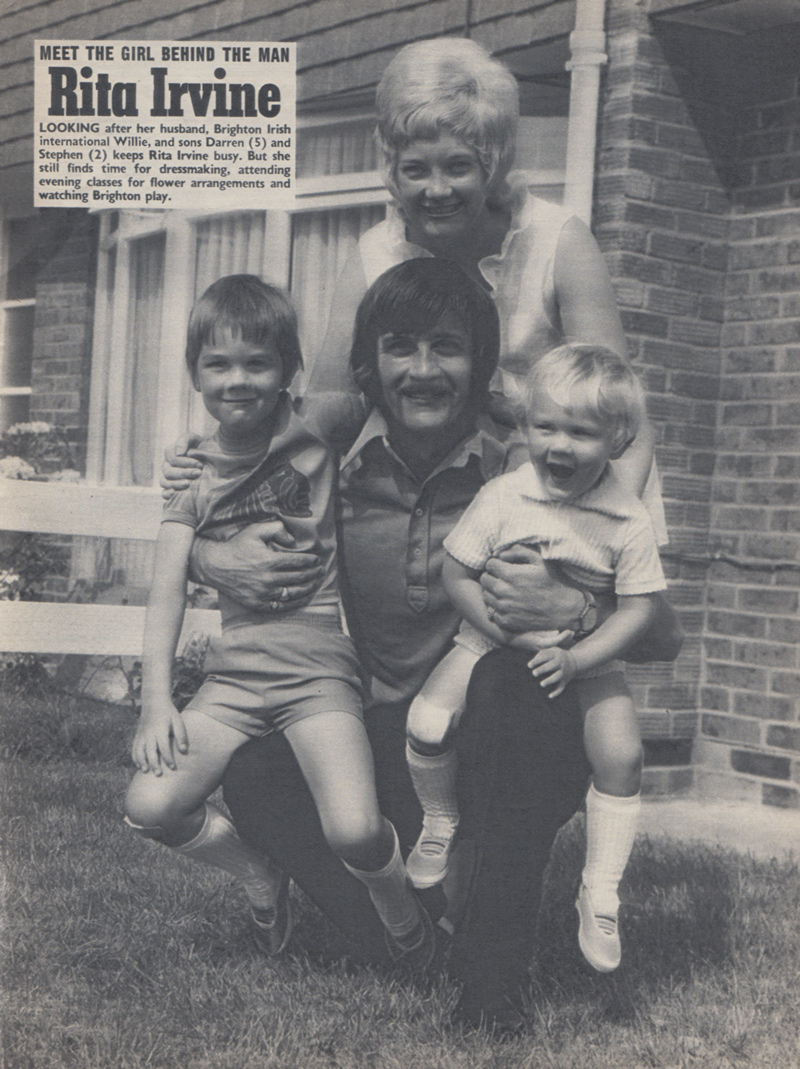
Meet the Girl Behind the Man: Rita Irvine

Northern Ireland centre-forward Willie Irvine was one of Brighton’s star strikers in the 1970s. He joined on loan from Preston in March 1971 and his six goals in fourteen League games helped to rescue the Albion from a Third Division relegation battle that season.

From Goal! Magazine:

ritairvine

Looking after her husband, Brighton Irish (sic) international Willie, and sons Darren (5) and Stephen (2) keeps Rita Irvine busy. But she still finds time for dressmaking, attending evening classes for flower arrangements and watching Brighton play.

A less rosy, but eventually happy, picture is painted in Willie Irvine’s autobiography, ”Together Again’:

The offer of a three-month loan to Brighton was made and Rita and I looked at each other. Against it was the fact that a move from Preston to Brighton would be 200 miles or thereabouts further than a move from Burnley to Preston. It seemed a huge distance for Burnley girl Rita, who would be leaving the closeness of family and relatives. The four of us – by now we’d had our second son – would be well and truly on our own. There’d be no bus rides home for the day like she could do from Preston to Burnley.

The club had promised to organise a rented property for us, a lovely flat in Shoreham-By-Sea. We kept the house in Preston for when we went back. The problems of being a football wife hit Rita hard. Strange place, strange flat, me away frequently. In the first week one of the boys took very ill while I was away for three days. All Rita could do, young, panic-stricken and frightened, was knock on the flat below and ask for help. She knew no one but the woman she begged for help, a total stranger, turned out to be a real saviour and called her own doctor who came every day for the next week. They became the best of friends and bit by bit we got to know other players and their wives. Only a footballer knows what the wife goes through at times like this. They are a special breed. Some are strong and can handle it. Others don’t. Rita might have had floods of tears on several occasions and suffered from my moods, but she coped, stuck it out and adapted every time we moved.

Tagged

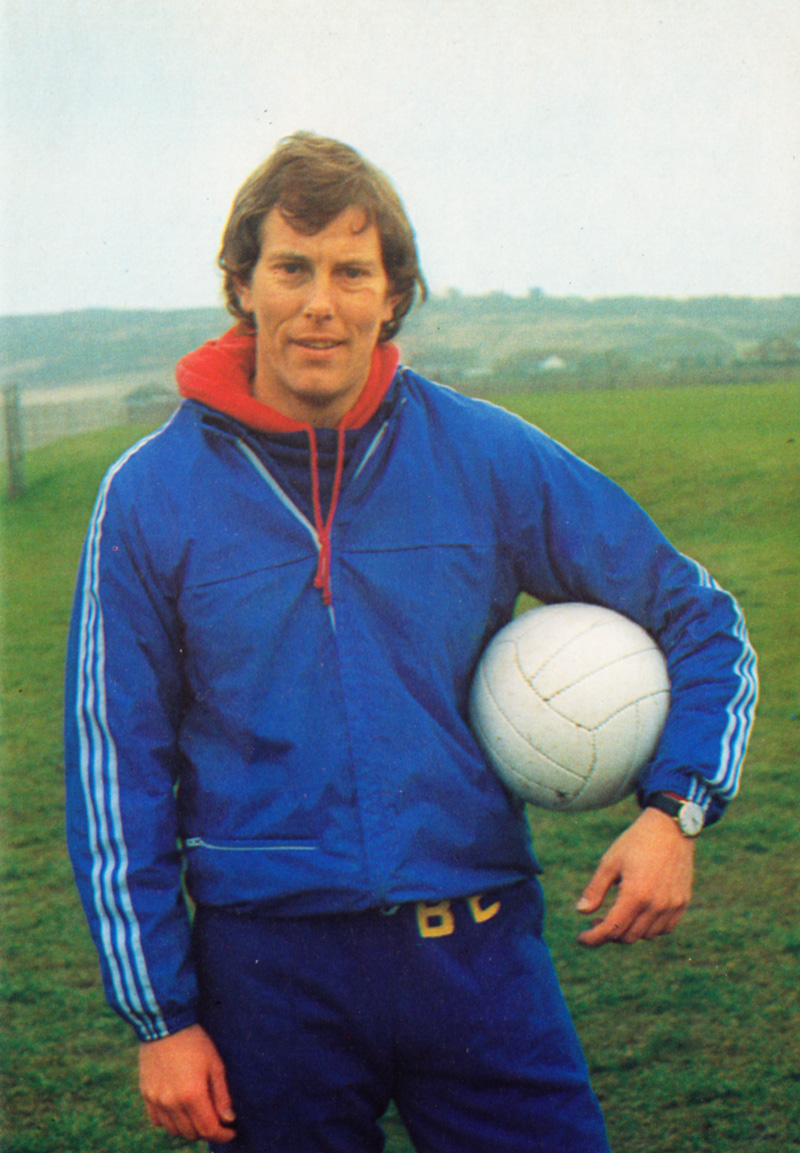
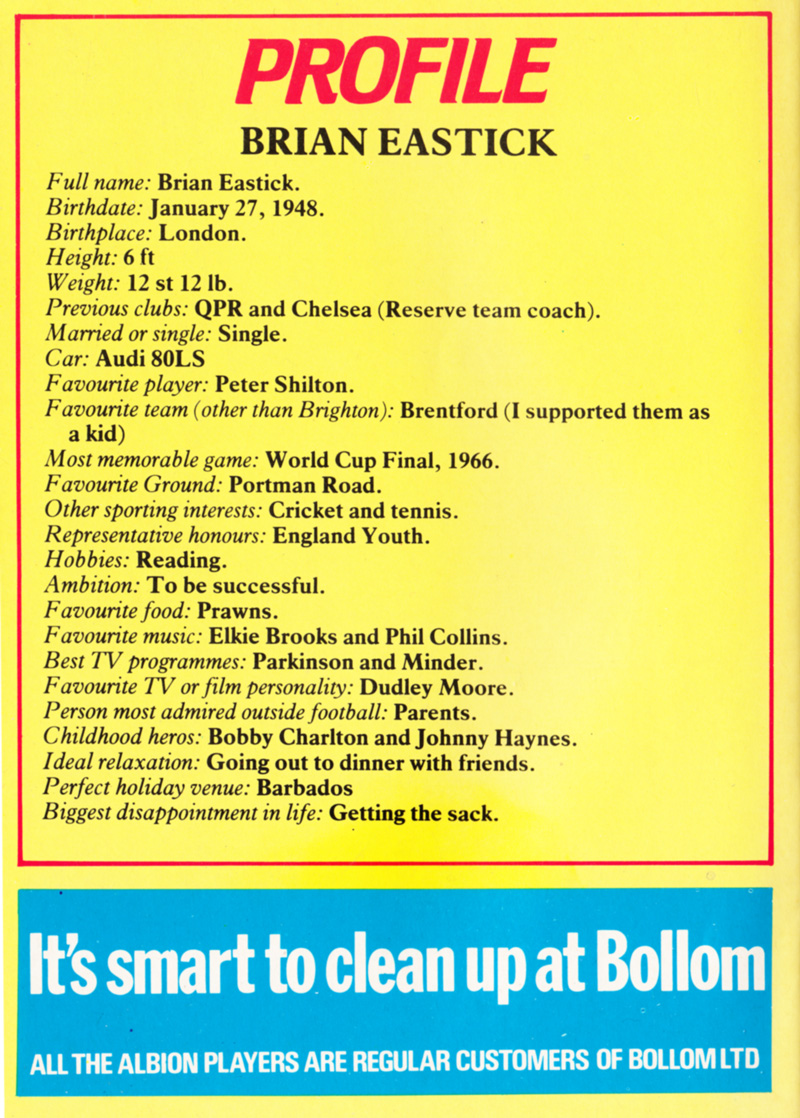
Brian Eastick and the imaginary football

brianeastick1

Brilliant anecdote from Gordon Smith’s ‘And Smith Did Score’ autobiography, page 123:

The players look at each other and wonder if they should believe what they have just heard. Standing on the training ground, they look askance at the Brighton youth team coach, Brian Eastick, who is taking the first-team training for he first time.

‘Right lads,’ he has just told us, ‘We’re going to have a game of football, so pick two sides. But what’s different about this game – and if you take this seriously it will be a great help to you – is that we’ll be playing with an imaginary ball.’

‘It’s twenty minutes each way – a practice game with a pretend ball.’

He senses a reluctance from the players and nobody moves. ‘Look,’ says Brian, ‘the boss is watching and it’s either this or he’ll have you running all morning – what’s it to be?’

Since anything’s better than running round a track for a couple of hours, we decide to go along with this rather unconventional training method. We’re about to start the 1982-83 season and this is undoubtedly the weirdest training session I have ever taken part in and that would go for the rest of the Brighton players as well.

We get ourselves into teams and line up to kick off. The former Arsenal star, Charlie George, has joined Brighton on a month’s loan and he’s in my team. I kick off by touching the imaginary ball to Charlie who makes an imaginary pass to our winger, ex-Manchester United player, Mickey Thomas, Mickey then makes a 20-yard run at full pace, slides along the touchline and jumps up to shout, ‘For fuck’s sake, Charlie, play it to my feet, will you?’

The players can hardly stand up for laughing and that’s the end of the game. Brian Eastick is not happy and, since we’re not taking his game with the imaginary football seriously, it’s back to running round the track.

Brian had been on the continent looking at how the European teams train and noting their coaching methods. He must have seen some foreign team trying out this practice match with no football and decided to introduce it to the British game. Brian had persuaded Brighton’s then manager, Mike Bailey, to let him take the first-team training for a morning and try out these new methods. Unfortunately, the British footballers weren’t quite ready for such progress and diversity of coaching methods.

brianeastick2

Tagged , ,

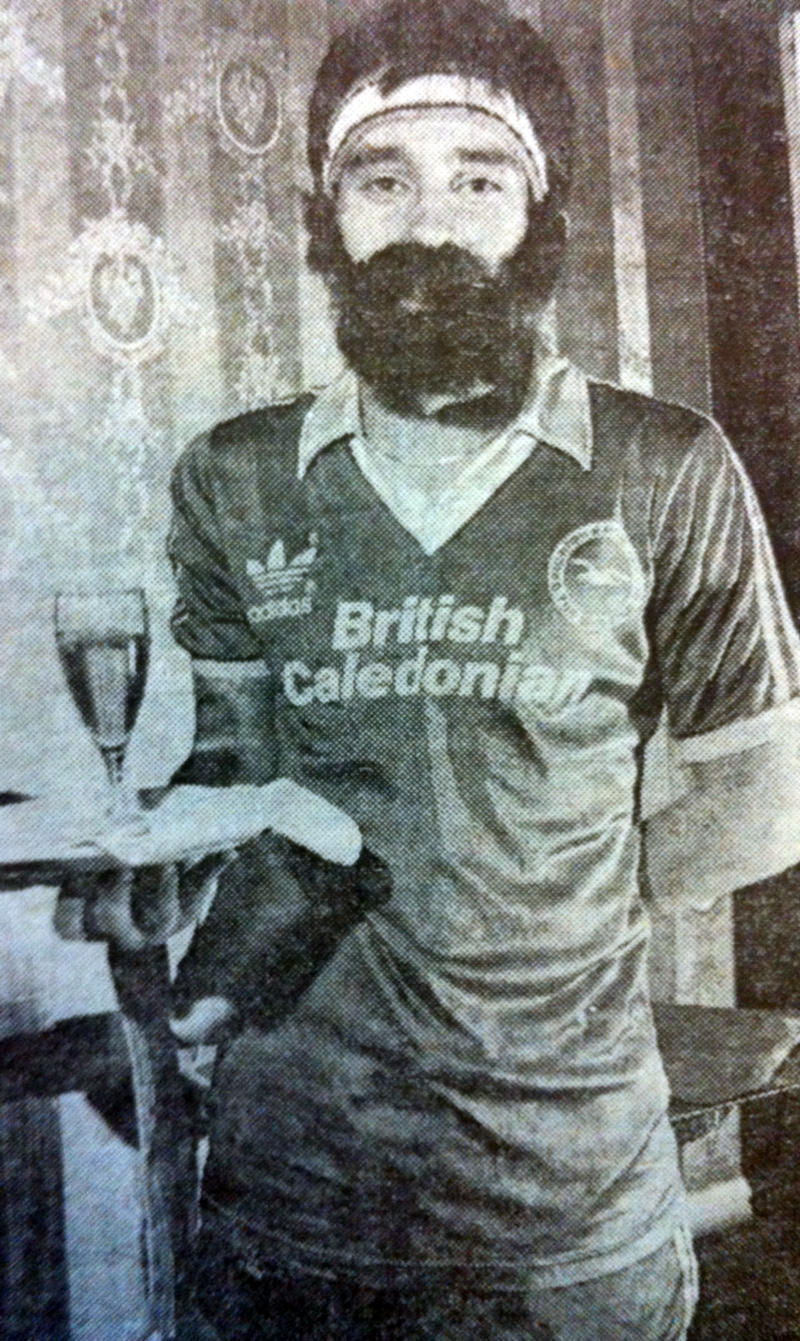
Random fan photo from the Evening Argus in the 1980s

moustache

I wish I could explain what this photo was all about but sadly it’s become detached from the story in the local newspaper. If anyone knows or would like to guess, feel free to add a comment!

Tagged

Michael Robinson, Albion’s sharpshooter, guns for Malcolm Allison

michael robinson cowboy

Over three seasons, Robinson scored 37 First Division goals for the club, more than any other Albion player. He joined Brighton in a £400,000 deal in the summer of 1980. In March 1981, he returned to Maine Road with the Seagulls to play in the First Division fixture against his old side. By that point, it was clear that his move to the South Coast had been a success. Although his new club was facing a relegation battle, Robinson was ever-present and his seventeen League goals so far had rebuilt his confidence and reputation as a centre-forward.

On the eve of the match, he spoke to Peter Gardner of the Manchester Evening News:

Michael Robinson returns to Maine Road today for the first time since his transfer to Brighton last summer with the controversial admission: ‘I had to leave City to get away from Malcolm Allison and save my career.’

Robinson lines up against a City side now without the man whose views forced him to leave the Blues. And the man who had earlier handed Preston a then-club record fee of £750,000 for the striker’s talents. Robinson says: ‘Malcolm Allison and I just didn’t see eye-to-eye – it became inevitable that I would have to leave the club. It was a total conflict of ideas. Malcolm wanted me to do things I didn’t think I was capable of doing. He was asking me to play wide up front, on my own or on the wing… crazy things like that. It just wasn’t me. All I ever wanted to do was to be successful for City as a centre-forward, my best position. But Malcolm somehow got these ideas that I should play everywhere except that one, and I could never agree. Being messed about like that was making me a poorer player. In those circumstances I just had to leave.

Looking back on his move to Brighton, Mike says: ‘Alan Mullery told me from the outset that he wanted me to play just as I always wanted to play, and I shall always be grateful to him for that. I am thoroughly enjoying my football once again. And that is certainly a relief after all the agonies and frustrations I went through in the later part of my stay at City.’

Robinson admits to still being baffled by the Allison strategy: ‘I couldn’t understand it then and I still can’t work it out now,’ he says, adding: ‘The season before Malcolm bought me he had Peter Barnes and Mike Channon drifting wide down the flanks, but no centre-forward to take advantage of the service. Then, when I arrived as an orthodox centre-forward, he sold Barnes and Channon. So where was I expected to get the service form? Since I have left City, I feel I have come on leaps and bounds. My game was deteriorating at Maine Road where Malcolm, in his time, blinded the players by science. Their minds were blank by the time they went out on the field. Here at Brighton I have found a new lease of life.’

The match at Maine Road ended in a 1-1 draw. Although Robinson didn’t score, he headed a long clearance by Digweed to give goalscorer John Gregory, in oceans of space, an excellent chance to make it two points rather than one, but Gregory stubbed his toe and the ball ran wide. Nevertheless, Robinson added two more goals to bring his League total for the season to nineteen. He also received the Albion Rediffusion ‘Player of the Season’ award.

Years later, Robinson was much more receptive to what Allison was conveying to his players as a coach. He said: “”I used to think Malcolm Allison woke up in the morning wondering how to complicate my life. He would speak to me about angles and zones. And I wasn’t the only one. Mick Channon didn’t understand a blind word either. But I archived it somewhere. Later, what Malcolm had been saying fell into place.”

Tagged

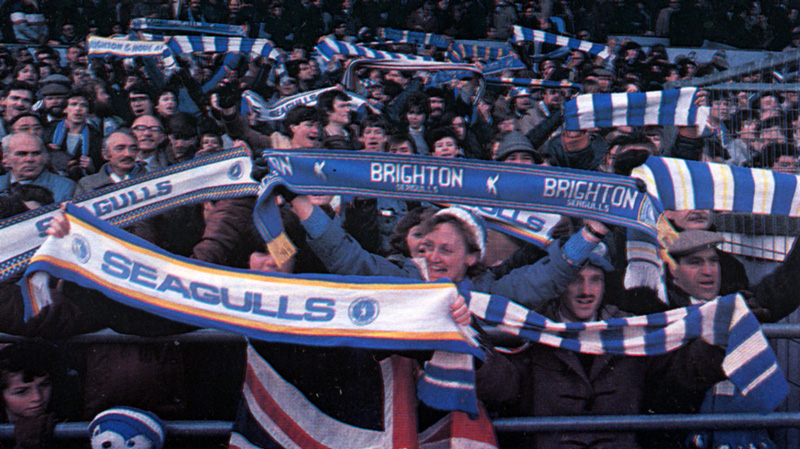
Fans warned by Bamber to turn up early

brighton-supporters

From Shoot! magazine in 1979:

Brighton fans get a warning from chairman Mike Bamber as they prepare to welcome the First Division big boys to the Goldstone Ground.

The Seagulls start life in the top flight with a glamorous home game against FA Cup winners Arsenal – and Bamber makes it clear the fans must get there early. “I’m afraid they are going to have to change the habit of a lifetime and turn up at the ground with plenty of time to spare now we are in the First Division,” he says.

“The days when they could turn up ten minutes before kick-off and stroll through the turnstiles are over. If they do that now there’s a fair chance they won’t get within a mile of the ground. Our promotion to the First Division has created tremendous interest down here and everyone is excited about seeing some of the great names and some of the great teams of football at Brighton.

“We have all got to make adjustments to meet the new challenge and I beg the fans to get here in plenty of time in future. We’v had problems in the past on big-match days trying to pack in everyone who turned up late and many have complained it’s taken them ages to get through the turnstiles.

“It will do. It you get lots of people arriving together – and late. They will have no chance at all this season if they leave it late. So my message to fans is – please be early.”

In the end, Bamber was both right and wrong. A huge crowd of 28,604 came to see Brighton trounced 0-4 by Arsenal in a First Division baptism of fire in August 1979. All but one home league game hit the 20,000 mark, which was understandably the Stoke match shortly before Christmas. (If fans had to miss one, they chose wisely as it was a 0-0 stalemate). At the same time, the attendance at the Arsenal match was still five-thousand short of the capacity at the time. There was not one 30,000 attendance at the Goldstone Ground by the end of 1979/80.

By the following season, the novelty of top flight football had waned, with Brighton mostly struggling to keep their head above water. With the onset of recession and much higher ticket prices than in the old days of the 1970s, home attendances began to dip.

Tagged ,

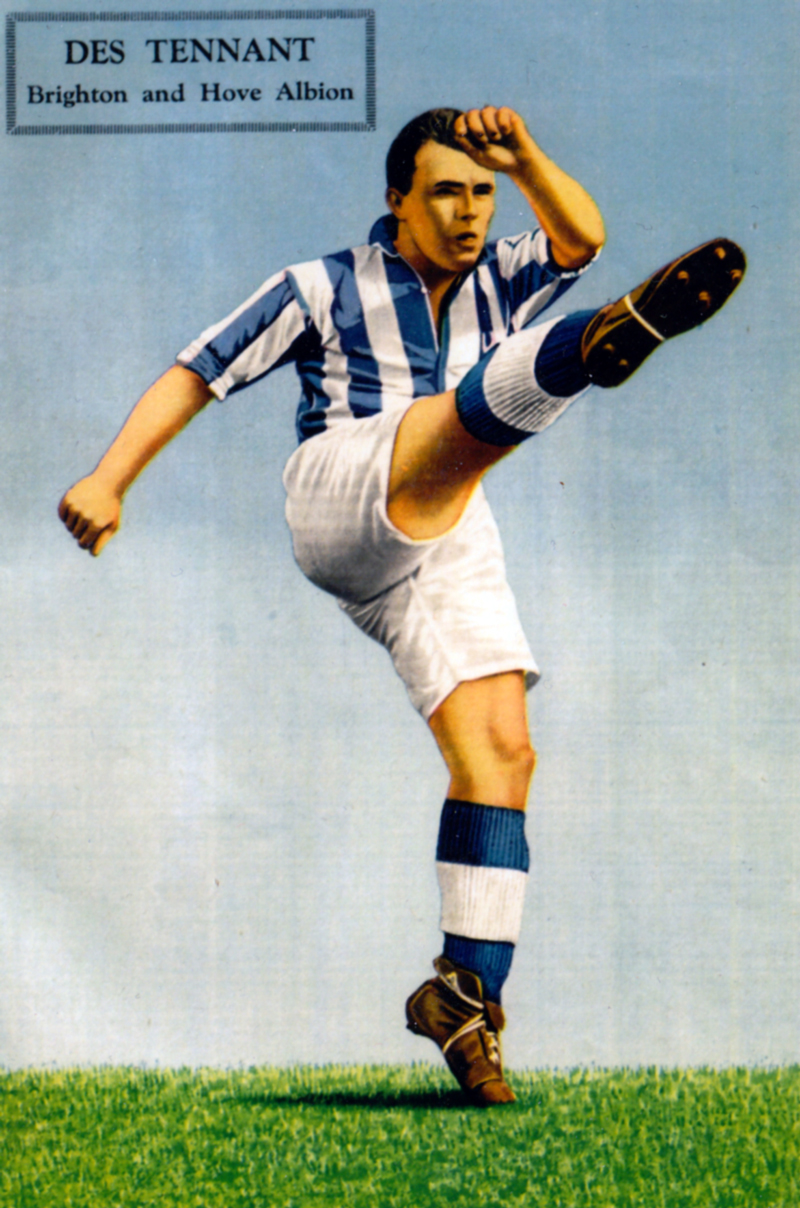
Des Tennant – the original ‘Tank’

destennant

Several Brighton players down the years have been known as ‘The Tank’ for the power of their play, but I think Des Tennant was the original.

He signed from Barry Town in the summer of 1948, as a 22 year old, and made a whopping 424 appearances for the club.

His lion-hearted forays down the touchline made him a favourite at the Goldstone. He initially lined up as a right-winger, also playing as inside-right before become a ferocious tackling right-back with a lot of attacking intent. No wonder that Des Lynam, in his autobiography, referred to the other Des as ‘a favourite player of mine.’

In the ten years when he was a fixture in the side, Tennant was also captain for three seasons, including in 1953/54 when Brighton were runners-up in Division Three (South). Unfortunately, in those days, only the champions were promoted. He also scored 47 goals, 23 of which were penalties.

One particular goal is remembered fondly on North Stand Chat by the user nobody’s dupe. He recalls the days when clubs would play home and away fixtures against the same opposition over Christmas. Brighton gave Newport an unhappy present on Christmas Day 1952, thrashing the Welsh side 3-0 on their own ground. Two days later, in the return fixture at the Goldstone, Albion were 1-0 up at half-time but then surprisingly found themselves trailing 2-1. It took a long-range effort from Des to save the day.

Des enjoyed a benefit match against Brentford in May 1954. He retired in 1959 to join the coaching staff.

Sadly, he died in January 2009. His niece, Gillian Marsh, of Derwent Drive, Cwmbach, said: “My uncle was a wonderful character who loved life and valued his family and friends above all else.”

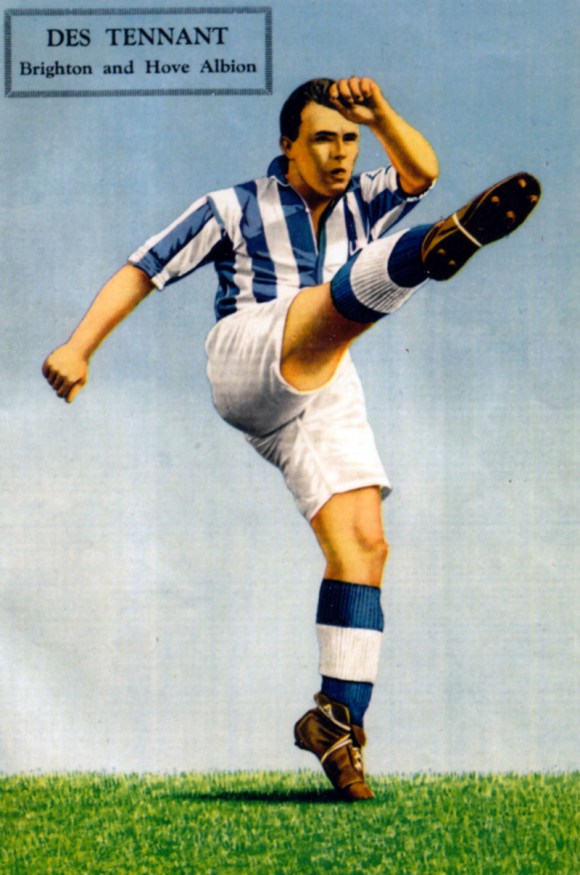
The image above, from a magazine, in a football shirt that buttons all the way down the front, is used to form the crest of the Brighton & Hove Albion Collectors and Historians Society.

Tagged ,

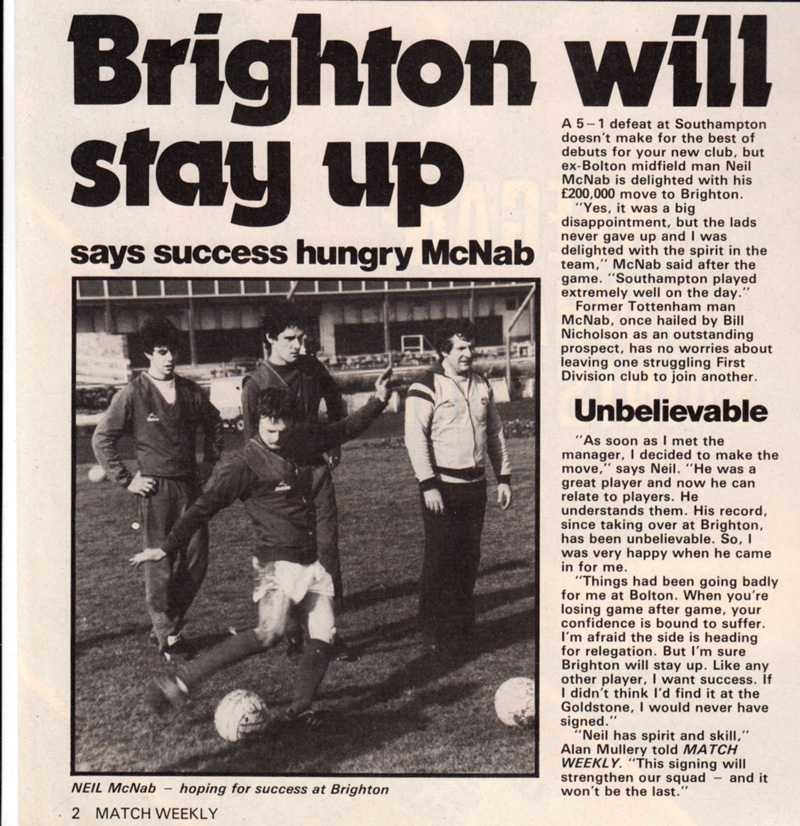
Neil McNab is sure Brighton will stay up

neilmcnab2

From Match Weekly in February 1980:

A 5-1 defeat at Southampton doesn’t make for the best of debuts for your new club, but ex-Bolton midfield man Neil McNab is delighted with his £200,000 move to Brighton.

“Yes, it was a big disappointment, but the lads never gave up and I was delighted with the spirit in the team,” McNab said after the game. “Southampton played extremely well on the day.”

Speaking of Alan Mullery, McNab said:

“As soon as I met the manager, I decided to make the move,” says Neil. “He was a great player and now he can relate to players. He understands them. His record, since taking over at Brighton, has been unbelievable. So I was very happy when he came in for me.”

After playing for Spurs in the infamous promotion game with Southampton in April 1978 (which Brighton fans deem a ‘fix’), McNab had found himself frozen out of the side by the signings of Osvaldo Ardiles and Ricardo Villa. He joined Bolton Wanderers in November 1978, Second Division Champions in 1977/78, but by 1980, they looked certain for the drop from the First Division.

McNab’s personal life had been clouded by the death of his father at the age of 43. Mike Bamber, Brighton chairman, promised to be a ‘second father.’

On the pitch, McNab brought some much needed class to the Goldstone. His busy, methodical play, with an excellent range of passing, did much to help the club secure top flight status comfortably.

neilmcnab

Tagged