Yearly Archives: 2013

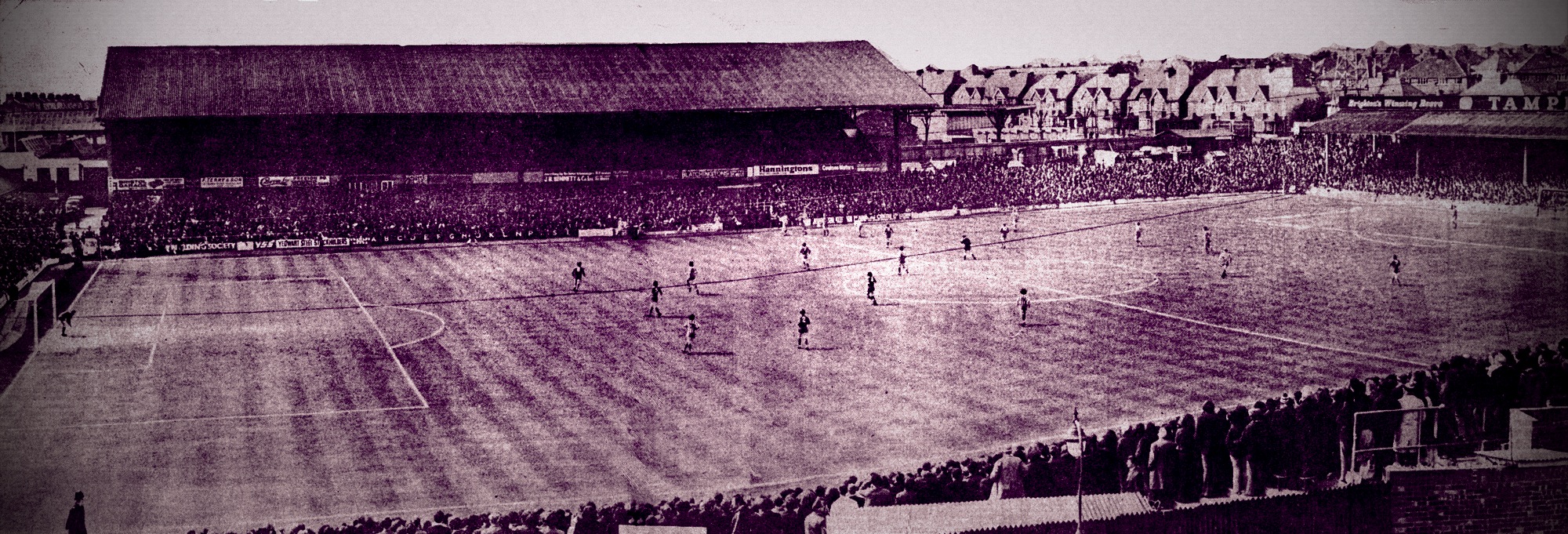
The Goldstone gets ready for Division Two in 1972

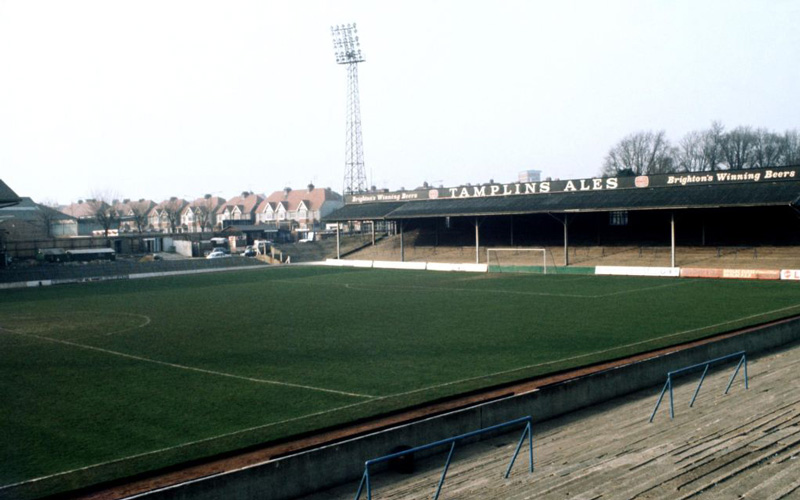
With its rather jolly looking Tamplin’s brewery advert and clear view of many people’s homes and gardens, the Goldstone Ground in 1972 may not look like an intimidating sight. However, it is where Brighton & Hove Albion showed sufficient form to clinch promotion from the Third Division in 1971/72. Pat Saward’s men won an impressive fifteen home league matches out of 23, with the Goldstone roaring the side on in the decisive 1-1 draw with Rochdale in May.

goldstoneground1972

An Evening Argus supplement was issued to celebrate the newly won Division Two status. Its centre-spread featured a magnificent image of three stands of the Goldstone. I’m not sure if this image below does it justice. Click on it to get an enlarged version to see a lot more detail:

goldstoneground5a

If you look closely, you can see that the club kept supporters up-to-date with the alphabetised half-time scores on the side of the pitch.

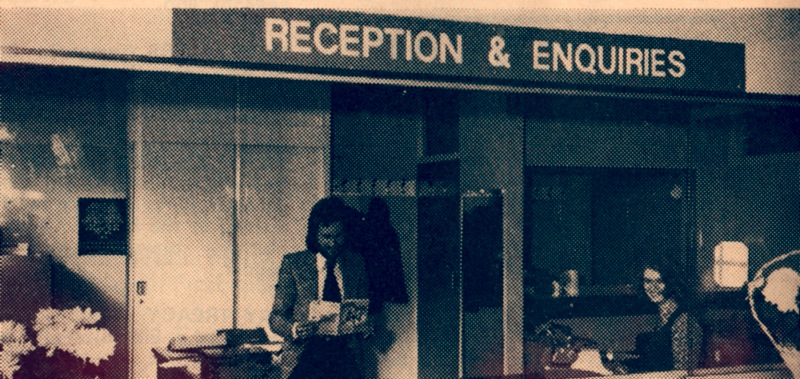
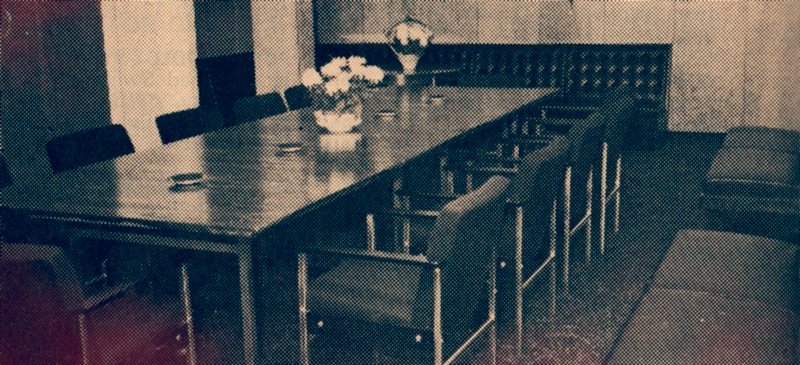
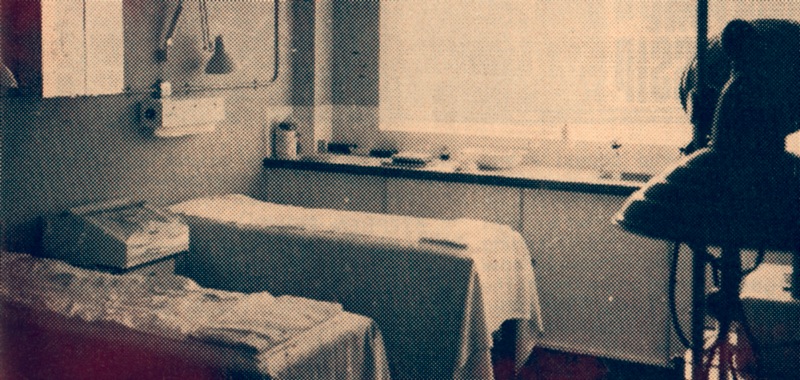
Promotion in 1971/72 was a shock to many at the Albion. Considerable money was spent and much building work was done in the summer to ensure that the spartan facilities were not an embarrassment in the Second Division:

Reception and general office

Reception and general office

Board room

Board room

Treatment room

Treatment room

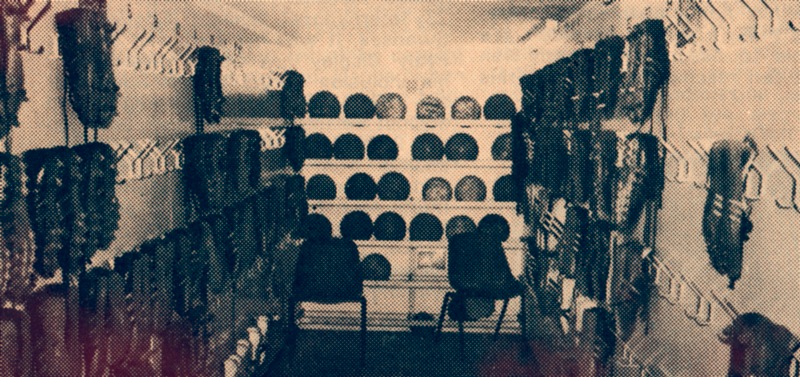
Players' boot room

Players’ boot room

I don’t know about you, but these renovations don’t look that impressive!

Still, it was probably the best that could be done. There was a lot less money to play about with at the club compared to later on in the decade.

Tagged

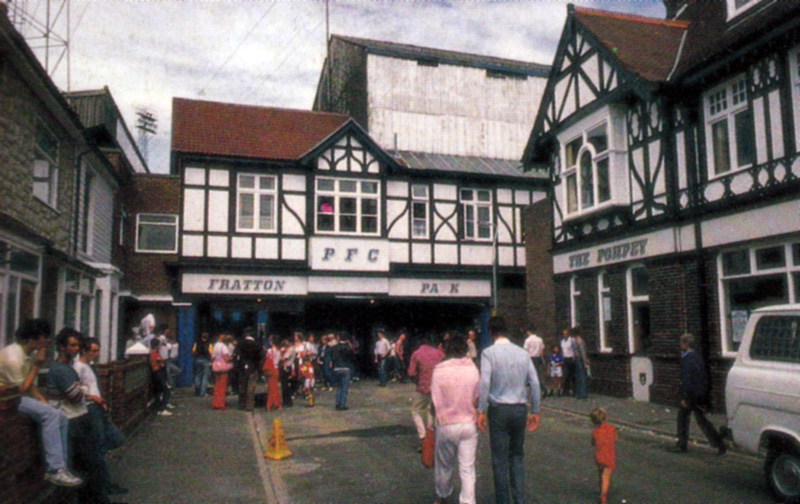
Fans fury over Brighton move to Fratton Park

frattonpark

Thank your lucky stars that the future looks bright for Brighton. The current set-up is quite unlike what it was in the mid-1990s when it was increasingly difficult to write about the club without using the word ‘beleaguered.’

This article by Andrew Arlidge from 1995/96 captures the horror as a soon-to-be homeless Brighton face up to the prospect of playing home matches in Portsmouth, with the recent demise of Maidstone hanging in the air:

Brighton’s shell-shocked players and fans are still finding it hard to come to terms with the club’s plans to sell the Goldstone Ground and share Portsmouth’s Fratton Park from next season.

Albion’s chief executive David Bellotti says the Second Division club are now £6 million in debt and the only way for them to survive within their own resources is to sell the Goldstone – their home for 93 years.

Bellotti claims there are now provisional contracts in place for the sale, and that is why they have secured a provisional agreement to play at Portsmouth, but he stresses that temporary facilities much nearer to the Goldstone are being examined.

A possible location is the Hove greyhound stadium, less than a mile from the Goldstone, but vanous hurdles need to be overcome before a safety certificate can be granted•.

As well as an agreement from owners Corals, Brighton would need land from the adjoining Alliance and Leicester Building Society, a new stand for 5,000 supporters and financial help from Hove Council.

Fans have been quick to oppose the prospect of making a 100-mile round trip to Fratton Park for home matches by staging a pitch invasion and demonstrations. But Bellotti emphasises going to Portsmouth would be a last resort.

He said: “If there is any chance of accommodating the club at the greyhound stadium, or anywhere else nearby, we shall make every effort to do so. Ground-sharing at Portsmouth is a safety-net but if there is no alterntive we shall be going there in 1996.”

Brighton have been told by the Football League that they will not sanction the ground-share unless they receive guarantees that the club will be building a new stadium in the town. So far a site for Brighton’s proposed 30,000 seater multi-purpose ground has not been identified and the League say they need to know the situation well before next June when Brighton are due to leave the Goldstone.

League spokesman Chris Worley confirms that regulations state new clubs must play in their home town while establishing themselves in the League. but the League would do all they could to help established sides, like Brighton, survive.

The League are anxious to avoid a repeat of the situation which led to the demise of Maidstone three years ago. The Third Division outfit were allowed to ground-share at non-league Dartford but their plans for a new stadium in the town never came to fruition, and the club eventually resigned from the League after going out of business.

Said Worley: “Brighton moving to Portsmouth is not ideal because of the distance supporters would have to travel. But it wouldn’t be a major obstacle as long as there were cast-iron guarantees from Brighton about the future.

“There would be no sanction from us until we were satisfied that the club had planning approval for a new ground and we had an idea when building would begin.”

Bnghton say they have to repay more than £4 million worth of debt by next June, but the total amount they owe is approaching £6 million because of other debts which are to be met on different timescales.

Bellotti maintains the only thing that prevented Albion from folding in 1993 was a financial re-structuring. This resulted in Greg Stanley and Bi!l Archer becoming the only shareholders in the club.

Said Bellotti: “They had a clear determination, whch rernalns to this day, that the first and foremost objective was to have a winning team and obtain Premier League status.

“A second objective was to build a new stadium fit for Premier League football. The Goldstone Ground cannot be developed as a football stadium.

Funding the debts in a ground that cannot be developed is not a viable proposition. The debts become repayable in the summer of 1996. They were incurred over many years and resulted in several High Court appearances in 1993.

“Since those days in the High Court nobody has offered to help with our debts and no true supporter would expect us to simply wait for the inevitable winding-up order finishing us off at the end of this season. We must maintain Albion as a League club at whatever sacrifice.”

Bellotti claimed club chairman Archer and president Stanley would Invest money on the club provided Albion has the council’s support to build a new stadium.

He added: “By the close season in 1996/97, the shareholders will make available more money than ever before for manager Liam Brady to buy players to strengthen the team for a real push for promotion.

“Other clubs succeeding with plans for new grounds have nearly all had planning and financial help from their local authormes. I urge our fans to contact the leaders of Bnghton and Hove councils requesting their heip in both the short term, with a move to the greyhound stadium, and in the longer term with a move to a permanent stadium.”

A step in the right direction has been the setting up of a Sports Development Trust with the aim of attracbng funds for the new stadium.

Meanwhile, Brady has gone into his second full season in charge having only added loan players Gary Bull and Greg Berry to his squad. His sole cash signing since taking over 21 months ago has been winger Stuart Storer, a £15,000 buy from Exeter last season, and Albion’s plight would be even worse without veteran battlers Steve Foster and John Byrne.

Brady commented: “It’s ironic because I had all this stadium talk when I was manager at Celtic. It didn’t help me there and it’s not helping at the moment. I wish I couid manage in calmer circumstances.

The former Republic of Ireland star admits this is a critical period in Albion’s history but he and his staff remain committed and won’t be quitting.

He confessed: “The situation at Brighton is of a very big concern to me, though it’s really out of my hands. I don’t have any role in decision-making as regards which way the club is going.

“Whether the right decisions have been made I am not prepared to say at the moment. I think we have got to give a little bit more time for things to develop.

“My job is to get results. Although we haven’t made a very good start to the season, I believe in the players and fee! we can c!imb the table to challenge for those play-off positions.”

Despite Brady’s attempt to sound optimistic, Brighton’s playing prospects were bleak. He did not survive the season as the club were relegated to the bottom division at the end of 1995/96.

When you're young...

When you’re young…

Tagged ,

Pat Hilton seals Clough’s first win as Brighton boss

Pat Hilton... Clough's first match winner

Pat Hilton… Clough’s first match winner

After Clough and Taylor took over at Brighton in 1973/74, the club received an unprecedented number of column inches for a Third Division side fighting a relegation battle. Here’s an article entitled ‘Clough miracle wanted… but it will take time’:

Brian Clough and Peter Taylor are not expected to work an overnight miracle on Brighton. But the immediate effect they had on the Third Division club was little short of unbelievable.

Not only did three times the normal gate see Brighton’s first match under the new regime but the players admitted the mere arrival of the two had given them a new lease of life.

More than 16,000 saw Brighton draw 0-0 with York and they cheered virtually every good move made by their team. With that kind of support, Brighton must be on the right road to success.

If that was a triumph for Clough, then so was Brighton’s performance. The man himself was fairly satisfied. He said: “The lads played remarkably well considering it wasn’t an easy match for them. We were all a bit tense. I was delighted with their enthusiasm and courage and this performance has certainly given us something to work on.”

The effect that Clough had in the dressing room was described as “incredible” by Barry Bridges. “I did more running about in this game than I had in the previous 10 matches,” admitted Bridges. “I’m 32 now, but with this chap geeing me up I reckon I can go on playing for several more years. We were a bit on edge before the game and the first thing he told us was to relax. Afterwards he told us he was pleased with the effort we showed and we can work from here and go places. •

“Though I was sorry to see Pat Saward go – he was a great coach – I think Brian’s got what it takes to make us a good side. He’s just what the club have been waiting for.”

Brighton chairman Mike Bamber, who talked Clough and Taylor into joining, says Brighton have acquired: “the best football parmership in the world.” And Bamber added: “We’re hoping for the very best, but we are not expecting them to perform miracles overnight.” But it seems •already that small miracles are about to happen in this South coast holiday resort.

Such an assertion was given weight in the next match against Huddersfield, on 10th November 1973, at Leeds Road, when Brighton stormed back from 2-0 down. Minus the skills of Frank Worthington, the Terriers had slid down two divisions in two seasons, been relegated alongside Albion in a mutually cataclysmic 1972/73 campaign. However, against Brighton, Huddersfield seemed to be running away with it, when Terry Dolan scored on 38 minutes and then Phil Summerhill doubled the margin ten minutes after half-time.

However, the lead was not to last, due to some hitherto unseen Albion resilience. Ken Beamish headed Albion back into the game 25 minutes from the end and Bridges earned the point with a searing shot from the right wing following a pass from the impressive George Ley.

Three days later, Brighton travelled to Walsall for a Tuesday evening match, achieving a morale-boosting victory at Fellows Park in the pouring rain. As John Vinicombe reported:

Albion gave manager Brian Clough his first Division III win at Walsall last night when Pat Hilton headed the only goal of a hard-fought match 12 minutes from time. Said Clough: “They fought very hard. I was delighted with them; they showed a bit of heart.”

A deserved victory saw Hilton with most cause to celebrate… it was his first-ever League goal in 12 appearances (three last season). His header from Lammie Robertson’s free-kick was beautifully placed and crowned a lot of hard work. An unobstrusive player, Hilton ran hard on a number of decoy runs to pull out defenders. Albion’s approach was altogether more skilful than Walsall’s but in terms of effort both teams gave everything.

The goal from man-of-the-match Hilton was enough to move Albion two places higher, to seventeenth in Division Three. With another bumper crowd at the Goldstone expected on the Saturday against Chesterfield, and an easy FA Cup draw against the amateurs Walton & Hersham just announced, things were definitely looking up.

Tagged , ,

Sew on Seagulls

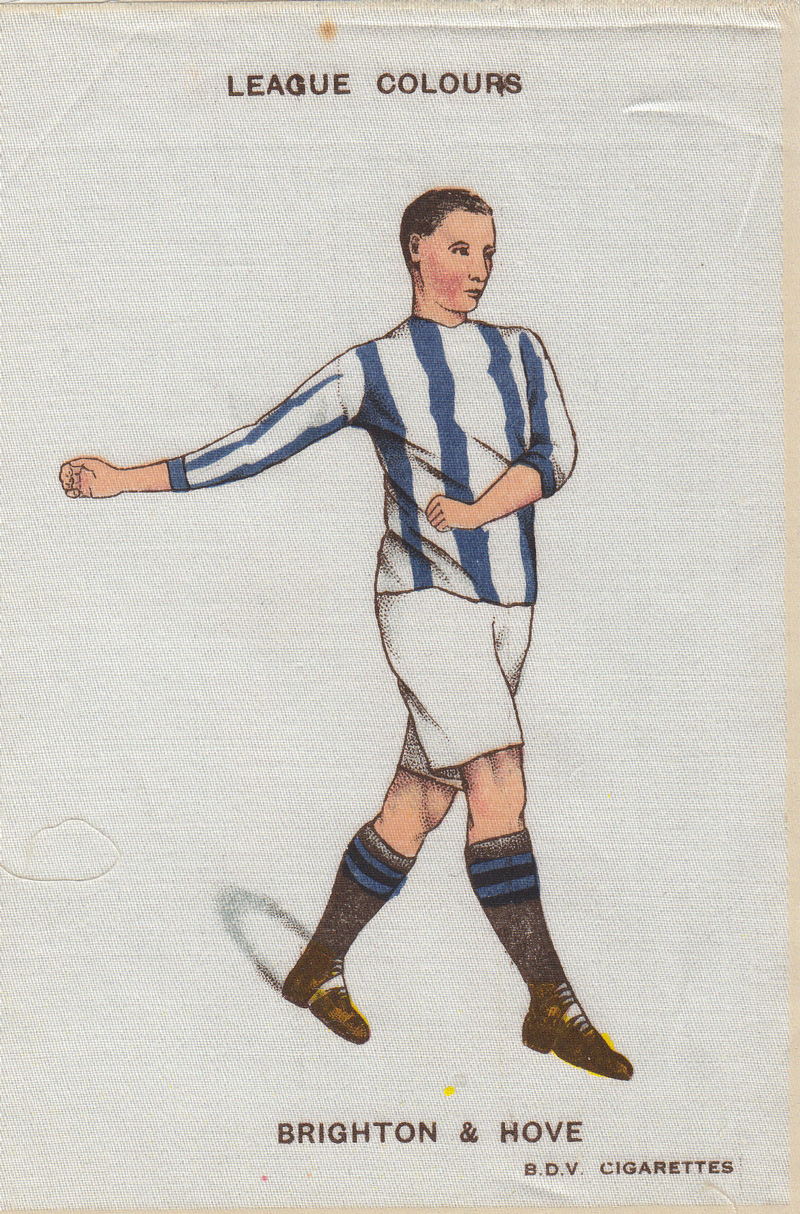
Once, sew on football-themed patches must have been all the rage, judging from these striking designs lent to me by Nick from Fishersgate. We kick off with this printed cloth by B.D.V Cigarettes, featuring an Albion player sporting broad white stripes:

sewon1

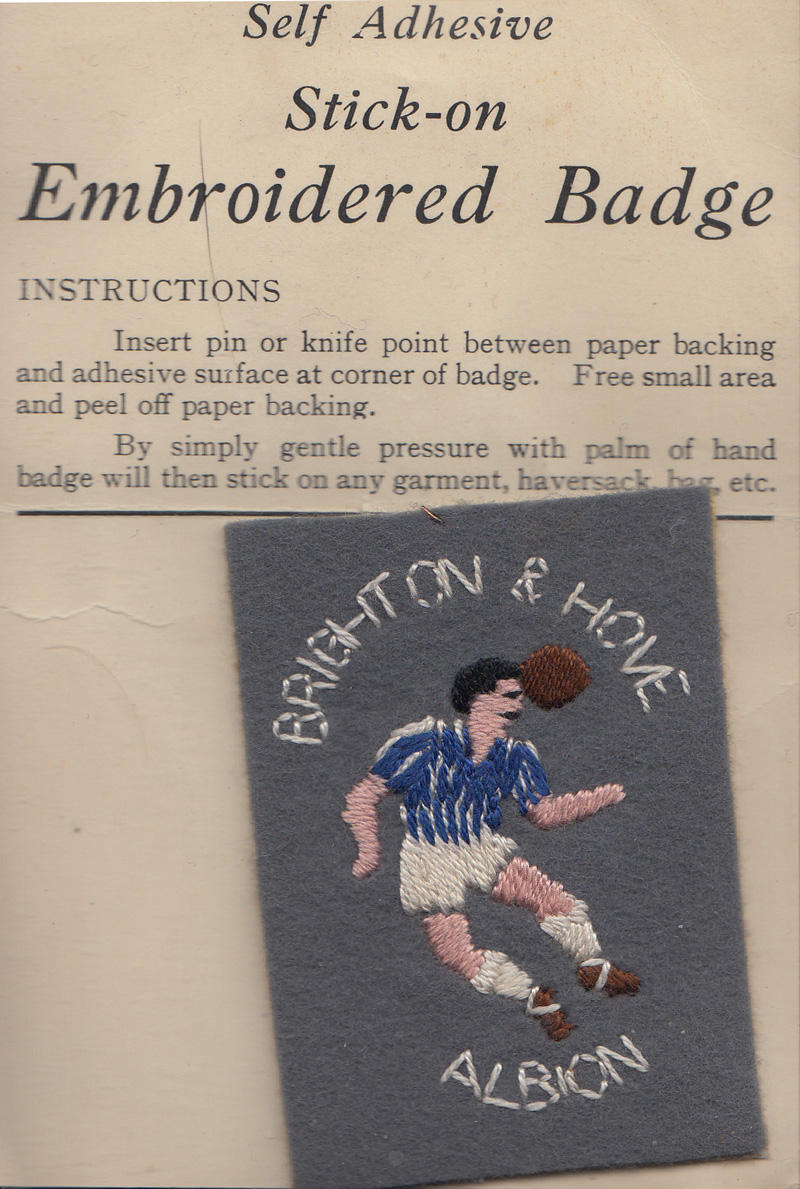
Then, to the other extreme, a rather messy interpretation of the stripes, makes this Albion shirt look like a Luton away shirt from the 1990s:

sewon2

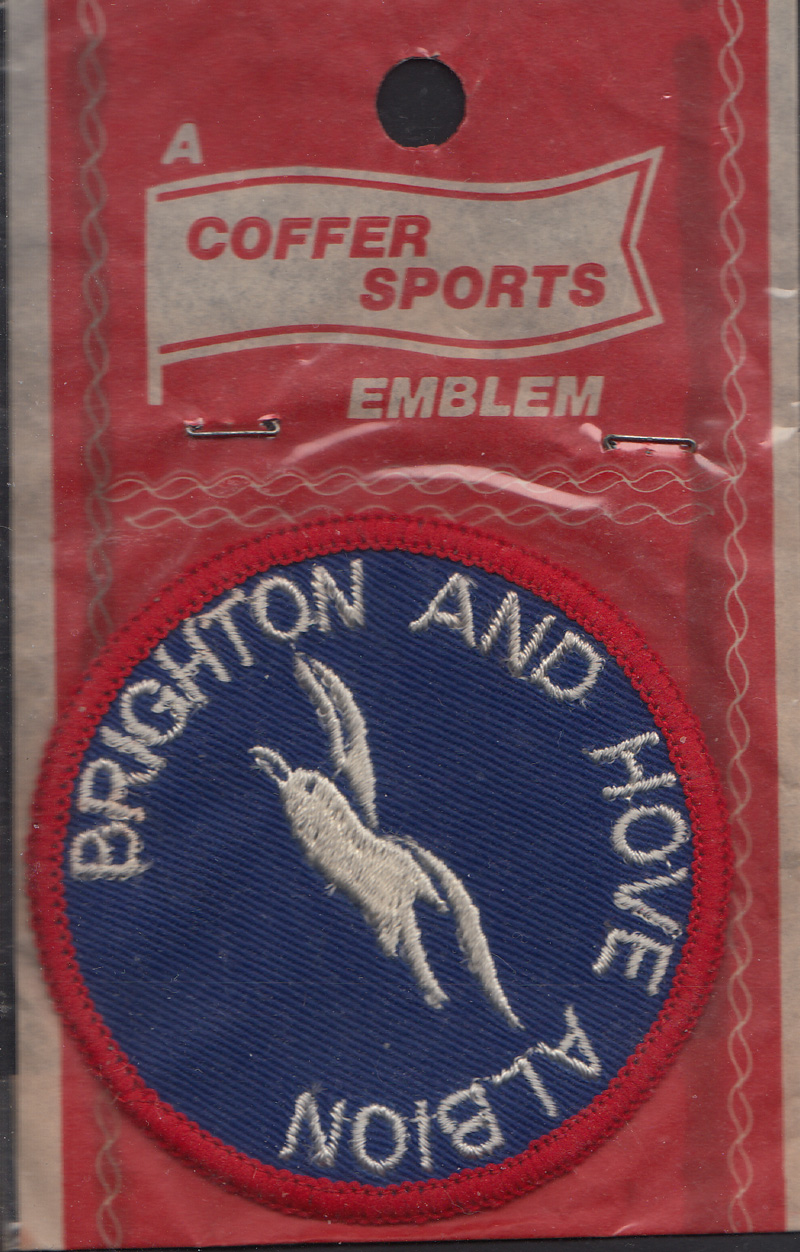
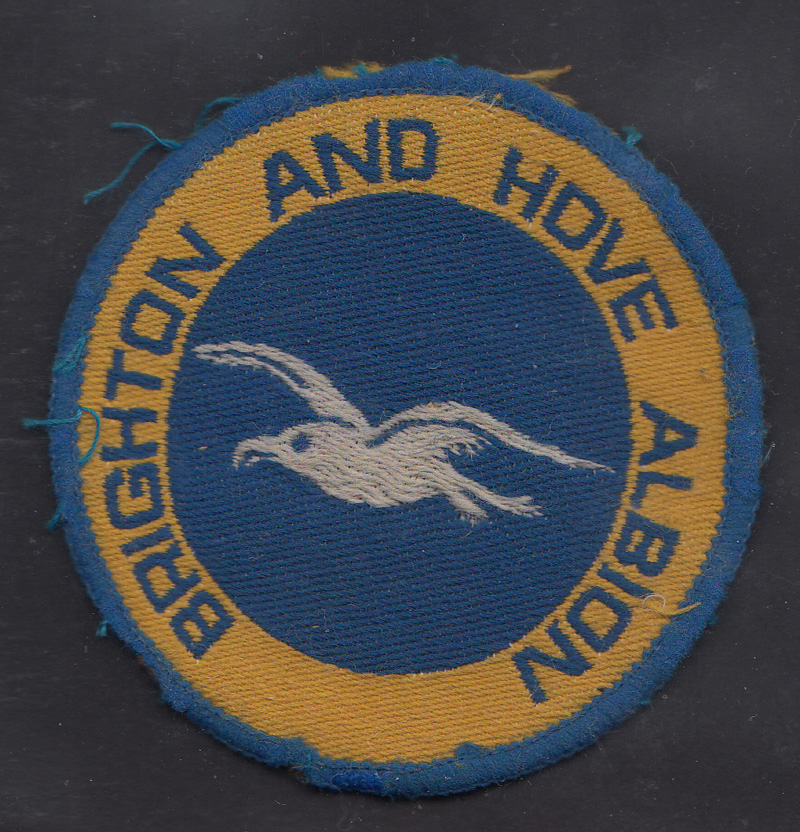
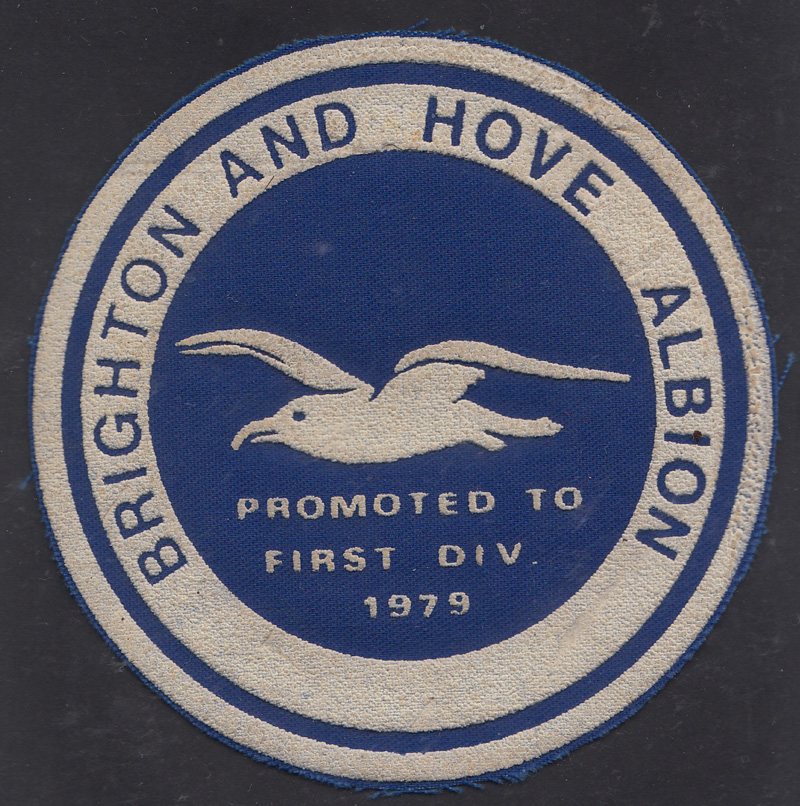
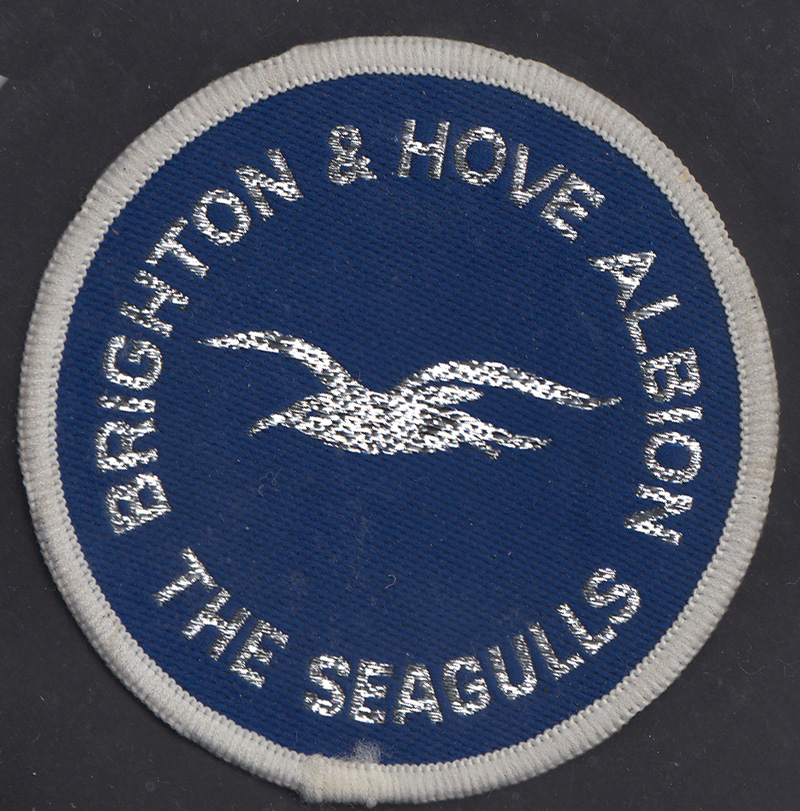
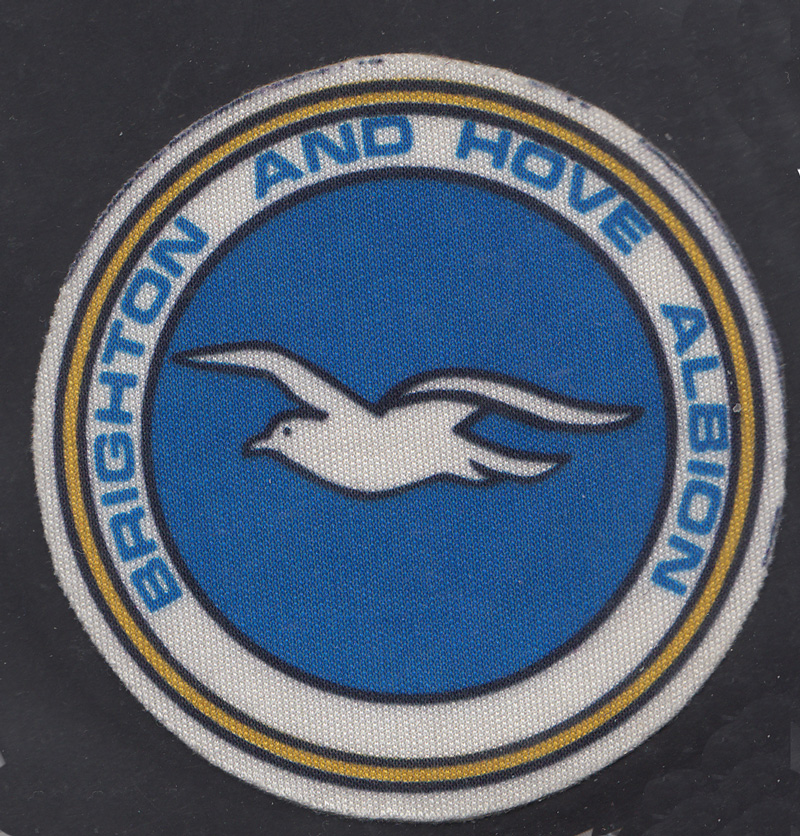
However, it is the classic round badge with the seagull facing left that was undoubtedly the most popular for sewing on jackets, jeans and bags. Here is a plethora of interpretations and re-interpretations of the crest that first made it onto the Albion player’s shirt in 1977:

sewon3

sewon11

sewon12

sewon14

sewon15

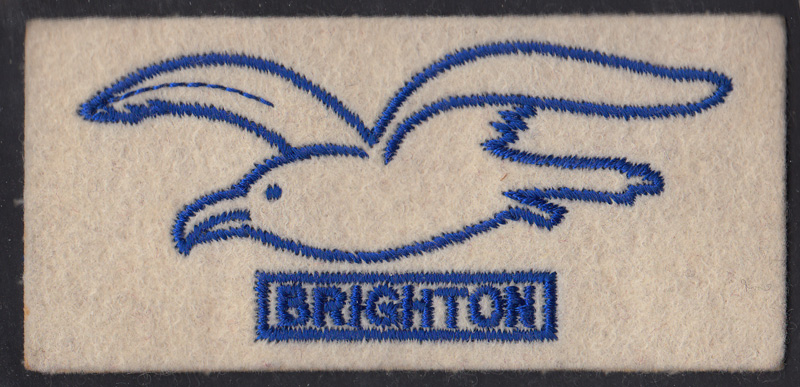
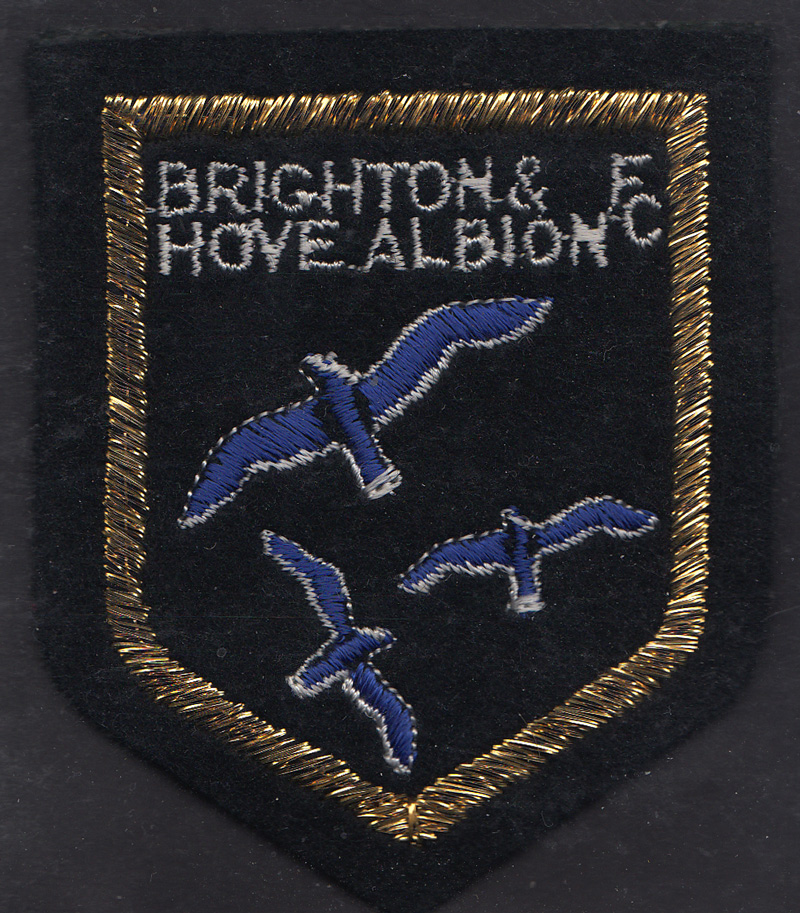
But if you were bored of the circle badge, you could rebel by going for these unofficial rectangular and shield designs, with the latter definitely catching the eye:

sewon6

sewon4

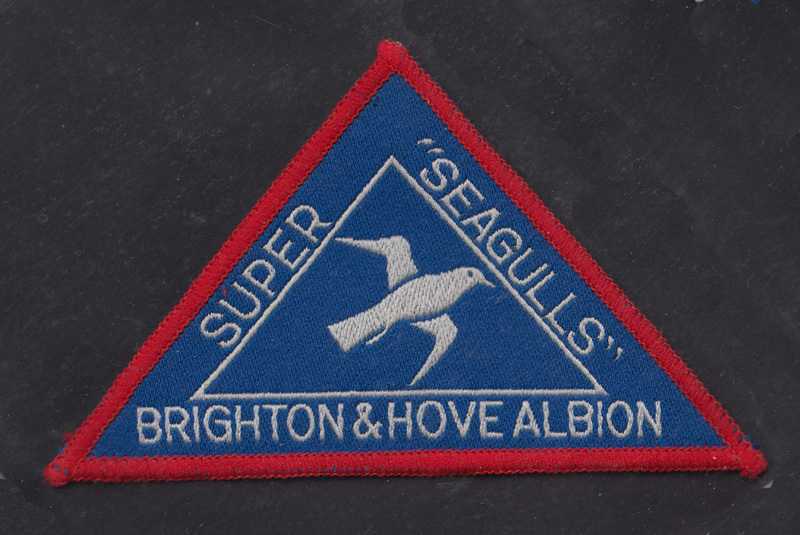
Or even a triangle! One of the first Albion seagulls to face right.

sewon7

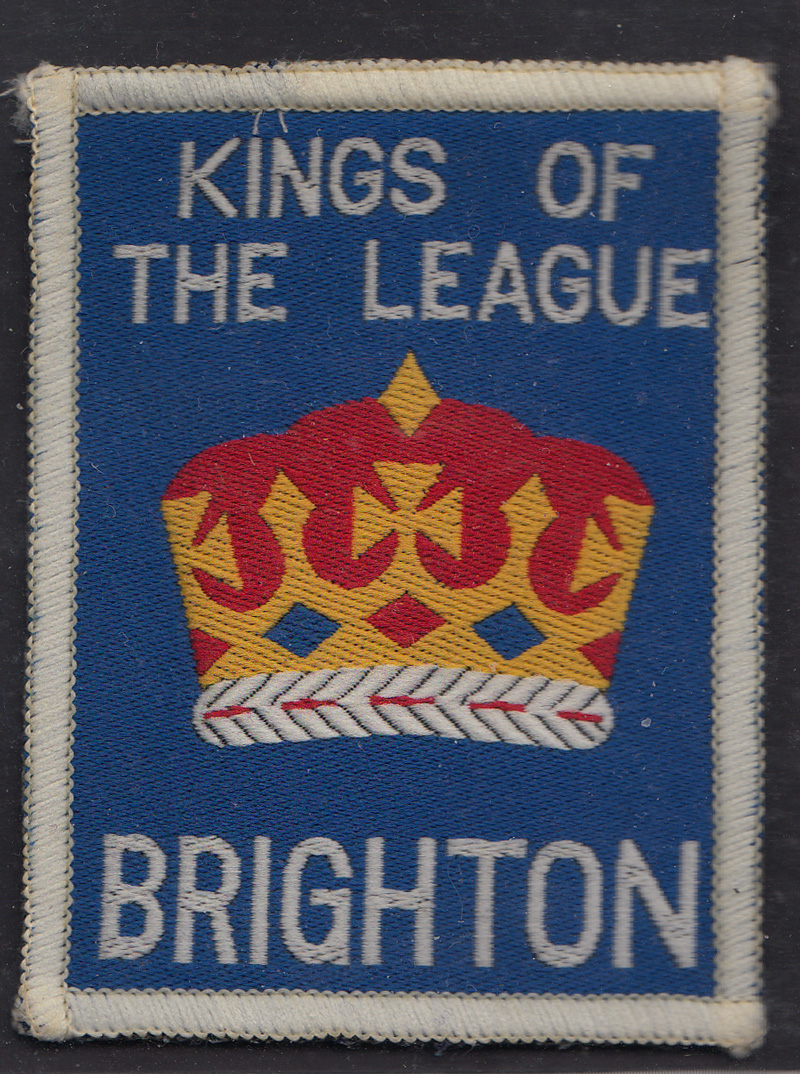
And look! Here’s a familiar sight for users of this blog who’ve been reading it from the beginning. The ‘King of the League’ patch from an exquisite Brighton tortoise!

sewon8

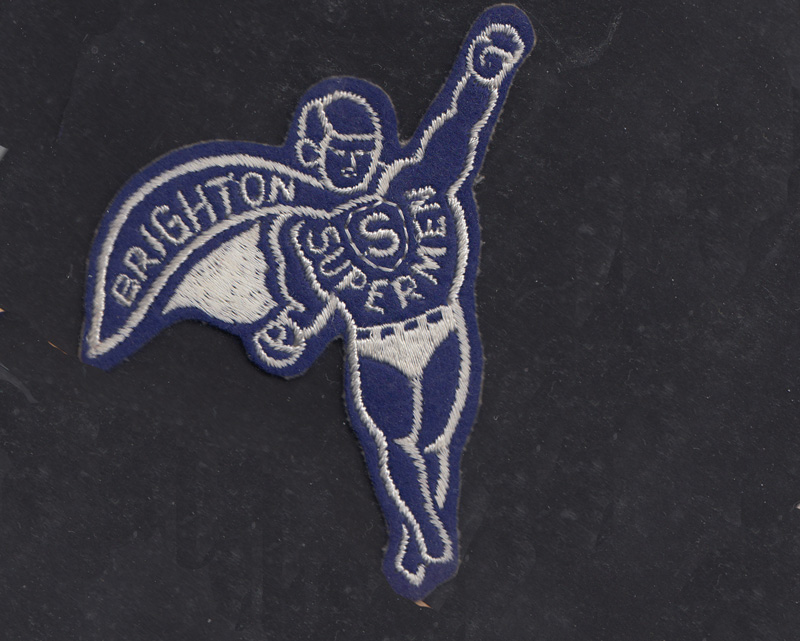
And who wouldn’t want this imaginative Y-fronted Superman for sewing onto their favourite underpants?

sewon5

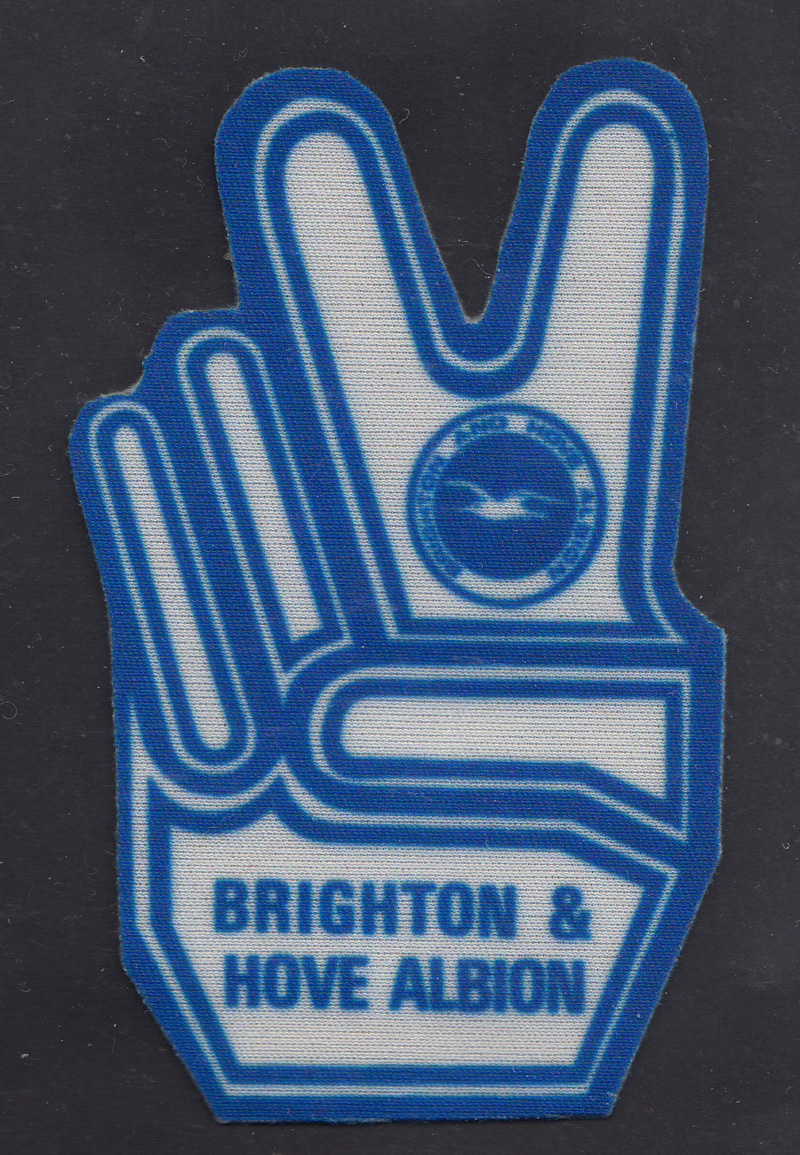
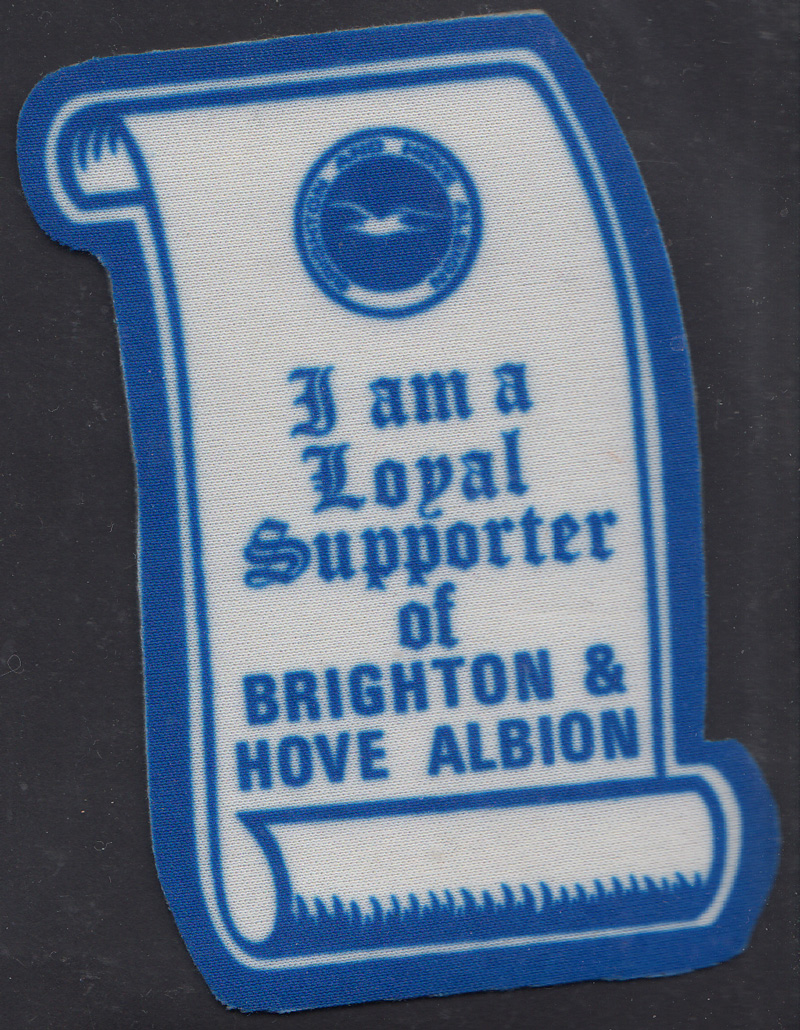
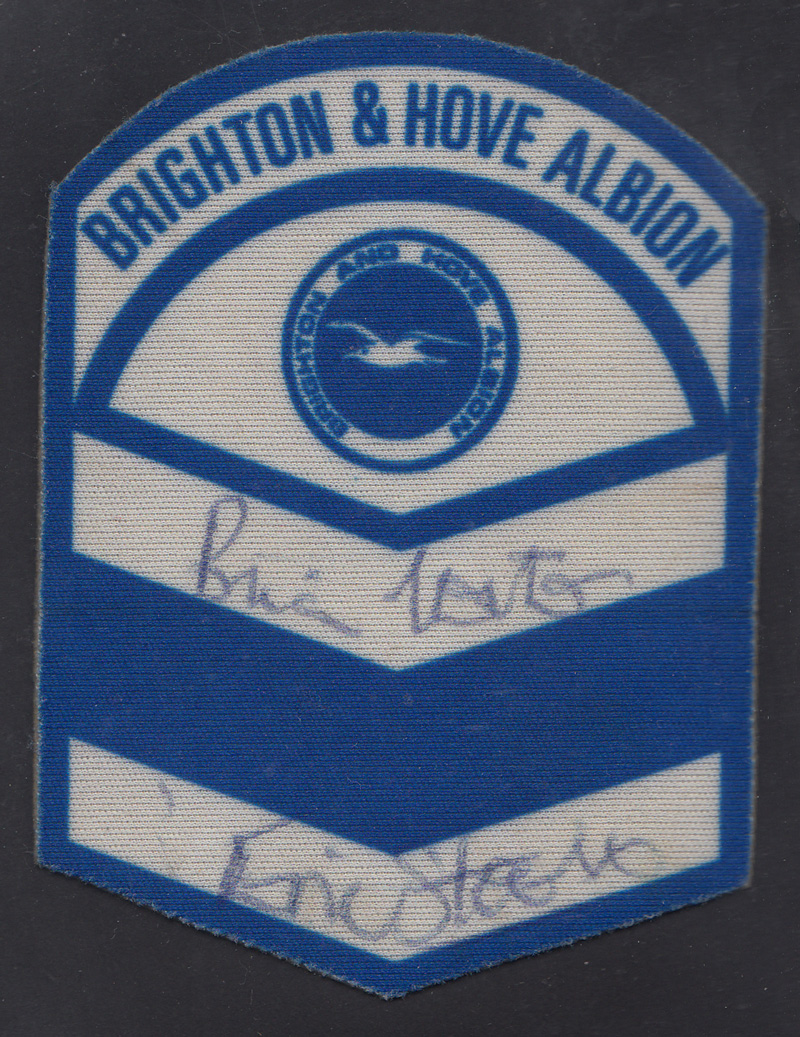
Finally, there are these three military-themed items. V for victory, a pledge of allegiance and some army sergeant stripes, the latter signed by Eric Steele:

sewon9

sewon10

sewon13

This was amble proof that in the 1970s and 1980s, when it came to patches for enhancing your clothes and school bags, Brighton & Hove Albion definitely had things covered. Respect to anyone who had all fifteen stitched onto one garment…

Brighton saviour Suddaby

petersuddaby

Thirty-four years ago today, centre-back Peter Suddaby made his Brighton debut in the famous 1-0 victory over Nottingham Forest at the City Ground. In this interview from Shoot! Magazine (6 January 1980), he lifts the lid on turning from a reserve in the Third Division to first choice in the top flight:

Peter Suddaby can’t thank Blackpool manager Stan Tennant enough – for dropping him!

For when Suddaby moved into the reserves to make way for Jackie Ashurst, Brighton manager Alan Mullery couldn’t move quick enough to snap up the commanding centre-half.

“Looking back, I suppose it was a blessing in disguise,” said Suddaby. “My career wasn’t going anywhere, and a move to the First Division was the perfect remedy.”

Suddaby’s arrival at the Goldstone Ground had an immediate impact on Brighton’s previously unhappy first season at the top. In his first game he helped Brighton end Nottingham Forest’s 51-game unbeaten home League record, and successive victories during the Christmas period against Wolves and Crystal Palace took the club out of the bottom three for the first time this season.

“I tried getting Peter last season to help our promotion bid,” Mullery explained. “He’s a tremendous winner and is just the sort of player we needed.

“But Bob Stokoe wouldn’t let him go which is why I was delighted when he suddenly became available in November.”

Suddaby admits that he has always been impressed with Brighton’s potential, and wanted to play in the First Division since Blackpool lost their place in the top flight.

“Obviously it wasn’t easy to adjust after playing two games in the reserves and I was sad about leaving Blackpool. But it was made clear to me that I was fourth in line for the centre-half position, so I made up my mind to move if the opportunity arose.

“Coming to Brighton cost me a testimonial,” Suddaby continued, “but this didn’t mean as much to me as Blackpool thought it might.

“I wanted a challenge and still felt I had something to offer which is why it didn’t worry me to join a struggling club. There’s still plenty of time for Brighton to move out of trouble which is what I think will happen as there’s a superb spirit in the club,” Suddaby commented.

Suddaby admits that life in the Third Division had proved hard for Blackpool. “The boardroom troubles inevitably rubbed off on the players and gave the club an unsettled atmosphere. The trouble is that neither the players nor the public have come to terms with the fact that Blackpool are a Third Division club,” Suddaby pointed out.

“When we were relegated it was only through a series of freak results which is why last season was something of a settling-in period. Even though there aren’t many medals in the club’s cupboard there’s a lot of tradition and people still talk of the team in the 50s.”

Suddaby modestly refused to accept that his move was a significant factor in Brighton taking what could be ten crucial points out of 14 in their battle for First Division survival.

“Forest are a very good side, but we defended well against them and had that little bit of luck we needed. But I thought that everyone in the Brighton side buckled down and gave everything that day.”

Suddaby’s fun loving approach to life, which makes it hard to believe he became a bookworm to study for a University honours degree, not only explains his long stay at Bloomfield Road but also why he bears no bitterness towards his former club.

“I desperately hope they do well as I had such happy memories but I would like to think they’ll miss me,” he added.

“Certainly, things are beginning to click at Brighton, and I’m sure we will survive this season. Alan Mullery has given me a chance to prove myself in the best League in the world, and i certainly do not wish to let him down now.”

Sadly, we never got to see him in this shirt

Sadly, we never got to see him in this shirt

Suddaby definitely didn’t let Brighton down. His strong, determined tackling and ability in the air at the heart of defence was an important factor in moving Albion up the table. It also released Mark Lawrenson to play in midfield. However, in May 1980, Suddaby slipped a disc and, as a result, was released by the club. Had he been able to continue First Division football, perhaps 1980/81 would have been not have have been a campaign of so much struggle.

He briefly returned to the Goldstone in 1986/87 as chief coach under Alan Mullery and held onto his position until the end of the season, even when Barry Lloyd took over.

Tagged

Radio Times in May 1983: Gold is their goal

The national edition of the Radio Times for 21-27 May 1983 was priced at 25p and this was its striking cover:

radiotimes

While the FA Cup itself is a familiar sight, the details of the medals are far less well known. Inside, Humphrey Evans revealed that:

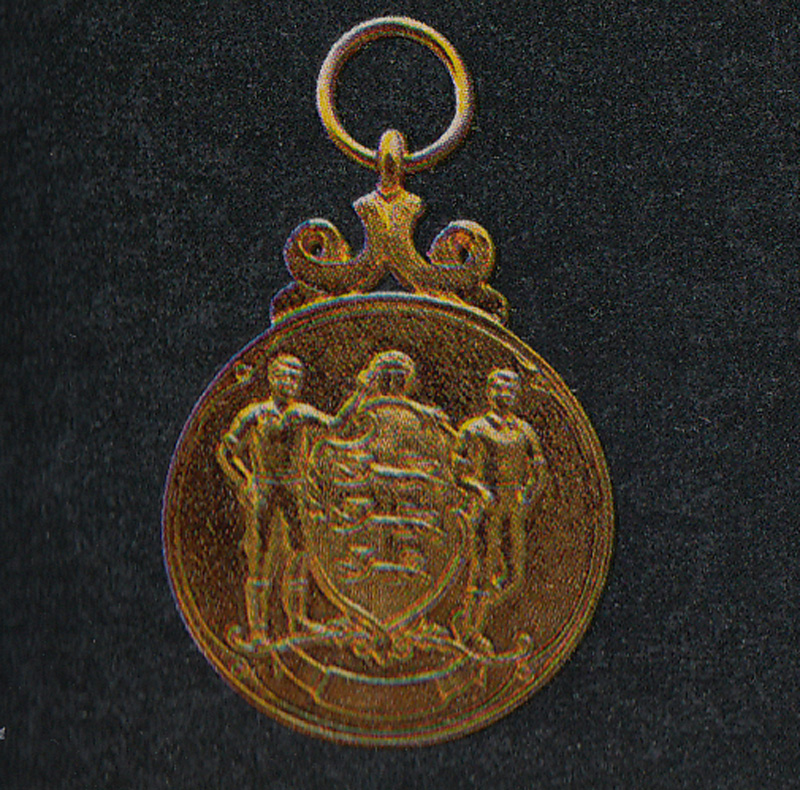
FA Challenge Cup medals are solid chunks of nine-carat, hallmarked gold, 1¼ inches in diameter. There are 12 each for the two teams plus one each for the referee and linesmen. The winners’ medals are about an inch thick and weigh around 25 grams, or just under an ounce:

radiotimeswinners

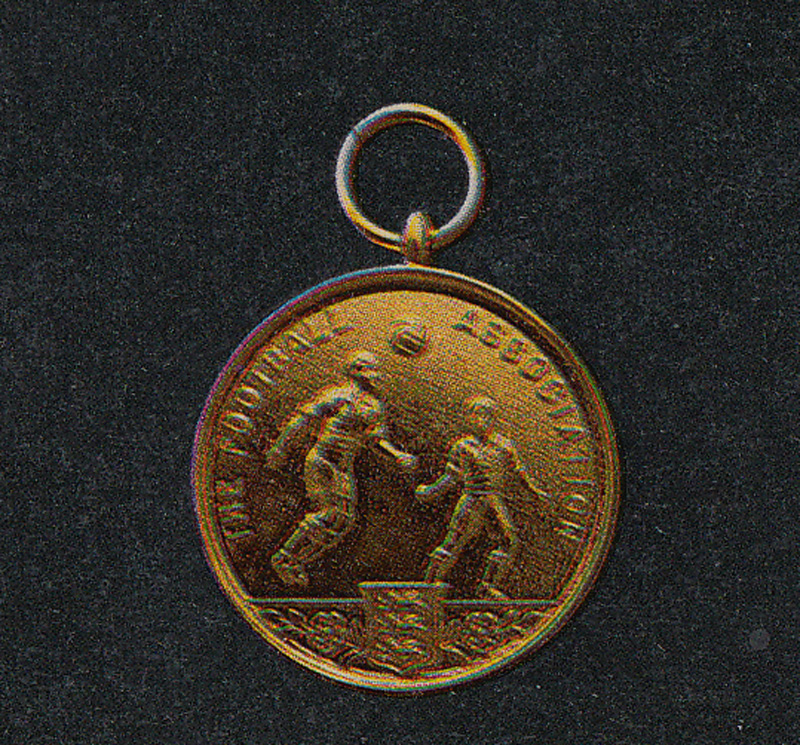
The others are thinner and lighter. They cost around £300 each. The front has a design with a couple of footballers in nostalgically baggy shorts either side of a shield carrying the lions of England:

radiotimesrunnersup

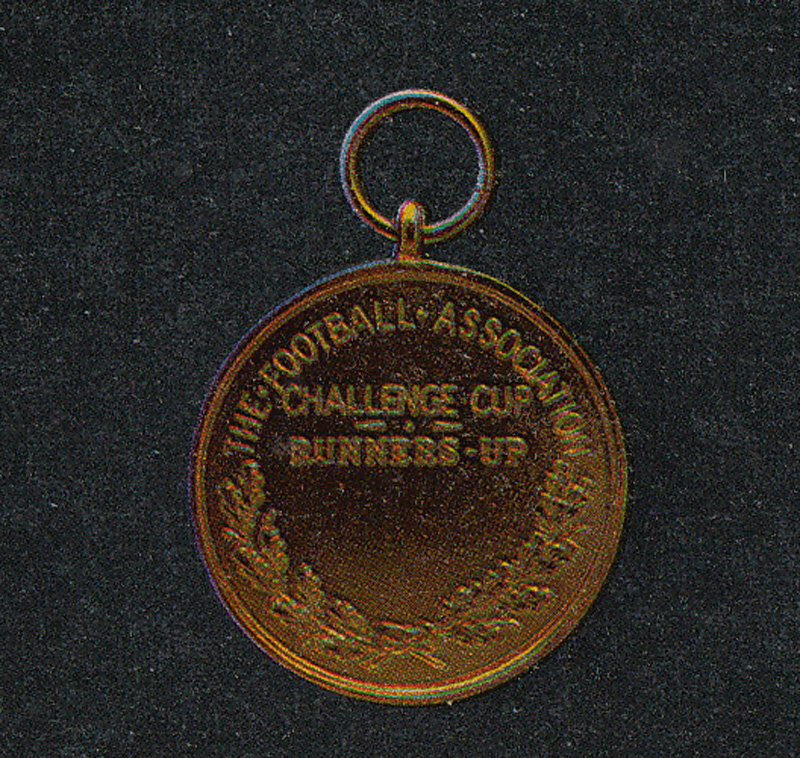
The back just says Challenge Cup winners or runners-up, with the relevant season engraved round the edge.

The back of the FA Cup Final winner's medal

The back of the FA Cup Final winner’s medal

The back of the FA Cup Final loser's medal

The back of the FA Cup Final loser’s medal

Evans’ article provides details about how these mementos are created:

In England, the Football Association medals are made by Fattorini and Sons Ltd, badgemakers of Birmingham. Each year they send in a quotation. Each year the FA accepts it, although the contract did drift away from them for a while back in the 1950s.

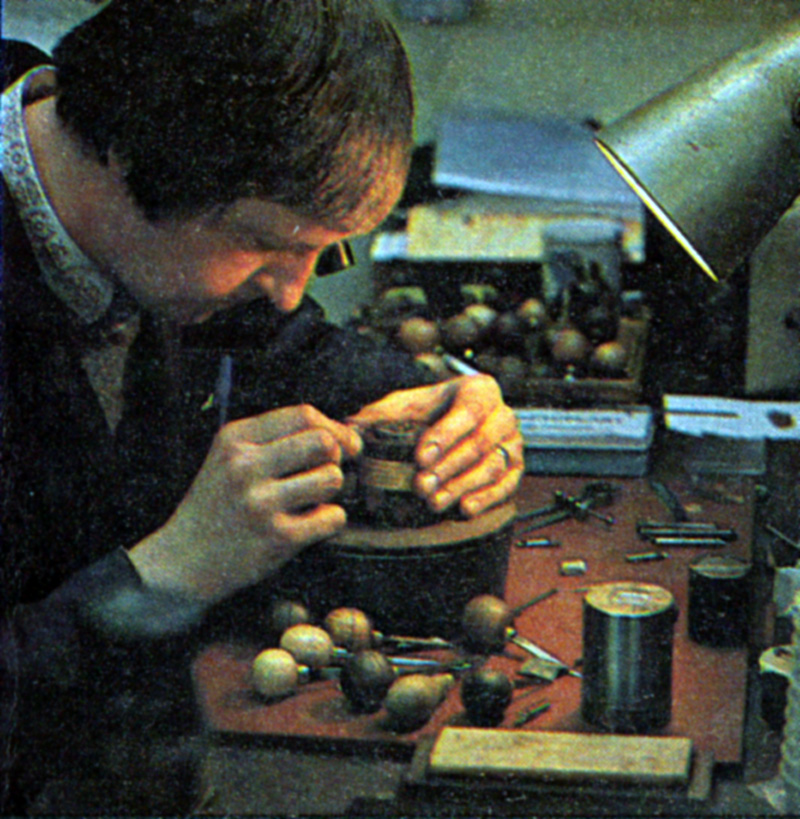
Fattorini’s is proud of the fact it makes all the badges that go on to Rolls-Royce cars. A couple of men are carving out new dies. Others are soldering suspension rings on to otherwise completed medals. And in glassed-off room at the other end of the floor, Rob Collins, Gold and Silver Supervisor, keeps an eye on the progress of the FA Cup medals.

‘You need someone you can trust 150 per cent,’ says Alan Jones [managing director], and Ron Collins is that someone. He has been with Fattorini’s for 18 years, and before that in jewellery all his life. He is past retiring age, but they haven’t been able to stop him coming in. ‘I should have retired,’ he says, ‘but I like practising activity, not vegetating.’

Collins checks and counter-checks each stage the Cup medals go through. Here are some of them:

The original die is hand carved from a solid piece of steel

The original die is hand carved from a solid piece of steel

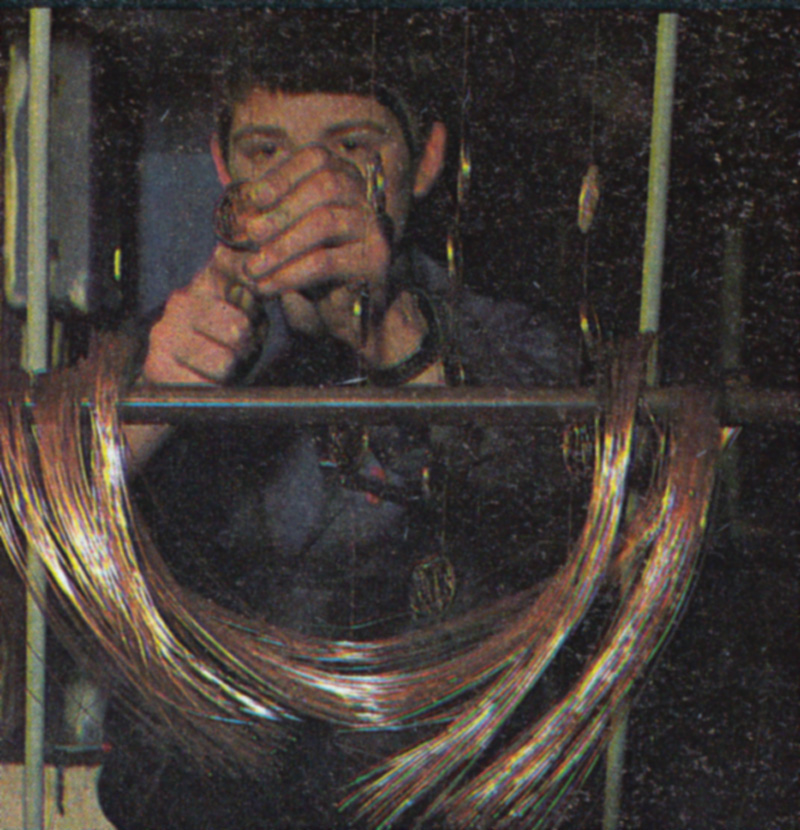
The medals are racked up and then gold-plated

The medals are racked up and then gold-plated

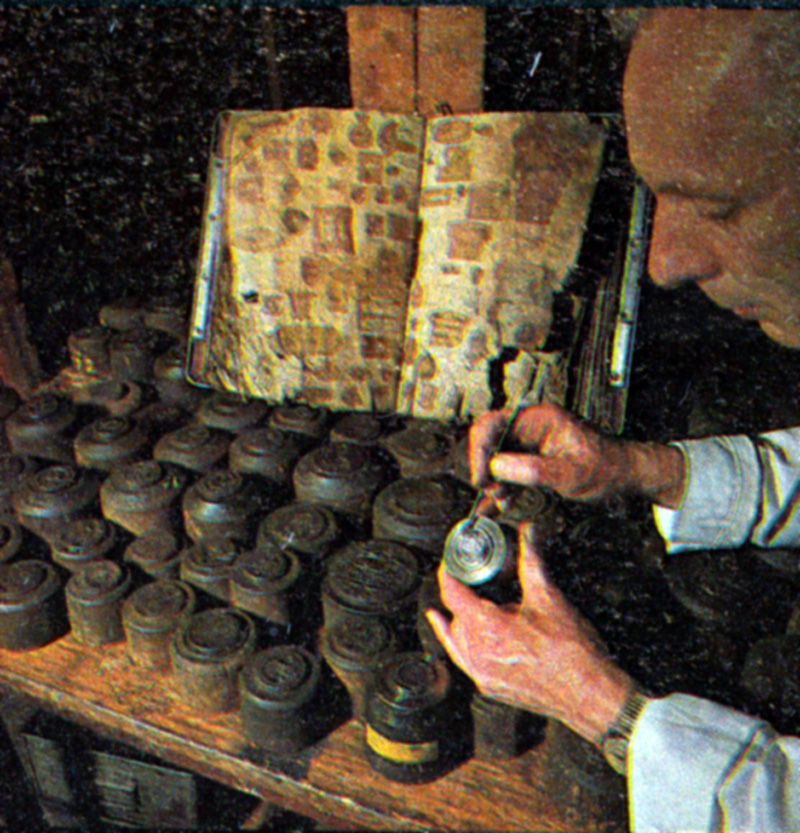
Finished dies are kept in the cellar for posterity

Finished dies are kept in the cellar for posterity

When the medals are plated with a final thin coat of pure gold, they are shined up to a high lustre. It is at this point they are sent to the FA in London, and held in a strong room until taken out to Wembley with the FA Cup. Ron Collins sums things up:

‘When they’re gone I can live again!’

Even so, he is still concerned that something might go wrong. The article informs us that:

The worst that has happened is that the medals were put in the wrong-coloured boxes. It should be blue for the winners and red for the runners-up.

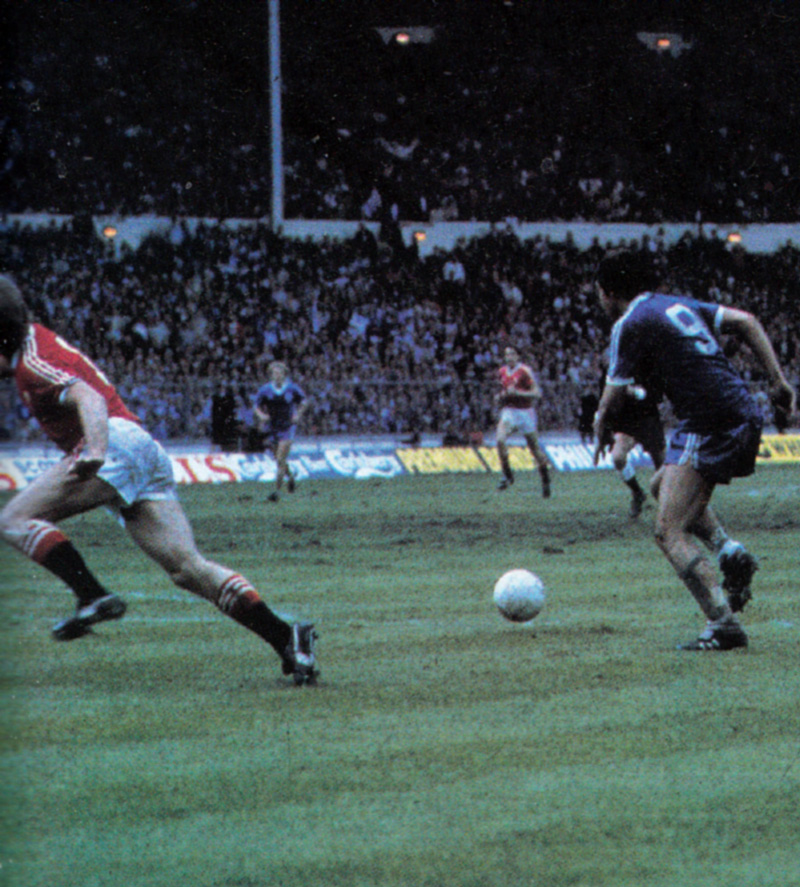
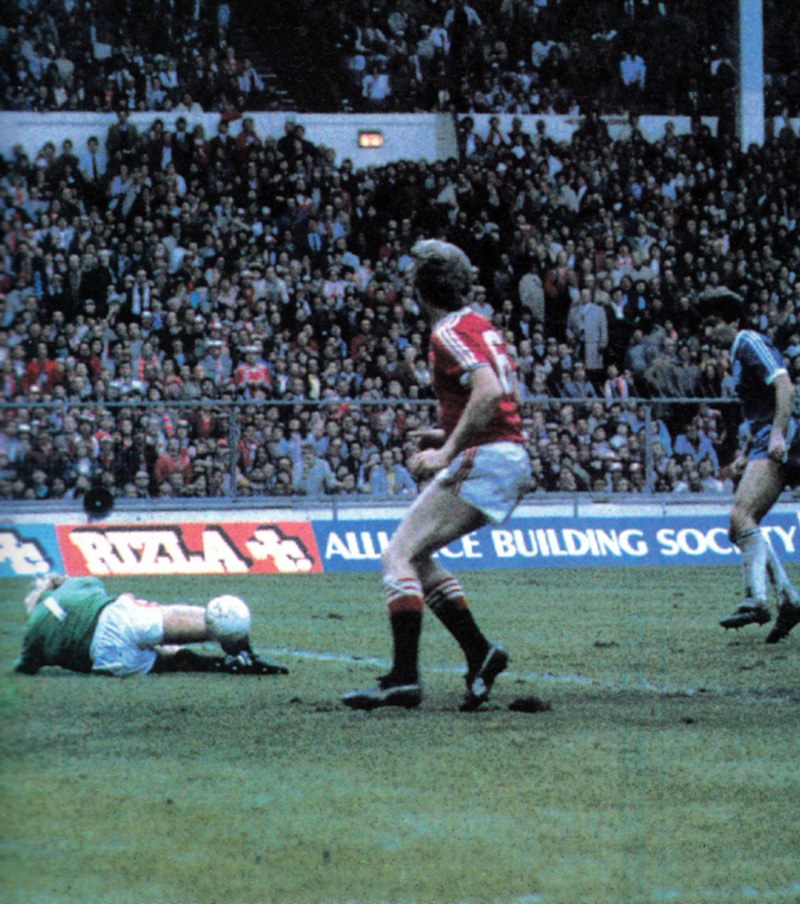
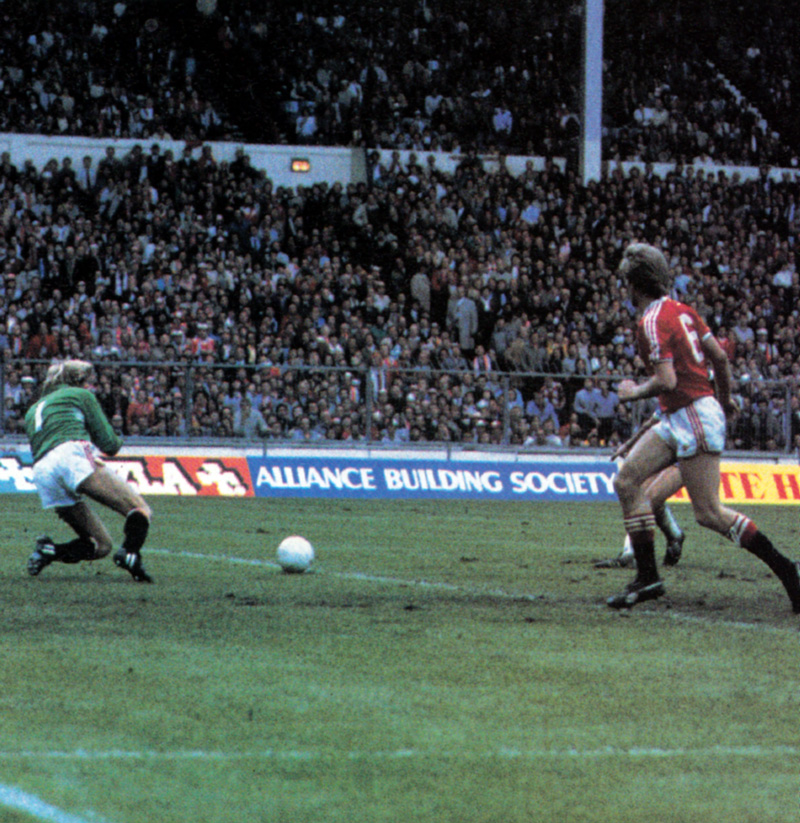
Yes, blue as the winners, red as the runners-up. It has a nice ring to it. Especially for 1983. If only Gordon Smith had put that chance away…

smithmust1

smithmust2

smithmust3

smithmust4

smithmust5

smithmust6

Tagged ,

Blood-stained Steve Foster for England!

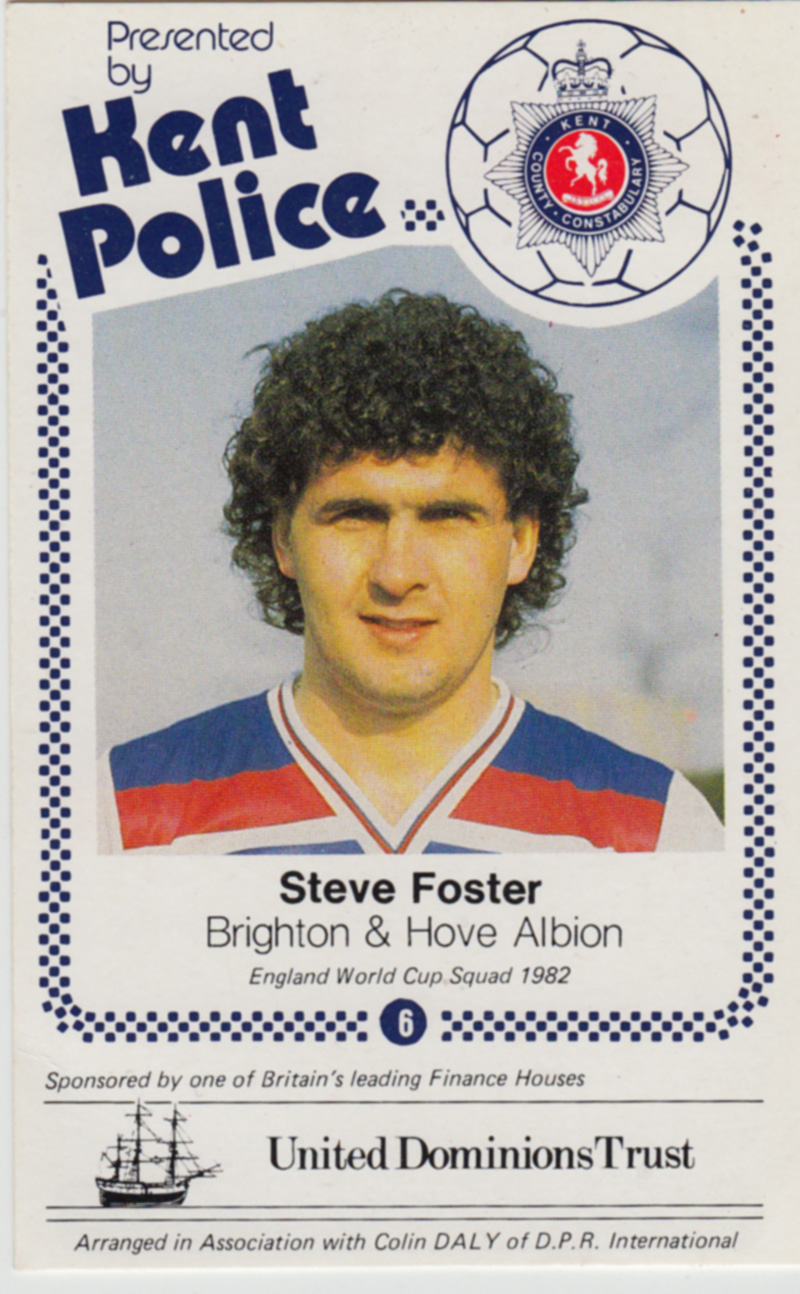
With an international weekend of football approaching, now seems an apt time to share this article discussing Steve Foster’s England chances. From the 1980/81 season:

stevefosterengland

Steve Foster, Brighton’s giant centre-half, has a habit of bumping into things. Like Andy Gray’s head and Justin Fashanu’s elbow!

“I received a bad cut on the first day of the season, against Wolves,” he says. “Andy and I went for a high ball and cracked our heads together. That left me with a two inch cut on my forehead.

“I had to go off, but I wanted to get back as soon as possible. They gave me an injection, but it hadn’t worked properly when they put a couple of stitches in, so it was a bit painful. But when I got on the field again, the injection took effect. I didn’t feel anything then.”

With a huge white bandage ~ across his brow, Foster looked like soldier in the heart of a battle. Grown men winced as he continued to win his duel in the air, the ball smacking into the plaster on, his head. By the end of the game, he looked drained. His shirt was stained with blood. But he dismisses the incident with a shrug.

“I had a headache afterwards, but that was about all. I wanted to be there at the final whistle. It was the same when I got cut against Norwich. I went for a high bail with Fashanu that time. That was a bad one, but I’d rather finish a game, before getting patched up.”

Here’s Foster nursing a broken nose…

Foster’s gutsy attitude is admired by Brighton boss, Alan Mullery, who has signed him on a ten-year contract.

“Steve’s a powerful player, with tremendous character. He’s very competitive. He wants to win and that’s the only attitude to have in this game,” says Mullery.

“I think he should be England’s next centre-half. He has the skill and he has the heart to succeed at international level.”

“It’s nice to hear the boss saying things like that,” says Steve, “but I know the way to make your name is to do well for your club. That’s what I’m concentrating on.

“But, of course, I’d be proud to play for England. You often hear of the pride of the Scots. Well, if I ever played for my country, I’d be as proud as any Scot has ever been. It’d be the biggest thrill of my life.”

Foster, who Mullery signed from Portsmouth in the summer of 1979, has had a busy season, as the Seagulls have battled to establish their right to First Division status.

There have been disasters, like the 4-3 defeat at Everton, and triumphs, like the 1-0 home win over Ipswich, when Foster snuffed out the menace of Paul Mariner.

“i’m enjoying playing alongside Mark Lawrenson at the back. I think our styles go well together.

We gave away some silly goals, especially at the start of the season, but we’re getting it together now. He’s got so much skill and he reads the game so well. Playing with someone like that every week can’t be bad!”

Ironically, Brighton’s First Division fight has given Steve’s game a terrific boost. Defenders, like ‘keepers, often perform best under pressure. That was certainly true, last term, when Seagulls’ fans voted Foster their “Player of The Year”. On the field he is a hard competitor.

Away from the action, he’s the Goldstone’s gentle giant. “‘1 enjoy having s laugh and joke with the other players. This is a happy club. They all kid me because I’m lucky at cards.

“They say they’re going to buy shares in me. We were at a reception the other week and they were joking about ‘Lucky Fossie’. Just then they called out the raffle winners. Guess who got first prize?”

With luck like that, combined with his tremendous determination and competitive spirit, Steve Foster would be a safe bet to lead Brighton away from the First Division relegation zone towards the promised land of security among soccer’s big boys.

And perhaps then he can make the England place his…

Foster eventually made his England debut against Northern Ireland at Wembley on 23rd February 1982. Partnering Dave Watson at the heart of the defence, the Brighton skipper played his part in a 4-0 victory. Three months later, Foster again helped England keep a clean sheet, with the Netherlands defeated 2-0. It was enough to book his place to Espana ’82, where he took Terry Butcher’s starting place for the final group game against Kuwait, a 1-0 victory.

He never got another England chance after that, but that record of three clean sheets in three matches is one about which he can be justifiably proud.

Tagged ,

Eric Potts – from New Brighton to Brighton

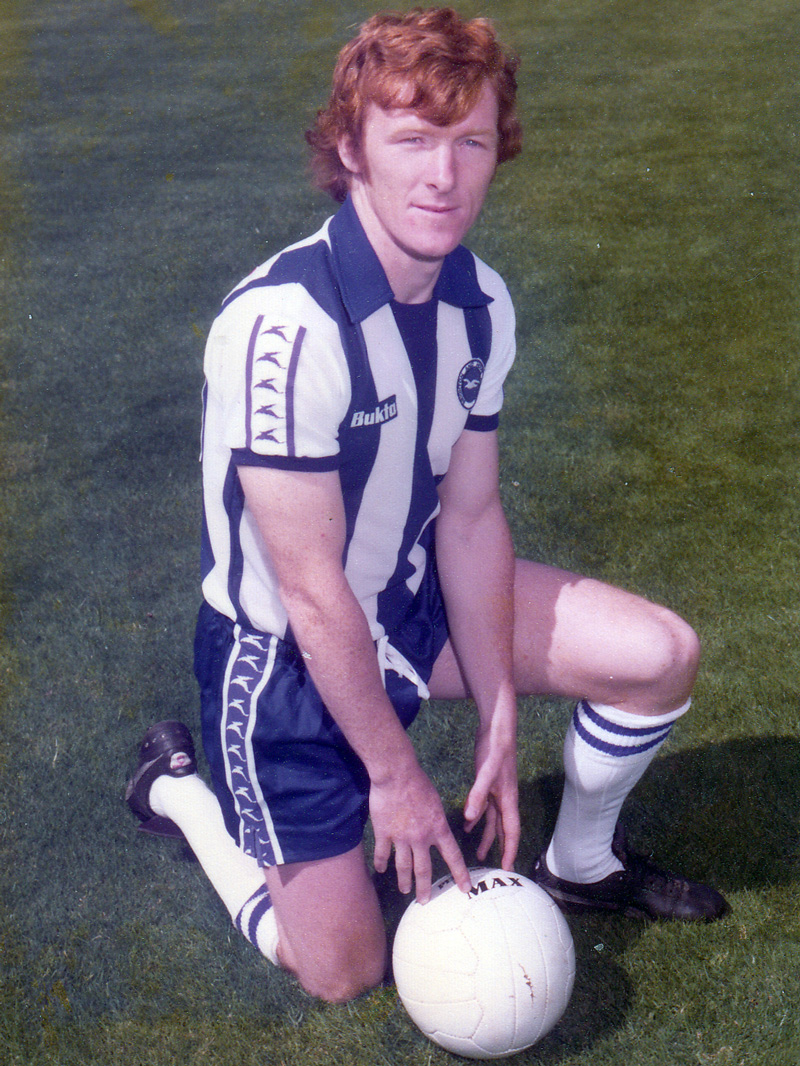
eric_potts

From the Brighton v Luton programme in September 1977:

Eric Potts joined the Albion from Sheffield Wednesday in June this year. His energetic and busy style of play had made him a real favourite with the Hillsborough crowd and in 1976 the knowledgeable Yorkshire fans voted him ‘Player of the Year’. Before joining Wednesday he had spells with Oswestry, New Brighton and Blackpool but throughout his career to date representative honours have always eluded him.

Christened Eric Stanley, he was born in Liverpool on March 16, 1950 and was educated in that famous city. In fact, the latter part of his schooldays were spent at the Anfield Comprehensive School, within a stone’s throw of that shrine of football, the home of Liverpool FC.

The Potts household gives the man of the house plenty of female company as, in addition to wife Linda, Eric has two lovely daughters, Jennifer and Deborah. Pop music often provides the home entertainment and Eric admits to being a fan of most brands of this kind of music.

For relaxation filmgoing features among Eric’s interests and he lists Kirk Douglas and Natalie Wood as the stars he enjoys most. If asked his favourite country Sweden is the immediate answer. Where likes end dislikes are concerned among foods fish and steak are his most popular dishes.

Fascinating stuff!

Like many of Albion’s very happy squad, Eric’s main ambition is to play first division football with the Seagulls but looking back the high spot of his career was playing against the legendary Pele when with Sheffield Wednesday.

In ‘A Light in the North – Seven Years With Aberdeen’, Alex Ferguson wrote a fine summary of what a ‘supersub’ was, when he described bringing on eventual match winner John Hewitt against Bayern Munich on a famous night in 1982/83:

‘John is a tremendous substitute and although he lacks the consistency for a full game, he can come on and change a match and often score. Some players are not good substitutes. They are not used to it mainly because they take a long time to get warmed up and cannot get into the swing of a game, but John is excellent is this role.’

Go back five years, and into the English Second Division, and that description would have been apt for Eric Potts. The winger and midfielder played for Brighton & Hove Albion for just that one season, in 1977/78, and yet he claims a place in club folklore for his goalscoring exploits as substitute.

Joining Brighton from the Owls in a £14,000 deal, the red-headed signing made his Albion debut as the number seven in the club’s opening fixture, at Cambridge in the League Cup. In the next round’s replay at Oldham, he notched up his first goal for the Seagulls. The 5ft 5in winger held onto his starting place until he lost out to Tony Towner for the visit to Tottenham in November. From this point onwards, Potts only started five more matches for Brighton, such was the form of Towner, and it was in the number twelve shirt that Potts made his most memorable impact.

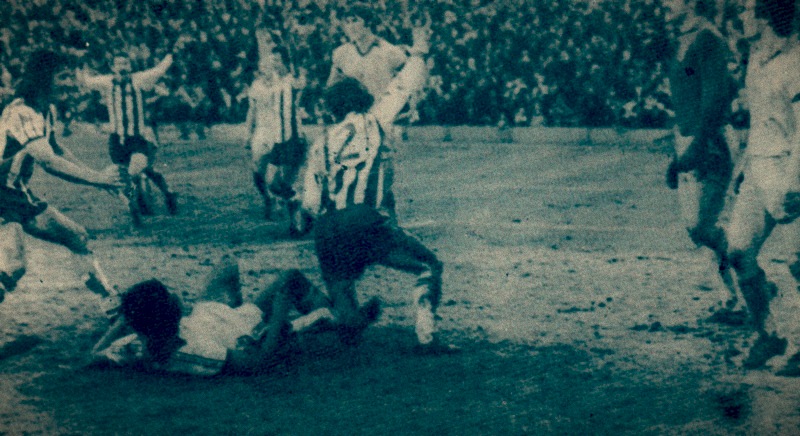
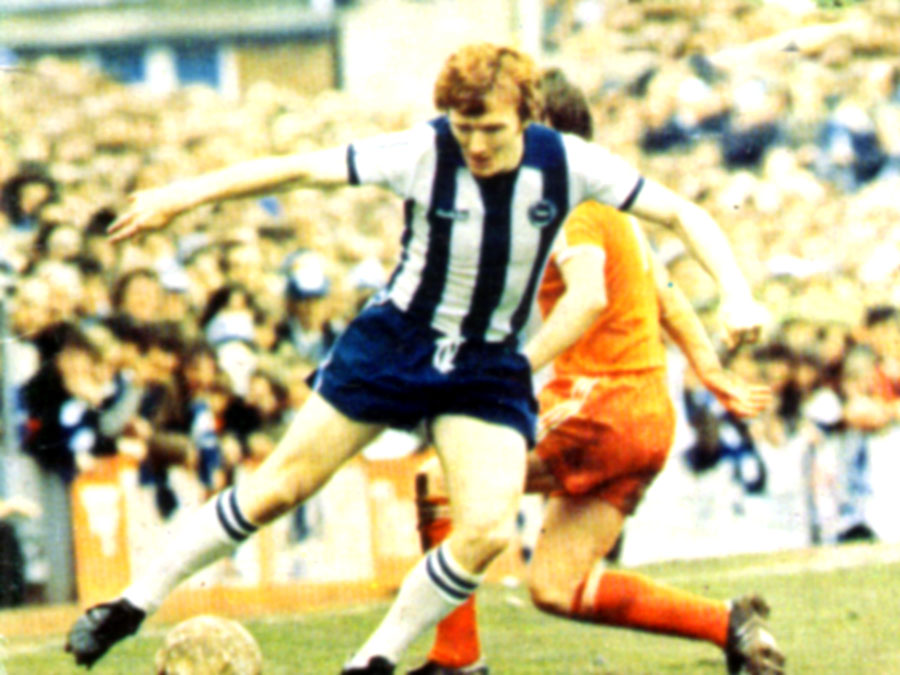
He scored Brighton’s second against Scarborough in the 3-0 win in the FA Cup 3rd Round in January 1978. Then, sensationally, he hit two goals in the last two minutes against Sunderland the following month, as Albion overturned a 1-0 deficit, after future Brighton loanee Jeff Clarke had given the Rokerites the lead. I know that match was televised by Southern TV but, sadly, I haven’t yet been able to track down the video footage. All I can offer is this image of the flame-haired one celebrating his winner:

pottssupersub2

Returned by Alan Mullery to the starting line-up, Potts opened the scoring against Stoke in a 2-1 win at the Goldstone in March. Then, combining well with John Ruggiero, Potts hit the late, solitary goal at Blackburn that these produced delirious scenes amongst the visiting players:

pottsgoalvblackburn2

And how did his manager reward his match winner for the next match? Yes, by dropping him to the bench for the Tottenham game, for the second time that season. Nevertheless, unperturbed, when he came on, ‘Supersub’ scored in the second half to clinch a famous 3-1 win. And that concluded Potts’ goalscoring at Brighton. Five League goals, four of which were as substitute.

Here he is, in action in his Albion swan song, against Blackpool on the final day of the season:

blackpool_potts

Once the season ended, he joined Preston for £37,000 in August 1978 before closing his Football League career with Burnley from 1980 and Bury for two seasons from 1982.

Tagged

The Brighton mystery of Murphy’s Mob

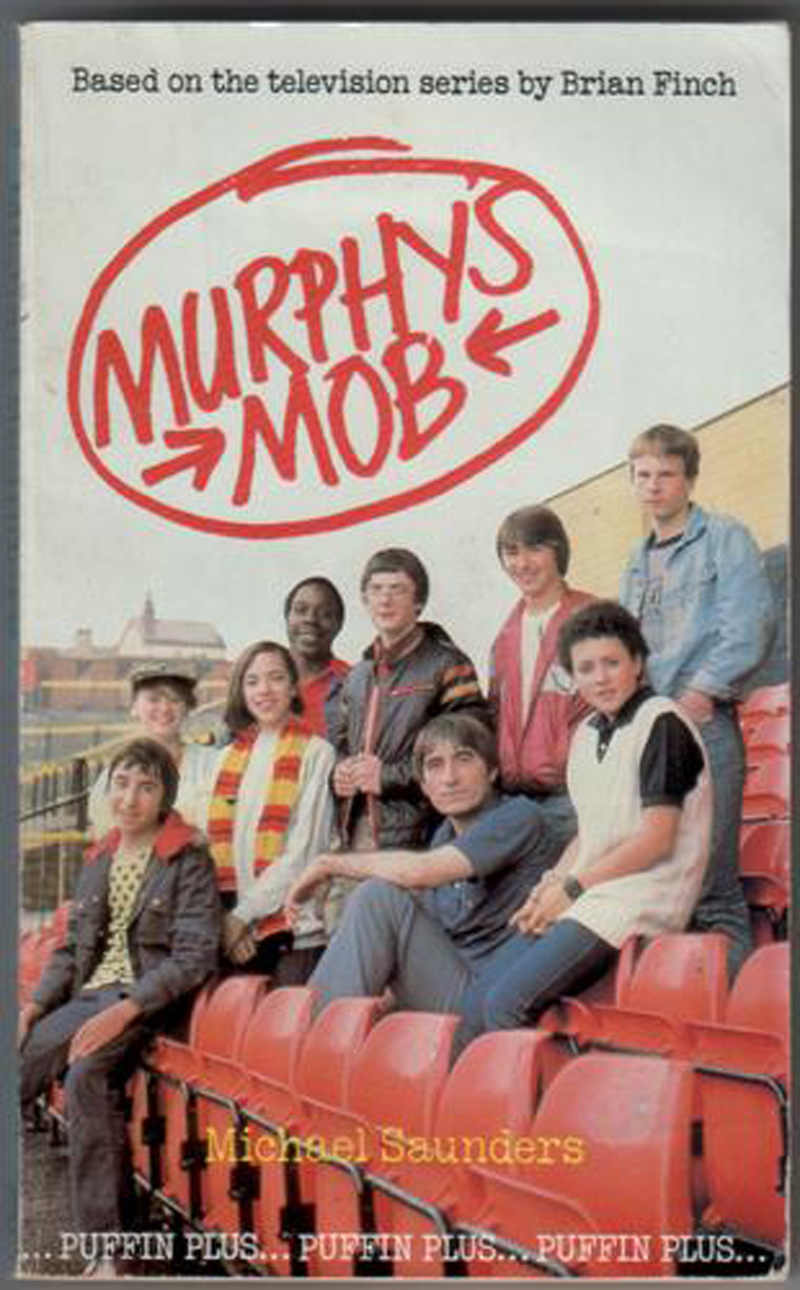
murphysmobWhile reading the Brighton v Watford matchday programme in December 2012, I was intrigued to read Spencer Vignes’ nostalgic article ‘Married to the Mob’ which celebrated Central TV’s youth drama Murphy’s Mob which ran for four series from 1982 to 1986.

Depending on your age, you may have enjoyed it. As a kid, I do remember it on Children’s ITV at the time. However I was slightly too young to appreciate it and instead gave my love to the supposedly much inferior Jossy’s Giants (1986-87) instead. Sorry!
Nevertheless, as Spencer explains:

‘Directed by former ‘Hey Hey We’re The Monkees’ drummer Mickey Dolenz, Murphy’s Mob charted the lives of a group of teenagers who followed an English lower league outfit called Dunmore United, in particular their efforts to set up and run a junior supporters’ club. You name it, Murphy’s Mob had it – school classroom angst, punch-ups, football rivalries, snogging (plenty of that) plus a catchy theme tune sung by the late Gary Holton who would find fame playing Wayne in the TV show Auf Widersehen Pet.

The show was originally filmed in Hertfordshire and even used clips from matches of Watford, then the new upstarts in the First Division and, by all accounts, finding life at the top a doodle. Ambitiously, Murphy’s Mob even combined real footage with sequences involving actors, as this video gem demonstrates:

Note the first clip is from Highbury, before it switches to Vicarage Road (or is it Stamford Bridge?) when the keeper catches the ball!

In November 1982, BBC’s ‘Match of the Day’ cameras arrived to see Graham Taylor’s high-flying Watford side blitz the Seagulls with the visitors playing about as well as that blundering keeper above. By the final whistle, the score was 4-1 with goals from Luthur Blissett (2 pens), John Barnes and Les Taylor, before substitute Gerry Ryan replied late on for the Albion. As Spencer laments:

A couple of weeks later Central TV went in search of footage from a Watford match to incorporate into Murphy’s Mob. They needed a game in which the Hornets, playing the part of Dunmore, had dominated and scored plenty of goals. Needless to say one particular fixture caught their eye.

Throughout 1983 and 1984 I, along with Albion supporting 11 to 16 year olds everywhere, had to endure countless school yard jibes every time footage of Watford’s (or should I say Dunmore’s?) rampant win over us appeared in Murphy’s Mob, which was regularly.

When I read those words, I was amazed. Could it really be that Brighton & Hove Albion had a significant, albeit a stooge-like, part to play in at least one of the episodes of this children’s TV series? Unfortunately, there wasn’t much footage unloaded to YouTube or indeed on other sources on the internet. However, after some detective work, I eventually did track down all 54 episodes, and scrolled through each one (sad, I know!) to find the episode where Dunmore gave Brighton a trouncing.

And do you know what? It’s still a mystery which edition it was because the only footage I could find with Brighton in it was this:

Perhaps some cuts had to be made to a re-running of the series, seeing as the BBC had the TV rights to the match:

By the end of the 1982/83 season, Watford were runners-up in Division One and Brighton had finished bottom. Both clubs enjoyed a run to Wembley in the FA Cup around that time before the unthinkable happened. In 1985, Central TV began using Derby County as the focus for its football footage, with Dunmore colours changing to blue and white. From Vicarage Road to the Baseball Ground, I wonder if Eric Steele remembers being a Dunmore player at either location.

Tagged

Maybank sent off… Chivers gets his chance

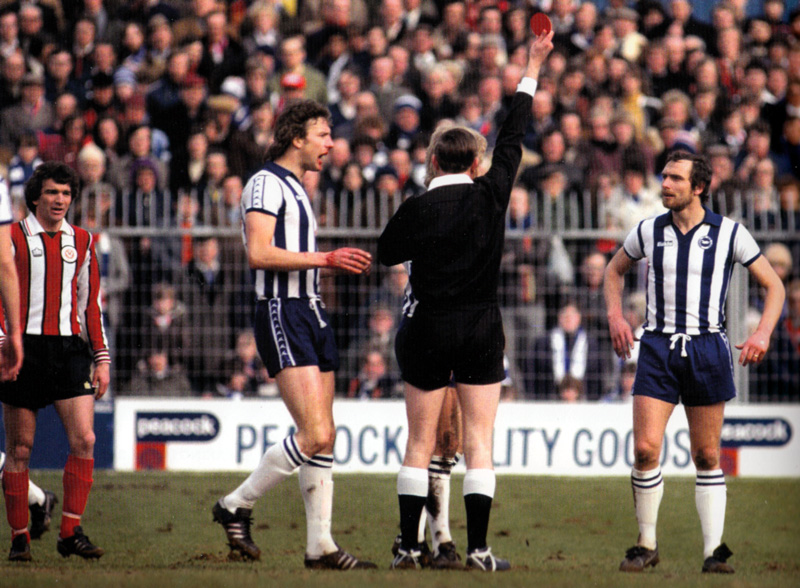
Obscured by referee Bill Bombroff (Bristol), here is Teddy Maybank getting his marching orders during Brighton’s match with Sheffield United in March 1979:

maybankoff

As expected, Andy Rollings and Brian Horton do not look very happy about the decision.

Despite being reduced to ten men, Mullery’s side ran out 2-0 winners against the relegation strugglers. Unsurprisingly, in Bill Chalmers’ match report, he focussed on this significant moment, and the Albion boss’ angry response – which was directed at his player rather than the official:

No-nonsense boss Alan Mullery last night lashed out furiously at Teddy Maybank – and fined the player a week’s wages.

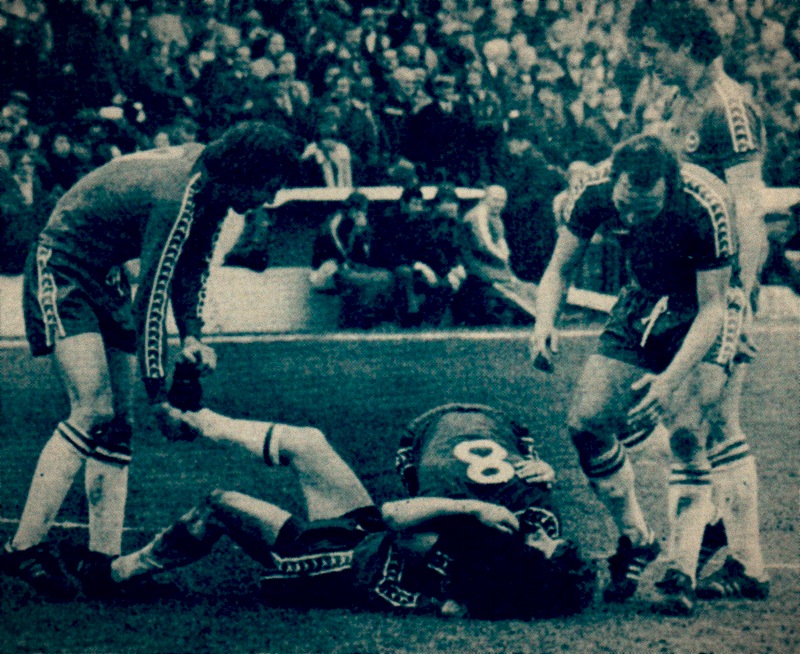
Maybank was sent-off in the 10th minute after a bad-tempered skirmish as Brighton rocked to the top of the Second Division. Maybank’s moment of madness ended with Sheffield centre-half John McPhail on the floor and referee Bill Bombroff waving the red card.

“It was ridiculous,” roared Mullery. “Maybank was tackled by McPhail and then he stupidly retaliated. His action was totally irresponsible and he will be fined a week’s wages by the club.”

The opening minutes were stormy and ill-tempered and McPhail Andy Rollings and the Brighton defender was left with a broken nose. With only ten men Brighton looked First Division material with some fine-flowing football but the bad-tempered tactics persisted. Fifteen minutes after the Maybank incident, Brighton’s Gary Williams and Mike Guy clashed and the Sheffield man promptly followed Maybank into the dressing room.

The second half was all action with Brighton dominating the exchanges. Shots by Brighton players rained in from all angles and Sheffield keeper Steven Conroy performed miracles until the 62nd minute.

A corner from Williams dropped to the feet of Mark Lawrenson, 12 yards out on the far post, and he drilled home a precision shot through a crowd of players.

Three minutes from time, winger Gerry Ryan made the points safe for Brighton when he slammed home a shot from ten yards.

Obviously, as manager, Alan Mullery was well within his rights to clamp down on a lack of discipline by one of his players. However, it’s not as if the Seagulls boss was a shining example of keeping his cool. Not just as manager, but also in his playing days. After all, he was the first England international to be sent off, when he understandably but unwisely retaliated against Yugoslavia in the European Championships in 1968.

With Maybank threatened with three match ban, Mullery went shopping for Martin Chivers from Norwich for £15,000. He explained:

‘I am buying Chivers to reduce the risks. Everyone at Brighton has worked damned hard for promotion and i don’t see why our ambition should be ruined because a player is suspended.’

chivers

Chivers was signed by Norwich from Swiss club Servette before his move to the Goldstone. The 33 year old striker said this:

‘Alan and I had a great association at Spurs He knows just what I’m capable of doing. But I did tell him I am no longer the player he knew.’

Tagged , ,