“I have played in three losing FA Cup semi-finals – two for Chelsea and one for Birmingham – but the most disappointing game of my career was Millwall’s last game of the season against Preston North End on April 29. We were leading 2-0 and with ten minutes to go someone in the crowd heard on the radio that our promotion rivals, Birmingham City, were losing at Sheffield Wednesday.
“The news spread through the crowd and within seconds everyone in the ground, including the players, knew as well. A defeat for Birmingham would have meant promotion to the First Division for Millwall and we naturally thought we were up.
“The side somehow managed to get through the final ten minutes without conceding a goal to Preston. As the final whistle went thousands of spectators streamed onto the pitch chanting ‘We are the champions’.
“We had our shirts stripped off our backs and were chaired around the pitch by excited fans. But then an announcement was made that Birmingham had beaten Sheffield Wednesday. It had all been a dreadful mistake.
“The four supporters, who had been chairing me off on their shoulders, dropped me. Everyone was stunned and we all had to troop off the pitch all bitterly disappointed and choked.
“It’s difficult to describe my feelings at that moment. I desperately wanted to play First Division football again and so did the rest of the lads. We were all sick.
“If Millwall had won promotion I am perfectly convinced that I would not be a Brighton player today. I don’t know how Millwall would have fared in the First Division but I would still have liked to have been part of their team.
“But that’s all in the past. I am now with Brighton and delighted to be so. I have been extremely impressed with their set-up, the marvellous training facilities, the ground and the grand bunch of players.
“Brighton could certainly become a First Division side. But it requires patience and a lot of hard work. The skill factor is a big thing in the Second Division. But the spirit is right within the club and that’s important.”
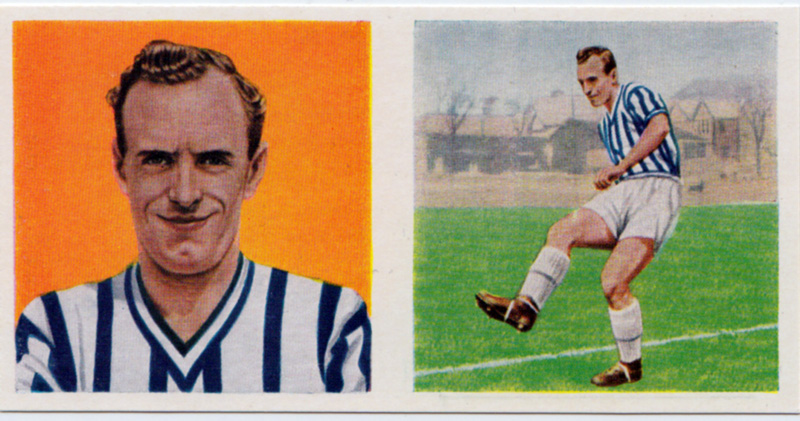
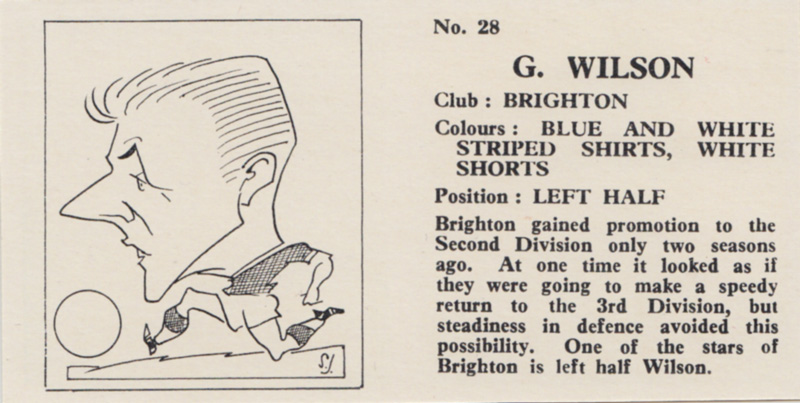
Glen Wilson, who died in 2005, became synonymous with the club during Goldstone Ground era, first as a player, then trainer, caretaker manager, physio and kit man. Although he was a Geordie, he was devoted to the Albion. He made his debut as inside-right in September 1949 against Bournemouth but it was as left-half where he clocked the most of his 436 appearances for Brighton. He was captain of the Billy Lane’s side that won the Third Division (South) Championship in 1958.
In North Stand Chat, Brighton fan nobody’s dupe recalls:
At The Dell I called something derogatory out to him as he was going down the tunnel at half time. He stopped and gave me a well-deserved verbal lashing. He saw me a few days later at a training session at The Goldstone and he continued the ‘conversation’. The next time he saw me was a couple of weeks later at Ashton Gate before a game against Bristol City. He got off of the team coach, came straight up to me and gave me a complimentary ticket for the match.
I also remember a game at Swindon. All through the game he and one Swindon player were giving each other physical stick. Glen was seemingly the only one to be punished with a string of free kicks against him. Towards the end of the game he was booked. Just after the final whistle the Swindon player held a hand out to Glen with a broad grin on his face. Glen stepped forward and delivered a beautiful left hook, and left the guy flat on his back. He then walked down the tunnel leaving a hell of a commotion behind him.
Sammy Morgan will tell you that when Glen was the physio he left him on a treatment table for ten minutes wired up to a heat treatment machine. The only thing was that Glen had forgotten to turn it on, but on his return he asked Sammy if he felt better for it. Sammy wholeheartedly agreed and got down from the table and did a little jig to demonstrate.
Apparently during this time his massages were delivered in a very zealous manner. The players nicknamed him after The Boston Strangler. Hence, Billy Boston.
I used to enjoy talking to him at the various dinners he attended. We used to jog each other’s memories about Albion matches. He loved The Albion through and through.
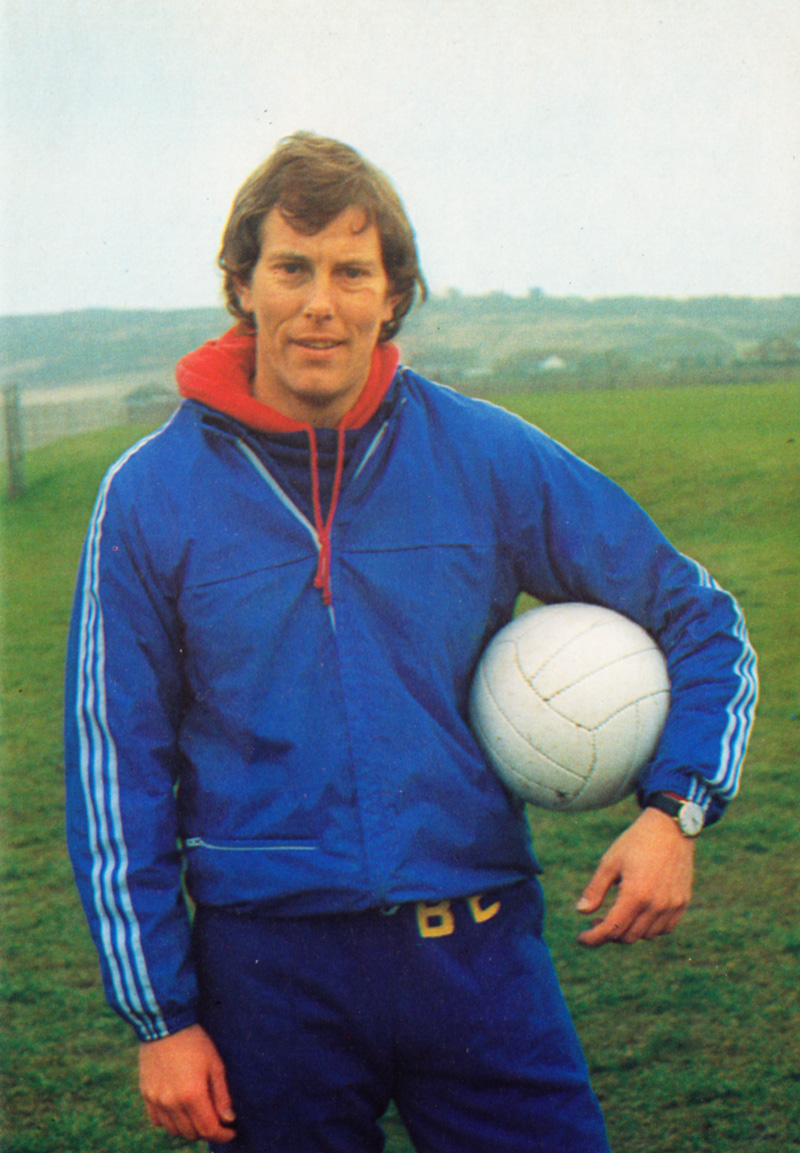
In 1978/79, Glen Wilson switched from being physio to kit man and, in this position, he was interviewed by David Bobin on the eve of the FA Cup Quarter-Final with Norwich City in 1983:
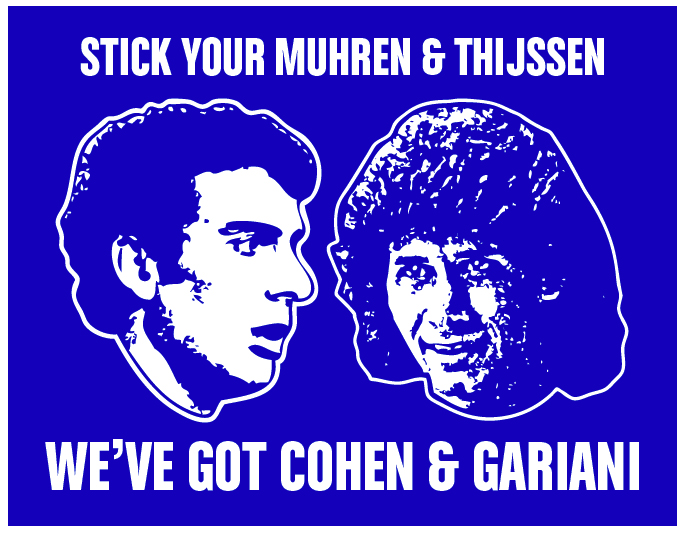
In the early 1980s, when foreign imports were rare, Tottenham had the duo Osvaldo Ardiles and Ricardo Villa, and Ipswich Town had Arnold Muhren and Frans Thijssen. Despite Brighton making a play for Peruvian World Cup stars Percy Rojas and Juan Carlos Oblitas in February 1979, nothing happened despite both featuring in a match behind closed doors at Hove Greyhound Stadium.
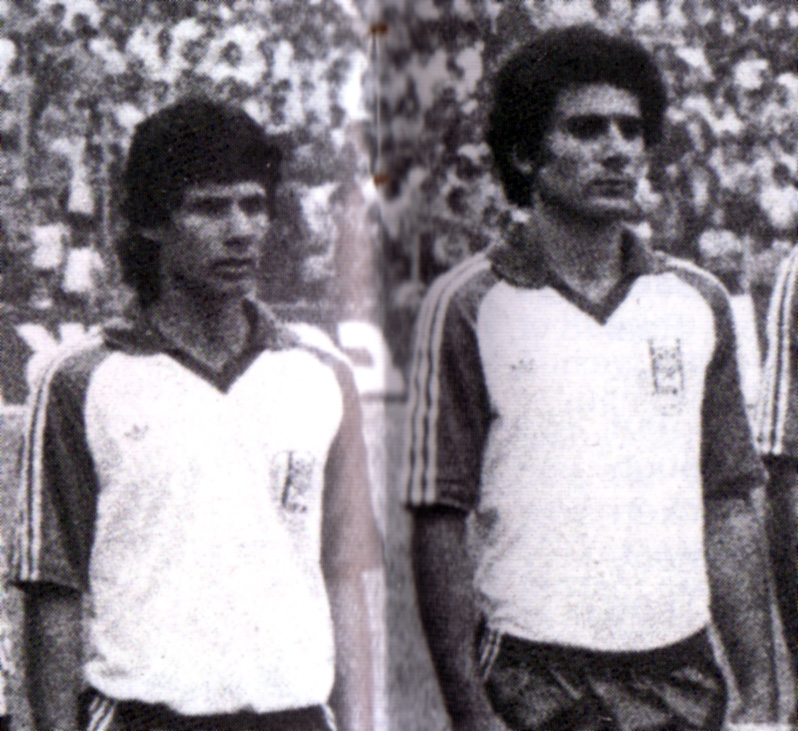
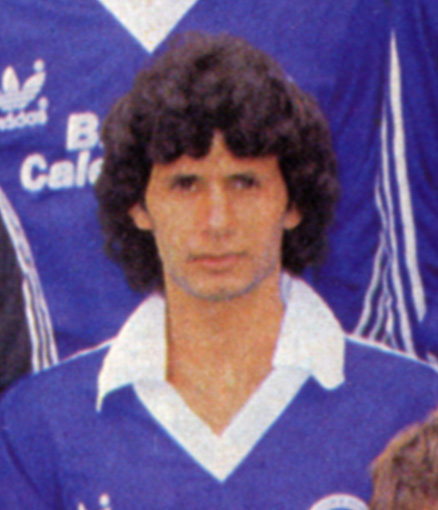
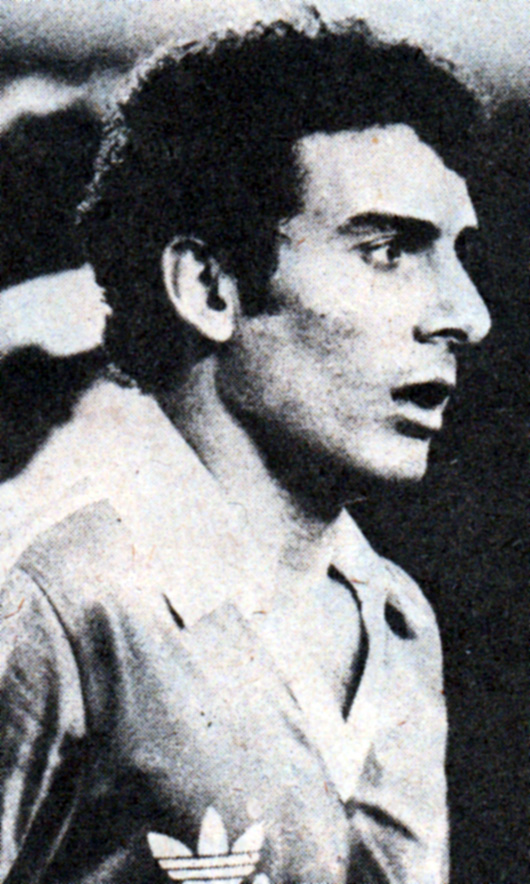
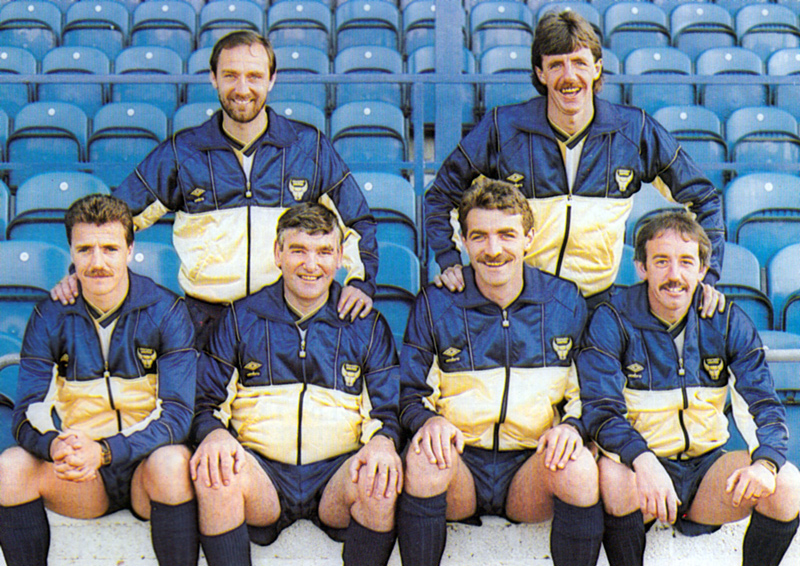
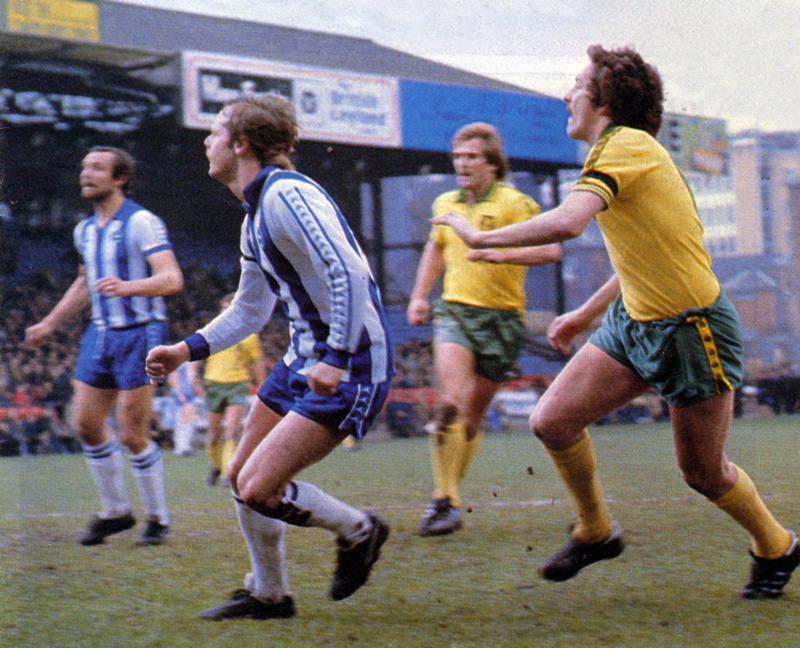
Eventually, though, we had Moshe Gariani and Jacob Cohen. You can see these two gods of Israeli football together in this image above, with Cohen on the right sporting the larger perm. I hope you’re grateful as, to track it down, it required much buying of Israel international football programmes from the 1980s, on the off-chance of a photo of the pair!
It took until May 1980 for Brighton & Hove Albion to join the growing trend of bringing ‘continentals’ into the First Division. The Seagulls had played a friendly match against the Israeli national team, managed by ex-Albion player Jack Mansell, in February 1980, triumphing 2-1 at the Ashkelon Stadium via goals from Mark Lawrenson and Peter Ward. Suitably impressed by the performance of opposition player Moshe Gariani, Mullery bought the 22 year old’s services for £40,000 three months later.
BBC reporter Alan Green (yes, that one) described Gariani as “one of Israel’s big successes. Looks very like Kevin Keegan and runs like him as well! Plays mostly on the left-hand side but always tries to keep in the thick of the action.”
Thanks to Paul from Cult Zeros, I’ve found this impressive footage of Gariani scoring for Maccabi Nathanya in the side’s 1979/80 championship-winning season:
The club’s line-up is unlikely to bear the name of Mullery’s fourth signing in the early stages of this season. The club’s coaches reckon Moshe Gariani will take at least four months to adapt before he is tried in the First Division, but more than one of the experts is confident Gariani, an aggressive midfield player who runs hard at defenders, will be pushing McNab hard if the former Bolton player fails to produce the goods.
Much earlier than expected, Gariani was an unused sub in the 2-2 draw at Tottenham in August 1980 before playing seventeen minutes of First Division football at Southampton the following month, after coming on for Gerry Ryan in a 3-1 defeat. Three matches later, the Israeli was again an unused substitute in the 2-1 League Cup home defeat against chocolate shirted Coventry. And that was that. Gariani had no other opportunities to impress in the first team. Although he featured in some pre-season squad photo shoots for the following campaign, he was sold to Tel Aviv in August 1981.
In between Gariani’s one appearance and his departure, Brighton fans were treated to the similarly brief English football career of his Israeli compatriot Jacob Cohen.
Jacob Cohen (or ‘Yaacov Cohen’ as he was often listed in international match programmes) had already been an Israeli international for four years by the time he arrived at Brighton in August 1980 for a trial. Once more, Jack Mansell played a part, recommending Cohen who was watched by Albion chief scout Jimmy Melia. Eventually, £40,000 was enough to buy him in October 1980.
Having made his debut as substitute in a 0-0 stalemate at Stoke City that month, Cohen (filling in for the injured Gary Williams) followed up with three successive starting appearances in the left-back position, against Manchester City, Arsenal and Middlesbrough. Unfortunately, all three matches were lost but still, that’s quite a lot of minutes more than Gariani managed at the Goldstone.
Having been substituted against Middlebrough, Cohen then lost the number three shirt to Gary Stevens and had to be content with two more substitute appearances, at Leeds in November and then a home win against Sunderland in early December, before his Albion career also petered out. He joined Israeli side Bethsheba FC after the 1980/81 season ended. In the Northern Ireland v Israel programme from November 1981, BBC reporter Alan Green says after his short stay at Brighton, Cohen “went back to Israel a very disappointed man.” He describes Cohen as “very much an attacking back in the Sammy Nelson mould but consequently leaves plenty of space for right-wingers.”
The following season, Brighton made do by signing the real Sammy Nelson, joining in a £30,000 deal from Arsenal.
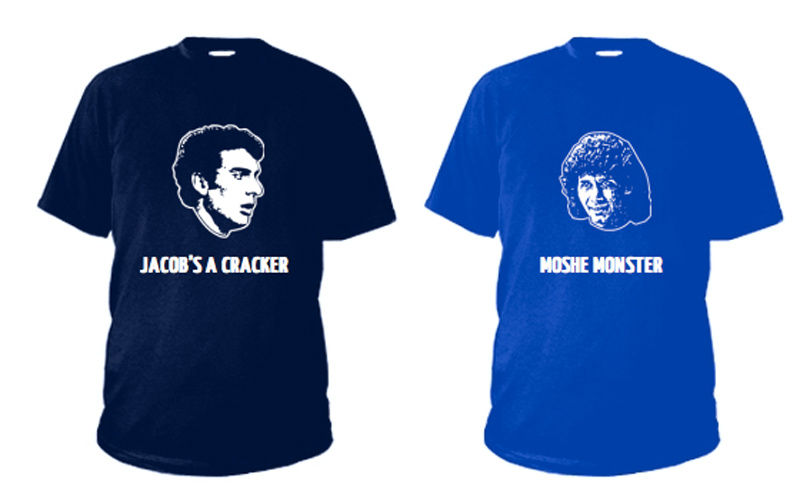
As for the homeward bound Israel internationals, not much is widely known about what happened to their careers after. Never mind, though. Because Cult Zeros, a company that specialises in custom-made football T-shirts of celebrated and not-so-celebrated players, have launched a range of Moshe Gariani and Jacob Cohen t-shirts. And they look fantastic! I went with this design:
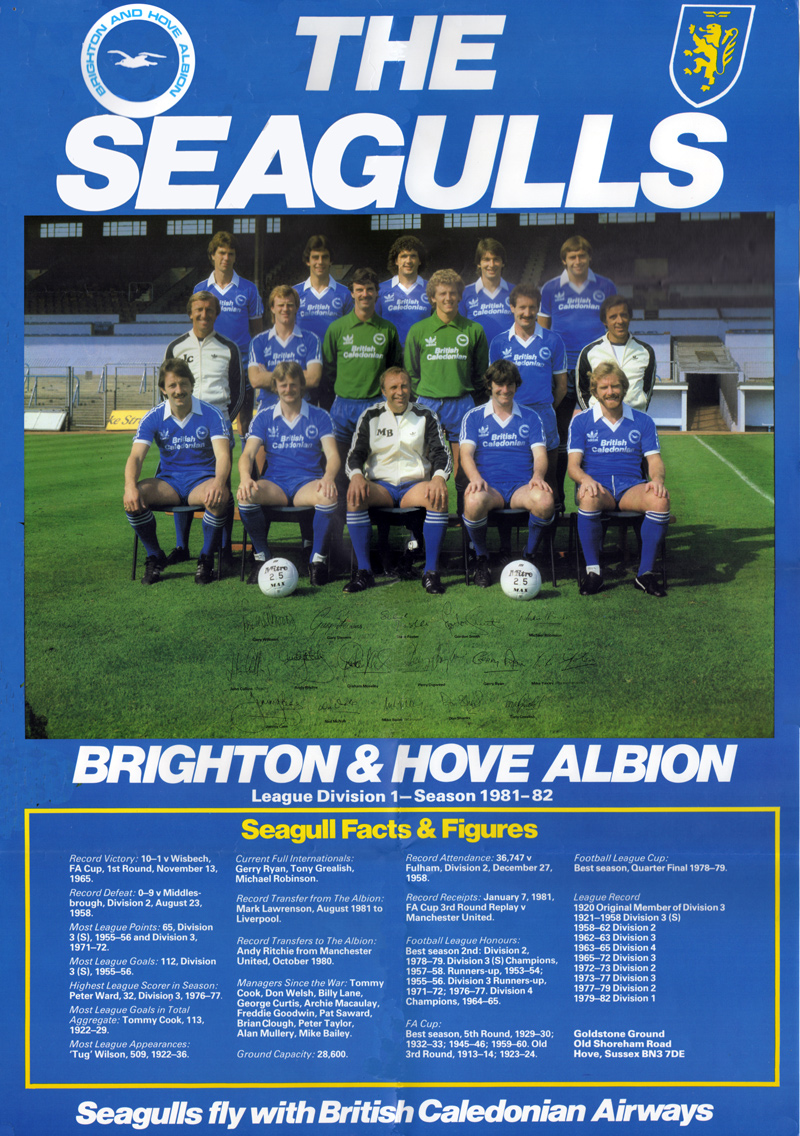
This glorious A2 colour poster from the Seagulls Shop would have been stuck proudly upon the bedroom wall of many Brighton fans. It would have helped familiarise them with the re-shaped team. In this very select team group photo with just eleven outfield players and two goalkeepers, new signings Jimmy Case, Don Shanks and Tony Grealish take pride of place in the front row with new boss Mike Bailey. As you can see, these were the good old days when the coaching staff had their initials printed onto their tracksuits. Very cute!
Just like his new buddy in midfield Tony Grealish, it is widely forgotten that Jimmy Case took some time to settle with the Seagulls. Grealish had a job to win over the fans as he had replaced club captain Brian Horton, who joined Grealish’s former club, Luton Town. After a long, successful career at Liverpool, Case’s form was indifferent in his first season at Brighton. Nevertheless, Case did manage to play 33 League matches. He scored just three goals, all in the early part of the season, the last of which was in November 1981.
Right-back Don Shanks (front row, fourth along) was a free transfer from QPR, and proved an instant hit, working his way up and down the line throughout the season in a way that many Brighton supporters remember fondly. This is illustrated by his great work down the right-wing that helped the Seagulls draw 3-3 against Liverpool in October 1981. His First Division know-how also made for a much meaner defence.
With Andy Ritchie and Michael Robinson banging in the goals, this tightly organised team never fell below 14th place and were able to play a whole season in the First Division without any relegation fears.
The gloriously manly Wang Computers are quite rightly hailed by The Football Attic as the greatest shirt sponsor of all time. Man, I wish Brighton & Hove Albion had the US computer company as our shirt sponsor in the 1980s. Instead, we wound up with the thoroughly embarrassing NOBO. I’m sorry, but boasting you are ‘Top of the First Division For Display and Training Aids’ cuts no ice with me.
When Wang Computer became the sponsor of Oxford United, a Division One club for the first time, in summer 1985, Brighton were still plying their trade in the Second Division. When the U’s, who had triumphed in the League Cup Final against QPR 3-0, won by the same score over Arsenal on the final day of the 1985/86 season, it inconveniently preserved the side’s top flight status. Their home kit, incidentally, looked strikingly similar to Brighton’s away kit for the forthcoming 2013/14 season.
Hopes of a mirth-making Wang v NOBO football match were dashed by that Arsenal result, and frustrated again the following season when both Oxford and Brighton went down, preserving the league gulf between them.
It took until September 1988 for newly promoted Brighton to play in their NOBO-emblazoned shirts against the team in Wang.
Brighton lost 3-2 to Oxford in a Second Division fixture as part of a depressing start to the 1988/89 campaign where they lost their first eight matches. Oxford manager at the time was ex-Seagulls favourite Mark Lawrenson. His programme notes explode the myth that he has never acknowledged his time at Brighton since leaving the Goldstone. Instead, he wrote warmly:
“Welcome today to Brighton and Hove Albion, the players and officials and everyone connected with the club. Brian Horton and myself spent many happy years at the club and we have a great affinity for the club from the good times we had there. Indeed Brighton’s result is one of the first we look for on a Saturday night. Dean Saunders too, I am sure will wish to have a good game today as he had a successful time at the Goldstone Ground.”
Due to the financial woes at Brighton, Saunders had been signed for a ludicrously low fee of £60,000 in March 1987. Sometimes, it is said by Brighton fans that Lawrenson took advantage of the difficulties at his former club to ‘steal’ Saunders from us, but the Oxford manager at the time was Maurice Evans (bottom row, second from left, in the image below), not Lawrenson.
Mark Lawrenson didn’t last long as manager, however. He was sacked the following month after making critical comments when Saunders was sold to Derby County against his manager’s will. The future complacent BBC armchair pundit was replaced by Brian Horton.
By the time of the return fixture, in late March 1989, Brighton had hauled themselves off the bottom of the table to 21st place, one place above the relegation trapdoor. They helped their cause even more by coming from behind to beat Oxford 2-1 at the Goldstone Ground.
The Seagulls eventually finished 19th, two places behind Oxford.
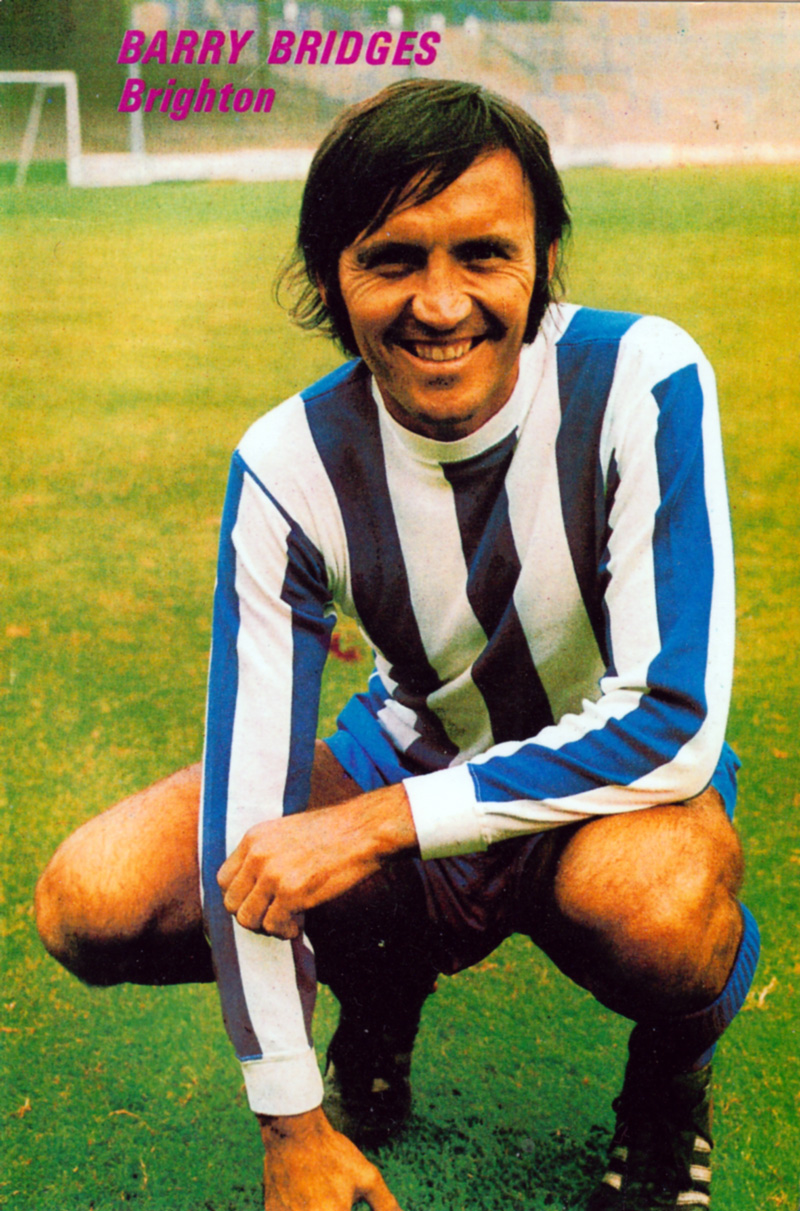
“I was really surprised to be voted Player of the Season. It was a great honour and one I shall always remember. But I thought it could have gone to any of the players as we have such a marvellous season. There was Eddie Spearritt, who was so consistent… Willie Irvine, who always scored vital goals… and Peter O’Sullivan, who started off like a bomb.
“As I have said, it wouldn’t have surprised me if the award had gone to any member of the first team squad. But naturally, I was very thrilled to be voted to the title.
“It will help me to remember last season even more. Once again, as I was at Birmingham, I was switched from my right-wing position to play right full-back. The move didn’t bother me. I don’t have any special preference for either position. I enjoy them equally.
“Nowadays, of course, wingers don’t play like the old-fashioned wingers and neither do the full-backs. I remember when I was at Chelsea and at Birmingham that if you were selected to play on the wing you had to stay out there. It was frowned upon if you wandered to the other side.
“But it’s all changed now. As long as you are aiming at something positive anything goes. A winger is allowed to move inside or drop back to help in defence and it’s commonplace to see full-backs go on runs. That’s what makes today’s game so exciting.”
Brilliant anecdote from Gordon Smith’s ‘And Smith Did Score’ autobiography, page 123:
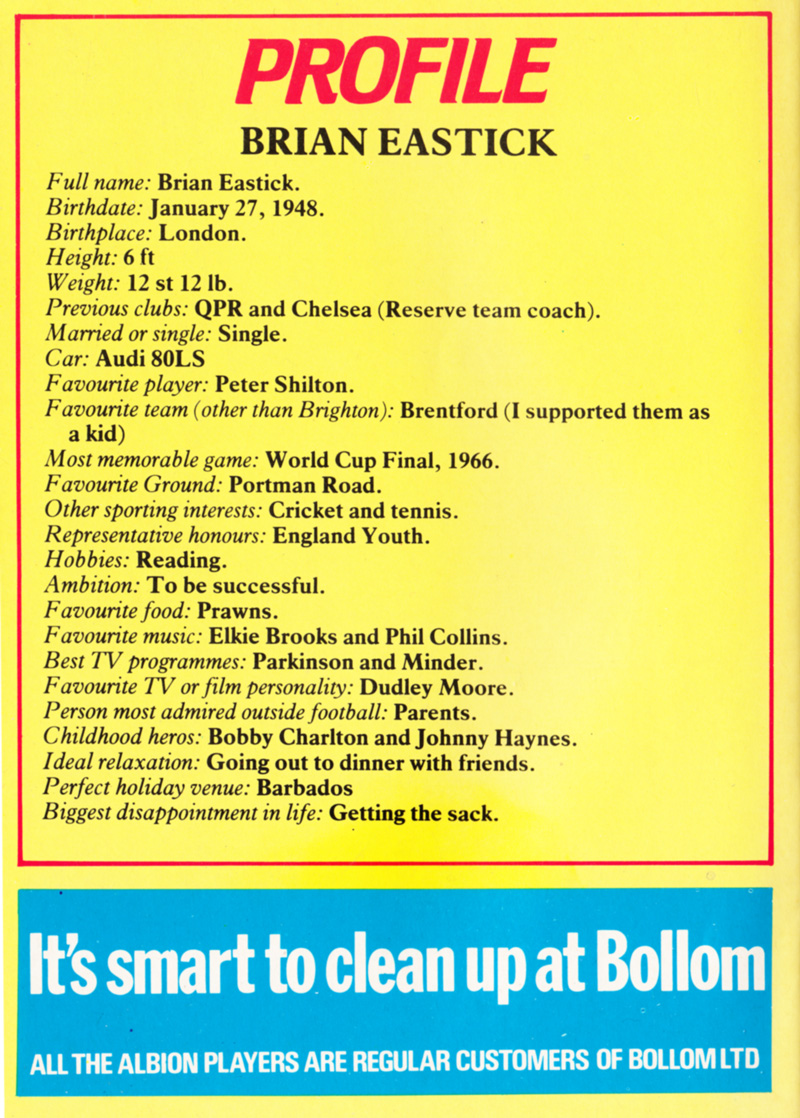
The players look at each other and wonder if they should believe what they have just heard. Standing on the training ground, they look askance at the Brighton youth team coach, Brian Eastick, who is taking the first-team training for he first time.
‘Right lads,’ he has just told us, ‘We’re going to have a game of football, so pick two sides. But what’s different about this game – and if you take this seriously it will be a great help to you – is that we’ll be playing with an imaginary ball.’
‘It’s twenty minutes each way – a practice game with a pretend ball.’
He senses a reluctance from the players and nobody moves. ‘Look,’ says Brian, ‘the boss is watching and it’s either this or he’ll have you running all morning – what’s it to be?’
Since anything’s better than running round a track for a couple of hours, we decide to go along with this rather unconventional training method. We’re about to start the 1982-83 season and this is undoubtedly the weirdest training session I have ever taken part in and that would go for the rest of the Brighton players as well.
We get ourselves into teams and line up to kick off. The former Arsenal star, Charlie George, has joined Brighton on a month’s loan and he’s in my team. I kick off by touching the imaginary ball to Charlie who makes an imaginary pass to our winger, ex-Manchester United player, Mickey Thomas, Mickey then makes a 20-yard run at full pace, slides along the touchline and jumps up to shout, ‘For fuck’s sake, Charlie, play it to my feet, will you?’
The players can hardly stand up for laughing and that’s the end of the game. Brian Eastick is not happy and, since we’re not taking his game with the imaginary football seriously, it’s back to running round the track.
Brian had been on the continent looking at how the European teams train and noting their coaching methods. He must have seen some foreign team trying out this practice match with no football and decided to introduce it to the British game. Brian had persuaded Brighton’s then manager, Mike Bailey, to let him take the first-team training for a morning and try out these new methods. Unfortunately, the British footballers weren’t quite ready for such progress and diversity of coaching methods.
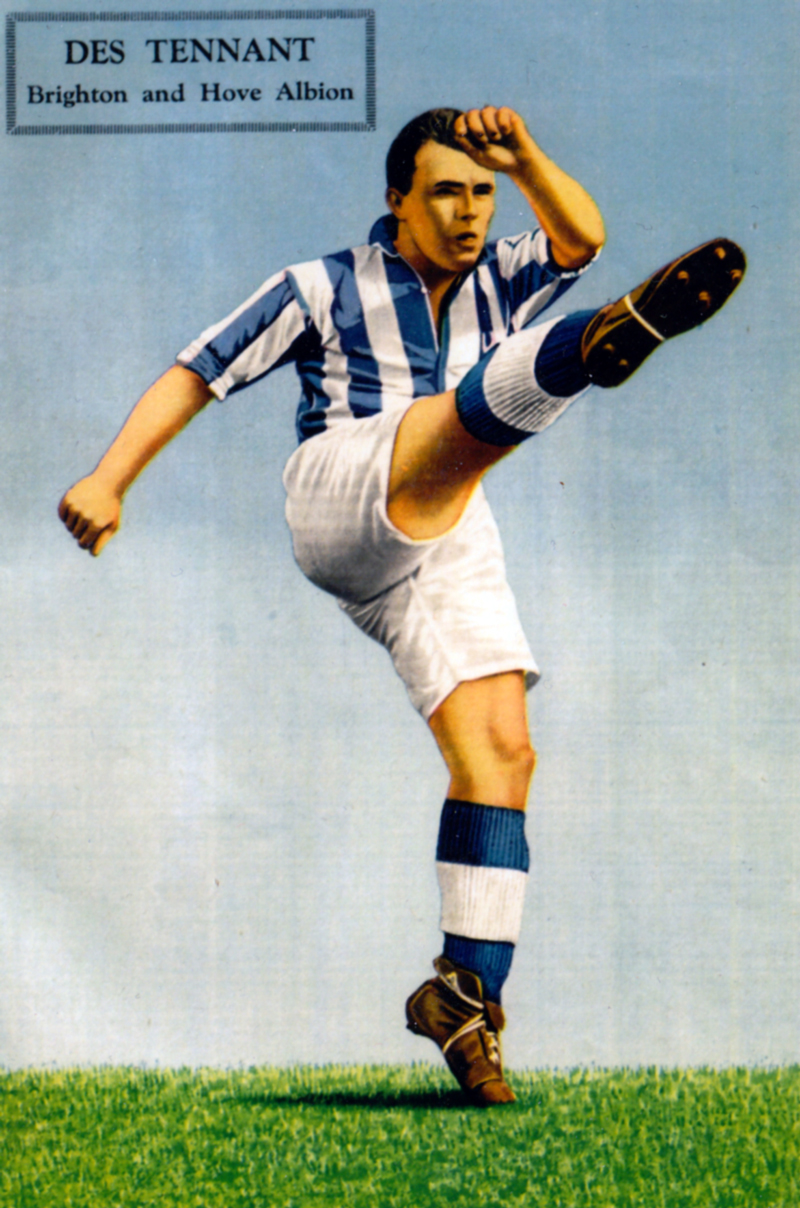
Several Brighton players down the years have been known as ‘The Tank’ for the power of their play, but I think Des Tennant was the original.
He signed from Barry Town in the summer of 1948, as a 22 year old, and made a whopping 424 appearances for the club.
His lion-hearted forays down the touchline made him a favourite at the Goldstone. He initially lined up as a right-winger, also playing as inside-right before become a ferocious tackling right-back with a lot of attacking intent. No wonder that Des Lynam, in his autobiography, referred to the other Des as ‘a favourite player of mine.’
In the ten years when he was a fixture in the side, Tennant was also captain for three seasons, including in 1953/54 when Brighton were runners-up in Division Three (South). Unfortunately, in those days, only the champions were promoted. He also scored 47 goals, 23 of which were penalties.
One particular goal is remembered fondly on North Stand Chat by the user nobody’s dupe. He recalls the days when clubs would play home and away fixtures against the same opposition over Christmas. Brighton gave Newport an unhappy present on Christmas Day 1952, thrashing the Welsh side 3-0 on their own ground. Two days later, in the return fixture at the Goldstone, Albion were 1-0 up at half-time but then surprisingly found themselves trailing 2-1. It took a long-range effort from Des to save the day.
Des enjoyed a benefit match against Brentford in May 1954. He retired in 1959 to join the coaching staff.
Sadly, he died in January 2009. His niece, Gillian Marsh, of Derwent Drive, Cwmbach, said: “My uncle was a wonderful character who loved life and valued his family and friends above all else.”
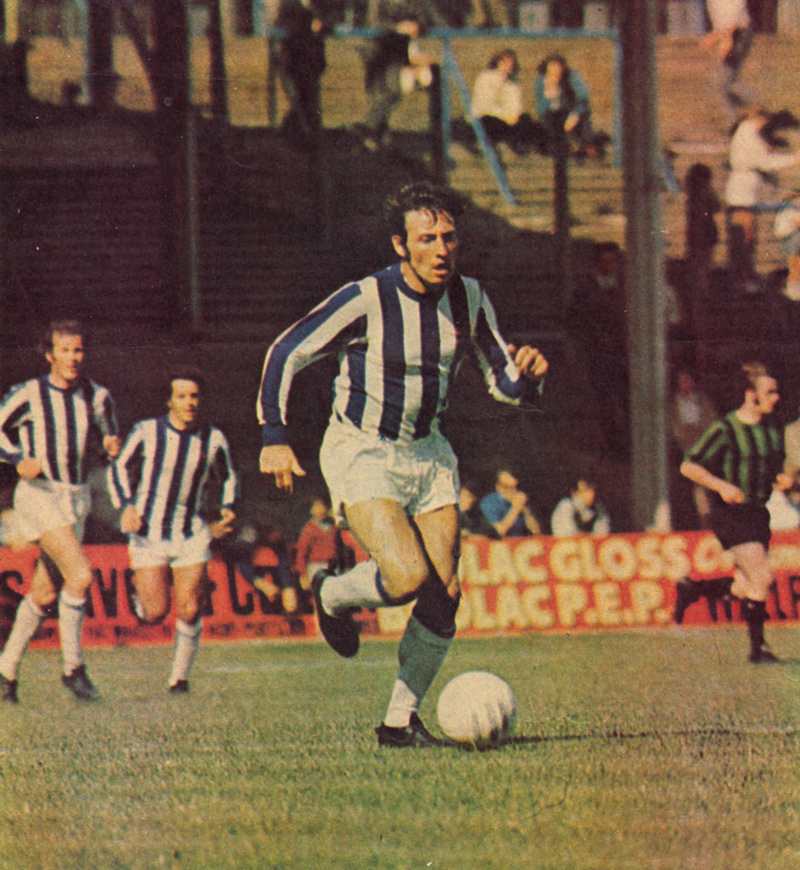
The image above, from a magazine, in a football shirt that buttons all the way down the front, is used to form the crest of the Brighton & Hove Albion Collectors and Historians Society.
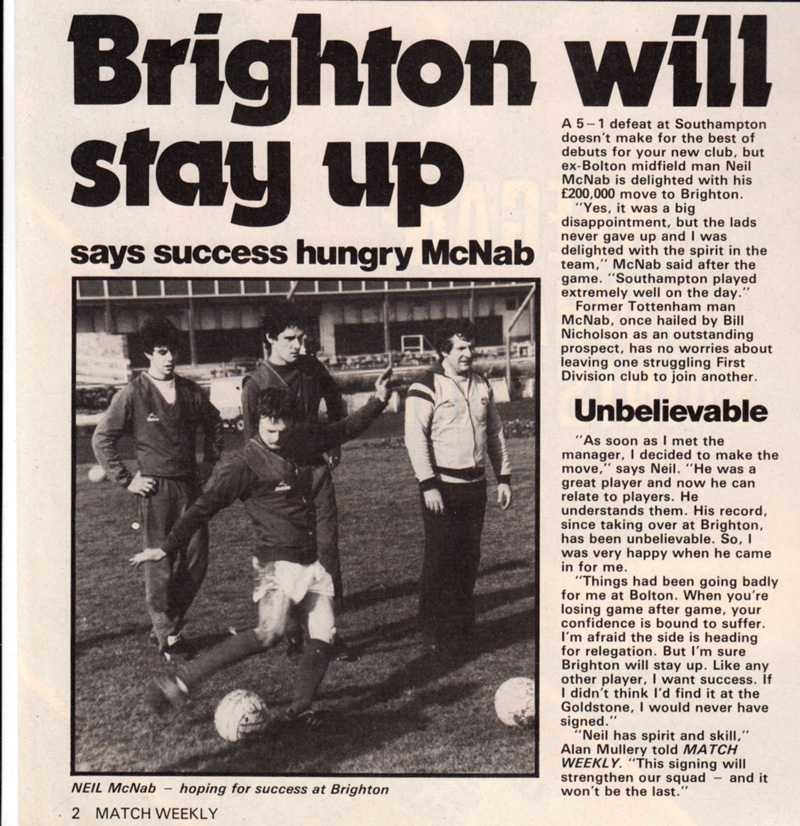
A 5-1 defeat at Southampton doesn’t make for the best of debuts for your new club, but ex-Bolton midfield man Neil McNab is delighted with his £200,000 move to Brighton.
“Yes, it was a big disappointment, but the lads never gave up and I was delighted with the spirit in the team,” McNab said after the game. “Southampton played extremely well on the day.”
Speaking of Alan Mullery, McNab said:
“As soon as I met the manager, I decided to make the move,” says Neil. “He was a great player and now he can relate to players. He understands them. His record, since taking over at Brighton, has been unbelievable. So I was very happy when he came in for me.”
After playing for Spurs in the infamous promotion game with Southampton in April 1978 (which Brighton fans deem a ‘fix’), McNab had found himself frozen out of the side by the signings of Osvaldo Ardiles and Ricardo Villa. He joined Bolton Wanderers in November 1978, Second Division Champions in 1977/78, but by 1980, they looked certain for the drop from the First Division.
McNab’s personal life had been clouded by the death of his father at the age of 43. Mike Bamber, Brighton chairman, promised to be a ‘second father.’
On the pitch, McNab brought some much needed class to the Goldstone. His busy, methodical play, with an excellent range of passing, did much to help the club secure top flight status comfortably.
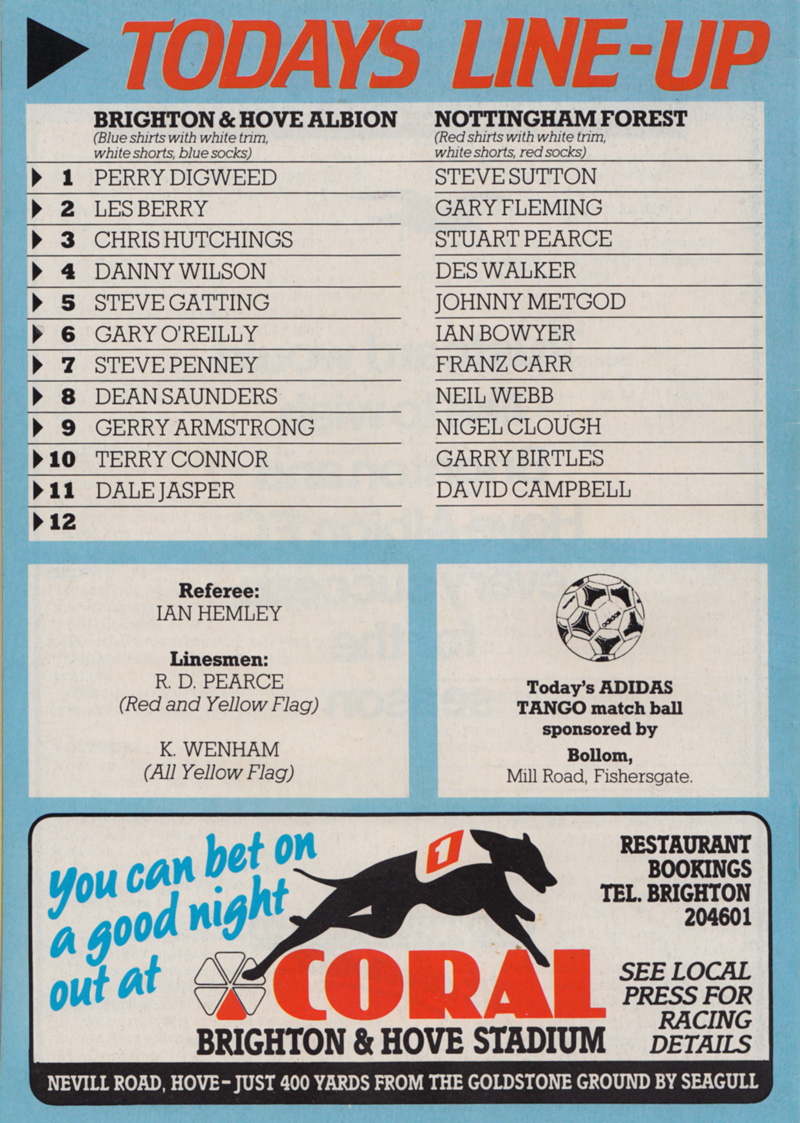
Here’s the back of the programme for the first leg of the Brighton’s cup tie against Brian Clough’s Nottingham Forest in the Littlewoods Cup in 1986.
Take a glance at the name of the linesman with the red and yellow flag, R.D. Pearce. Surely just a coincidence that he has the same surname as Forest’s left back? Or is it?!
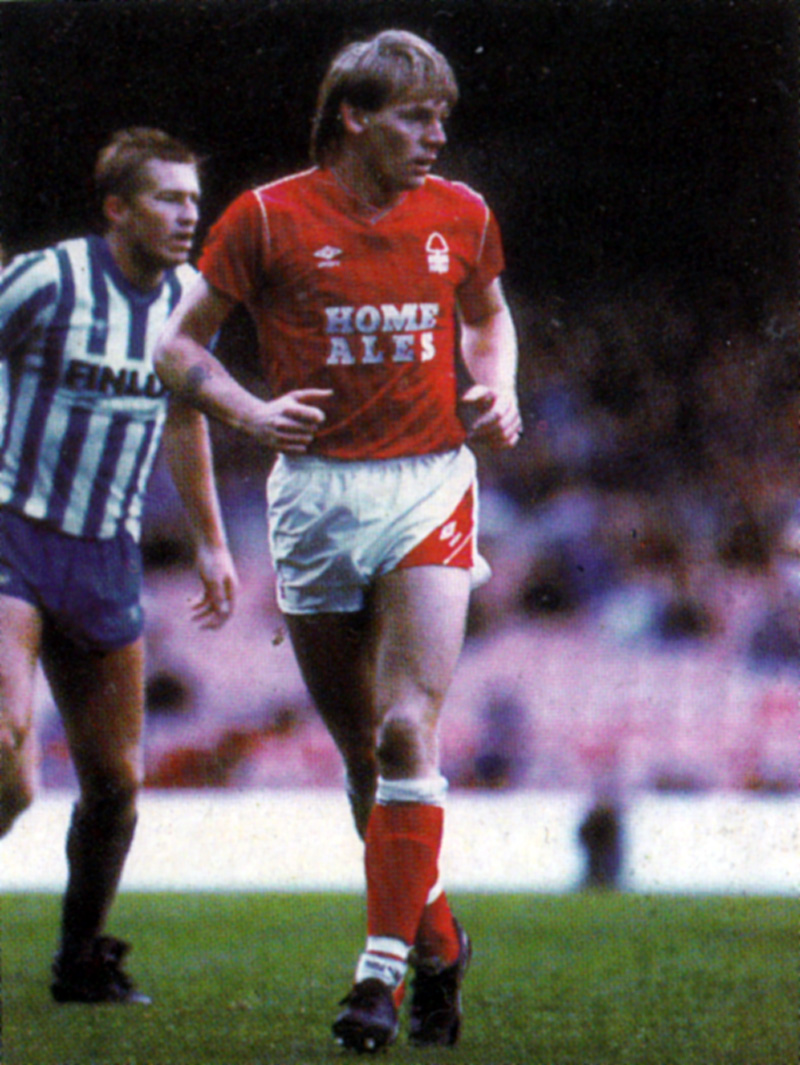
Writing in ‘Psycho,’ his autobiography, Stuart Pearce explains how his brother Ray took up football officiating, eventually finding his way to running the line at the Goldstone Ground:
He progressed through non-league into the Football League and ran the line in top matches. The big age difference between us meant that when he was asked the usual questions about whether he had any relatives in the game he answered quite truthfully that he had not.
I’m not sure that makes complete sense, unless Ray Pearce was only ever asked the question only once, before Stuart became a pro…
Anyway, the punk-lovin’, tough tacklin’ Pearce continues:
A trivia question that would flummox even the most knowledgeable football fan is when did two brothers take part in the same game with one playing and one officiating? It happened to us when he ran the line in a Nottingham Forest League Cup tie at Brighton. He disallowed a goal for Brighton! I had no fears, however, about his honesty. He would err on the side of Brighton rather than favour me.
No one knew, apart from the Forest team. It was funny running up the wing and having my brother alongside me on the touchline. He could have booked me because I kept taking the mickey out of him – ‘Oi, you ginger dickhead,’ is one thing I remember calling him. Perhaps it is a good thing that he never became a League referee because it would have come out eventually that he was my brother.



 The Goldstone Wrap