Author Archives: Goldstone Rapper

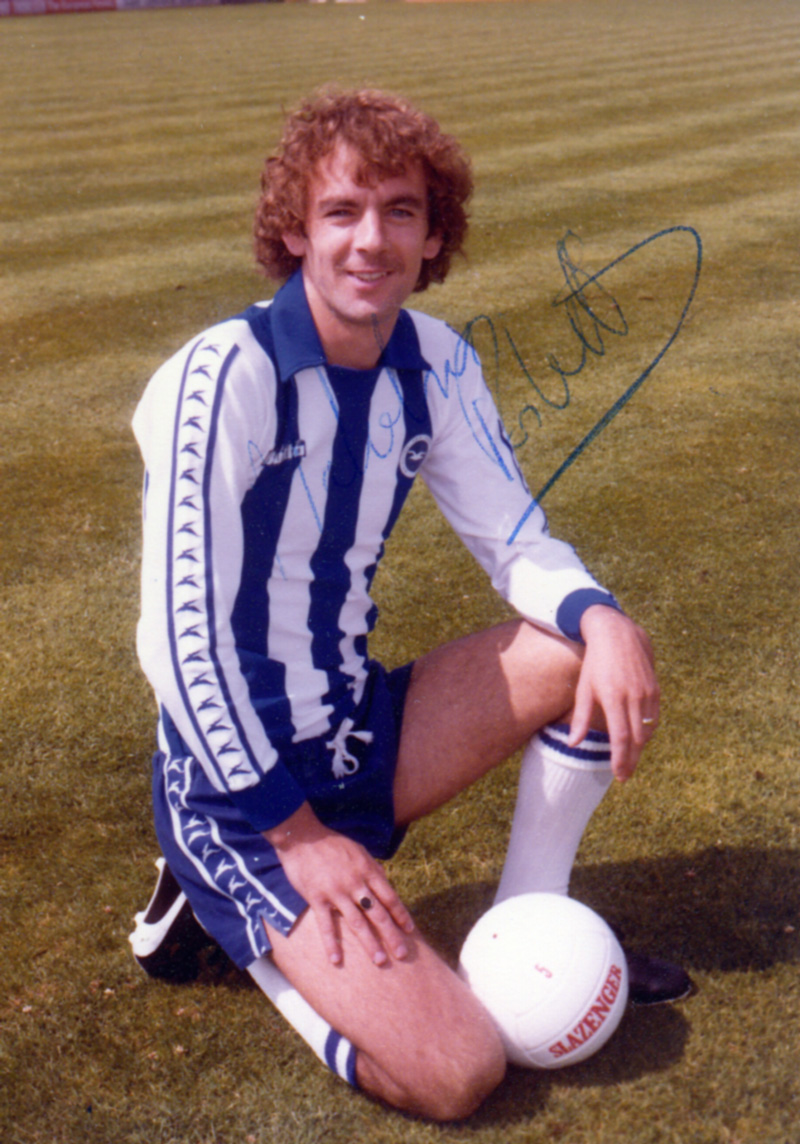
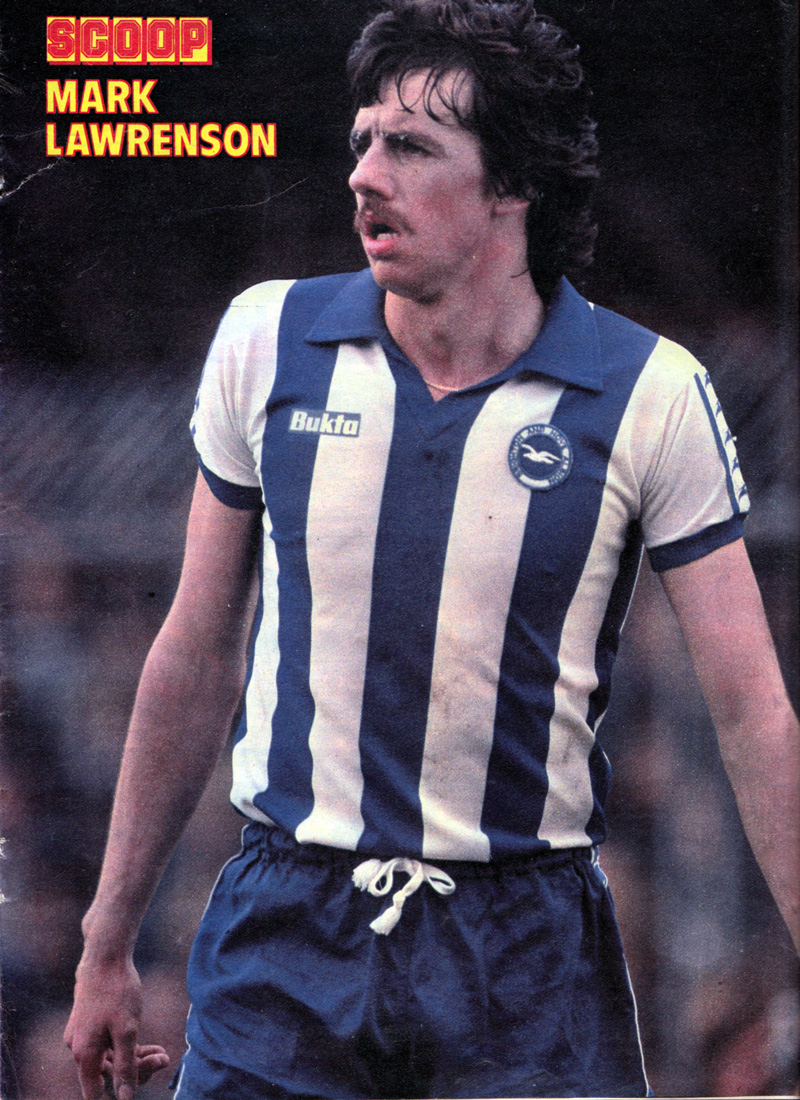
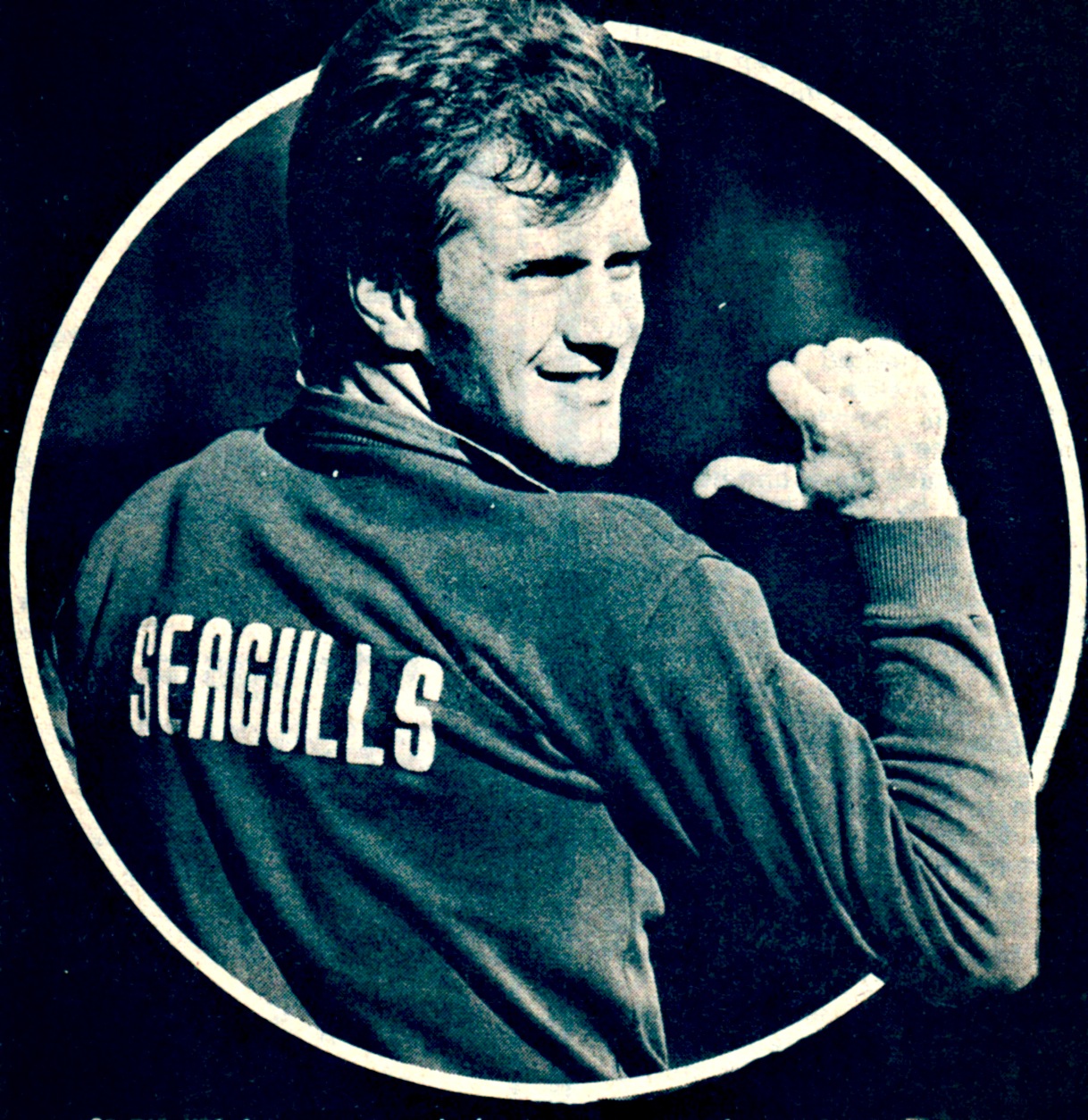
Mark Lawrenson expresses his love for Brighton down the years

marklawenson9

One of the myths that has snowballed down the years has been that Mark Lawrenson does not ever acknowledge his time with Brighton & Hove Albion, or that he has only done so in recent times when the club has been on an upward trajectory. However, a read of his autobiography from 1988 suggests a different story:

I loved Brighton as soon as I saw the place, bright, bustling and cosmopolitan, and the football club was on a high. They had just been promoted to the Second Division and everything was looking good.

What I did not realise when I arrived was that I was taking the place of Graham Cross, the former Leicester player, who had enjoyed a tremendous season in Brighton’s promotion run. There were a few mutterings in the dressing room about this unknown teenager from Preston but Alan Mullery soon silenced them and made it very clear that he was backing me to the hilt. It was the first time I had been away from home but it did not seem to matter. Most of the Brighton players had been recruited from different parts of the country and there were very few locals in the team. There were never any problems about settling in because the majority of the players were in the same boat so we tended to stick together.

I defy anyone not to like living in Brighton. I could see myself staying there permanently long after my football career was over, that’s how much I liked the place, and it seemed that the club would be successful for a long time to come. We just missed out on promotion to the First Division in my first year, but it would happen 12 months later. The town was football daft and we were getting gates of 24,000 on a regular basis at the Goldstone Ground.

Into the 1990s, Lawrenson was again happy to talk about his Albion days as some of the happiest of his career. In ‘Soccer in the ’70s’ on TVS and one of Gary Lineker’s first TV presenting jobs, he spoke warmly of his time at the club (from 3 minutes onwards):

Fast forward to the 2000s, and as he explained to Spencer Vignes in ‘A Few Good Men’, his time down south remains firmly in his affection:

‘Brighton was just great. I’m sure everyone you’ve spoken to who went there has said the same thing. In terms of fun and everything it was just the best, apart from big Al occasionally going mental at us after games. It was a great time to be there with a great set of players and fantastic supporters. So many wonderful memories, both on the playing side and the social.’

And if that wasn’t enough, in the 2010s, he helped present the edition of Football Focus live from the Amex, on the day of the match v Doncaster, and posed in front of his ‘Legends’ banner.

It certainly makes for a juicy story to say that one of Brighton’s best ever players pretends he never played for us. It makes a even better one to add that, as Oxford manager, Lawrenson took advantage of his hard-up former club to ‘steal’ Dean Saunders from us for just £60,000 in 1987. Nevertheless, it isn’t actually true. Maurice Evans was the Oxford manager at the time that Saunders left the Goldstone and, as you can see here, there are ample examples to show that Lawrenson has sung the praises of Brighton in terms of the town (as it was then), his playing days and the current successful times.
Tagged

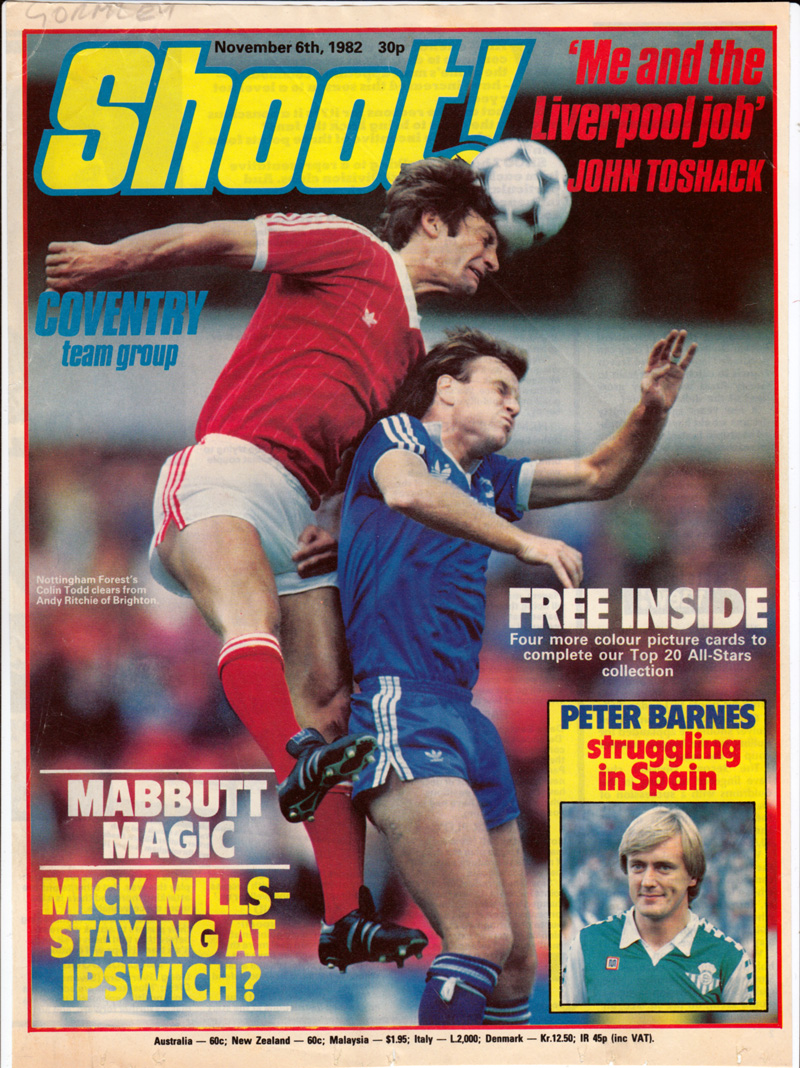
Shoot cover: Andy Ritchie (6 November 1982)

shootcover11

‘Reject Ritchie has a score to settle’ from 1980/81:

Brighton’s record £500,000 signing, Andy Ritchie, has a few words of warning for his former colleagues, Manchester United, as they prepare themselves for Saturday’s (Nov 22) visit to the Goldstone Ground.

“‘I know they’ve been doing well and we’ve been struggling, but I feel this match could go either way especially if we can put our game together and attack. Forget our position in the League, because we’ve been playing far better than the tables suggest.

“Obviously I’ll be trying to prove they were wrong to let me go,” Ritchie continued, “and I’ll be going all out, although I realise that I’ll have to pace myself so that I won’t run out of steam.”

Ritchie describes his move to the South Coast as the biggest decision of his life and still admits to having a few regrets about leaving Old Trafford:

‘I’d lived in Manchester all my life and I’ve got a lot of friends there,” he said. “! didn’t want to leave but in the end I had choice, because there would have been no future for me if I’d stayed.”

ritchie2c

Before choosing Brighton, Ritchie turned down offers from Aston Villa and Chelsea which he still feels he was right to do.

‘The Villa offer was about 12 months ago and I didn’t really have enough time to think about it. I had a look round, and although I liked Ron Saunders and the club, I was still convinced I had some thing to offer United,” Ritchie commented.

Ritchie also stressed that his decision not to join Chelsea was not influenced by the outburst which resulted in Queens Park Rangers parting company with Tommy Docherty.

“There were a lot of reasons why I didn’t go, and what Mr Docherty said didn’t have anything to do with it. I’d rather just say that I didn’t fancy the move,” Ritchie said.

Before joining Brighton, Ritchie had only made five appearances for Manchester United this season, and although he had failed to score he was satisfied with his form.

“1 thought I’d done quite well, even though I know I could have played better. But at least I had given my best, which is why I was a little disappointed at being dropped,” he reflected.

Despite the bizarre events which involved him, Peter Ward and Garry Birtles in the notorious ‘transfer triangle’ between Brighton, Nottingham Forest and Manchester United, the thought that his move to Brighton could fall through never entered Ritchie’s mind.

“I first came down Alan assured me that I would a Brighton player provided I wanted to sign. I was told that Newcastle were also interested in me but I said ‘no way” until I’d made a decision with Brighton.

“I don’t feel there’s pressure on me. The fans know they must give me time to settle and I’m sure they realise that Peter Ward and I are two different types of player,” Ritchie explained.

Despite The Seagulls” precarious position in the relegation zone, Ritchie remains adamant that Brighton will still be a First Division club next season. “I can’t see any way we’ll go down if we continue playing as we have been. Things must start going right for us eventually as the club’s got tremendous potential, which is why I’m proud to be part of it.”

It did not take long for Ritchie to discover what a friendly club Brighton are, and despite their bad run and speculation about Alan Mullery’s future he quickly settled in.

“We’re certainly not the worst team in the First Division, and that makes it all the more important that we give our fans a treat on Saturday,” Ritchie pointed out.

Here’s, ahem, ‘highlights’ of the match with Manchester United in November 1980. Ritchie scores a consolation in a defensive horror show, and is involved in a dust up with former colleague Joe Jordan:

Tagged

Digweed’s meteoric rise

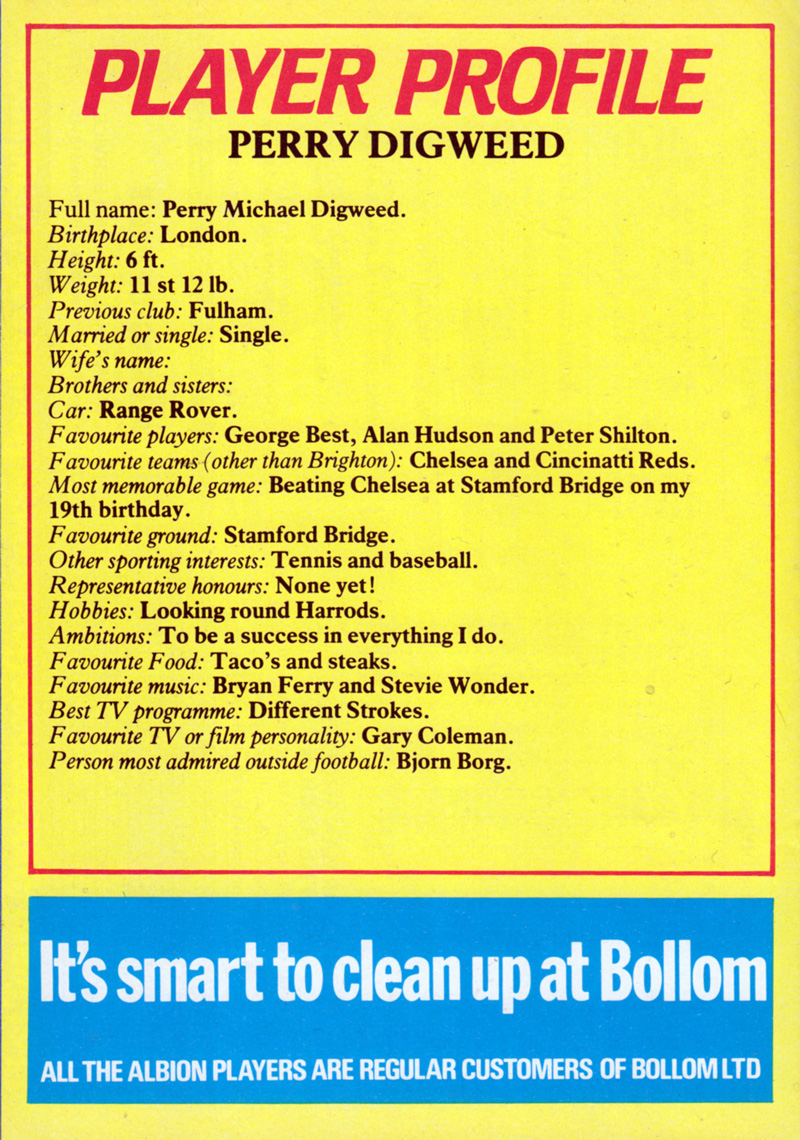
digweed5

digweed4

From either Shoot! or Match Weekly in 1980/81:

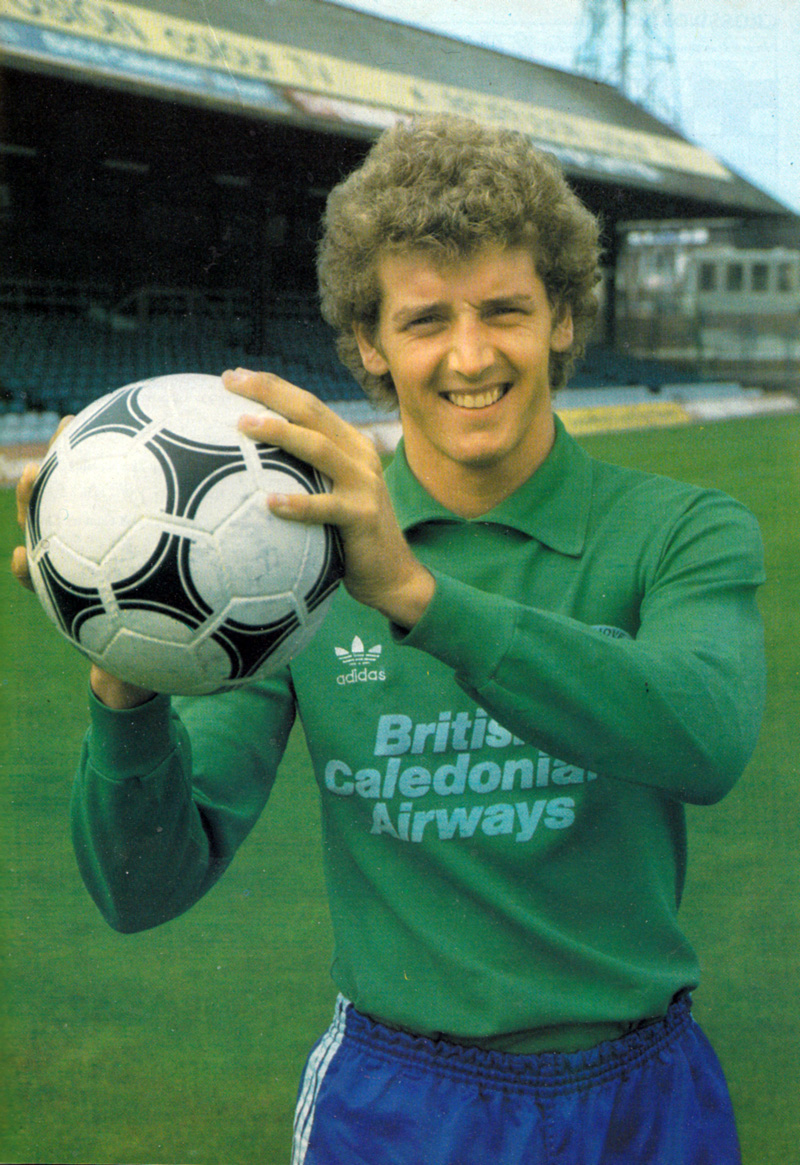
The opportunity of playing First Division football as Brighton’s first choice goalkeeper seven days after playing in front of a meagre 400 spectators for Fulham reserves left Perry Digweed with no doubts about leaving Craven Cottage.

“I’d asked for a move about a month before. I’d only played in a handful of first team games in five years and felt the time had come for me to establish myself somewhere.

“I was a little surprised to join a First Division club,” Digweed admitted, “although I had read that Brighton were interested in me.” But even though Digweed conceded two goals against West Bromwich Albion on his First Division debut and his 16th League appearance, Alan Mullery felt his new ‘keeper had justified the £150,000 gamble he had taken in plucking Digweed out of obscurity.

“Obviously we were after the best when it became clear that Graham Moseley was costing us vital points, but neither Peter Shilton nor Ray Clemence were available, which is why we had to look to the future,” Mullery explained.

“OK, so the lad was at fault with the first goal he let in, but his overall debut convinced me more than ever that we’ve signed someone who’s going to become a very good ‘keeper,” Mullery commented. And as if to confirm Digweed’s rapid arrival at the top, he was recently called into the England Under-21 squad for the game against the Republic of Ireland.

“He had to withdraw from the squad due to League commitments, but although he could not hide his disappointment, Perry was undoubtedly encouraged by his sudden arrival in the limelight. Digweed, who lives just a stone’s throw from Stamford Bridge, has always been an avid Chelsea supporter and is confident that he will be playing against his heroes in the First Division next season.

“Of course it will take time for me to adjust to the First Division, but it hasn’t taken me long to settle with Brighton as they’re such a young team. This is why there’s such a terrific spirit in the club, which makes me feel that once we’re established in the First Division we must be candidates for European football,” Digweed predicted.

Moving to Brighton has also enabled Digweed to rejoin Brighton’s assistant manager Ken Craggs, who was largely responsible for Digweed joining Fulham.

“My uncle, who played for Hounslow, is a great friend of Ken’s, and because of this, started training with Fulham when I was 13. Eventually Alec Stock saw me play and signed me up.

“It baffles me how Fulham have slipped so quickly,” Digweed continued. “They’ve always played attackinq football and should have pulverised some sides. Their problem has been that they haven’t scored many goals which is, after all, what the game’s about.

“It doesn’t worry me that I’ve joined a struggling club, because there is so much difference between playing here and the reserves. While my immediate aim is to help Brighton maintain their place among the elite, my main aim is to play for England,” Digweed stressed.

Digweed wrestled the first team keeper’s jersey from Graham Moseley, and ended up playing fifteen of the last sixteen matches of the 1980/81 season. However, when Mike Bailey took over the following season, the ex-Fulham player found himself back in the reserves again. Nevertheless, he had the distinction of playing in both the famous victories at Anfield in 1981/82 and 1982/83 and remained with Albion into the 1992/93 season. Despite his long service for the club, he was not awarded a testimonial match, and was fobbed off with a ‘golf event’ to celebrate his decade at the club.

Want to show your appreciation? You can buy a Perry Digweed T-shirt or hoodie at Cult Zeros. I wonder if they do special tracksuit bottoms as favoured by Perry himself…

Tagged ,

Football Pictorial Pennant from 1970/71

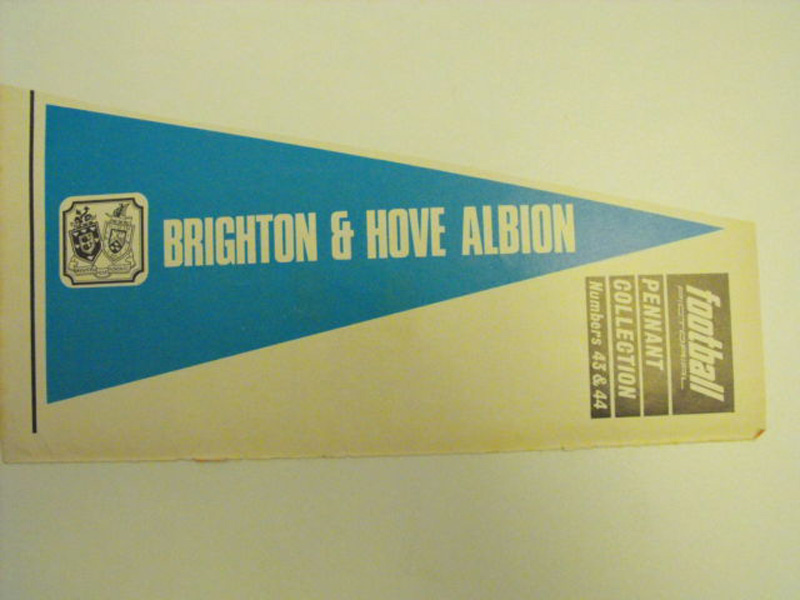
Fix your eyes on this Albion pennant from the Football Pictorial Pennant Collection, cut out from the magazine. Yes, it’s a cheapo paper one and it doesn’t come with any tassels:

pennant

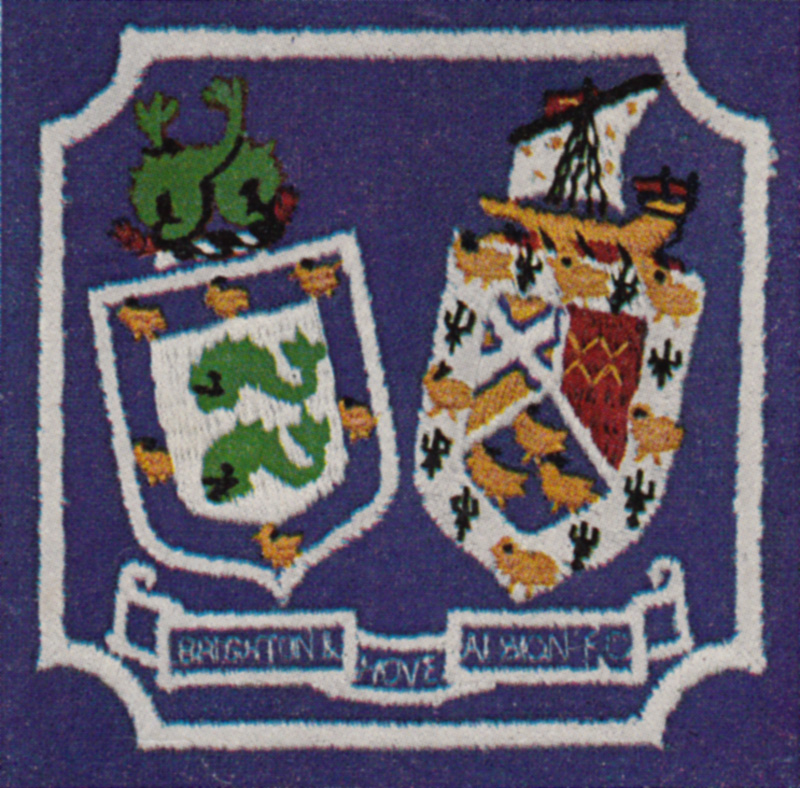
It does, however, include the official badge. Featured most prominently on the ‘blue Arsenal’ kit from 1964 (and indeed, a few jersey designs before), this crest was dropped from the shirts in the Pat Saward era from summer 1970, in favour of B&H AFC calligraphic lettering. Nevertheless, the badge made it onto this unofficial pennant (above) and continued to be used to some extent until about 1974. As Football League Review described:

badge

The club’s official badge features the arms of Brighton and Hove, set against the club colours of blue and white, The Brighton arms feature two dolphins surrounded by the six gold martlets of Sussex. Above the shield, a further pair of dolphins divided by two branches of coral refer to the sea and the South Coast climate. Hove’s arms also feature the County martlets. The ship at the top of the Arms represents a 16th Century French Galley, commemorating French attacks on the Hove coast.

At the time, the club also had this metal lapel badge, on sale to the public, price 3/6:

badgeb

This particular crest was used on the matchday programme throughout the 1970/71 season. It took four more seasons before the club moved beyond the whole ‘coat of arms of the local boroughs’ paradigm and came up with the much simpler, cleaner Dolphin design for the first season under Peter Taylor. However, even this new badge didn’t feature on the club shirt.

Only in 1977/78 did a badge return to the club shirts. By then, we were, unmistakably, the Seagulls.

Tagged

A rush to watch Brian Clough’s first match

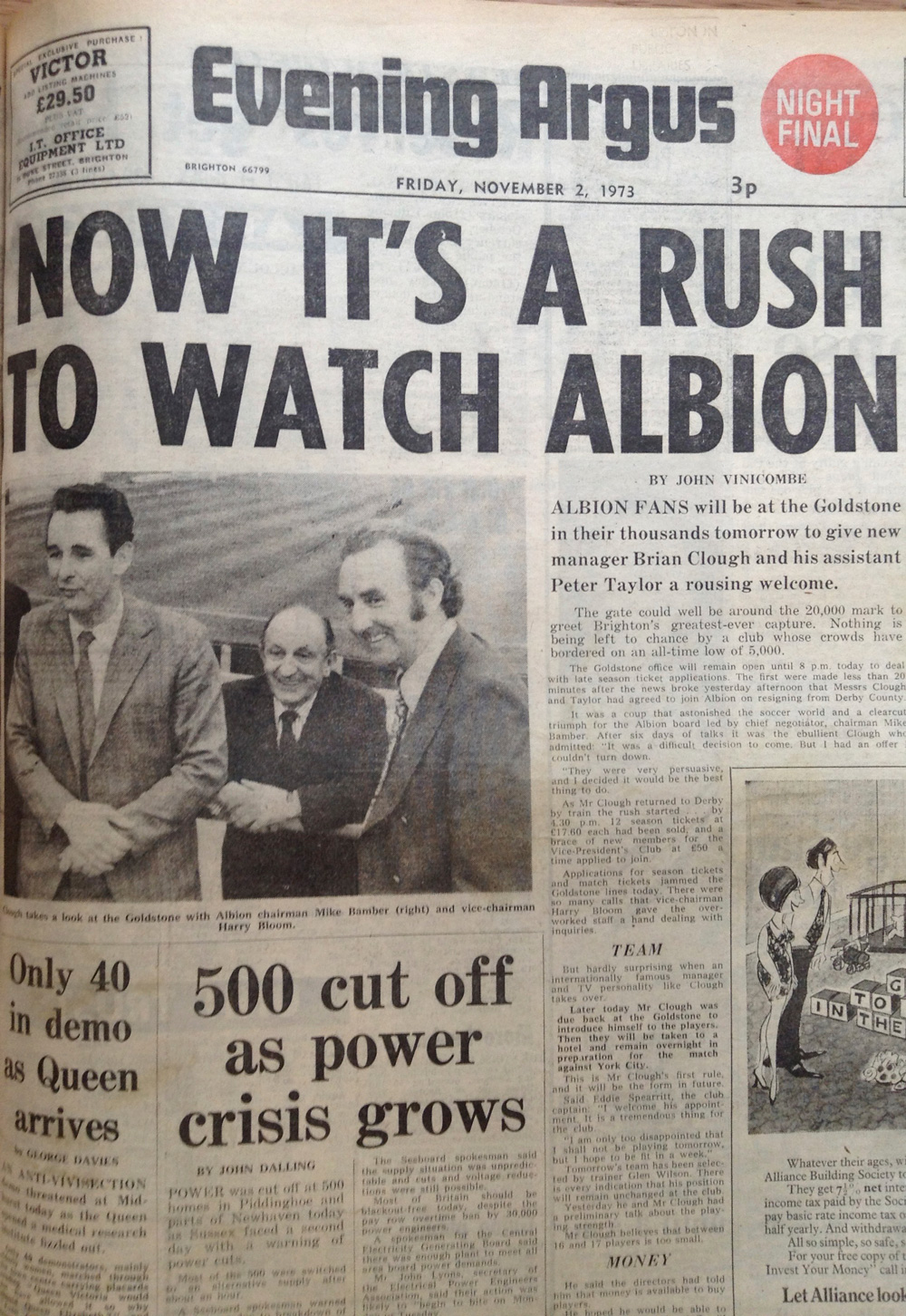
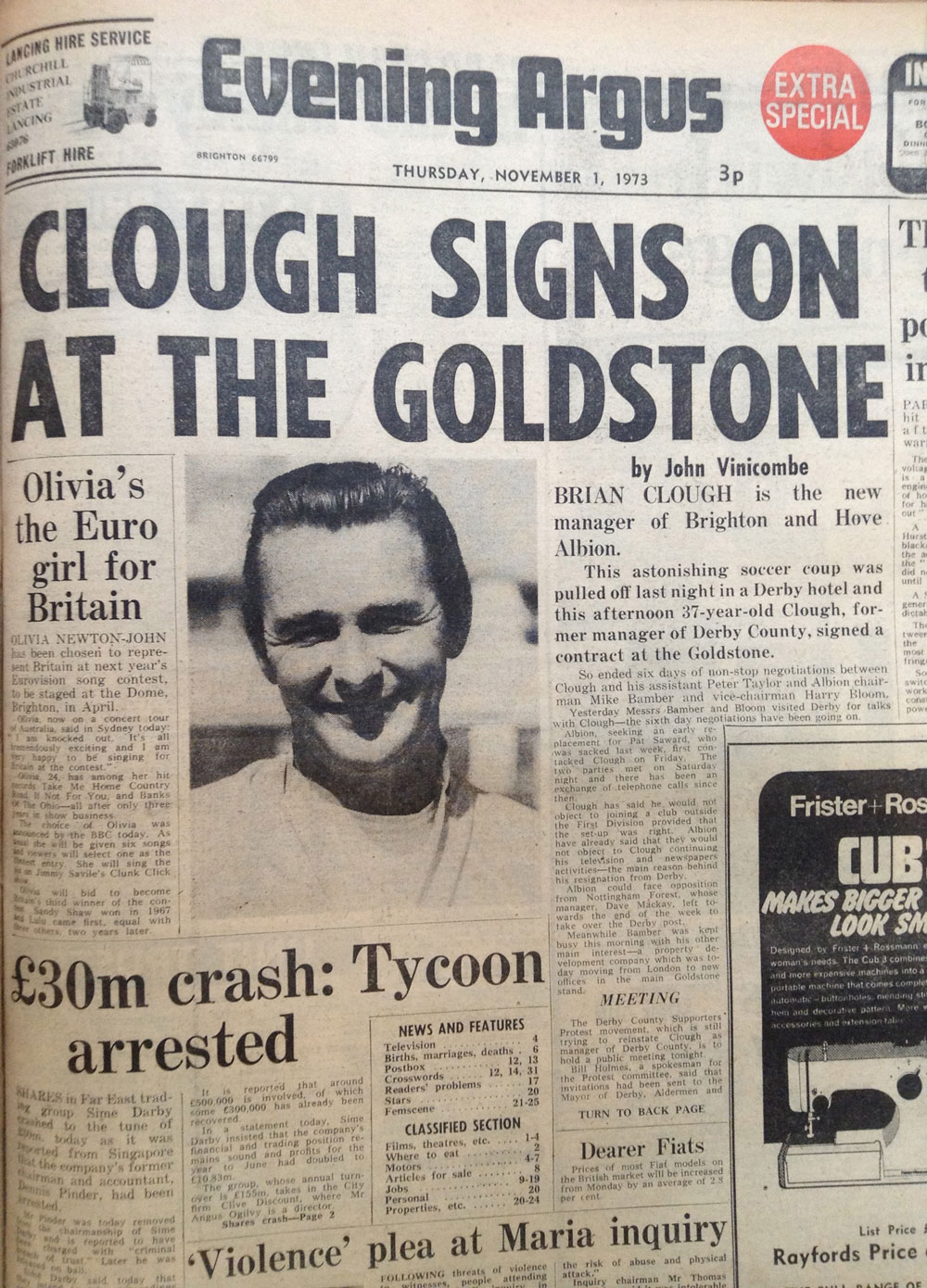
Unsurprisingly, there was a massive media whirlwind around the sensational news that Brian Clough had taken over as the manager of Third Division Brighton. As a result, the story dominated the front page as well as the back page of the Evening Argus over the next few days. From Friday 2nd November 1973:

cloughsigns4

Albion fans will be at the Goldstone in their thousands tomorrow to give new manager Brian Clough and his assistant Peter Taylor a rousing welcome.

The gate could well be around the 20,000 mark to greet Brighton’s greatest-ever capture. Nothing is being left to chance by a club whose crowds have bordered on an all-time low of 5,000.

The Goldstone office will remain open until 8pm today to deal with late season ticket applications. The first were made less than 20 minutes after the news broke yesterday afternoon that Messrs Clough and Taylor had agreed to join Albion on resigning from Derby County.

It was a coup that astonished the soccer world and a clearcut triumph for the Albion board led by chief negotiator, chairman Mike Bamber. After six days of talks it was the ebullient Clough who admitted: “It was a difficult decision to come. But I had an offer I couldn’t turn down. They were very persuasive, and I decided it was the best thing to do.”

As Clough returned to Derby by train, the rush started – by 4.30pm, 12 season tickets at £17.60 had been sold, and a brace of new members for the Vice-President’s Club at £50 a time applied to join.

Applications for season tickets and match tickets jammed the Goldstone lines today. There were so many calls that vice-chairman Harry Bloom gave the over-worked staff a hand dealing with inquiries.

But hardly surprising when an internationally famous manager and TV personality like Clough takes over.

Later today Mr Clough was due back at the Goldstone to introduce himself to the players. They will be taken to a hotel and remain overnight in preparation for the match against York City.

This is Mr Clough’s first rule, and it will be the form in the future.

Said Eddie Spearritt, the club captain: “I welcome his appointment. It is a tremendous thing for the club. I am only disappointed that I shall not be playing tomorrow, but I hope to be fit in a week.”

Tomorrow’s team has been selected by trainer Glen Wilson. There is every indication that his position will remain unchanged at the club.

Yesterday, he and Mr Clough had a preliminary talk about the playing strength. Mr Clough believes that between 16 and 17 players is too small. He said that directors had told him that money is available to buy players.

He hoped he would be able to motivate the present staff: “I have got to get it out of them. We are now in the bottom six of the Third Division. It will take a lot of hard work to get into the Second. Before anyone starts talking about the First, let’s get into the Second. I think I would settle for staying in the Third for a few months…”

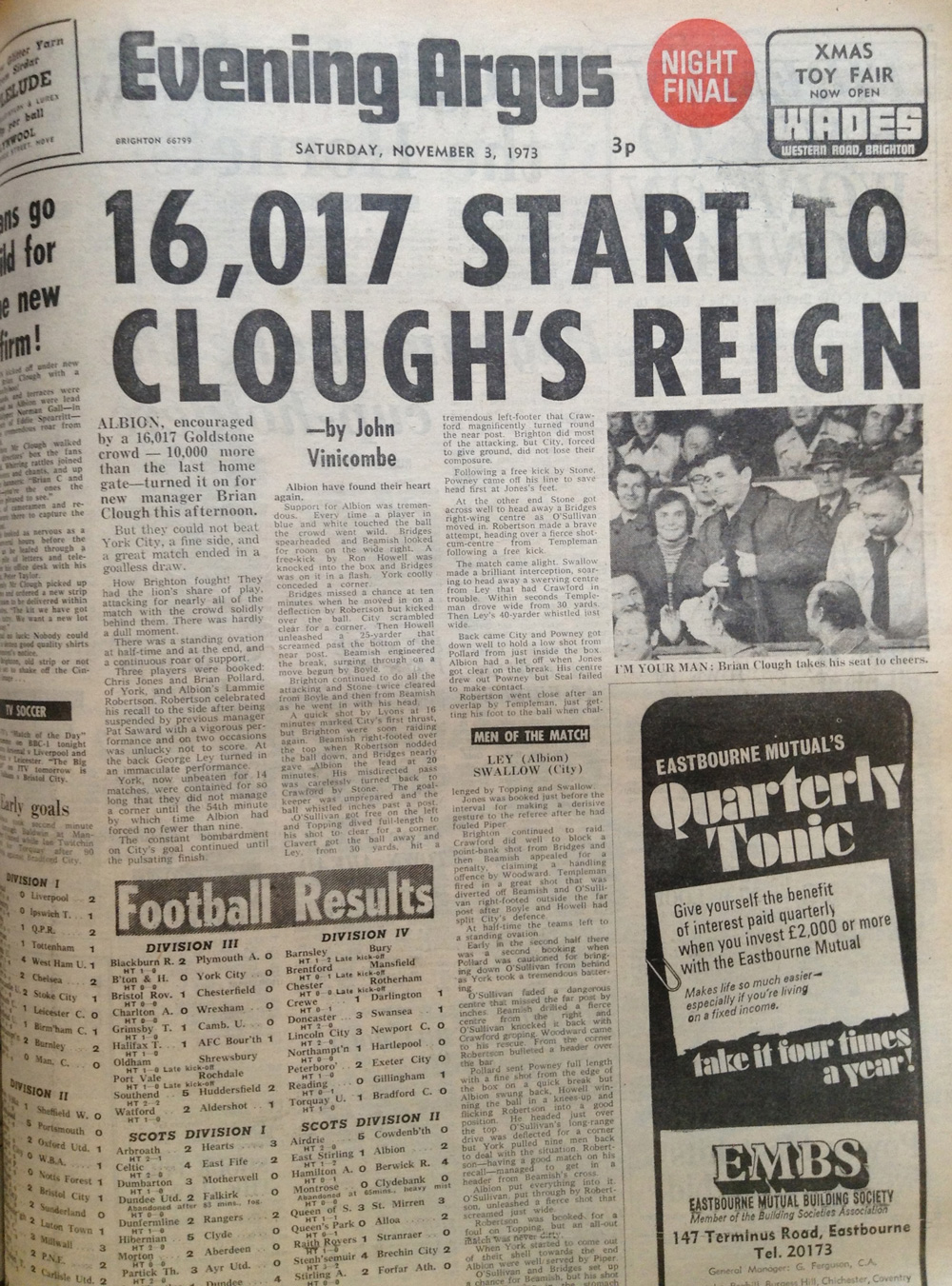
Come Saturday, 16,017 packed into the Goldstone to watch the curious affair of Clough’s debut match as Brighton boss, almost 10,000 more than the previous gate against Southport. From Vinicombe’s report, it seems as if Albion had the lion’s share of the possession:

cloughsigns6

[Lammie] Robertson celebrated his recall to the side after being suspended by previous manager Pat Saward with a vigorous performance and on two occasions was unlucky not to score. At the back George Ley turned in an immaculate performance. York, now unbeaten for 14 matches, were contained for so long that they did not manage a corner until the 54th minute by which time Albion had no fewer than nine.

The constant bombardment on City’s goal continued until the pulsating finish. Albion have found their heart again. Support for Albion was tremendous. Every time a player in blue and white touched the ball the crowd went wild.

The 0-0 draw left Brighton in 19th position, barely above water in the fight against relegation. Clearly, there was a lot of work to do by the new men in charge with players who Taylor later described as ‘a bunch of amateurs and layabouts.’

Tagged ,

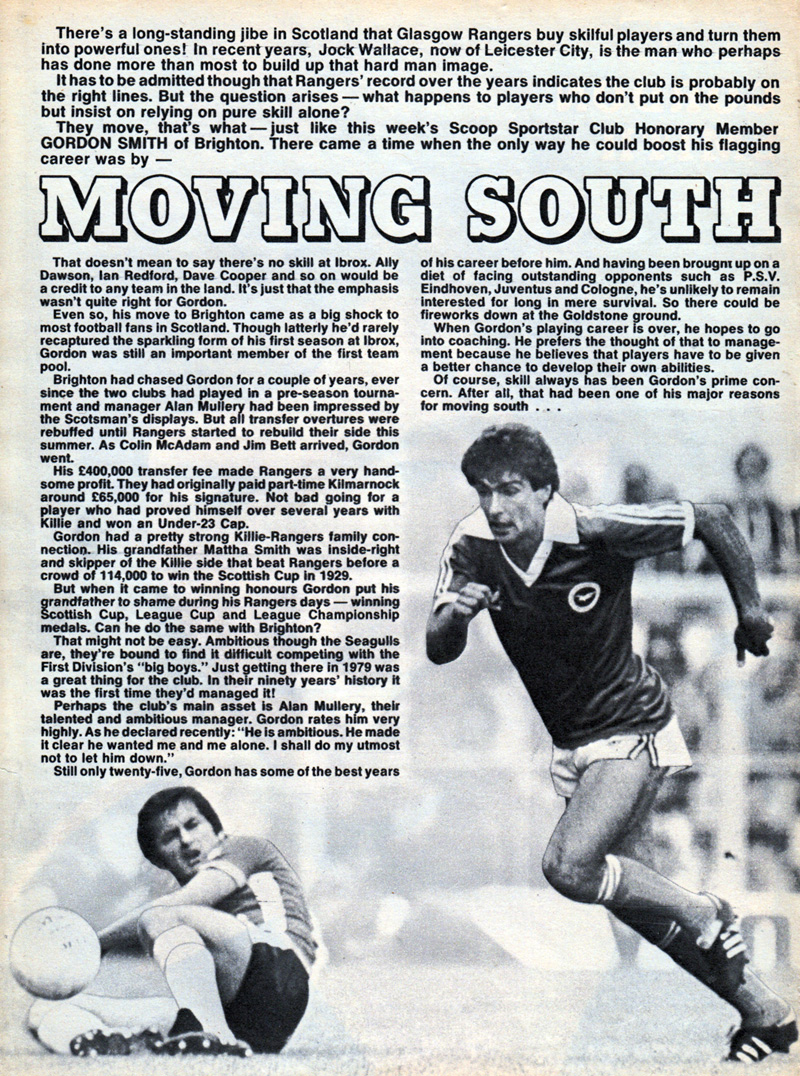
Gordon Smith: ‘I shall do my utmost not to let Mullery down’

gordonsmith7

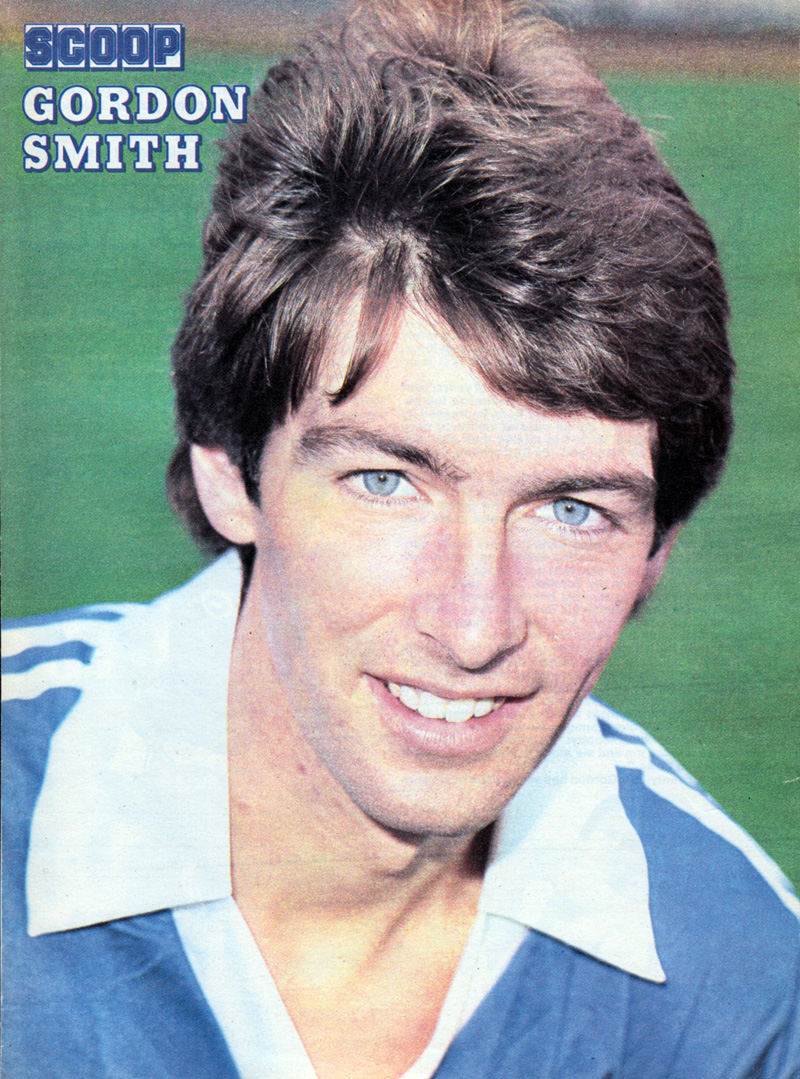
This feature in Scoop magazine on Gordon Smith came in 1980/81, after he had completed his move from Rangers to Brighton. It doesn’t seem as if they had direct access to the Scottish attacker, but the article makes for an interesting read nevertheless. I’m sure he feels privileged about being a Scoop Sportstar Club Honorary Member!

There’s a long-standing jibe in Scotland that Glasgow Rangers buy skilful players and turn them into powerful onest in recent years, Jack Wallace, now of Leicester City, is the man who perhaps has done more than most to build up that hard man image.

It has to be admitted though that Rangers’ record over the years indicates the club is probably on the right lines. But the question arises – what happens to players who don’t put on the pounds but insist on relying on pure skill alone?

They move, that’s what – just like this week’s Scoop Sportstar Club Honorary Member Gordon Smith of Brighton. There came a time when the only way he could boost his flagging career was by moving south.

That doesn’t mean to say there’s no skill at Ibrox. Ally Dawson, lan Redford, Dave Cooper and so on would be a credit to any team in the land. It’s Just that the emphasis wasn’t quite right for Gordon.
Even so, his move to Brighton came as a big shock to most football fans in Scotland. Though latterly he’d rarely recaptured the sparkling form of his first season at Ibrex, Gordon was still an important member of the first team pool.

Brighton had chased Gordon for a couple of years, ever since the two clubs had played in a pre-season tournament and manager Alan Mullery had been impressed by the Scotsman’s displays. But all transfer overtures were rebuffed until Rangers started to rebuild their side this summer. As Colin McAdam and Jim Belt arrived, Gordon went.

His £400,000 transfer fee made Rangers a very handsome profit. They had originally paid part-time Kilmamock around £65,000 for his signature. Not bad going for a player who had proved himself over several years with Killie and won an Under-23 Cap.

Gordon had a pretty strong Killle-Rengers family connection. His grandfather Mattha Smith was inside-right and skipper of the Killie side that beat Rangers before a crowd of 114,000 to win the Scottish Cup in 1929.

But when it came to winning honours Gordon put his grandfather to shame during his Rangers days – winning Scottish Cup, League Cup and League Championship medals. Can he do the same with Brighton? That might not be easy. Ambitious though the Seagulls ere, they’re bound to find it difficult competing with the First Division’s “big boys.” Just getting there in 1979 was a great thing for the club. In their ninety years’ history [seventy eight, actually!] it was the first time they’d managed it!

Perhaps the club’s main asset is Alan Mullery, their talented and ambitious manager. Gordon rates him very highly. As he declared recently: “He is ambitious. He made it clear he wanted me and me alone. I shall do my utmost not to let him down.”

Still only twenty-five, Gordon has some of the best years of his career before him. And having been brought upon a diet of facing outstanding opponents such as P.S.V. Eindhoven, Juventus and Cologne, he’s unlikely to remain interested for long in mere survival. So there couM be fireworks down at the Goldstone ground.

When Gordon’s playing career is over, he hopes to go into coaching. He prefers the thought of that to management because he believes that players have to be given a better chance to develop their own abilities.

Of course, skill always has been Gordon’s prime concern. After all, that had been one of his major reasons for moving south…

Smith certainly made a quick impact, scoring the opening goal in the 2-0 victory over Wolves on the opening day of the 1980/81 season. Thriving in a free role behind the strikers Ward and Robinson, he enjoyed a purple patch in front of goal, hitting the target seven times in just nine League matches, including a famous hat-trick at Coventry when Albion stormed back from 3-0 down.

However, as the Scot recalled in his ‘And Smith Did Score’ autobiography: ‘When a few results started to go against us, I was put in a more defensive role.’ After that, the goals dried up. Not only that, but Brighton were in serious danger of relegation from Division One. It took a crucial decision at a team meeting before the season’s finale for Smith to be restored as an attacking force:

‘Now I was back in that free role again and playing in front of midfield just behind the strikers. It was a 4-3-1-2 formation and it worked well for us. There’s no question that has always been my best position.’

The change paid dividends. The Seagulls won each of their last four games to save themselves from the drop. Smith contributed with a towering header that capped a superb 3-0 victory at relegated Crystal Palace. He also supplied the cross for Gary Williams’ winner at Sunderland. Summing up 1980/81, Smith said:

I had scored ten goals from midfield that season, which was quite a good return for a midfielder at that level. For me, it had been a good season – we had stayed up, I felt I had made a significant contribution to the cause and I was getting on well with the manager.

Then two weeks later, things changed dramatically. Mullery resigned, Bailey was brought in, and Smith found himself out of favour.

gordonsmith8

Tagged

Brian Clough signs on at the Goldstone

Here is the Evening Argus front page from exactly forty years ago, on 1st November 1973:

cloughsigns

Penning by far the biggest story of his journalist career, John Vinicombe wrote:

Brian Clough is the new manager of Brighton and Hove Albion.

This astonishing soccer coup was pulled off last night in a Derby hotel and this afternoon 37-year-old Clough, former manager of Derby County, signed a contract at the Goldstone.

So ended six days of non-stop negotiations between Clough and his assistant Peter Taylor and Albion chairman Mike Bamber and vice-chairman Harry Bloom.

Yesterday Messrs Bamber and Bloom visited Derby for talks with Clough – the sixth day negotiations have been going on.

Albion, seeking an early replacement for Pat Saward, who was sacked last week, first contacted Clough on Friday. The two parties met on Saturday night and there has been an exchange of telephone calls since then.

Clough has said he would not object to joining a club outside the First Division provided that the set-up was right. Albion have already said that they would not object to Clough continuing his television and newspaper activities – the main reason behind his resignation from Derby.

Albion could face opposition from Nottingham Forest, whose manager, Dave Mackay, left towards the end of the week to take over the Derby post.

Meanwhile, Bamber was kept busy this morning with his other main interest – a property development company which was today moving from London to new offices in the main Goldstone stand.

Tagged ,

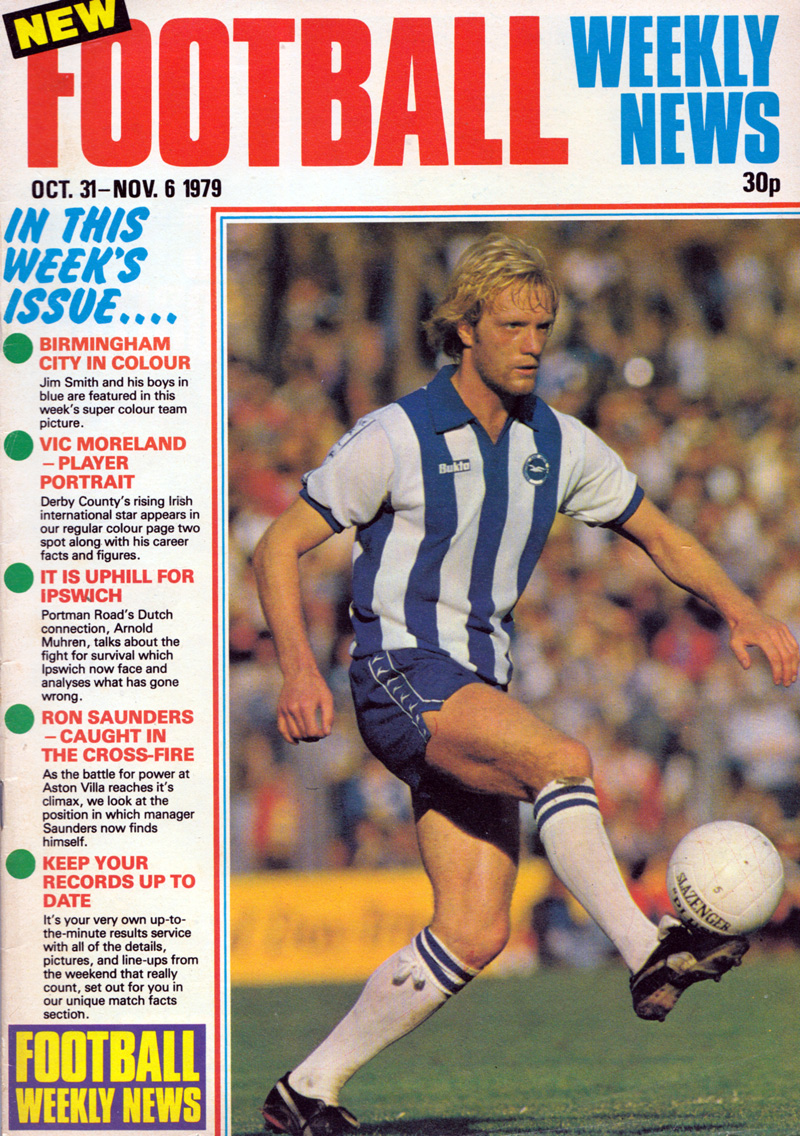
Maybank: ‘Peter… one of the reasons I went to Brighton’

footballweeklynews

As the 1978/79 season approached, Teddy Maybank had high hopes of forming a deadly strike force with Peter Ward:

A partnership that has got fantastic potential ~ but hasn’t really fulfilled any of it as yet. That’s how I’d sum up our partnership at the end of last season.

I can’t deny it’s been a bad time for me since I went to Brighton. I cost them £238,000 from Fulham and I suppose people expected miracles for that sort of cash. But it took me longer to settle than I anticipated and then I got a bad knee injury, which put me back even further.

About the same time, Peter was going through a rare lean spell and •even dropped into the reserves for a couple of games to try and find his goal-touch once again.

It all meant our partnership, which had looked so promising, wasn’t getting off the ground. But I can promise the Brighton fans – we’ll get It together next season.

What we can do together is unlimited and I’m vary excited about the potential.

I will play as the Brighton target man with Peter feeding off me. But I’ll try and use my skill on the ground, too, so I take a bit of attention sway from Peter and give him some room to score goals.

I can’t waIt to start fresh next season. Peter has got tremendous skill and is a natural goalscorer; you can see that the way he nips in to score goals all the time. His ability, and the desire to play alongside him, was one of the main reasons why I went to Brighton in the first place.

I’d always fancied playing upfront wIth him after seeing him score so often earlier in the season. I jumped at the chance to join but I’ve had to put up with a lot of frustrations and disappointments, mainly through injury and my poor form. But I still believe in my own ability ~ make no mistake about that.

Peter Ward can be a world beater. He’s got great skill on the floor and we were Just beginning to show what we could do together, when I got my knee injury. That wrecked it but I’ll be back.

My strength and his skill, speed and ability to snap up any half chances can really do things for Brighton next season.

After Albion fired two blanks in their opening two fixtures, against Wrexham and Cambridge, a purple patch of ten goals in the eight matches between Maybank and Ward suggested the partnership was finally beginning to gel.

peterward12

With Maybank bearing the brunt of the physical battle and Ward feeding off the scraps, the duo were able to find the way to goal, despite the former Fulham man not being blessed with the same touch and technique and ‘Magic’ not always being as selfless in the partnership. After a wonderful team performance against Burnley at Turf Moor in the League Cup, when Maybank got one and Ward grabbed two, including a rare one with his head, the goals suddenly dried up.

While Ward showed his goal touch against Nottingham Forest in mid-December, it took until a Boxing Day hat-trick for Maybank to hit the net again. By that point, it appeared to Mullery that a Maybank-Poskett (below) partnership was a better bet during the winter months.

malcolmposkett5

Tagged , ,

Happiness in the bath at Newcastle, 1983

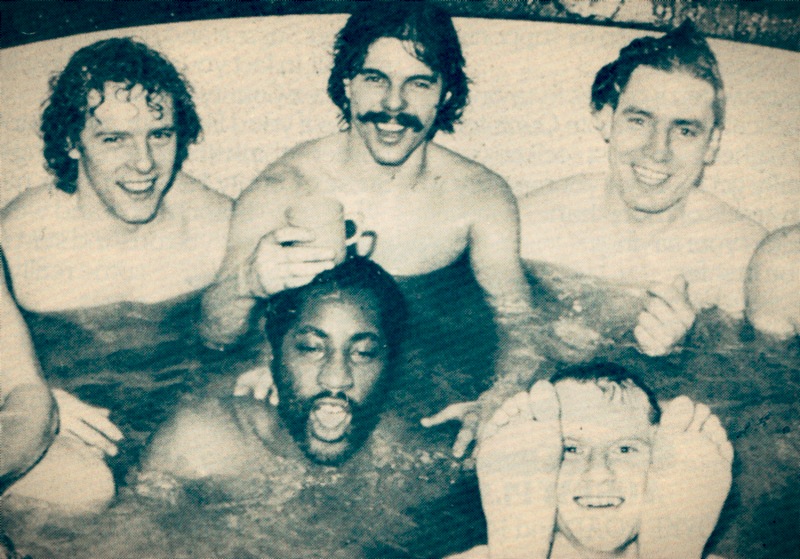
Neil Smillie, Peter Ward, Steve Gatting, Chris Ramsey, and especially that japester Andy Ritchie (!), are all smiles following the surprise replay victory at St James’ Park on 6th January 1983. The result sets Albion’s historic FA Cup run on its way…

newcastleaway1983a

Tagged , , , ,

‘Smashing’ Brighton suits Jimmy Case

jimmycase16

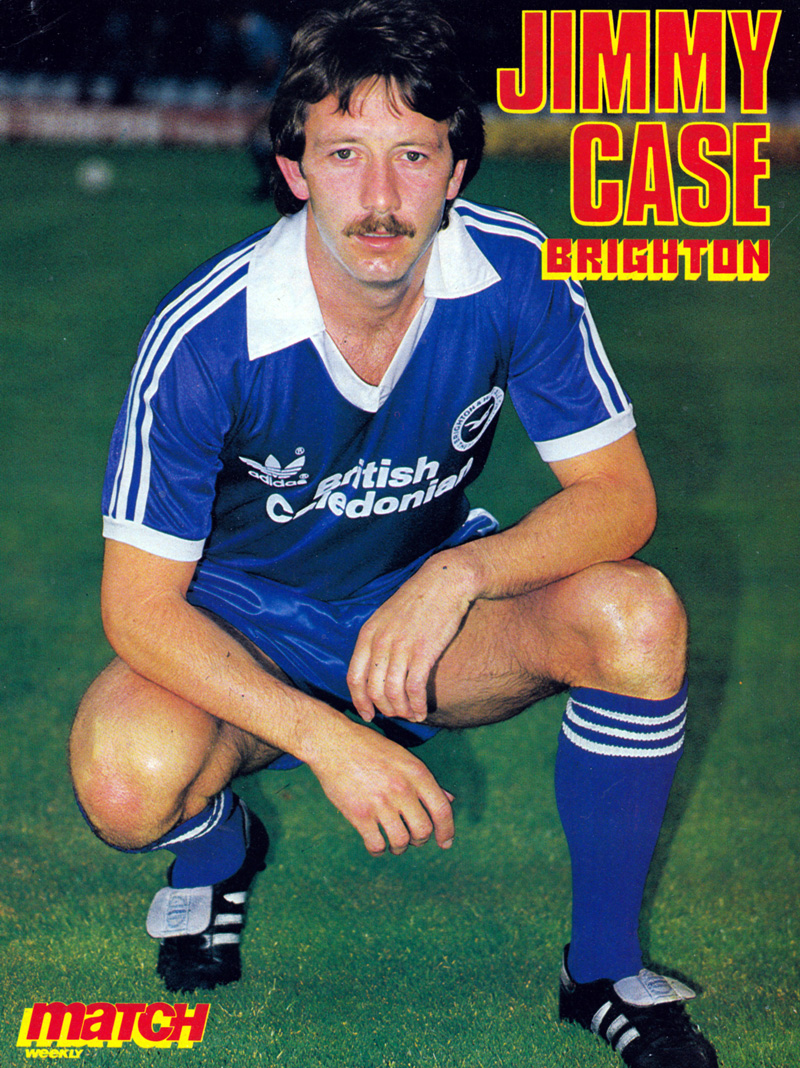
A nice magazine interview with Jimmy Case at the start of the 1981/82 season:

When a Scouser regretfully shakes the Liverpool dust from his feet, life, at least in the football sense, is never the same again.

Jimmy Case, a Reds favourite since he was s starry-eyed 18-year-old from Wooiton, has, however, made a rapid conversion to Brighton and Hove Albion, which lies snugly in the soft underbelly of the South.

If, say, a year ago Case had been asked where he would be playing at the start of the 1981-82 season, then Brighton would have been the unlikeliest answer.

Little did he know, but his destiny was wrapped-up in the ambitions of Mark Lawrenson, the Brighton and Eire central defender.

When Lawrenson told Brighton he wanted, after four years, to join a club with a realistic chance of winning a major trophy, there was no way the Goldstone could hold him.

At first it was Manchester United who showed a lively interest, then Arsenal and finally Bob Paisley set the wheels in motion that took Lawrenson to Anfield for £900,000. Part of the deal allowing Lawrenson to leave was that Brighton would have Case, 27, for £350,000.

The nearest Case had previously been to Brighton was a holiday in Hastings with his parents. Apart from a couple of visits with Liverpool, Brighton might just have been a vague spot on the map. Yet the welcome he received quickly warmed Case’s heart.

Breezy Brighton also delighted Lana, Case’s wife. Both Jimmy and •Lana were born and bred in Woolton, and they have a daughter, Emma, of five months.

It is a long way from Liverpool where the Case’s look around the smart furnished bungalow that Brighton have made available.

Case didn’t fancy hotel living, and quickly asked his wife to join him. So much for the tearsway image.

“Brighton and the area is ideal for us,” he said. “The place itself is smashing, especially all the antique shops.”

Case, after 186 League games for Liverpool and 23 goals in the Championship, is only too well aware that he has joined a side that has struggled for the first two seasons to stay in the First Division.

“If they look like going down this time, I’m not one to say that I’ll be off. I’ll just keep fighting. I shall commit myself fully to what I am contracted to do.” Mike Bailey has told Case that he wants him to get into the box more than he did at Liverpool.

“Nell McNab makes s lot of runs similar to Terry McDermott, and that will help me. I’ll be looking for a few goals. I had a good season in 1977, and I managed to get some vital goals. It’s high time I did the same again.”

Brighton players were almost total strangers when Case arrived in time to play in three pre-season friendlies. “I remembered Graham Moseley, the goalkeeper, from the England Under-23 squad in Hungary a while ago, end I had spoken to McNeb before and met Mike Robinson briefly at Manchester City,

“I well remember my last appearance at Brighton. That was at right-beck and Liverpool were disorganised at the back around that time.

“My favourite position is wide on the right, and there you can receive the ball easily with your back to the touch-line and then be able to turn. I like to be busy.”

And he admitted: “I thought I would be at Liverpool for my entire career. I had two years as a semi-pro and signed full time at 20. They asked me to sign at 18, but I turned them down because I wanted to finish my apprenticeship. I’ve had six marvellous years at Liverpool with medals every year; three in one year, in fact.

“‘1 suppose in my heart of hearts I knew eventually I would have to move, but I didn’t think it would be so soon.

“If I had gone to a Midlands club, or Manchester, or Leeds, it would have meant commuting by motorway, and being behind the wheel of a car for long periods is the easiest way to pull muscles.

“If you must move, then a long distance is preferable from the point of view of fitness. Travelling kills you up and down the motorways.”

Life at Brighton may lack the bustling pace of Merseyside and there is not such a committed following for the game, but it will suit Jimmy Case, who, when not playing football, likes to shoot and fish. “I reckon this could become my kind of place you know. And all I really care about now is keeping Brighton in the First Division.”

Although Brighton reached thirteenth position in Division One in 1981/82, their highest League position, Case’s form was patchy, rarely hitting the heights of his time at Anfield. For all his flaws as a League manager, it took the reign of Jimmy Melia for Case to truly sparkle, famously scoring in each round of the FA Cup bar one on the round to Wembley in 1983.

After Brighton were relegated, the ex-Liverpool hard man kept his word and continued to battle for the club in the Second Division, helping towards to a tilt at promotion in 1984/85. At a talk I went to last week given by Chris Cattlin, Melia’s successor said there was a specific reason why he felt he had to sell Case in March 1985, but out of respect to Jimmy, he couldn’t disclose it at the meeting…

Tagged